A recurring theme of the public discourse on immigration in Europe today is that migrants are primarily young people, of working age. Against this short-sighted view, the main contribution of this book is to propose that processes of ageing and dying constitute a critical juncture in the settlement of migrant-origin communities, precipitating novel intercultural negotiations in societies characterized by post-migration diversity. Bringing together seven studies reflecting different institutional and (trans)national contexts, the chapters fall under two main themes. A key issue when facing death is the organization of adequate care for the dying, which may be a challenging task in pluralized settings involving both migrant patients and migrant carers. Facing the end of life furthermore involves the practice of rituals in order to make sense of the transition from life to death. Whether through care or ritual, the studies presented here show that the need to reconcile different cultural, religious and administrative norms relating to death is infused with ontological insecurities which may result in new or renewed interrogations of identities and belongings. This book was originally published as a special issue of the Journal of Intercultural Studies.
eBook - ePub
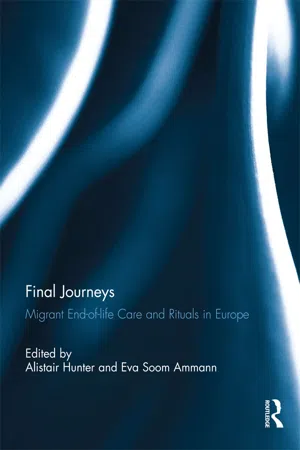
Final Journeys
Migrant End-of-life Care and Rituals in Europe
- 122 pages
- English
- ePUB (mobile friendly)
- Available on iOS & Android
eBook - ePub
About this book
Information
End-of-life Care and Rituals in Contexts of Post-migration Diversity in Europe: An Introduction
Alistair Huntera and Eva Soom Ammannb
aIslamic and Middle Eastern Studies, Edinburgh, UK; bHealth Division of the University of Applied Sciences, Bern, Switzerland
This special issue on migrant dying and death showcases the work of a number of authors exploring a newly emerging field of study within European research and policy contexts. Indeed before the 2000s the question of dying and death in migratory contexts received very little attention from researchers, be it in the social sciences or beyond. At first sight this is puzzling, given that when treated separately these fields have constituted a rich terrain for scholarly inquiry, not least in the discipline of sociology where studies of dying and death (Durkheim 1897) and migration (Thomas and Znaniecki 1918, Park 1928) have been foundational. Even social demographers, who by vocation are attentive to mortality as well as population mobility, seemed reluctant to enter this field of study. In the period before 2000, population health was the only scientific domain in which a substantial body of knowledge accumulated, focussing on the apparent paradox of lower than average mortality rates among migrants in industrialised countries (Markides and Coreil 1986, Abraido-Lanza et al. 1999). Migration scholarship in the social sciences, by contrast, was oriented to younger people, of working age. In following this orientation, migration studies have arguably internalised the priorities of governmental actors and employers, for whom the costs and benefits of migration have long been measured in economic terms (Sayad 2006). This is particularly the case in Europe since the 1960s, which constitutes the geographical and temporal frame of reference for this special issue. As Berger and Mohr’s parody of the prevailing logic of European guestworker capitalism put it: ‘So far as the economy of the metropolitan country is concerned, migrant workers are immortal […] they do not age: they do not get tired: they do not die’ (Berger and Mohr 1975: 64).
This short-sighted approach began to lose credibility in the late 1980s, as the first generation of post-WWII labour migrants to Europe began to retire from (or were forced out of) the labour market. The first studies on migrant ageing, focusing on countries which recruited migrants early such as Britain, France and Switzerland, were intended to sound the alarm on the poverty and ill-health which touched the ex-migrant workers, many of whom had worked in physically wearing and poorly paid manual jobs (Samaoli 1989, Blakemore and Boneham 1994, Bolzman et al. 1996). The first studies on death and dying amongst this pioneer migrant generation would follow shortly, with a number of research monographs (Firth 1997, Tan 1998, Chaïb 2000, Gardner 2002) and vanguard contributions in peer-reviewed journals (see, for example, Jonker 1996, Reimers 1999, Oliver 2004) appearing around 2000.
It is noteworthy that many of these early studies were written by anthropologists or undertaken from an ethnographic perspective, and that most took as their subject Muslim communities in different European countries. Furthermore, they focused primarily on what happens in migrant communities after a death occurs, rather than describing the preceding transitions involved in dying. The themes which they treated can be summarised under three headings: identities, rituals and legal–institutional aspects. The question of multiple identities and place attachments looms large: many first-generation migrants strived hard to maintain ties with places of origin, yet the experience of settlement in European countries also strongly marked their worldviews (Reimers 1999, Gardner 2002). Funeral rituals are the last opportunity to express such ties of belonging, and these may be complicated in a migration context. Muslims in particular, because of the religious imperatives of whole body burial and uninterrupted repose, have been confronted with a stark choice about where to be interred. The overwhelming preference reported in these early works is for funeral rituals to take place in countries of origin (Chaïb 2000, Gardner 2002), although opting for countries of immigration is interpreted as a practice which would anchor future generations in Europe (Jonker 1996, Reimers 1999, Chaïb 2000). Related to this, a further theme concerns the legal–institutional barriers which arise when relatives, religious specialists and undertakers in countries of residence attempt to faithfully replicate the end-of-life rituals practised in places of origin (Firth 1997, Chaïb 2000, Gardner 2002). Public authorities have erected a rather strict framework of regulations for the treatment and transport of corpses, which sets clear limits to the freedom of organising burial rituals – especially if they stretch over transnational spaces as is often the case for migrants (Zirh 2012).
Legal–institutional barriers may also arise before the funeral, during the different transitions of dying. This is foregrounded in studies of the palliative care provided to dying migrants (see, Spruyt 1999, de Graaff and Francke 2003, Evans et al. 2011, Gunaratnam 2013, Salis Gross et al. 2014). Dying in European late modernity is characterised by a shift from sudden death (for example, from accidents, violence or infection) to slower dying caused by chronic disease and which to a certain degree can be managed and planned by specialist institutions, above all by a highly elaborate medical system with impressive powers to maintain and restore life (Walter 2003, Kellehear 2007, Walter 2012). The manageability of dying, however, also demands that numerous decisions be taken, leading to the construction of the ideal–typical autonomous patient who is expected to be in a position to take prospective decisions and, by doing so, to determine his or her dying. Dying in the context of European health services is in this sense dominated by a very specific ‘cultural’ ideal of self-determined dying. These professional ideals may collide with patients’ or relatives’ own views of ‘good dying’: such incompatibilities may arise in many contexts, including but not limited to instances of migrant dying (Gunaratnam 2013).
An additional aspect inherent in the contested notion of ‘good death’ centres on where death takes place. This has particular significance in migratory contexts: ‘good deaths’ may be idealised as taking place ‘at home’ surrounded by loved ones (see for example, Ariès 1981), whereas dying alone or in a foreign or unfamiliar environment may indicate a ‘bad death’ (Seale 2004). Increasingly however death takes place in institutions of curative or palliative care, where the biomedical aspects of dying can be well-controlled by care professionals, but potentially at a cost to the dignity of the dying person (Kellehear 2007). Producing a ‘good death’ furthermore involves the appropriate handling of bodies and the social organisation of bereavement rituals after the medically determined moments of death – a dimension often overlooked by public health and health care professionals (Venhorst 2013).
To summarise, a number of contributions about dying and death in migratory contexts have been published in the last 15 years, initially in social anthropology and later in nursing studies. We hesitate however to describe this scientific production as a coherent body of literature because by and large these contributions have not been in dialogue with each other. In part, this can be attributed to language barriers, with an important output in French (see Chaïb 2000, Petit 2002, Aggoun 2006, Lestage 2012) and German (for example, Tan 1998, Salis Gross et al. 2014) remaining largely unknown to Anglophone audiences. Nor has there been much dialogue between European work and research conducted in North America or Australasia, where, in addition to a well-established focus on the challenges of palliative care with ethnically diverse patients (e.g. Turner 2002, McNamara 2004), attention has recently turned to the mounting migrant death toll in increasingly securitised border zones (Nevins 2010, Weber and Pickering 2011).
In reviewing the literature on migrant dying, it is clear that – as in life – no death is the same: differences in cause of death, institutional setting (hospital, hospice or at home), policy contexts (international, national and local) as well as the ethnicity, socioeconomic and residency status of the dying person all lead to manifest heterogeneity. There are, in other words, many angles from which to apprehend dying and death in migratory contexts (Gunaratnam 2013). Without pretending to cover all of them, we do aspire with this special issue to make connections between hitherto closed spheres of inquiry in the hope of generating fresh insights. Furthermore we do so in the expectation that questions around migrant dying will only become more pertinent in Europe in the next decades, as the demographic ageing of migrant communities becomes more prevalent (see, Rallu 2016).
Bringing together seven studies reflecting different institutional and (trans)national contexts of migrant dying, our point of departure is that the end of life is a critical juncture in migration and settlement processes, precipitating novel intercultural negotiations which hitherto have not been examined comparatively by scholars. The papers can be broadly categorised under two themes which emerged as central in the above literature review: end-of-life care and end-of-life rituals. A key issue when facing death is the organisation of adequate care for the dying, which may be a challenging task in pluralised settings involving both migrant patients and migrant carers. In the next section we introduce the papers devoted to care issues. We then turn to the papers treating ritual aspects: facing the end of life furthermore involves the practice of rituals in order to make sense of the transition from life to death. As regards both care and ritual contexts, the papers show that the need to reconcile different cultural, religious and administrative norms relating to death is infused with ontological insecurities which may result in new or renewed interrogations of identities and belongings, frequently attended by the need to (re-)negotiate frames of reference.
Dying and end-of-life care
The current state of European research on migrant dying largely treats migrants as a group of patients posing specific challenges to professionals working in institutions of end-of-life care. Migrants’ perspectives on dying and end-of-life care, however, have rarely been put centre stage. Research therefore has a tendency to dwell on the specific professional competences needed to deal with migrants’ supposedly unique needs.
Critical reflections on professional approaches to migrants’ care needs are the starting point for the first contribution of this special issue. Torres, Ågård and Milberg focus on the views and expectations of Swedish end-of-life care providers towards patients with a migrant background. Drawing on data gathered in focus group interviews with end-of-life care professionals, their paper finds that professionals’ views on migrant patients are closely linked to expectations of difference and, by extension, expectations of difficulties. Resolving such difficulties requires specific skills (referred to as ‘culture competence’), which they do not think they possess. In their analysis, the authors connect the ‘othering’ concept of ‘culture competent care’ to the professionally very well-established concept of ‘patient centeredness’. They point to the fact that assuming ‘otherness’ when dealing with migrant patients at the same time implies the assumption of ‘sameness’ with respect to non-migrant patients. Patient centeredness, in contrary, stresses the uniqueness of every patient, which in itself contradicts the concept of ‘sameness’. In recommending that nursing staff focus on individual uniqueness instead of supposed ‘otherness’, the authors conclude with a conceptual solution to the practical problems perceived by end-of-life care professionals vis-à-vis patients with migrant backgrounds.
While the first paper focuses on carers, the next contribution by Soom Ammann, Rauber and Salis Gross looks at interactions between carers and dying persons with a migrant background. Based on ethnographic research in Swiss nursing homes focussing on how institutions ‘do death’, they explore how end-of-life care for migrant elders in long-term care establishments is subject to interpretations by staff of how a ‘good death’ can be achieved. These interpretations, however, may collide with the interpretations of additional actors involved in ‘doing death’, such as relatives, but also other professional carers. Caring for dying migrants may involve more diversified ideas, and therefore collisions may arise more readily. They are, however, not clearly traceable to ‘cultural’ systems of reference in the sense of migrant origin, but are more complex. Thus migrant background is, as has already been argued in the first paper, not a decisive line of difference, but an additional frame of reference requiring consideration.
The third paper, by de Graaff, extends the scope of the special issue in two ways. First, it is inclusive of migrant perspectives by foregrounding relatives’ views on end-of-life care provision. The paper draws on data from focus groups with the relatives of deceased cancer patients of Turkish and Moroccan background in the Netherlands, as well as interviews with their palliative care professionals. In resonance with the foregoing papers, the article points to challenges stemming from different implicit normative positions. Second, de Graaff is exploring a genuinely new analytic terrain in focusing on the transition between end-of-life care and the ‘burial care’ involved in preparing the body for the funeral and accompanying the bereaved. The way relatives experience this transition points to a change in their subjectively experienced positionality, which the author traces back to different logics of care. De Graaff argues that palliative care givers, whose worldview is guided by professional standards, can learn from the customer-oriented sensitivity to diverse needs shown by undertakers.
Death and end-of-life rituals
De Graaff’s contribution fruitfully bridges the conceptual gap between end-of-life care and end-of-life rituals and sets the scene for the fourth paper, by Balkan. His focus is the involvement of Muslim undert...
Table of contents
- Cover
- Half Title
- Title
- Copyright
- Contents
- Citation Information
- Notes on Contributors
- 1. End-of-life Care and Rituals in Contexts of Post-migration Diversity in Europe: An Introduction
- 2. The ‘Other’ in End-of-life Care: Providers’ Understandings of Patients with Migrant Backgrounds
- 3. The Art of Enduring Contradictory Goals: Challenges in the Institutional Co-construction of a ‘good death’
- 4. End-of-life Care and Beyond
- 5. Between Civil Society and the State: Bureaucratic Competence and Cultural Mediation among Muslim Undertakers in Berlin
- 6. The Importance of a Religious Funeral Ceremony Among Turkish Migrants and Their Descendants in Germany: What Role do Socio-demographic Characteristics Play?
- 7. Staking a Claim to Land, Faith and Family: Burial Location Preferences of Middle Eastern Christian Migrants
- 8. Uncertain Belongings: Absent Mourning, Burial, and Post-mortem Repatriations at the External Border of the EU in Spain
- Index
Trusted by 375,005 students
Access to over 1.5 million titles for a fair monthly price.
Study more efficiently using our study tools.
Frequently asked questions
Yes, you can cancel anytime from the Subscription tab in your account settings on the Perlego website. Your subscription will stay active until the end of your current billing period. Learn how to cancel your subscription
No, books cannot be downloaded as external files, such as PDFs, for use outside of Perlego. However, you can download books within the Perlego app for offline reading on mobile or tablet. Learn how to download books offline
Perlego offers two plans: Essential and Complete
- Essential is ideal for learners and professionals who enjoy exploring a wide range of subjects. Access the Essential Library with 800,000+ trusted titles and best-sellers across business, personal growth, and the humanities. Includes unlimited reading time and Standard Read Aloud voice.
- Complete: Perfect for advanced learners and researchers needing full, unrestricted access. Unlock 1.5M+ books across hundreds of subjects, including academic and specialized titles. The Complete Plan also includes advanced features like Premium Read Aloud and Research Assistant.
We are an online textbook subscription service, where you can get access to an entire online library for less than the price of a single book per month. With over 1.5 million books across 990+ topics, we’ve got you covered! Learn about our mission
Look out for the read-aloud symbol on your next book to see if you can listen to it. The read-aloud tool reads text aloud for you, highlighting the text as it is being read. You can pause it, speed it up and slow it down. Learn more about Read Aloud
Yes! You can use the Perlego app on both iOS and Android devices to read anytime, anywhere — even offline. Perfect for commutes or when you’re on the go.
Please note we cannot support devices running on iOS 13 and Android 7 or earlier. Learn more about using the app
Please note we cannot support devices running on iOS 13 and Android 7 or earlier. Learn more about using the app
Yes, you can access Final Journeys by Alistair Hunter,Eva Soom Ammann in PDF and/or ePUB format, as well as other popular books in Social Sciences & Anthropology. We have over 1.5 million books available in our catalogue for you to explore.