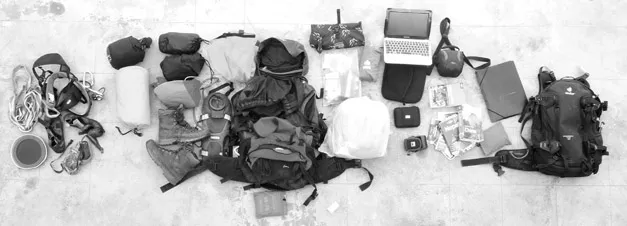
During a backpacking trip around Europe, a friend and I decided to visit Iceland. It was at the height of the Eyjafjallajökull eruption that halted global aviation. Getting to Iceland was a challenge in itself, as most flights were cancelled or delayed due to the volcanic ash cloud. After waiting all day in London Gatwick airport, ironically our flight to Iceland was one of the few flights out of the country that day.
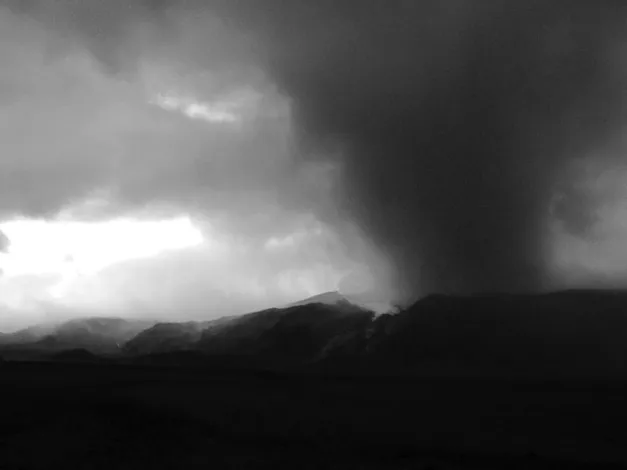
One of the first things we did upon arrival in Iceland was book a tour to see the erupting volcano ‘up close’. We left Reykjavík, the capital city, in a big tour truck at dusk, driving through the ash-covered landscape and streams of glacial meltwater. We were dropped off about three kilometres from the base of the small volcano. Ash filled the sky and our vision (Figure 1.1). Sounds rumbled below the ground, the air was thick with an earthly smell, and we had to wear a thin facemask. It was the epitome of an immersive environmental tourist experience.
We returned to our hostel dormitory room in the early hours of morning covered in ash. A person in the bunk bed next to me asked in a sleepy voice, ‘what’s that smell?’ It was the earthly, ashy aroma that clung to our clothes. I dumped my clothes and boots that I had worn on the tour on top of my bag. The next morning all around my bag was covered in ash. Weeks later, we were still finding unexpected residue and pockets of ash in our clothes, and a fine dust would spill out of our bags while we were packing. It was an experience that infused the everyday, mundane process of packing a bag with the surreal, eruptive, earthly tourism experience.
In this instance, my friend and I, our bags, and the volcano became bound together. The interaction of materials, the spatial distribution of the ash, our bodies, bags, the ongoing process of movement and travel, and, perhaps most importantly, the resistance of the nonhuman actors involved—the ash residue and its relationship to the global travel event (Birtchnell and Büscher 2011)—all contributed to the complexity of the packing process and the relational, affective mobilities involved. This experience in tourism highlights a moment where habitual tendencies and expectations are necessarily overturned in favour of haphazard interactions that prompt collective forms of action and re-orientation. The process of collecting together, assembling, and forming relationships through movement brings to the foreground our ability to move across boundaries and thresholds of identity, modes of thought, location, perception, and action. Movements that harness the relational and affective intensities of the situation—that unsettle, disrupt, or re-route our individual actions—offer new ways to collaboratively experience mobilities.
Focusing on Packing
The act of packing a bag is emblematic of a processual, everyday performance of mobilities that tourists undertake. It is a complex negotiation with a range of material and spatial qualities and movements, forging relationships between ourselves, the bag, the task at hand, and the situation we are within. It highlights the overlapping of everyday and mundane mobilities within larger global transitions and tourism ideals. Merging experiential, ethnographic, and theoretical perspectives, Everyday Practices of Tourism Mobilities considers how relationships are formed during packing and travel and how these may attune us to collective and affective experiences. As a result of these attunements, questions arise regarding the boundaries of human and nonhuman action, and how our experiences reflect the flexibility, dissolution, and reconfigurations of these boundaries. Mobilities, when understood as the complex assemblages of individual movements and larger systems and the relations formed through movement, reveal how interconnected and co-dependent our movements are.
Packing is an activity that we have all experienced. Whether on a holiday with family, on a round-the-world backpacking trip, travelling for work, relocating or migrating, or simply packing a handbag or school bag for the daily commute, packing objects in and out of a bag is a practice that is experienced in a variety of different settings and for a range of purposes. This book focuses on how packing is a practice that unfolds in tourism situations, specifically within dormitory-style hostelling accommodation. Numerous people are in close proximity to each other, sleeping in bunk beds and sharing bathroom facilities. Bunk beds are strewn with towels, hand-washed clothes, and assorted personal items. Almost always you will find someone frantically sorting through their bag, as all of their belongings (including their underpants) are upturned and out on display for the dormitory occupants to see. Communal dormitory spaces present a hive of activity that offers a certain kind of atmosphere in which collaborative and social interactions often emerge (Murphy 2001; Oliveria-Brochado and Gameiro 2013), which makes it perfectly suited for studying practices of mobilities. Often the fleeting or heightened moments of intense interactions during packing become the everyday experience for tourists in hostels.
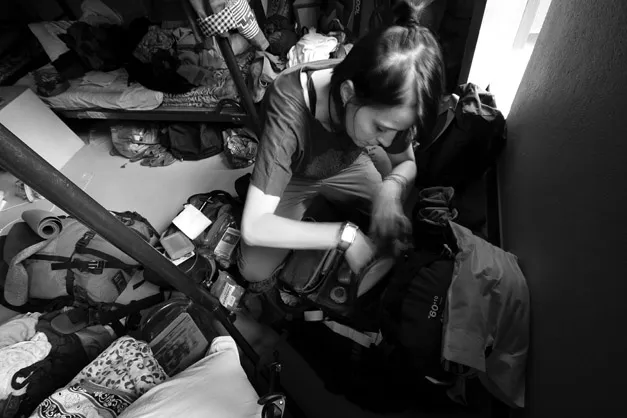
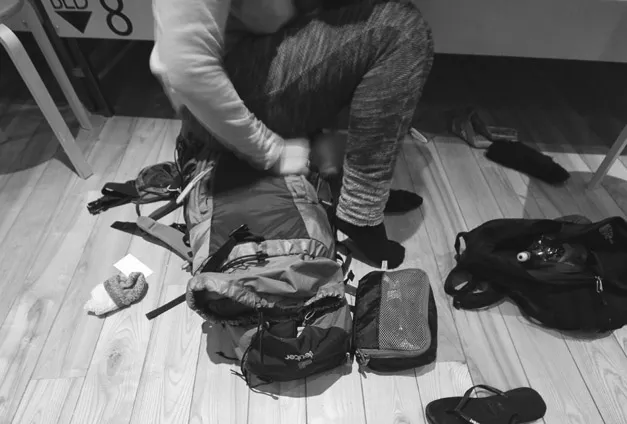
From this hothouse of intense and heightened activity, an experience emerges that begins to overcome human–nonhuman boundaries of interaction. Packing reveals interactions that deviate from habitual expectations of mobile proximities and spatial boundaries. By ‘packing’, I am not only referring to filling an empty bag; I am alluding to the small and often overlooked or under-considered moments when we directly engage with materials that we have brought with us and have around us. These may be our clothes, toiletries, the bags themselves, souvenirs, the surface of the floor we are packing on, or the space between the bunk beds where the bag is stored. The packing process encompasses a space that is beyond the perimeter of the bag, extending past the areas on the floor of the hostel room where the individual is packing (Figures 1.2 and 1.3). Objects move in and out of the bag, and we move in and out of rooms, around beds, and so on. As objects are located, collected, and moved into arrangements, they spill out on the floor, are strewn around the room, and then collated, reassembled, and moved back into the bag. Packing might be a procedural, organised,
Figure 1.2 Photograph of myself packing, situated amongst six people’s belongings intermingled on the floor of a hostel dormitory room in Nepal
Figure 1.3 A tourist sitting on their backpack while trying to close the zip
and purposeful activity where we know in advance what we want to bring; or it can be the impulsive, ‘running late’, or hasty experience of travelling.
The practice of packing reveals an intersection of a number of concerns surrounding how mobilities encompass relational and collective processes. Reflecting on the packing process, one tourist stated, ‘I’m packing and unpacking so often… It becomes part of your everyday… it becomes, going through the motions in a way’. As an ongoing daily interaction, packing reveals how we organise ourselves by sifting through objects, discarding or consuming items. It is a practice that draws attention to the various modes of relation between and across material and spatial qualities, in terms of navigating who and what we are travelling with, the social and lived experiences of spaces, or the co-construction and consumption of environmental and socio-cultural ideals of how and where we are moving. In this way, individual actions are never isolated but are always bound within collective processes. The practices that individuals generate to adapt and move with these collective concerns are indicative of the relationships that form and re-form through mobilities. Packing, as an everyday practice of tourism mobilities, contributes to the way we understand ourselves, our position in the world, and the ways in which we move.
Despite the fact that packing is an essential part of tourism—we pack before, during, and after each trip—there have been few studies that have examined packing and the myriad of experiences, sensations, movements, and practices that it encompasses. While the following studies investigate packing in various situations, there are limitations and differences to the approach that I deploy in this book. The materiality of the ‘travel bag’ is explored by Gavin Jack and Alison Phipps (2005) as an analogy for tourism experiences. The object of the bag becomes a metaphor for their fieldwork experiences while staying in various tourist accommodation sites on the Isle of Skye in Scotland. For Jack and Phipps, the bag is read as a ‘text’ (2005, p. 66), which can uncover stories, experiences, and interactions. Jennie Small and Candice Harris (2012) explored the gendered roles and differences in packing through interviews with academics travelling for conferences about the specific things (such as objects, clothing, or tools) that they brought with them. They found that the relationships between gender and identity was produced and reinforced through what was packed, which stabilised the gendered identities of the academic tourists. Similarly, Kenneth Hyde and Karin Olesen analysed media content and internet sources for advice on packing for air travel (2011) through video ethnography to explore how the items packed were used as props for ‘constructing self-identity’ (2012, p. 91). The notable study by Neil Walsh and Hazel Tucker (2009) examined how a backpack, as a material artefact, co-produces and performs the identity of ‘backpacker’ tourists (see further discussion in Chapter 2). Although there are only a scarce few studies, they all highlight the importance of packing in tourism experiences. Jack and Phipps point out that packing ‘is the subject of stories’ (2005, p. 50). Packing is a practice that everyone can relate to, and that everyone has experienced in one way or another.
In this book, I take an innovative approach by situating packing as an ongoing tourist practice that is interactive, performative, and generative. I document and survey this mundane, everyday routine to argue that packing is an example of an everyday practice of mobilities that involves negotiations of materiality, spatiality, and environmental ideals.1 Packing is a situation where there is an increase in one’s attunement to the way that we construct relationships as we move, and how these individual movements feed into larger collective concerns and practices. Of course, this process is embedded in a series of larger systems and processes that feed into, and are incorporated by, the practice of packing.
Figure 1.4 A tourist packing on the roof of the hostel in Kathmandu, Nepal. Often ample room is required to spread out items during packing
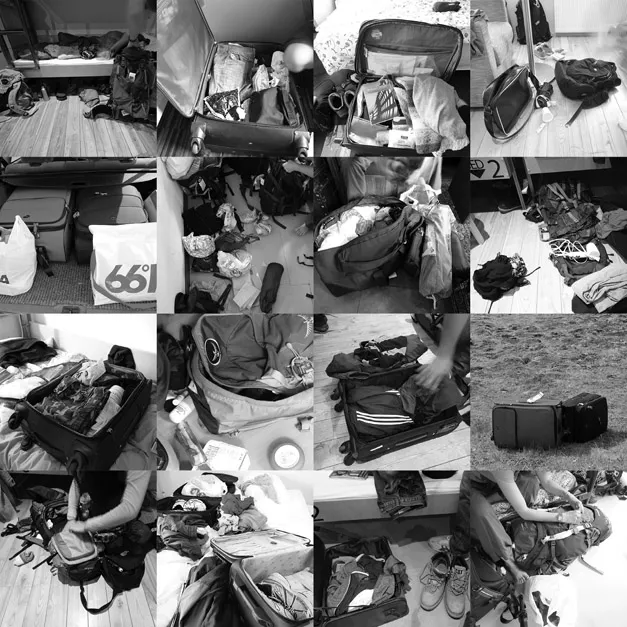
Packing can be a haphazard process that never seems to go according to plan (Figures 1.4 and 1.5). Another tourist that I interviewed explained:
I just always put my [laughing] sleeping bag in the bottom, and then just, on top everything else. I try to have a system, but it’s not always working [laughs]… It’s a problem with the sleeping bag, it’s in the bottom and then you take it out, you can open the bottom [of the bag], but then everything falls down and then, [laughing] yeah, you sort of have to unpack.
Moving one item means moving all the contents of the bag and often the bag itself, too. Movements are beyond the usual expected boundaries of singular objects—materials merge and become fluid as they interact with each other and with the person that is packing. Movements are never straightforward. It is a complex situation but also a common experience that that provides the perfect mix of constraint and complexity to track, analyse, and respond to mobile practices.
Figure 1.5 A variety of packing practices
Focusing on packing a bag allows for an ‘unpacking’ of two key themes: collective interactions and global mobilities. Together, these two themes are informed by and intertwined within this book’s inquiry into the everyday mobile practices of tourists and their encounters with materiality, spatiality, and environmental ideals. Through these themes, packing is examined as a situation where tourists become attentive to the way that their individual actions are entangled within larger global mobilities. I demonstrate that the practices developed during transit assist in honing our abilities to extract collective modes of knowledge from a variety of mobile situations and interactions.