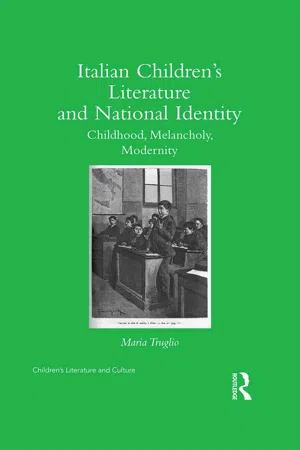
This book bridges the fields of Children's Literature and Italian Studies by examining how turn-of-the-century children's books forged a unified national identity for the new Italian State. Through contextualized close readings of a wide range of texts, Truglio shows how the 19th-century concept of recapitulation, which held that ontogeny (the individual's development) repeats phylogeny (the evolution of the species), underlies the strategies of this corpus. Italian fairy tales, novels, poems, and short stories imply that the personal development of the child corresponds to and hence naturalizes the modernizing development of the nation. In the context of Italy's uneven and ambivalent modernization, these narrative trajectories are enabled by a developmental melancholia. Using a psychoanalytic lens, and in dialogue with recent Anglophone Children's Literature criticism, this study proposes that national identity was constructed via a process of renouncing and incorporating paternal and maternal figures, rendered as compulsory steps into maturity and modernity. With chapters on the heroic figure of Garibaldi, the Orientalized depiction of the South, and the role of girls in formation narratives, this book discloses how melancholic itineraries produced gendered national subjects. This study engages both well-known Italian texts, such as Collodi's The Adventures of Pinocchio and De Amicis' Heart, and books that have fallen into obscurity by authors such as Baccini, Treves, Gianelli, and Nuccio. Its approach and corpus shed light on questions being examined by Italianists, Children's Literature scholars, and social and cultural historians with an interest in national identity formation.
eBook - ePub
Italian Children’s Literature and National Identity
Childhood, Melancholy, Modernity
- 208 pages
- English
- ePUB (mobile friendly)
- Available on iOS & Android
eBook - ePub
About this book
Information
1 Garibaldi’s Shadows
Heroism and Melancholia
Eroe: chi dà prova di straordinario coraggio e abnegazione, spec. in imprese guerresche;chi si sacrifica per affermare un ideale: l’eroe dei due mondi, per antonomasia, G. Garibaldi (1807–1882).
[Hero: one who demonstrates extraordinary courage and abnegation, especially in military undertakings; one who makes sacrifices in the name of an ideal: the hero of the two worlds, through antonomasia, Giuseppe Garibaldi.]
—Garzanti Linguistica
In his preface to a collection of Italian short stories for children published in 1890, the Neapolitan intellectual Michele Ricciardi remarked, “se ne potrebbe dare facilmente una ricetta: prendi dieci grammi di eroico, due di malinconico e fa’ un libro per fanciulli” [one could easily write up a recipe for children’s literature in our culture: take ten grams of heroism, add two grams of melancholy, and you’ve got a children’s book] (Errico 9).1 Ricciardi’s recipe highlights the healthy doses of heroic imagery and sentimentality being doled out to Italian children in the late nineteenth century and into the twentieth. The memorable monthly stories that punctuate Edmondo De Amicis’s Cuore (1886) [Heart] epitomize the potent mixture of heroism and sentimentality described by Ricciardi. In these tales from “the book that was best known and most read in schools” (Lollo 197), child protagonists from Italy’s different regions offer models of courage and self-sacrifice to very powerful effect. In one such monthly story, a young boy from Padua, whose desperately poor parents sold him to a traveling circus, dramatically throws back the money offered to him by wealthy adults because they have insulted Italy.2 In an escapist rather than openly didactic mode, Emilio Salgari’s many late-nineteenth-century adventure novels offered extremely popular images of swashbuckling, daring Romantic heroes in exotic locales.3 In Le tigri di Mompracem (1884) [The Tigers of Mompracem], for example, Sandokan the pirate with a small band of rebel followers takes on the colonial might of the British and Dutch. In yet another genre deploying this same theme, Lino Ferriani’s 1905 bildungsroman, Un piccolo eroe [A Little Hero] charts the development of the earnest protagonist Pin. This “little hero” suffers a bloody nose while protecting a crippled classmate from a gang of other youths, saves a group of women and children from a rabid dog by beating it to death with a stick, and finally loses his own job by standing up to an exploitative London foreman in defense of a young Italian construction worker. Poetry of the period, too, more than sprinkled in the ingredient of heroism. Giuseppe Zucca’s 1918 collection entitled Vincere, vincere, vincere [Win, Win, Win] gathers stirring poems written during the Great War to foster patriotic fervor. One poem paints the portrait of Giuseppe Lavezzari, a veteran of Garibaldi’s 1860 campaign who volunteers to fight again in his old age. Rushing into the Austrian line crying “Viva l’Italia,” he reveals his Garibaldian red shirt and dares the enemy to kill him (7–10). These and many other stories attest to the currency that martial exploits, courage, and patriotic self-sacrifice held in Italian children’s literature in the decades preceding fascism.4
In this chapter, I explore the recurrent call to heroism that appears so often and so openly in children’s books from Cuore through the First World War. As with many of the overt lessons promoted by books that state straightforwardly their agenda, the call to heroism is not masked, and its utility for the State is clear and rational: the need to inculcate in its youth a willingness to die for the Fatherland. It is not surprising that writers, even those who were penning books marketed as pleasure reading rather than as mandatory school curriculum, should encourage young Italians to be brave and selfless, and should offer heroic role models to their young readers to admire and imitate. As Lindsay Myers documents in her study of Italian children’s fantasy books, such a strategy rose to particular prominence in the years 1915–1918 in support of Italy’s belated and much debated entrance into the First World War. Myers points out that “[r]ealist novels generally proved more conducive to the dissemination of pro-war ideologies than did works of fantasy” (87), but even the fantasy genre, via allegorical strategies, served to justify and support Italy’s intervention. According to Myers, works like Yambo’s Ciuffettino alla guerra (1916) [Ciuffettino Goes to War] constituted a new “subgenre,” which she terms the “Quest Fantasy.” Even after the conclusion of the war, the agenda of inculcating patriotism persisted, as attested to by Olindo Giacobbe in the opening pages of his 1925 critical bibliography of children’s books. In underscoring the care with which school teachers should select texts, he unabashedly lists the making of “valorous soldiers” as one of the goals of children’s literature (Giacobbe, Letteratura infantile 4).
What I will examine here is the specific manner in which heroism is staged in many children’s books of the period. It is not particularly surprising that these books should adopt heroism with such great frequency as a theme or even that they should simplify the complex history of Italy’s nineteenth-century unification (traditionally referred to as the “Risorgimento”), consolidating and deploying this history as heroic mythology for young readers.5 What is of interest in many of these Italian texts is that heroism seems to be staged neither as a present possibility nor as a future goal, but quite often as a memory. More precisely, what these stories appear to perform is not so much an advocacy of heroism as a mourning of it. Deployed in a melancholic structure, the mourning of heroism that I see operating in these books announces their ambivalent relationship to modernity.
The association between heroism and mourning emerges in Lino Ferriani’s 1905 book Un piccolo eroe (mentioned above). Here, the call to heroism is staged in a scene of death: at 10 years old, the protagonist “Pin” listens to his dying father’s exhortation to “fa’l’uomo” [become a man; italics in orig.] (105). Pin’s father, an “honest blacksmith” (22), crushes his hand at work and suffers for a week from the subsequent infection. Finally, he utters his last word to his son, “Coraggio” [Courage] (108). Pin must assume the role of man of his own house and that of the neighboring widow and her daughter, as the narrator remarks, “ormai era considerato l’uomo delle due famiglie” [at this point he was considered the man of the two families] (115). The little hero emerges from the scene of death and goes on to display acts of selfless bravery. The readers are advised that Pin “ora sta per apparirci sotto una luce di vero eroe, di chi, cioè, inalzandosi al disopra degli uomini mediocri, e tanto più dei fanciulli, si rende noto e chiaro per un fatto grande, magnanimo, che gli frutta l’ammirazione, il plauso dei buoni, e la gioia interna della coscienza soddisfatta” [is now about to appear to us in the light of a real hero. A hero, in other words, is one who rises above mediocre men, and even more so above children, and who makes himself known for a great and magnanimous deed. A hero earns the admiration and applause of good men and the internal joy of a satisfied conscience] (116). This account of heroism includes the ingredients of manliness (“fa’l’uomo”), excessiveness (“al disopra”), and martial valor (“un fatto grande” that is enacted, as enumerated in the above list of Pin’s deeds, as physical confrontation), which still constitute today the dictionary definition of heroism, evident in this chapter’s epigram from Garzanti.6 The texts I examine below, most of which were published in multiple editions and had wide circulation at the turn of the century, promote this traditional conception of heroism for their young readers. However, as a kind of shadow, they simultaneously mourn such heroism, coding it as an anachronism. In moving, so to speak, from an epic to a novelistic textuality of heroism, these children’s books grapple with the question of the possibility of heroism in modern Italy. The conclusion to Un piccolo eroe exemplifies the dynamic I am describing. Ferriani’s “little hero” takes to heart his dying father’s command to become a man and after his more dramatic moments, emerges at the end of the novel as a productive and financially stable merchant with plans to open a delicatessen. Having read Giuseppe Mazzini’s texts on the duties of man and having spent six years patiently working in England, he returns home ready to provide for his childhood sweetheart, Maria, as a stable husband.
The issue of defining a modern heroic mode goes beyond simply the challenge of finding new dragons to slay in a world of telegraphs and railroads, which Ferriani manages to do by having Pin bludgeon a rabid dog. In other words, it is not merely a matter of updating content. Instead, these texts structure modern Italian subjects on the very ground of this lost possibility. By extolling heroism, and specifically by fetishizing Giuseppe Garibaldi as the embodiment of this ideal, these texts both reveal and cover up anxieties about modern networks of social relations.7 Ferriani rather eloquently articulates this very anxiety when he describes Pin’s perception of modern London: “lo colpì la regolarità con cui questo movimento fantastico funzionava, come se tutti, uomini e cose, ubbidissero a un ordine superiore, a un direttore generale invisibile, ma onnipotente cui nulla sfuggiva e a tutto provvedeva” [he was struck by the regularity with which this fantastic movement functioned. It was as if everybody, men and things, were obeying a superior order, a general director who was invisible but omnipotent. Nothing escaped from this director who provided for everything] (187–188). The invisibility of the source of this omnipotent power disconcerts the protagonist, who initially reacts to the English city with “grave melanconia” [deep melancholy] (187) as he observes the trains and electric trams.8 However, he cannot assume his role as a good Italian husband to Maria until he has spent time in the more modernized London. He must acclimate to the city and bring what he has learned, and earned, back into Italy. Pin’s exposure to modernity in the North builds on, but also supersedes, what he had learned in school from his teacher Signor Stefano, who in his younger days had been a “garibaldino” (88). Ferriani describes the invisible capitalist-technological forces that regulate London through a rhetoric evoking theological concepts: providence, omnipotence, the superior order that commands absolute obedience, and the force that functions as the Prime Mover. Pin, then, attempts to understand new social relations, in which “men and things” are implicitly interchangeable, through a premodern epistemological grid. The use of this theological register to describe modern urban society, in effect, suggests that the latter has replaced the former. The fetishization of Garibaldi, who becomes a kind of “direttore generale visibile” as it were, compensates for this perceived loss.
A contemporary consideration of the image of the hero can help further elucidate these anxieties. In the same years in which these children’s books were being written and circulated, Freud’s colleague Otto Rank turned his critical attention to what he perceived as recurrent motifs in hero myths. He sought to strip these various myths down to the “ideal human skeleton” (65) that served as a common structure to stories from different times and places. In The Myth of the Birth of the Hero (1909), he argues that hero stories from Sargon and Perseus and from Moses to Jesus are ultimately grounded in memory. Specifically, he argues, a hero story is a coded elaboration of the subject’s infantile perception of his parents, evoking a time when the parents seemed to him to be omnipotent kings and queens. The subject’s repressed childhood hostility toward the father is projected and reimagined as the father’s (king’s) hostility toward the son, a structure that provides the psychological source of so many changeling stories. Rank ends the essay by connecting this family romance with contemporary anarchist attacks on political father figures. I turn to this important text not as an interpretative key through which to analyze the hero stories of Italian children’s literature. Rather, this contemporary discussion of heroism sheds light on two major nexuses of issues that are bound up in and worked out through the books I will discuss, namely the perceived deterioration of paternal power and the epistemological paradigm of recapitulation.
As in Rank’s analysis, the children’s books that I will discuss here intimately link heroism to paternal figures. Pin, for example, is spurred to heroic deeds by his father’s exhortation to “become a man.” Similarly in Cuore, the monthly stories of heroism are dictated to Enrico and his classmates by the paternal teacher Signor Perboni, who, on the first day of school, begs his students to “essere i miei figliuoli” [be my dear little sons] (29), and it is Enrico’s actual father who encourages him to study with the words “[c]oraggio, dunque, piccolo soldato dell’immenso esercito” [take courage, then, little soldier of the immense army] (37). In her novel Piccoli eroi (1892) [Little Heroes], Virginia Tedeschi Treves (who wrote under the name “Cordelia”) shows how the protagonist Maria must heroically care for all her siblings in order to allow her widowed father to continue to work, and Lino Ferriani’s brief contribution to the Garibaldi-themed issue of Il giornalino della Domenica (1907) [The Little Sunday Paper] discourages lying and calls for brave honesty among young readers by quoting Garibaldi’s words to his own son Manlio, thus putting the “blond Hero” explicitly in the role of father figure (Bertelli 19).9 Within the texts, then, father figures encourage heroism for the child protagonists and, by extension, their readers.
While the fictional fathers of all these “little heroes” were inspiring their children to acts of self-sacrifice and courage, the readers of these books and their families were witnessing significant renegotiations of patriarchal power in Italy on several fronts. In his study of “letteratura infantile” [children’s literature], Vittorio Spinazzola reminds us that Italian children’s literature came into its own in a period of post-Risorgimento anxieties—political, cultural, and “infine familiare per la difficoltà di reimpostare i rapporti fra i sessi e le generazioni in un’ottica più evoluta rispetto a quella dell’assolutismo patriarcale” [even familial because of the difficulty of redefining relationships between the sexes and between generations in a manner more evolved than that of patriarchal absolutism] (12). Changes in the modes of production were sending women out of the home and into the factories, particularly in northern Italy, where most of the writers and publishing houses of children’s literature were located. These changes, as Silvana Andretta has noted in her study of contemporary literary depictions of childhood, were perceived as a threat to the family: “Il processo di trasformazione del sistema produttivo aveva provocata un indebolimento della famiglia, poiché anche le donne entravano nel mondo del lavoro” [The process of transforming the system of production had provoked a weakening of the family, since even women were entering the workforce] (8).
Along with industrialization and urbanization, however uneven and belated vis-à-vis other European nations, the decades at the turn of the century saw attempts to modernize the authoritarian civil code of 1865, specifically through agitation in favor of legalizing divorce. Between 1878 and 1902, eight different pro-divorce proposals were brought to parliament. In the same period, analyses such as Teresa Labriola’s Del divorzio: Discussione etica (1901) [On Divorce: An Ethical Discussion] and literary works such as Anna Franchi’s Avanti il divorzio (1902) [Forward with Divorce] and Sibilla Aleramo’s Una donna (1906) [A Woman] aimed to sway public opinion.10 Not surprisingly, none of the Garibaldian children’s books that I have studied mention Garibaldi’s own request to Rome’s civil tribunal in 1879 for a state annulment of his nineteen-year marriage to Giuseppina Raimondi.11 During these same decades, especially prompted by the 1897 scandal of the Neapolitan “Annunziata” foundling home, politicians debated various methods to combat the shockingly high mortality rates in the nation’s institutions for abandoned children (Ipsen 15–49). Many reformers considered these death rates, and indeed the entire foundling home structure, to be an embarrassing sign of Italy’s backwardness (36). Reformers proposed policies of providing govern...
Table of contents
- Cover Page
- Half Title
- Title Page
- Copyright Page
- Dedication Page
- Table of Contents
- List of Figures
- Acknowledgments
- Introduction: Two Grams of Melancholy
- 1 Garibaldi’s Shadows: Heroism and Melancholia
- 2 Geographic Expressions: Mapping Modernity
- 3 A Beatrice for Modernity: Girls in Italian Children’s Literature
- Conclusion: The Heart of the Matter
- Bibliography
- Index
Trusted by 375,005 students
Access to over 1.5 million titles for a fair monthly price.
Study more efficiently using our study tools.
Frequently asked questions
Yes, you can cancel anytime from the Subscription tab in your account settings on the Perlego website. Your subscription will stay active until the end of your current billing period. Learn how to cancel your subscription
No, books cannot be downloaded as external files, such as PDFs, for use outside of Perlego. However, you can download books within the Perlego app for offline reading on mobile or tablet. Learn how to download books offline
Perlego offers two plans: Essential and Complete
- Essential is ideal for learners and professionals who enjoy exploring a wide range of subjects. Access the Essential Library with 800,000+ trusted titles and best-sellers across business, personal growth, and the humanities. Includes unlimited reading time and Standard Read Aloud voice.
- Complete: Perfect for advanced learners and researchers needing full, unrestricted access. Unlock 1.5M+ books across hundreds of subjects, including academic and specialized titles. The Complete Plan also includes advanced features like Premium Read Aloud and Research Assistant.
We are an online textbook subscription service, where you can get access to an entire online library for less than the price of a single book per month. With over 1.5 million books across 990+ topics, we’ve got you covered! Learn about our mission
Look out for the read-aloud symbol on your next book to see if you can listen to it. The read-aloud tool reads text aloud for you, highlighting the text as it is being read. You can pause it, speed it up and slow it down. Learn more about Read Aloud
Yes! You can use the Perlego app on both iOS and Android devices to read anytime, anywhere — even offline. Perfect for commutes or when you’re on the go.
Please note we cannot support devices running on iOS 13 and Android 7 or earlier. Learn more about using the app
Please note we cannot support devices running on iOS 13 and Android 7 or earlier. Learn more about using the app
Yes, you can access Italian Children’s Literature and National Identity by Maria Truglio in PDF and/or ePUB format, as well as other popular books in Literature & Folklore & Mythic Literary Criticism. We have over 1.5 million books available in our catalogue for you to explore.