This book, first published in 1987, is an attempt to explain Adam Smith's theory of property. The author examines Smith's theory in the context of The Wealth of Nations, and explores what Smith said, what he really meant, and what can be logically deduced from it. This title will be of interest to students of economic thought.
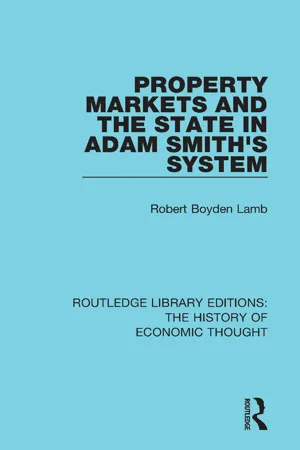
- 478 pages
- English
- ePUB (mobile friendly)
- Available on iOS & Android
eBook - ePub
Property Markets and the State in Adam Smith's System
CHPATER VII
ALIENATION OF PROPERTY: THE EFFECT OF INDIVIDUALS
Two diametrically opposed effects of commerce are described by Smith. Firstly, it established useful routines for working behaviour and institutions and for market standards of exchange. But at the same time commercial society intensified the harmful effects of class conflict, and of extreme division of labour on industrial workers of all kinds. In this chapter we will consider these contrasting effects of commerce upon individuals and review Smith’s explanation for them.
I
Smith presents a schematic commercial society composed of equally independent individual merchants. He also outlines the existing class structure in which individuals’ desires were submerged within economic group interests. Although each man may be a merchant, what a man has to sell in this commercial society determines his interests and his position in the broad class structure. This differentiates one class of individuals who sell their labour and have no other property to sell, from the landlord and capital owner who can sell or rent their capital or landed property to purchase the labour of others.
In his abstract social scheme Smith says almost all men are totally dependent on others for their supplies in commercial society. Yet most men are “personally independent”; that is, they do not depend on one single other individual for their subsistence, but on many.1 In Smith’s factual description menial servants are the only completely economically-dependent group of labourers in commercial society. Wage labourers are dependent to some degree, but not in the same way as a feudal serf. Smith’s schematic description of the commercial individual is only incidentally mentioned in connection with his historical class analysis. Usually the two methods are employed for strictly separate purposes and in entirely different contexts.
A commercial society is divided into a large number of different groups2 which share not only common economic interests but also similar morals, characters and social rank.1 Group members sympathise more easily and completely with each other. The social status of a group depends on other people’s evaluation of it, and this in turn reflects mainly its wealth and power.2
Commercial society consists of three main groups: landowners, merchants, and labouring poor.3 But Smith provides a much more detailed breakdown of its constituent groups which I have listed in a footnote below for the sake of brevity.4 The three main classes, in Britain during Smith’s life formed a social scale or hierarchical structure. But in contrast to France5 and to other continental countries, there was considerable intermingling and great fluidity within classes and a degree of mobility up and down the class structure1 According to Ashton:
These class gradations were rungs of a ladder on which many climbed and descended … the rungs were many and closely spaced making it easy for ability to be equated with task.2
Ashton goes rather far in his assertion of the fluidity of classes in 18th century England.3 He appears to equate the extreme intra-class mobility within each strata which did exist, with extreme inter-class mobility between rich and poor which was relatively limited. J.H. Plumb in The First Four Georges asserts that “The majority had a profound sense of the laws of subordination.”4 And later he spells this out:
Free and mobile as the English Society was, compared with other European countries, it was nevertheles very rigid by modern standards. The theme of many people’s lives was fixed by birth. They stayed in the village in which they were born and pursued those avocations in which their fathers and grandfathers had been employed.1
In Scotland, among the highland crofters and fishermen there continued the same social class relations that had persisted for centuries throughout much of northern Scotland. Only in the lowlands and particularly in the cities of Edinburgh and Glasgow was there really significant fluidity within classes and some upward mobility. In all the ancient walled towns such as Edinburgh rich and poor shared the same staircase in their tall tenement apartments. The Judge or rich merchant was distinguished by inhabiting the middle, not the upper or lower floors. These notoriously unpleasant tenements caused a similarity of social experience in this period which disappeared when the New City of Edinburgh was built and the rich en masse left the “old city” to the poor. In Glasgow the considerable growth of the city in population and wealth during the eighteenth century of necessity caused an extraordinary intermingling of classes. The good parish schools too may have led to a certain blending of strata within the middle class especially. And of course class fludity accompained the tremendously rapid transformation of Scotland from a stagnant rural backwater to a thriving commercial economy in the space of scarcely one generation in the 18th century.2
In Smith’s works there is a recognition of considerable mobility within classes and to some extent between classes in his extensive descriptions of tasks and professions as “confounded”. By calling many tasks “confounded” Smith meant that the primitive state of industry, manufacturing, and merchant trading was such that the same man often performed many of the different roles and tasks which in more advanced commerce are separated and singular. In Scotland, a man of mixed profession1 was even more common than in England,2 for poverty had required that each man hold more than one job. Few shepherds or farmers could subsist without fishing or gathering kelp. And most tradsmen, manufacturers, and merchants kept a small garden and some animals. Furthermore, according to Smith the majority of a Scotsman’s furniture, clothing, tools and food were still of his family’s own creation.3
Even though class activities were “confounded” in the 18th century (by the accounts of Gray,1 Marwick,2 the Webbs,3 Ashton4 and Smith himself5) it is noteworthy that Smith defined class structure with considerable clarity. Individuals he divided into three classes; those who derived their living from capital, land, or labour.
If this class division now seems obvious Ronald L. Meek’s article “Adam Smith and the Classical Concept of Profit” helps to remind us that it was not obvious then. Indeed Meek goes so far as to claim that:
Adam Smith seems to have been, if not the first to discern the existence of this pattern in the society around him, at least the first to appreciate its enormous significance.1
Smith was the first to establish profit on capital as a general category of class income which accrued to all who used “stock” in the employment of “productive” wage-labour2 and which was qualitatively distinct both from the rent of land and from the wages of labour.3 As Meek points out,
Smith’s division of society into landlords, labourers and capitalists would appear to presuppose quite a considerable infiltration of capital and capitalist methods of organisation into agriculture and manufacture, yet if we look at Britain, and still more if we look at Scotland, at the time when Smith’s basic ideas were formed, we are forced to the conclusion that this process of infiltration had not then proceeded far enough to render Smith’s basic pattern plausible ...
Table of contents
- Cover
- Half Title
- Title Page
- Copyright Page
- Original Title Page
- Original Copyright Page
- Dedication
- Table of Contents
- I Introduction
- II Property During Adam Smith’s Lifetime: A Brief Survey
- III The Influence of John Locke on Adam Smith’s Theory of Property
- IV Property in Adam Smith’s System of Moral Philosophy
- V Origin of Property: Conjecture or History
- VI Alienation of Property: The Market
- VII Alienation of Property: The Effect of Individuals
- VIII Existing Government: Theory and Practice
- IX Future Property Relations: Prescriptions and Projections
- X The Objectives of Government
- XI Conclusion
- Appendices
- Bibliography
Trusted by 375,005 students
Access to over 1.5 million titles for a fair monthly price.
Study more efficiently using our study tools.
Frequently asked questions
Yes, you can cancel anytime from the Subscription tab in your account settings on the Perlego website. Your subscription will stay active until the end of your current billing period. Learn how to cancel your subscription
No, books cannot be downloaded as external files, such as PDFs, for use outside of Perlego. However, you can download books within the Perlego app for offline reading on mobile or tablet. Learn how to download books offline
Perlego offers two plans: Essential and Complete
- Essential is ideal for learners and professionals who enjoy exploring a wide range of subjects. Access the Essential Library with 800,000+ trusted titles and best-sellers across business, personal growth, and the humanities. Includes unlimited reading time and Standard Read Aloud voice.
- Complete: Perfect for advanced learners and researchers needing full, unrestricted access. Unlock 1.5M+ books across hundreds of subjects, including academic and specialized titles. The Complete Plan also includes advanced features like Premium Read Aloud and Research Assistant.
We are an online textbook subscription service, where you can get access to an entire online library for less than the price of a single book per month. With over 1.5 million books across 990+ topics, we’ve got you covered! Learn about our mission
Look out for the read-aloud symbol on your next book to see if you can listen to it. The read-aloud tool reads text aloud for you, highlighting the text as it is being read. You can pause it, speed it up and slow it down. Learn more about Read Aloud
Yes! You can use the Perlego app on both iOS and Android devices to read anytime, anywhere — even offline. Perfect for commutes or when you’re on the go.
Please note we cannot support devices running on iOS 13 and Android 7 or earlier. Learn more about using the app
Please note we cannot support devices running on iOS 13 and Android 7 or earlier. Learn more about using the app
Yes, you can access Property Markets and the State in Adam Smith's System by Robert Boyden Lamb in PDF and/or ePUB format, as well as other popular books in Business & Business General. We have over 1.5 million books available in our catalogue for you to explore.