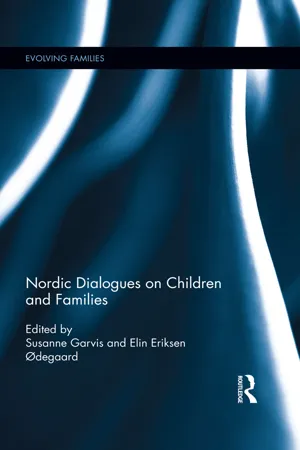
This book brings together key authors from the Nordic countries (Sweden, Finland, Norway, Denmark and Iceland) to discuss theoretical and empirical research on families and children. Sharing the Nordic perspective from each of the five countries, the book highlights key ideas within and across the countries. The chapters provide an understanding of the history of the Nordic perspectives of family and children, present current innovative research on solutions to complex issues, and explore contemporary issues. Nordic countries continually attain high scores in lifestyle measures, quality of life and children's outcomes. Much of this has to do with the specific culture and policy of the Nordic countries. Written by academics within the region who are well regarded for contributing to academic and public debate, this book will appeal to an international audience interested in the Nordic perspective and social policy around family and children.
eBook - ePub
Nordic Dialogues on Children and Families
- 178 pages
- English
- ePUB (mobile friendly)
- Available on iOS & Android
eBook - ePub
Nordic Dialogues on Children and Families
About this book
Information
1
Introduction
Introduction
This book explores the concept of Nordic perspectives of family and children. In addition to families, institutions are spaces where social mobility, change and lifelong learning take place. Needless to say, numerous mechanisms will synthetically form ways that families and children live their lives. Political, cultural-historical and geographical conditions are crucial mechanisms, but as we will learn throughout this book, the Nordic perspective will visualize and document the importance of the children’s agency, their activities and experience within families and institutions. Understanding children and family is of crucial importance for a wide scope of professionals within education, social work, care and health. New ways of living and a change of the status of children challenge established views and practices.
Social and educational institutions in the Nordic countries will often claim to work within a ‘Nordic model’, even if programs, methods and philosophy are imported from other parts of the world. We therefore need to address the concept of the ‘Nordic model’ to get to the Nordic perspectives on family and children. Because globalization, exchange of ideas and transnational agreements and common grounds exist across geographical borders and boundaries, it is reasonable to critically ask if there is a Nordic perspective and, if yes, why it is of interest.
Our answer to that question is yes; we can talk about a Nordic dialogue. Even if the ‘Nordic’ can seem blurred, and it is not difficult to come up with examples of common ground across other geographical axes, there are compelling reasons for paying attention to a Nordic perspective on family and children. In an era of globalization, Nordic dialogues must consequently be seen in a prism. What we claim to be Nordic perspectives are closely linked to national and global economies as well as transnational cultural ideas and ideals on families and children.
The universal idea and continuous challenge of how to shape better lives for children motivate the cooperating authors. In this book we see children as participants in families and society, and a premise is the fact that a body of scientific evidence shows that economic growth and conditions are not only mechanisms that ensure and provide a good life for children. It is, however, of interest that economic equal distribution, often referred to as the Nordic welfare system (the ‘Nordic model’) can seem a reasonable factor for a high level of trust, openness and tolerance, factors often referred to as common features in Nordic countries. Openness generates trust in other people, in legal systems and in politicians, something that is said to be unique in a global context (Høybråten, 2015). For this reason, we will elaborate on how the Nordic welfare system deals with conditions for families in the introduction.
The concept of family is broadly understood and elaborated to embrace both nuclear and extended families. Also historical and new ways of living and understanding children, childhood and generations are relevant when understanding family. What constitutes a family could mean a family or group in which the decision-making processes over and with children and members of the family are taking place over time. The members of a family will not necessarily live in the same household but be emotionally attached, detached or related by kin. When it comes to the laws and regulations in welfare states, however, definitions about living in the same household might be a condition for benefits.
Contemporary knowledge sees family and children, on the one hand, as resources, partners who can be more involved in activities, development and creation of curriculum and change. On the other hand children and families are also seen as at risk, underprivileged, underdeveloped, hard to involve and difficult to change (Rogoff, 2003; Hedegaard, Aronsen, Højholt & Ulvik, 2012). In practice these two opposite perspectives are often blended. Involvement, development and change in institutions have traditionally been reserved for professionals, but ecological, cultural and systemic bases of knowledge take into account that children are parts of family systems and relations that affect the development and well-being of children.
Furthermore, the aim of the book is to share the Nordic perspective from each of the five countries in the Nordic region: Island, Finland, Sweden, Denmark and Norway.1 The research chapters highlight key ideas within and across countries. Key academics from across the Nordic region share an understanding about the history of the Nordic perspectives of family and children as well as providing current innovative research about problems and solutions to complex issues related to family and children.
Each of the chapters shares examples of empirical research as well as theoretical perspectives in arguing the Nordic perspective. The common contribution is this interdisciplinary body of articles that renews the understanding of family and children from among the Nordic authors. The book brings new knowledge and insights into the cultural understanding of the Nordic region of interest beyond the Nordic region.
The Nordic model
What is then the ‘the Nordic model’? It refers to the combination of a market-based economy with a significant tax-financed welfare policy and an emphasis on social transfer and equality goals across gender and class. There is a high labour force participation rate for both men and women. Wages and income have been kept equal for many years, sustained by labour unions. The open economy also includes a tendency for an openness towards new technologies. There is participative democracy and traditions for local authorities and local influence, including neighbour-organized communities
The first key consideration is the innovative design of policy and practice to deal with contemporary issues within society. The second is that Nordic countries are grappling with problems that other countries will have to deal with in due course, such as how to organize society when almost all women work and how to listen to children’s voices when parents divorce. Nordic perspectives appear to reject tired, orthodox approaches and provide innovative solutions. In addition, the system has paradoxical consequences, and claims of the perfect realization are often exaggerated.
The Nordic countries have a collective population of only 26 million. This is not a substantial population compared to other regions, yet the Nordic region is considered a powerhouse in many policies and practices within societies. This is evident in Nordic countries scoring highly in lifestyle measures, quality of life and most livable places to work and live. The Nordic countries are able to dominate league tables in indices of country competitiveness as well as well-being, democracy and peace. The countries have for 200 years kept peace among each other and have substantial cooperation across national borders.
The objective is therefore not to convey the Nordic perspective as a homogeneous perspective, nor to give an impression that all Nordic citizens, families and children, institutions and policy makers think and behave in the same way. The ‘Nordic model’ is still a work in progress, and there are contemporary efforts that the Nordic countries are using to update their model to retain and make it distinctive (Høybråten, 2015). This book provides some understanding about ‘the work in progress’.
A brief Nordic comparison
To help provide an overview of Nordic countries, we have decided to include tables to show the implementation of policy around childhood, parental provision and welfare support for children. The tables show key dates and provision for support for families. The tables also show the differences across the countries of Sweden, Norway, Finland, Denmark and Iceland. This suggests that whereas there might be a general model around the ‘Nordic dialogue’, different perspectives also dominate across countries in regard to rights, provision and support.
The first table (Table 1.1) highlights the different country’s perspectives in regard to policies around childhood. Although all countries have similar ways in regard to corporal punishment laws, universal access to kindergarten, starting age of school, provision for schooling and curriculum frameworks, there are differences in when policies were implemented and the actual provision given. For example, school starting age varies across the Nordic region, as does universal access. The actual cost of kindergarten and formal schooling also varies across the countries. What the countries do share, however, is a commitment to universal access for children, higher ages for starting school compared to Anglo-Saxon
Table 1.1 Nordic policy around childhood


countries and heavily subsidized early childhood and schooling. The countries also have a universal understanding to ban corporal punishment and ratify the Rights of the Child. Another similarity is in the early childhood curriculum frameworks, which have a strong focus on play, learning and democracy.
The second table (Table 1.2) provides a comparison of parental policy in the region. This includes the amount of maternity and paternal leave provided, father’s rights and access to prenatal care. All countries appear to offer maternity and parental leave at between 70 to 90 per cent of income. Whereas the actual time and amounts vary, all of the countries have split policies for both the mother and the father. Fathers are also entitled to leave to look after their newborn children and have rights to initially take time off when the child is born. Free prenatal care is also available to all expecting mothers. Once children are born, they are entitled to free health care.
The final table (Table 1.3) shows comparisons across policies for welfare support for children. All countries have free medical care for children until the age of 18, with Sweden offering free health care until the child is 20. In some countries dental care is also covered under this health provision. Some of the countries have also made allowances for parents to look after sick children and still receive between 80 to 100 per cent of their salary. This may be a unique feature of the Nordic perspective in supporting working parents to also have entitlements to care for sick children. Each country also has provision for child benefits, with some countries making the payment dependent on income and other countries paying all families. Whereas support is given for children who attend kindergarten, some countries also have support for children who do not attend kindergarten as part of the thinking around equality. Again although the exact details of time and amounts differ across the region, there is a general trend of providing free health care, supporting families to care for sick children and providing access to kindergartens as well as providing funded alternatives. Overall the policies show strong support for children and their families to ensure adequate standards of living.
Other countries often admire the ‘Nordic model’ for families and children and quote their successes in achieving good outcomes. This book is intended to dig deeper into these policies to see what they look like within each of the contexts for families, children and professionals. How do such policies and provisions work in contemporary times? What is the relationship among families, children and professionals? The purpose of the book is to explore such questions and look at the Nordic dialogue across the different countries in regard to families, children and professionals.
Overview of the book
The Nordic dialogue brings together a number of different authors from across the region. The first chapter provides an introduction to the book and summarizes. In Nordic society, family members’ lives are historically structured and distributed in the sense that children and parents share a common, everyday life together. In the
Table 1.2 Policy for parents in Nordic countries

Table 1.3Welfare support for children


second chapter, Charlotte Højholt, Pernille Juhl and Dorte Kousholt draw upon research projects exploring children’s everyday lives across a variation of contexts through participatory observations and interviews. They focus on the parents’ perspectives on their lives across family, day care, family relief and children’s lives in relation to settling into school. The chapter takes a point of reference in the collectivity of everyday life and self-understanding as a family.
The third chapter by Lena Bäckström presents family life in Nordic countries from the children’s perspectives. She reports on data collected from 11-year-old children about their family life and upbringing as a starting point. The findings suggest that the children talked about the concept of a ‘good family’ that includes many different types of family structures. Given the high rates of divorce and separation in Nordic countries, the chapter provides an important contribution about family life in general as well as the support structures available.
In his chapter on compassion (Chapter 4), Lasse Lipponen discusses the emotional worlds of early childhood settings in a Swedish context. He focuses on the formation of compassion related to the rules that govern how it is and should be expressed in early childhood settings. He then relates this to the emotional worlds of families. He concludes that each family has its own emotional world and that almost every day, especially when parents leave and pick up their children, the two worlds (family and kindergarten) negotiate boundaries on emotions.
The chapter by Sonja Sheridan and Pia Williams from Sweden (Chapter 5) explores pedagogical leadership and families within a Swedish preschool cont...
Table of contents
- Cover
- Title
- Copyright
- Contents
- List of Contributors
- 1 Introduction
- 2 The collectivity of family conduct of life and parental self-understanding
- 3 Family life in Nordic countries
- 4 Constituting cultures of compassion in early childhood educational settings
- 5 Pedagogical leadership and families in Swedish preschool
- 6 Early childhood education, gender relations and equality among parents and families in Sweden
- 7 Divorce, families and children
- 8 “We have this family ‘under the microscope’ so to speak”: schools, child abuse and family support
- 9 Economic, social and cultural status (ESCS) and mathematics performance of immigrant students in the Finnish metropolitan area in PISA 2012
- 10 Coming and staying or coming and going? Immigrant families in Denmark: challenges and opportunities for integration
- 11 Parental engagement in Icelandic preschools
- 12 The importance of aesthetic activities in Norwegian kindergartens
- Index
Trusted by 375,005 students
Access to over 1.5 million titles for a fair monthly price.
Study more efficiently using our study tools.
Frequently asked questions
Yes, you can cancel anytime from the Subscription tab in your account settings on the Perlego website. Your subscription will stay active until the end of your current billing period. Learn how to cancel your subscription
No, books cannot be downloaded as external files, such as PDFs, for use outside of Perlego. However, you can download books within the Perlego app for offline reading on mobile or tablet. Learn how to download books offline
Perlego offers two plans: Essential and Complete
- Essential is ideal for learners and professionals who enjoy exploring a wide range of subjects. Access the Essential Library with 800,000+ trusted titles and best-sellers across business, personal growth, and the humanities. Includes unlimited reading time and Standard Read Aloud voice.
- Complete: Perfect for advanced learners and researchers needing full, unrestricted access. Unlock 1.5M+ books across hundreds of subjects, including academic and specialized titles. The Complete Plan also includes advanced features like Premium Read Aloud and Research Assistant.
We are an online textbook subscription service, where you can get access to an entire online library for less than the price of a single book per month. With over 1.5 million books across 990+ topics, we’ve got you covered! Learn about our mission
Look out for the read-aloud symbol on your next book to see if you can listen to it. The read-aloud tool reads text aloud for you, highlighting the text as it is being read. You can pause it, speed it up and slow it down. Learn more about Read Aloud
Yes! You can use the Perlego app on both iOS and Android devices to read anytime, anywhere — even offline. Perfect for commutes or when you’re on the go.
Please note we cannot support devices running on iOS 13 and Android 7 or earlier. Learn more about using the app
Please note we cannot support devices running on iOS 13 and Android 7 or earlier. Learn more about using the app
Yes, you can access Nordic Dialogues on Children and Families by Susanne Garvis, Elin Eriksen Ødegaard, Susanne Garvis,Elin Eriksen Ødegaard in PDF and/or ePUB format, as well as other popular books in Psychology & Developmental Psychology. We have over 1.5 million books available in our catalogue for you to explore.