eBook - ePub
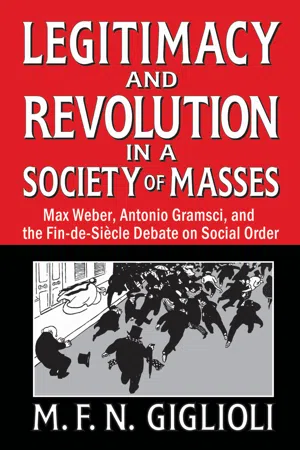
Legitimacy and Revolution in a Society of Masses
Max Weber, Antonio Gramsci, and the Fin-de-Sicle Debate on Social Order
- 260 pages
- English
- ePUB (mobile friendly)
- Available on iOS & Android
eBook - ePub
Legitimacy and Revolution in a Society of Masses
Max Weber, Antonio Gramsci, and the Fin-de-Sicle Debate on Social Order
About this book
Questions surrounding the concept of legitimacy—the force that keeps a polity together, and whose absence causes it to shatter—are possibly the most important concern of a study of politics. M. F. N. Giglioli examines the shift to a distinctly modern understanding of the concept in Continental Europe, following the crisis of liberal rationalism in the late nineteenth century, and the search for new ways of envisaging the determinants of collective action into the twentieth century.The author examines certain aspects of the intellectual and political background of early twentieth-century theories of legitimacy elaborated by Max Weber and Antonio Gramsci. These theories are interpreted as the outcome of a contested process of redefinition of the concept, itself prompted by the social and political circumstances of the late nineteenth century, such as economic modernization and the attempt to incorporate the working class into the political system.This is the first book in a generation to offer a general reassessment of issues of legitimacy in political thought at the turn of the twentieth century. It examines the development of the concept in France, Italy, and Germany during the half-century or so following the Paris Commune. It discusses six key critics of classical Victorian liberalism on the revolutionary Left and the conservative Right. The political position and biography of each is a central focus of the study, as the culture of the age was decisively shaped by reflection on the social role of intellectuals.
Information
1
Introduction
The set of questions surrounding the concept of legitimacy, the peculiar centripetal dynamics that keep a polity together, or, by disappearing, shatter it to pieces, is possibly the most important with which a study of politics may concern itself. As Isaiah Berlin quite correctly remarks, the fundamental question in politics is why a man should obey another,1 since force alone cannot guarantee universal compliance with rules, but everyone stands to gain from regulated social cooperation. The reason legitimacy is understood to be a central problem in political thought is precisely the perceived indispensability of motivations in favor of obedience, because the willingness to obey authority logically puzzles us at the level of individual rationality, even as we perceive its necessity for the smooth functioning of social interaction as a whole.
Interest in issues with a recognizable bearing on legitimacy has been recurrent in the history of Western political thought. Indeed, beginning at least with La Boétie, the question of the grounding of political authority can be seen as the dominant preoccupation of what we have come to think of as the classical tradition of political theorizing, from Grotius to Hobbes, from Locke to Montesquieu, from Rousseau to Kant. Proponents and opponents alike understood nineteenth-century liberalism to issue directly from this tradition and to offer a systematic and comprehensive answer to the question of political legitimacy. However, beginning with the last decades of the nineteenth century, increasing challenges to the liberal image of legitimate order emerged and new formulations were sought for the concept. One of the chief outcomes of the process was the contemporary theorization of legitimacy within the social sciences, which has decisively shed the link between the normative and descriptive (or the motivational and the behavioral) aspects of legitimacy. Such a transformation, I claim, was the consequence of the historical encounter with the new society of masses.
The present work is an attempt to contribute to the intellectual history of the concept of legitimacy during this crucial phase. It takes the form of an investigation into reflection on the concept in Continental Europe during the half century or so following the Paris Commune. In those years, I claim, three major European countries—France, Germany, and Italy—underwent momentous changes in social and political conditions that on the one hand ushered in a new, modern world, recognizably similar to our own, and on the other brought the legitimacy issue into dramatic, real-world focus.
The period preceding the First World War was a phase of crisis in the political structures of European States. Issues related to legitimacy became salient in the interests of many leading political thinkers of the age. The fin-de-siècle crisis is admittedly not the only historical instance of an intellectual debate centering around a vast social upheaval, but it possesses characteristics, both material and spiritual, that make it especially valuable as a case study for those who seek insights on the role of legitimacy in the modern world. Let us explore each in turn.
In terms of socioeconomic developments, the end of the nineteenth century saw the consolidation and spreading to the whole European continent of the vast shift in productive processes springing from the Industrial Revolution. The changes in the balance between city and countryside and the rapid development of communications and transportation ushered in a completely novel society, characterized by its mass dimensions, on an altogether different scale of magnitude from the past. At the same time, these years saw the apogee of the modern Nation-State form. The rapidly expanding public bureaucracy undertook the regulation of ever-wider spheres of social interaction as it attempted to carry through the first systematic nation-building projects. If the civilization of machines was attaining unparalleled heights of wealth and material comfort, proving the extent to which social collaboration could multiply individual endeavor, the State was demonstrating similar advances in physical power, internationally as well as domestically. Both industrialism and government bureaucracies, however, required for their functioning an ever-increasing amount of discipline from the individuals subject to their control. The society of masses was a physically and psychologically invasive order.
The political crisis of the fin de siècle proceeded precisely from the search for the means to justify such an invasive but unprecedentedly successful order.
The central decades of the nineteenth century, the heyday of Victorianism, had witnessed the triumph of such a rational, immanent justification of authority in the form of classical liberalism. Therefore, in terms of the history of political thought, the fin-de-siècle crisis can be interpreted as the reaction to the end (or the eclipse) of the hegemony of liberal theory and practice. From the perspective of the ruling classes, the crisis was experienced as an untethering of rational political discourse from collective action. The metaphor of the social contract, with its double implication of free choice of obedience and rational obedience to one’s own choice, no longer seemed relevant to modern conditions; the calculating reasonableness of the utilitarian individual appeared as the product of a more and more far-fetched moral anthropology. Indeed, for the period before World War I—and with a century’s hindsight—we can speak of a historical hiatus of the microeconomic reference in the interpretation of politics.
What was to be done with those who rejected what were understood as the rational forms and modes of politics and government? The age of progress had also been obliged to face such dilemmas, as the encounters with Luddism and the colonial Other amply attest. Nevertheless, the fin de siècle signals a qualitative shift in this confrontation that becomes systematic inasmuch as the disciplinary requirements of mass society do not allow resistance to modernity to be safely marginalized, either politically or intellectually.2 As a result, a very idiosyncratic shift takes place in the intellectual conceptualization of politics. Throughout the history of Western thought irrational behavior was considered an empirical fact, to be deplored or stigmatized, but signifying in itself nothing more than the unavoidable imperfection of the material world, unworthy of further interest as such. In the period we are concerned with, on the contrary, the actual collective behavior of the newly politically relevant masses is taken to be a meaningful and valuable object of analysis in its own right. The sources of collective beliefs are investigated without explicit reference to the normative standards they are to be measured against. It is the methodological revolution that stands at the origin of modern social science.
Yet, normative questions or, rather, policy issues dependent on the normative attitudes and preferences of the masses, were of the utmost importance to the political environment in which fin-de-siècle thinkers operated. For those who, broadly speaking, supported the status quo, the problem of concrete collective behavior was largely conflated with the attitude toward Reason of State. This was the traditional ancien régime techne3 of rule, realist in its assumptions and flexible enough to conceive of strictly nonrational popular enthusiasms and expectations. The problem became the regime of publicity to be afforded to these techniques or, in other words, the self-reflexive effects of this type of knowledge on the body politic in a mass constitutional system.
For the intellectuals in the revolutionary camp, the empirical puzzle of mass behavior in the fin de siècle was different; it involved a widening gap between socioeconomic conditions and political action. While socialist movements developed and institutionalized across the Continent, the horizon of decisive revolutionary transformation seemed to recede indefinitely. The failure of any historical automatisms to materialize in turn led to a contentious debate on the concrete aims of socialist politics. In other words, posing the question of legitimacy raised awkward issues for the materialist theory of revolution of Marxist socialism. One potential solution to the impasse was the foregrounding of normative arguments or, otherwise put, the introduction of some form of a Kantian conception of ethics into socialism. This was the path taken by currents of Austro-Marxism4 and by Carlo Rosselli’s liberal socialism in the interwar years; in the period under consideration, however, it was a minority position. The more characteristic posing of the dilemma revolved around the issue of historical determinism with respect to the spontaneous initiatives of revolutionary enthusiasm, leading to competing theorizations of political vanguardism.
From a narrative point of view, the present project can be understood as an inquiry into certain aspects of the intellectual and political background to two early twentieth-century theories of legitimacy, elaborated by Max Weber and Antonio Gramsci. These theories, it is claimed, were the outcome of a process of (conflictual) redefinition of the concept of legitimacy, itself tied to particular social and political circumstances. The fin-de-siècle generation began a debate on the status of legitimacy in society that ultimately led to the formulation of descriptive theories in contrast to the normative treatment the topic traditionally received. “Legitimacy” had been an evaluative term; it became much more of a neutral, descriptive one. The rest of this introduction will sketch the chronological progression by which I claim this transformation took place.
At the outset, it is worth noting one characteristic of the debate that we are to chronicle and its outcomes. The group of theorists herein analyzed was certainly not the first to puzzle over the foundations of political order, or to do so under the shadow of imminent radical change. After all, the age of revolutions was already a century old in the 1870s, and, indeed, the forty-odd years leading up to World War I were a comparatively peaceful time for Europe. In the early nineteenth century, the term “legitimacy” had been the purview of a very different tradition of political thought; De Maistre, Bonald, Lamennais, and Donoso Cortés had made extensive use of the concept, so much so that they collectively came to be identified under its rubric. The key shift in perspective that separates the Legitimists and their concerns from the fin-de-siècle legitimacy debate is the abandonment of the metaphysical foundations so crucial to the earlier group of theorists. The resulting theories of Weber and Gramsci are fully immanent portrayals of social order or, to speak clearly, atheistic views of society. It is by no means clear that, together, they exhaust the possibilities of this approach so that, as some have claimed, their rejection should imply by necessity a “return to God” in political thought. On the other hand, it is doubtful that an acceptance of either theory could be made compatible with a strong conception of the providential role of political power in history and, thus, with a Versöhnung of religion and politics.
The proximate origins of the fin-de-siècle legitimacy debate can be found, at the level of theory, in certain Tocquevillean admonishments as to the fragility of the liberal order in the face of the rising tide of egalitarianism and, at the level of political life, in the long-term consequences of the pan-European liberal débâcle in the revolutionary upheavals of 1848.
The ideal of peaceful change that haunted Continental liberalism in the nineteenth century appeared all the more chimerical in the wake of the political event that stands as the terminus a quo of the present study: the Franco-Prussian war of 1870 and the Paris Commune. Its outcome shaped the contours of the legitimacy dilemma both for the supporters and for the opponents of the liberal-bourgeois status quo. The French “party of order” directly experienced the consequences of the legitimacy deficit of the previous regime: humiliating military defeat and domestic social chaos. Given the nature of the national emergency, it was seen as imperative that the new Republic benefit from the support of as wide a national constituency as possible, for the internal divisiveness of Napoleonic imperial rule was taken to be one of the key factors leading to the disaster of 1870. Similarly, the lesson of 1871 was a harsh one for the revolutionary workers’ movement; the ferocity of repression clearly demonstrated that under modern political-technological conditions the institutions of the State were both capable and willing to defeat popular uprisings in a purely military confrontation. A cycle of revolution begun more than eighty years earlier finally drew to a close; no longer were regimes to change as a result of Parisian journées révolutionnaires. It would seem that the Gramscian “revolutionary war of movement” was already doomed in the West well before 1922. The political future lay in large-scale, long-term mass organization.
In the wake of defeat, the French intellectual scene was dominated by the twin figures of Hippolyte Taine and Ernest Renan. Rather than focus on their theories of nation and revolution taken in isolation, we will be discussing general characteristics of the Parisian cultural landscape as a whole inasmuch as an entire generation sought the answers to the burning questions of social order and stability.
The contrasted history of the Third Republic in its formative decade seemed to prove the practical failure of doctrinaire liberalism. Specifically, the notion that society could, at least at the level of juridical fictio, be understood as an association of equally free rational individuals agreeing to mutually beneficial limitations on their liberties was severely compromised by the rise of militantly anti-system mass movements. How, then, was the Social Question to be conceptualized? How could the bounds of the polity be redrawn to permit solid social cooperation?
One may isolate three ideal-typical attempts to do so, each challenging one of the premises of the traditional liberal account by offering a determinist “dominant-factor” explanation. Theories of social psychology, mass behavior, and criminology attempted to relax the rationality assumption in their redescription of deviance as a social pathology of the lower classes. Thus political protests were denied any agency and reduced to pure instinct channeled by situational constraints.5 Theories of geographical or biological determinism, whether they followed an aesthetic literary approach or a (pseudo) scientific one, instead targeted the equality condition of liberal theory. Political disagreement was once more naturalized by a reductionist, determinist explanation: political arguments used to justify colonialism were reimported to deal with the domestic Social Question.6 Finally, theories of nationalism questioned the harmony-of-interests aspect of liberal theory. The defense of the Fatherland, which for these theories assumes transcendental dimensions as the standard and metric of interests and morality, demanded complete obedience to the social hierarchy, but this ideal could never be achieved as long as a domestic “fifth column” was present, in the form of cosmopolitanism and free-thought, at the very apex of the institutions of government themselves.
These different forms of theorization, which shared the goal of redefinition of the polity to expel conflict toward the exterior, can furthermore be placed within a cultural field, structured notably according to a methodological polarity between positivist scientism at one end and literary aestheticism at the other, and a professional polarity, depending on the degree of acceptance of the theorists within the institutions of the academic world.7 Chapter 2 retraces the development of antidemocratic thought in France from the viewpoint of the cultural preoccupation with decadence.
The first genuine step forward in the legitimacy debate was the work of what has since come to be known as the Italian school of sociology; their substantive contribution was the theory of elites. The theory, by positing an empirical regularity in the structure of all human societies, namely their hierarchical nature (or the separation of governing and governed strata), attained a superior level of abstraction with respect to dominant-factor accounts. In the process, it recovered a measure of autonomy for the human sciences, previously condemned to irrelevance by competing deterministic reductionisms. A key part of the theory was the analysis of political thought as ideology (Pareto’s “derivations” and Mosca’s “political formulas”), that is, as an instrumentum regni.
The same dynamics of hierarchism, bureaucratization, and the instrumental use of doctrinal dogma were then revealed by Robert Michels to be at work in party organizations as much as in the polity as a whole, thereby uncovering one of the main weaknesses of the theory, namely, its inability to account for the recursive nature of the legitimacy problem. Further, the clear-cut distinction between a fully conscious, cynical, and deliberately instrumental ruling class and a completely unsuspecting, credulous mass of followers had always appeared artificial and not in line with prac...
Table of contents
- Cover Page
- Halftitle
- Title Page
- Copyright Page
- Content Page
- 1 Introduction
- 2 Legitimacy and Decadence. Antidemocratic Social Thought in France
- 3 Legitimacy and Reason of State. Vilfredo Pareto
- 4 Legitimacy and Modernity. Georges Sorel
- 5 Legitimacy and the Philosophy of History. Antonio Labriola
- 6 Legitimacy, Charisma, and Disenchantment. Max Weber
- 7 Legitimacy, Alienation, and Totality. Antonio Gramsci
- 8 Conclusions
- Bibliography
- Name Index
- Subject Index
Trusted by 375,005 students
Access to over 1.5 million titles for a fair monthly price.
Study more efficiently using our study tools.
Frequently asked questions
Yes, you can cancel anytime from the Subscription tab in your account settings on the Perlego website. Your subscription will stay active until the end of your current billing period. Learn how to cancel your subscription
No, books cannot be downloaded as external files, such as PDFs, for use outside of Perlego. However, you can download books within the Perlego app for offline reading on mobile or tablet. Learn how to download books offline
Perlego offers two plans: Essential and Complete
- Essential is ideal for learners and professionals who enjoy exploring a wide range of subjects. Access the Essential Library with 800,000+ trusted titles and best-sellers across business, personal growth, and the humanities. Includes unlimited reading time and Standard Read Aloud voice.
- Complete: Perfect for advanced learners and researchers needing full, unrestricted access. Unlock 1.5M+ books across hundreds of subjects, including academic and specialized titles. The Complete Plan also includes advanced features like Premium Read Aloud and Research Assistant.
We are an online textbook subscription service, where you can get access to an entire online library for less than the price of a single book per month. With over 1.5 million books across 990+ topics, we’ve got you covered! Learn about our mission
Look out for the read-aloud symbol on your next book to see if you can listen to it. The read-aloud tool reads text aloud for you, highlighting the text as it is being read. You can pause it, speed it up and slow it down. Learn more about Read Aloud
Yes! You can use the Perlego app on both iOS and Android devices to read anytime, anywhere — even offline. Perfect for commutes or when you’re on the go.
Please note we cannot support devices running on iOS 13 and Android 7 or earlier. Learn more about using the app
Please note we cannot support devices running on iOS 13 and Android 7 or earlier. Learn more about using the app
Yes, you can access Legitimacy and Revolution in a Society of Masses by M. F. N. Giglioli in PDF and/or ePUB format, as well as other popular books in Politics & International Relations & Political History & Theory. We have over 1.5 million books available in our catalogue for you to explore.