eBook - ePub
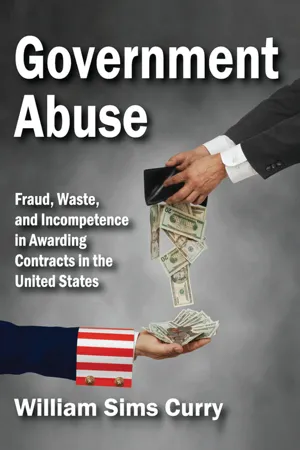
Government Abuse
Fraud, Waste, and Incompetence in Awarding Contracts in the United States
- 249 pages
- English
- ePUB (mobile friendly)
- Available on iOS & Android
eBook - ePub
Government Abuse
Fraud, Waste, and Incompetence in Awarding Contracts in the United States
About this book
Government contracting is plagued by nefarious, amateurish, and criminal behavior. By awarding government contracts to corporations as compensation for lavish gifts and personal favors, the United States government fails to serve the public interest effectively and honestly. William Sims Curry identifies and categorizes multiple deficiencies in how government contractors are selected, and proposes how reforms can be instituted.This book is based on extensive research. Curry sifted through two years worth of contractor claims maintained by the Government Accountability Office (GAO) regarding improper behavior of federal government agencies during the contract award process. He identified additional government contracting failures through review of media stories, inspector general reports, court cases, and press releases by government investigatory agencies.Much of this abuse originates from the mandated but ineffective practice of color coding rating proposals and a subjective ratings system. Curry proposes replacing the current practice with a scoring system that weighs contractor selection criteria according to the government's needs. This, along with the other procurement reforms Curry recommends, offers promise for an alternative to the fraud, waste, and incompetence currently rampant in government contracting.
Information
1
Defining and Narrowing the Problems of Fraud, Incompetence, Waste, and Abuse
Introduction
The United States is plagued by the acquisition of weapons systems and other federal programs costing billions of dollars that are neither useful nor needed by the military. This aberration is aggravated by a federal government procurement process distraught by fraud, incompetence, waste, and abuse (FIWA). This enduring entanglement has persisted since well before President Eisenhower’s 1961 warning of the threat to liberties or democratic processes from the military-industrial complex1 and continues into President Obama’s administration. The collaboration between corrupt corporate representatives and incompetent or similarly nefarious public servants in dubious government contract dealings have been familiar to Americans since the United States began its rise as a world power. In his 1935 book War is a Racket,2 Brigadier General Smedley Butler wrote about his dismay regarding manufacturing companies and bankers that instigate wars to increase their corporations’ profitability, and he noted that corporations profited immensely during World War I. Two quotes from his book, with respect to defense contractors’ profits, are provided below:
In the World War [World War I] a mere handful garnered the profits of the conflict. At least 21,000 new millionaires and billionaires were made in the United States during the World War. That many admitted their huge blood gains in their income tax returns. How many other war millionaires falsified their income tax returns no one knows. Airplane and engine manufacturers felt they, too, should get their just profits out of this war. Why not? Everybody else was getting theirs. So $1,000,000,000 – count them if you live long enough – was spent by Uncle Sam in building airplanes and airplane engines that never left the ground! Not one plane, or motor, out of the billion dollars’ worth ordered, ever got into a battle in France. Just the same the manufacturers made their little profit of 30, 100 or perhaps 300 per cent.
The Military-Industrial Complex
President Eisenhower’s warning of the dangers of the military-industrial complex, pronounced near the close of his administration, marked the beginning of this imbroglio as the end of World War II and the Korean conflict. He indicated that the United States was compelled to develop a vast and permanent armaments industry because the nation no longer had the time needed to respond to national security threats by converting from a peacetime industrial base to a manufacturing infrastructure suited for warfare. President Eisenhower warned, in the following excerpt from his 1961 speech, of the potential for misplaced influence and power when maintaining an ongoing defense industry became a necessity:
In the councils of government, we must guard against the acquisition of unwarranted influence, whether sought or unsought, by the military-industrial complex. The potential for the disastrous rise of misplaced power exists and will persist.
As reported in the Washington Post article,3 “Weapons Wars – Defense Secretary Gates Takes on the Military-Industrial Complex,” concern regarding the military-industrial complex persists to the present time. During the earliest days of President Obama’s administration, Defense Secretary Robert M. Gates proposed drastic cuts to coveted military programs such as the F-22 fighter, the C-17 cargo plane, the stealth destroyer, the army’s advanced combat vehicle, and portions of the missile defense system. Mr. Gates was reportedly frustrated by obstacles to obtaining weapons needed in Iraq and Afghanistan because defense contractors were adept at garnering congressional support for their more profitable programs. Defense contractors achieved funding for their favored programs by performing manufacturing operations and making campaign contributions in support of unworkable or unnecessary weapons systems in multiple states and congressional districts.
Financial Rewards through Abuse of Power
Certain members of Congress, as evidenced by the above discussion, benefit from campaign contributions and jobs within their states or districts through support of weapons systems even though the armaments may not be needed or wanted by the military. Government contractors benefit through the award of contracts and resultant profits, valued in billions of dollars. Compounding the problem of acquiring expensive, useless government systems are FIWA-infected federal procurement practices and practitioners. Awarding lucrative contracts to unscrupulous corporations in exchange for cash or other personal gains is a favored stratagem for corrupt government officials to be enriched.
Government officials involved in illicit contracting transactions, who comprise an infinitesimal element of the primarily honest government workforce, almost certainly act as rogues or by colluding in small groups because there are no obvious scenarios wherein a government entity might benefit from awarding contracts fraudulently. It is nearly as improbable for corporations, as it is for government agencies, to implement organizational policies that include engaging in fraudulent acts, such as obtaining government contracts, by bribing government representatives. Corporations profit substantially from large government contracts obtained through congressional support for programs obtained through campaign contributions and the promise of employment opportunities for constituents. Seeking such congressional support, while not in the interest of the citizenry, is not illegal and likely represents the limit of corporate policies with respect to obtaining government work. The threat of severe degradation of profitability, market share, and reputation should a corporation be found responsible for such acts make it highly improbable that the bribing of government contracting officials as a means for receiving contracts would be a rational corporate objective. Professional advancement within the corporation is the more likely motivation of rogue corporate malefactors that bribe public officials. It is, therefore, likely that payers and payees involved in contracts-for-cash bribery schemes consist primarily of rogue employees and that neither government agencies nor corporate entities are routinely involved organizationally in fraudulent contracts. The disparity between contracts valued in millions or billions of dollars and gratuities valued in thousands of dollars, however, suggests that company representatives are not willing to risk prosecution for proffering bribes unless there are highly significant returns from their relatively meager outlays. Most surprising is the great personal risks public officials are willing to endure for their comparatively meager personal enrichment in exchange for richly rewarding corporations with high value contracts.
Supreme Court's Facilitation
The Supreme Court’s ruling in the Citizens United v. Federal Election Commission case4 resulted in the determination that, based on First Amendment rights, corporations and unions were not prohibited from independently supporting political campaigns. The Supreme Court decision includes the following statement in the syllabus:
[T]his Court now concludes that independent expenditures, including those made by corporations, do not give rise to corruption or the appearance of corruption. That speakers may have influence over or access to elected officials does not mean that those officials are corrupt. And the appearance of influence or access will not cause the electorate to lose faith in this democracy.
The evidence, provided in chapter 2, “Government of the Corporations, by the Unions, and for the Special Interests,” highlights Congress’ degeneration into depravity as a result of access by special interest groups to elected officials. The failure of the majority of Supreme Court justices to recognize Congress’ corruption while pondering this case and rendering the above conclusion ostensibly renders them as naïve.
The ability of unions and corporations to expend prodigious sums of money, in comparison to the resources available for campaign contributions by ordinary citizens, in support of candidates for political office provides these nonvoter, noncitizen organizations the continuing capability to persuade Congress to act on behalf of these large contributors rather than on behalf of average citizens. The momentous impact from this decision is that “we the people” have little influence over congressional actions.
Collaboration between Bureaucrats and Contractor Representatives
In addition to the absence of effective congressional representation, ordinary citizens are also plagued by deceptive actions of appointed or career civil servants and government contractor executives. Readers who might question the likelihood that executive level government or corporate officials would engage in fraudulent government contracting activities are reminded of the Boeing/Air Force aerial refueling tanker case5 and the Randall Cunningham case.6 The two principal players in the aerial refueling tanker case were the then Principal Deputy Assistant Secretary of the Air Force (Acquisition and Management) Ms. Darlene Druyun, and Boeing’s then Chief Financial Officer, Mr. Michael Sears. In exchange for steering the colossal refueling tanker program and other contracts to Boeing, Ms. Druyun was rewarded with executive level employment with Boeing. She also obtained Boeing employment for her daughter and her son-in-law. Both Druyun and Sears pled guilty for their part in the aerial refueling tanker duplicity and were sentenced to prison. In the other case, Randall Cunningham was a US Navy fighter pilot hero; he was the first ace of the Vietnam War. Cunningham was awarded the Navy Cross, two Silver Stars, and a Purple Heart; he had also been nominated for the Medal of Honor. Following his service in the US Navy, he was elected to eight terms in the US House of Representatives. Former Congressman Cunningham confessed to accepting bribes valued at $2.4 million from Department of Defense (DOD) contractors. He was sentenced to eight years in federal prison. After serving time in prison, Cunningham was assigned to a federal halfway house in New Orleans in December 20127 and has since been released. While considerable material in this book is dedicated to the revelation of fraud, incompetence, waste, and abuse (FIWA) in federal government procurement, this is not the sole focus here. Recommendations for addressing FIWA problems are offered and, when practicable, recommendations for reducing the incidence of and impact from nefarious and amateurish acts are proposed. Tools and processes recommended for reducing negative FIWA impacts are fully described in subsequent chapters.
Government Procurement Process Failures
There have been substantial improvements to government procurement processes. The type of contract used during World War I to encourage manufacturing companies to participate in the war effort, when designing and manufacturing costs for armaments could not be determined in advance, is called a cost-plus-a-percentage-of-cost (CPPC) contract.8 Although admittedly having the advantage of hindsight at this writing, one would have thought it obvious, even then, that paying contractors actual costs plus a percentage of their actual costs would encourage government contractors to spend excessively. Military contractors learned early on during the war effort that the more they spent designing and manufacturing weapons, the greater their profits. If, for example, a contractor had a CPPC contract that would reimburse it 10 percent over its costs, and if that contractor incurred costs of $50 million, it would earn $5 million in profit. Under the same contract, however, had the contractor incurred costs of $100 million for the same armaments, it would double its profits and earn $10 million. The government, however, apparently failed to recognize this incentive for excessive profits in return for unrestrained contractor spending until after the war when contracting activities were eventually evaluated. The failure of government to recognize the problem associated with CPPC contracting, or at least to identify and correct the problem during the course of the war, is puzzling. Military contractors immediately developed proficiency in maximizing profits through unfettered spending. It is difficult to determine whether incompetence or unmitigated fraud were the reason for the government’s delay in recognizing the irrationality of CPPC contracting. The prohibition of CPPC contracts9 resulting from the above mentioned post–World War I study into armament contracts, however, was a significant improvement to government contracting.
Department of Defense Proposal Evaluation Weaknesses
Although the prohibition against CPPC contracts constitutes a significant improvement in government contracting, correction of the numerous remaining vexations remains unfulfilled. During a concentrated effort to implement recommendations for resolving the plethora of remaining problems, DOD established the Source Selection Joint Analysis Team (JAT) on November 10, 2008. The JAT standardized the methodology and approach for conducting competitively negotiated source selections.10 The JAT also incorporated key elements of the contract planning process in a March 4, 2011, memorandum from the director of defense procurement and acquisition policy. The memorandum established mandatory source selection procedures applicable throughout the DOD. The DOD supplement to the Federal Acquisition Regulations (FAR) refers DOD contracting officials to the March 4, 2011, memorandum for direction in source selection activities in negotiated, competitive acquisitions conducted according to FAR part 15.11 The source selection procedures outlined in the memorandum are primarily logical and prudently established minimum qualifications for key personnel involved in source selection activities.
A persistent problem concerning ambiguous results from source selection evaluation teams, however, was not cor...
Table of contents
- Cover
- Half Title
- Title
- Copyright
- Dedication
- Contents
- List of Figures
- List of Tables
- Preface
- Acknowledgments
- Abbreviations
- 1 Defining and Narrowing the Problems of Fraud, Incompetence, Waste, and Abuse
- 2 Government of the Corporations, by the Unions, and for the Special Interests
- 3 Exemplary Actions by Government and Nongovernment Entities for Combating Fraud, Incompetence, Waste, and Abuse
- 4 Protests Sustained by the GAO for Proposal Evaluation Errors
- 5 Protests Sustained by the GAO for Other Deficiencies
- 6 Weaknesses and Strengths of Selected Proposal Rating Processes
- 7 Imperfections in the DOD's Efforts to Improve Its Process for Selecting Contractors
- 8 Single-Score Best-Value Selection Process Eliminates Ambiguity
- 9 Scandalous Socioeconomic Contracting Practices
- 10 The Absurdity of Waiving All Procurement Controls during Disasters
- 11 Compendium of Measures for Minimizing Fraud, Incompetence, Waste, and Abuse in the Federal Government
- Appendix A
- Appendix B
- Appendix C
- Index
Trusted by 375,005 students
Access to over 1.5 million titles for a fair monthly price.
Study more efficiently using our study tools.
Frequently asked questions
Yes, you can cancel anytime from the Subscription tab in your account settings on the Perlego website. Your subscription will stay active until the end of your current billing period. Learn how to cancel your subscription
No, books cannot be downloaded as external files, such as PDFs, for use outside of Perlego. However, you can download books within the Perlego app for offline reading on mobile or tablet. Learn how to download books offline
Perlego offers two plans: Essential and Complete
- Essential is ideal for learners and professionals who enjoy exploring a wide range of subjects. Access the Essential Library with 800,000+ trusted titles and best-sellers across business, personal growth, and the humanities. Includes unlimited reading time and Standard Read Aloud voice.
- Complete: Perfect for advanced learners and researchers needing full, unrestricted access. Unlock 1.5M+ books across hundreds of subjects, including academic and specialized titles. The Complete Plan also includes advanced features like Premium Read Aloud and Research Assistant.
We are an online textbook subscription service, where you can get access to an entire online library for less than the price of a single book per month. With over 1.5 million books across 990+ topics, we’ve got you covered! Learn about our mission
Look out for the read-aloud symbol on your next book to see if you can listen to it. The read-aloud tool reads text aloud for you, highlighting the text as it is being read. You can pause it, speed it up and slow it down. Learn more about Read Aloud
Yes! You can use the Perlego app on both iOS and Android devices to read anytime, anywhere — even offline. Perfect for commutes or when you’re on the go.
Please note we cannot support devices running on iOS 13 and Android 7 or earlier. Learn more about using the app
Please note we cannot support devices running on iOS 13 and Android 7 or earlier. Learn more about using the app
Yes, you can access Government Abuse by William Sims Curry in PDF and/or ePUB format, as well as other popular books in Politics & International Relations & Politics. We have over 1.5 million books available in our catalogue for you to explore.