- 150 pages
- English
- ePUB (mobile friendly)
- Available on iOS & Android
eBook - ePub
About this book
In this distinctive and personal narrative of Barack Obama's 2008 campaign for the American presidency, Carlos Rangel chronicles the underlying currents of social change that led to this successful campaign. The results were a president with a clear majority of the votes cast; elected by a commanding majority of electoral votes; and who won states on both coasts, in the South, the Rust Belt, and the West. There were no recount battles, or intervention by the courts.Rangel notes that the effective professional politician gathers coalitions around positions on the issues and uses these coalitions to formulate policies that bring these positions to fruition. The Obama Campaign coalesced expectations that he would be able to rapidly transform the way the country is led and lead Americans to a better future. These expectations were multiplied by an effective, well-run campaign. Certainly, Obama's capacity to inspire during the campaign led many to believe he could do the same as president.Management of high expectations became one of President Obama's greatest challenges in the immediate period after the election. In transforming ideals of hope and change into reality, he faced political resistance from multiple fronts, an economy with structural flaws, and an internationally isolated United States. Rangel's unique background in Latin America enables him to make sharp observations about policies and campaign statements that may have influence in that region, including trade deals, drug wars and the populist rhetoric, and actions emanating from the region. This book is a solid start at analysis of the years ahead, as well as the year that was.
Information
1
The Democratic Primaries
In the aftermath of the disappointing results of “Super Tuesday” (February 5, 2008), by which time she had expected to clinch the Democratic nomination, Senator Hillary Clinton became more aggressive in her attacks against Senator Barack Obama. Old politics would have suggested counterattacks by Senator Obama but, in a sign of things to come, he in fact did not pursue the aggressive attack style of old politics. His style developed as punctilious, cerebrally playing by the rules laid out, and strategizing accordingly.1 In the end, this was like throwing a slider strike to the Clinton campaign, which only too late realized that the rules of the game had changed. However, she ignored these new rules until it was too late. Between Super Tuesday and the meeting of the Democratic National Convention Rules Committee, I wrote the following notes, some perhaps a little more passionate than fair-minded, including allegations that were perhaps more campaign fodder than fact.
So, She Won the Battle but…. Did She Lose the War?
March 7, 2008
The way Senator Clinton won last Tuesday, March 4, in Texas and in Ohio brings back into the fray what New Democrats have been reacting against. Her campaign’s strategy apparent view that all she needs to do to win is to get half of the support plus one—disregarding the alienation of the disenfranchised half minus one—returns to the political arena the divisiveness that often characterized former President Clinton and the current President Bush. In winning by attacking she may have started a cycle that could bring down the election for the Democrats. Her personal attacks go to the core of what a candidate is: a qualified office holder. Contradicting the way she acted and reacted during the most recent two debates in which she praised Senator Obama, she now constantly disqualifies his capabilities as a possible President. These attacks may have the potential consequence of Senator Obama’s attacking back.
In the quickly fed misinformation and sound bite news that many voters use as a basis for their decision, attacking back may be the unfortunate path that Senator Obama’s campaign takes. Because of her trajectory and years in the limelight, many allegations and unfounded charges have been made against Senator Clinton. The laundry list of attacks may include questioning her values and judgment regarding her allegedly philandering husband, charges about the so-called “Travelgate” and her renting of bedrooms at the White House, not to mention land deals in Arkansas—and some dirt on international fundraising with the Chinese around the time of the trade deals with that country.2
If Senator Obama’s campaign goes the nasty route, the Republicans will be very happy. Regardless of who is the candidate for the Democratic Party, the Republicans will benefit from either one of them being portrayed over an extended period of time as naïve, inexperienced, and unknown, or with so much dirty laundry that the stench will permeate well into the fall.
Senator Clinton wants it both ways, first suggesting that Senator Obama is not qualified to be president, and then not disqualifying him as a potential VP for her ticket. Which is it then? Is he qualified or is he not? And, who would really want to be the VP in a Clinton co-presidency? Ralph Nader may be right. He has stated that if the Democrats do not win—given the current state of the country and given the status of the Republican Party—they may have to close up shop come November.3
The Numbers Game
March 11, 2008
Governor Ed Rendell of Pennsylvania was a guest atMeet the Press on March 9 with the late Tim Russert. On that occasion, he ardently supported Clinton’s electoral math (Rendell 2008). The numbers upon which the following is based were published online by CNN, MSNBC and FOX at the time. The numbers crunch game was also thrown a wrench on account of Florida and Michigan, which held primaries in January, disregarding the scheduling guidelines of the Democratic National Committee (Shear 2007; Nagourney 2007). Florida and Michigan were punished by the DNC for jumpstarting the primary schedule by not having their delegates count towards the total number required to nominate the Democratic presidential candidate.
Governor Rendell’s assertion that caucuses are not democratic processes was at best incredibly dismissive and at worst extremely divisive. Disqualifying the massive turnouts that we have seen in these processes in order to suggest that Senator Obama’s success in caucuses is undemocratic seems to be a way of attempting to change the rules after the results. Suggesting that “shift workers and disabled senior citizens”—supposedly Senator Clinton’s core constituencies—are disenfranchised by the caucus process is disingenuous (Rendell 2008). Many of these constituencies have let their opinions be known and have influenced caucus attendees. Caucus voters represent—in this manner—not only themselves, but mini-constituencies. Union leaders typically are caucus attendees, for example.
Arguably, primary early voting and mail-in ballots have resulted in political setbacks for Senator Obama because in every primary in which he has campaigned he has closed the gap as Election Day draws closer. Thus, it could be rendered as “undemocratic” that voters chose before actually knowing him well enough. With Senator Clinton being the “default candidate” of the Democratic constituency, Senator Obama has an uphill battle during all primaries. Both this point and the caucus argument are moot, however, when the rules of the process are set. And, furthermore, in the specific case of the Clinton/Obama race, Senator Obama is still ahead by any count.
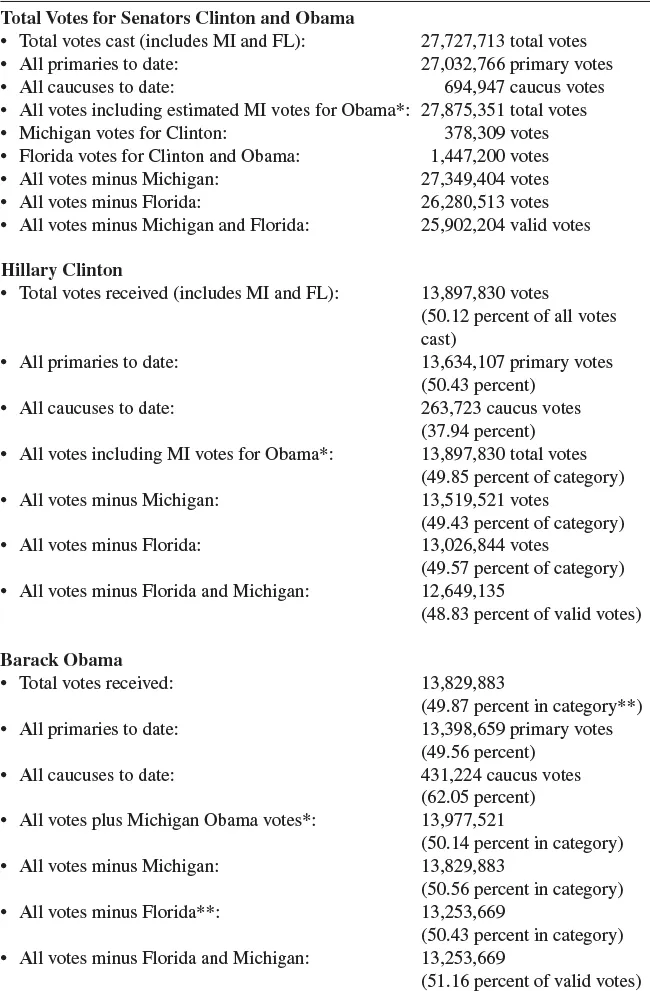
I write this early on Tuesday March 11, 2008 in the morning, before the Mississippi primary.4 A quick analysis of voting numbers shows Senator Obama leading in number of primary votes 51 percent to 49 percent. When Florida and Michigan are added to the primary vote count, Senator Clinton is leading in votes cast. But let us review this issue more closely.
Senator Clinton won Michigan with 55 percent of the vote. In an uncontested election, you would hope she would do better than slightly more than half. With no other name on the ballot, with her high-profile status, and with the “momentum” of her early New Hampshire victory, that 55 percent is not very good. The current spin on this result is that “you run against uncommitted, that is the toughest election to win” (Rendell 2008).
Regarding Florida, as a resident of the state I was aware that Clinton was campaigning here (Scott, A. 2008). The number of times that she was in the area doing “fundraising events,”—some of which in fact could only be interpreted as political rallies for which people paid a small fee to attend (Schumacher-Matos 2007)—and her many other visits for various reasons were significant. No other Democratic candidate spent more time in Florida before the primary (and none—not even her—after the primary and before the nomination), and she headed a primary victory party in the state (Liasson 2008). Bending the rules seems to be part of her campaign strategy, and we have had enough of rule-bending presidents.
The reality is that Senator Obama leads at this time in valid votes cast in primary elections and in caucus elections, and he leads in pledged delegates and states won (table 1). The argument that the states that Senator Clinton has won are, in essence, “more equal” than Obama’s is specious. When Governor Rendell says that Senator Clinton has won in states that constitute a total amount of electoral votes greater than the states won by Senator Obama he makes a point. But, is he really suggesting that these states (for example, New York) will not be in the Democrat column come November unless Clinton is the nominee? He claims that many of the states Senator Obama has won will likely represent Republican Electoral College votes, and in many cases this may be true. It will almost certainly be true with Clinton against McCain, but it is not so clear with Obama against McCain. Obama, for example, won the South Carolina primary—a traditional red state—with a number of votes for all Democrats greater than the aggregate Republican vote for the same state early in their primary process.5
Senator Obama has changed the rules of campaigning, attracting new voters, minimizing personal attacks, reaching out to outsiders, reestablishing fundraising patterns, and generally campaigning to position his own credibility as a leader without attempting to diminish the stature of his opponent. Senator McCain seems to have noticed this campaign style, and has sometimes tried to emulate it. These are the new rules of the game. On the other hand, by refusing to recognize this electoral national sentiment, Senator Clinton’s tactics at this time could be working to destroy an opportunity to seize a chance at a new era in politics for the Democratic Party. If she becomes the Democratic nominee, her focus on her husband’s style of half-plus-one politics will make Senator McCain the next president of the United States, as disenchanted new Democrats will skip the polls or will vote for Ralph Nader.
Open Letter to Senator Obama
March 26, 2008
Shortly after the Super Tuesday debacle for Senator Clinton (February 5), and after a string of wins by Senator Obama in small caucuses and states, the Reverend Wright issue came to the forefront. Despite the fact that some of these videos had been around for a while by then, their existence was brought into the spotlight at this time, with the Republican nominee already selected and with Senator Clinton behind in the Democratic race. No one knows for sure who was responsible for the high exposure of the “revelations.” It could have been conservative pundits or conservative media, which certainly did give great exposure to Rev. Wright’s videos and sound bites; it could have come from the Republican side, beginning their Rovian tactics; or it could have come from Clintonites in Chicago. In the end, Rev. Wright used this limelight to burn up his fifteen minutes of fame, revealing himself as an anachronistic throwback to the black activism of the sixties, frozen in time and ideas. He has not understood the changes that have grown around him, using the pulpit for self-aggrandizment and dismissive of the possibility of Senator Obama’s election. The Rev. Wright issue was the beginning of more subversive attacks on Senator Obama, as Senator Clinton’s campaign went from front-runner status to a fight for survival.6
Table 1 Summary of Primary Voting Results as of March 11, 2008 (Not Including Mississippi)
Notes
* Estimated attributed Michigan vote is 25 percent of votes cast in the primary (Total votes in MI 590,553; attributed to Senator Obama: 147,638 votes). Senator Obama has not gathered less than 25 percent of the vote in any primary held to date.
** Michigan not included as Senator Obama was not on the ballot.
*** This difference at certification for the Denver convention was 67,947 votes.
Source: CNN Election Center (all counts updated to final certified results)
At that time, I wrote an open letter to Senator Obama and emailed it to friends, family, and others, including Senator Obama’s own “personal” campaign email address.7
Dear Senator Obama:
I do not really expect you to read this letter at this time, and I certainly do not expect to receive any acknowledgment for it. Still, I need to write it. You must have heard it already many times, but it bears repeating that—framed within the objective of refocusing bias, prejudice and racism into a discussion on how to communicate about each other’s fears, misconceptions and stereotypes—your Philadelphia Race Relations “A More Perfect Union” speech encourages a national self-introspective process that is part and parcel of what leadership is all about; and I wholeheartedly believe that this process is good for America.8
As an American born abroad, and having lived many years in Latin America, I have personally experienced these types of cultural gaps and ideological misconceptions regarding our country; the kind of gaps and misconceptions that have created a World view of America from abroad to which our country sometimes seems witless.
The mainstream view in the U.S. that, although misunderstood by the World we are fundamentally good is, unfortunately, not entirely shared. Rev. Wright’s September 16, 2001 incendiary remarks about 9/11 that ended with “…the chickens have come home to roost,” are an echo from abroad and, as uncomfortable as they make us feel, they beget a discussion that we need to eventually have in America.
Senator Obama, I believe that your formative years in an environment not entirely unlike the one in which I was raised, allow you to understand these cultural gaps. The gaps generated by America’s modern “original sins.”9
The modern sins that the World at large generally holds us accountable for include the massive killings of civilians in a major dramatic strike on Hiroshima the morning of August 6, 1945 and, more unforgivably, in Nagasaki two days later, birthing the might of modern America for years to come. Outside America’s mainstream thought, these events are characterized as genocidal actions. The hundreds of thousands of deaths in the firebombing of Dresden and Tokyo in the middle of a few nights has not fully been addressed yet either, except in a superficial way. The trampling of children and villagers in South East Asia is still glossed over. To say that these actions were necessary to save American lives is not enough. It is also necessary to be candid about the fact that these actions killed innocent non-Americans, and that our sentiments and sympathies do go beyond a “collateral damage” rationalization, while suggesting the existence of second or third-class world citizens that can be bought off with a fist full of dollars.
We may not be ready for this discussion in America, and no leader may be able to politically survive an open discussion on these issues at this time. But, at some future point, the U.S. will have to apologize publicly and sincerely, atoning to the World just as Germany seems to continuously do for WWII and the Holocaust, and as Japan has begun, tentatively and vacillating, for its actions before and during WWII.
To end the increasing isolation and perceived arrogance of America, the dialogue may need to begin with a reckoning of some of our sins to the World. And, as Rev. Wright’s “unpatriotic” 9/11 statements shockingly reveal to us—and similar remarks with different phrasing occasionally come out from other public figures dismissively characterized as “extreme left” and “nuts” such as Rosie O’Donnell and Michael Moore—there is a need for an internal healing on this issue. Hopefully Senator Obama, given your Philadelphia speech, today we may be closer to the beginning of that healing process; we may be moving forward towards a more perfect union, not just in better touch with ourselves but also closer to the world around us.
Senator Barack Oba...
Table of contents
- Cover Page
- Half title
- title
- copy
- dedication
- ack
- fmchapter
- 1 The Democratic Primaries
- 2 Clinton vs. Obama
- 3 A Pair of Primary Issues
- 4 The Primaries are Over— Election Time is Here
- 5 One Nation Indivisible
- 6 The National Campaign (Finally) Begins
- 7 State of the Nation
- 8 The Debates
- 9 An Outward Look
- 10 The Elections
- Conclusions
Trusted by 375,005 students
Access to over 1.5 million titles for a fair monthly price.
Study more efficiently using our study tools.
Frequently asked questions
Yes, you can cancel anytime from the Subscription tab in your account settings on the Perlego website. Your subscription will stay active until the end of your current billing period. Learn how to cancel your subscription
No, books cannot be downloaded as external files, such as PDFs, for use outside of Perlego. However, you can download books within the Perlego app for offline reading on mobile or tablet. Learn how to download books offline
Perlego offers two plans: Essential and Complete
- Essential is ideal for learners and professionals who enjoy exploring a wide range of subjects. Access the Essential Library with 800,000+ trusted titles and best-sellers across business, personal growth, and the humanities. Includes unlimited reading time and Standard Read Aloud voice.
- Complete: Perfect for advanced learners and researchers needing full, unrestricted access. Unlock 1.5M+ books across hundreds of subjects, including academic and specialized titles. The Complete Plan also includes advanced features like Premium Read Aloud and Research Assistant.
We are an online textbook subscription service, where you can get access to an entire online library for less than the price of a single book per month. With over 1.5 million books across 990+ topics, we’ve got you covered! Learn about our mission
Look out for the read-aloud symbol on your next book to see if you can listen to it. The read-aloud tool reads text aloud for you, highlighting the text as it is being read. You can pause it, speed it up and slow it down. Learn more about Read Aloud
Yes! You can use the Perlego app on both iOS and Android devices to read anytime, anywhere — even offline. Perfect for commutes or when you’re on the go.
Please note we cannot support devices running on iOS 13 and Android 7 or earlier. Learn more about using the app
Please note we cannot support devices running on iOS 13 and Android 7 or earlier. Learn more about using the app
Yes, you can access Campaign Journal 2008 by Carlos Rangel in PDF and/or ePUB format, as well as other popular books in Politics & International Relations & Politics. We have over 1.5 million books available in our catalogue for you to explore.