- 175 pages
- English
- ePUB (mobile friendly)
- Available on iOS & Android
eBook - ePub
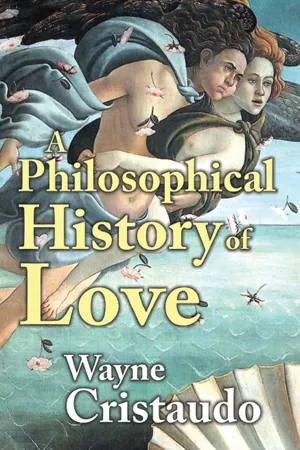
A Philosophical History of Love
About this book
A Philosophical History of Love explores the importance and development of love in the Western world. Wayne Cristaudo argues that love is a materializing force, a force consisting of various distinctive qualities or spirits. He argues that we cannot understand Western civilization unless we realize that, within its philosophical and religious heritage, there is a deep and profound recognition of love's creative and redemptive power. Cristaudo explores philosophical love (the love of wisdom) and the love of God and neighbor. The history of the West is equally a history of phantasmic versions of love and the thwarting of love. Thus, the history of our hells may be seen as the history of love's distortions and the repeated pseudo-victories of our preferences for the phantasms of love. Cristaudo argues that the catastrophes from our phantasmic loves threaten to extinguish us, forcing us repeatedly to open ourselves to new possibilities of love, to new spirits. Fusing philosophy, literature, theology, psychology, and anthropology, the volume reviews major thinkers in the field, from Plato and Freud, to Pierce, Shakespeare, and Flaubert. Cristaudo explores the major themes of love of the Church, romantic love and the return of the feminine, the conflict between familial and romantic love, love in a meaningless world and the love of evil, and the evolutionary idea of love. With Cristaudo, the reader embarks on a journey not just through time, but also through the different kinds, origins, and spirits of love.
Information
1
Plato and the First Philosophy of Love
The evolution of the West is, inter alia, a synthesis of three main loves: love of wisdom (philosophy), love of God (the church), and romantic love, which eventually becomes the basis of the modern family and the source of endless “entertainment.”
To be sure, love of wisdom has largely dissipated now into science and administration, love of God into the means whereby the neighbor is not treated as an inferior or exploited. Romance has still largely been encapsulated in the marriage partner/life partner, although the large numbers of marriage breakdowns make a reassessment of that myth, and a more open and honest account of the needs and truth behind it, as pressing for us as it was for Flaubert, whose Madame Bovary so beautifully shows that romance is one of the last and most durable myths of the modern.
All forms of the expression of love are love’s means, not its ends: this is as true of God as it is of philosophy, as it is of the family. Love is violated whenever the form for the activation of love is taken as the source of love itself. Of course, the fundamental idea of designating love as the God, as the one God of love was meant to enable men and women to never lose their way. The name and the simplicity of his command was meant to keep ever alive the value and wonder of serving love. But it is impossible for us not to lose our way. And the name that activates so much glory, by that very fact inevitably finds itself covered in deeds of shame by those who fail to live up to love’s requirements, either through the rigidity and dogmatism and shortsightedness of their own understanding or else through their preference for more immediate ends, which have to do with loves that no longer care for the neighbor and the kingdom to come. The heart is what we take to heaven, and the futurity of heaven—the endless deferral unto death—makes it easy for the heart to follow a more immediate goal.
The moment human beings developed a method for their love of wisdom, philosophy was born. From philosophy the techniques for a systematic ordering of our understanding of the soul, the polity, nature, and the cosmos were first set out. The Western modalities of the organization of knowledge (which itself leads to an expansion of some types of knowledge) are fundamentally philosophical. Our technological and administrative and legal systems owe their potency to the systemic capacity that is philosophy’s greatest achievement—an achievement which is very general, and yet far greater than any single philosophical solution to any philosophical question. It was philosophy that created the university, philosophy that created theology, philosophy that enabled the systemization of legal codes (hence the enormous significance of the application of Aristotelian reasoning to the rediscovered Justinian law Code),1 philosophy that created the entire re-view of the structure of nature. In his Logic, Hegel had noted that the extent of the gamut of philosophy can be gauged not only from the fact that Newton was considered to be a great philosopher, but that the name of philosopher went down “as far as the price list of instrument makers.” “All instruments, such as the thermometer and barometer,” he continued, “are styled philosophical instruments.”2
Just as the breakthrough in modern science was seen as a philosophical breakthrough, so were the breakthroughs in modern systems of government—breakthroughs to be sure which built upon historical contingencies, but which, nevertheless, received important refinements by Locke, Montesquieu, and Rousseau that came to be inserted in the constitutions of the United States and France. Even Adam Smith’s case for economic efficiency being grounded in the free market was a philosophical argument which he developed while being employed as a professor of moral philosophy. But love is far older than philosophy, and philosophy is but one of its branches. Though love’s shards are everywhere, the love that finds its way into philosophy is a Greek love.
Even before the Greeks had written records of the gods’ presence, they had stone figures of worship. We might say that the capacity to range between earth’s stone and the gods’ who dwell in heaven points to the infinite power of the human imagination. Poetry had, however, been called to follow the song that moved through everything, including stones. Thus, in his The Goddess of Love: The Birth, Triumph, Death and Return of Aphrodite, Geoffrey Grigson speaks of the origin of the goddess of love, Aphrodite, long before she appears as an epic character: “She began as a conical stone, as if the symbol and the weight of a blind urge.”3
Aphrodite begins as a blind urge. But all the Greek gods display what Bernard Knox has called their “furious self-absorption.” “Each one,” he continues:
is a separate force which, never questioning or examining the nature of its own existence, moves blindly, ferociously, to the affirmation of its will in action…. To be a god is to be totally absorbed in the exercise of one’s own power, the fulfill-ment of one’s own nature, unchecked by any thought of others except as obstacles to be overcome; it is to be incapable of self-questioning or self-criticism.4
If Aphrodite does first appear as stone, it is suggestive of her relativity in the scheme of things, as is the fact that in Hesiod her birth is the result of Cronos having castrated his father, Ouranos, and throwing his testicles into the sea. She is born out of the foam that gathers around them in the sea. In other words, love is originally for the Greeks, a power born of other forces, not the source of creation.
The earliest fully developed philosophical expositions on love that we have are, of course, from Plato. In the Symposium, he indicates just how important he considers love to be, first by having Socrates say that “love is the one thing in the world I understand” (Symposium 177d) and second, by having the character, Eryximachus, complain that “not one single poet has ever sung a song in praise of so ancient and so powerful a god as love.”5 That is a very strong claim, and while it is open to dispute (Sappho, for example) it does alert us to the fact that Plato does think that he is dealing with a neglected force. Certainly the epic and, what we have of the tragic and comic traditions are far from offering paeans to love. For example, much of the Iliad deals with the power of love in one shape or other. But love is far from represented as a great good, and whereas the Symposium celebrates eros, in Homer it is love under the auspices of Aphrodite which occupies most of his attention. Moreover, through Homer we see what significance can be drawn from Aphrodite’s relationship to war. The evil of the Trojan War is born out of love, of the erotic love between Helen and Paris. It is the impropriety of love which tears apart kingdoms and households. Paris “offended Athena and Hera—both goddesses./ When they came to his shepherd’s fold he favored Love/ who dangled before his eyes the lust that loosed disaster” (Iliad 24:31–36). Aphrodite is an affront because she is a transgressive goddess. Athena, the protectress of cities and the bearer of urban manners, was offended because Paris had succumbed to a power that threatened to tear apart civility. Hera, the jealous wife of Zeus, was angry because Aphrodite tears husbands from their duty, thus leaving a wife vulnerable to warriors seeking booty. Hera’s and Athena’s hatred of the Trojans is a hatred of the energy (of Aphrodite) that leads men to violate the most fundamental law of civility toward strangers in peacetime. The destruction of Troy stems from Paris’s enchantment that led to the violation of that code of civility. Yet the power of this love and the potency of the beauty which causes it is so intoxicating that the old chiefs of Troy, when they get a glimpse of Helen “moving along the ramparts/…murmured to one another, gentle, winged words: Who on earth could blame them? Ah no wonder the men of Troy and Argives under arms have suffered years of agony all for her, for such a woman. Beauty, terrible beauty!” (Iliad 3:185–90). And Hera herself so single-minded in her animosity to the Trojans knows that the powers of Aphrodite can conquer even the will of the strongest of the gods. In her desire to manipulate Zeus, Hera asks for extra powers from Aphrodite. “Give me love,” she says, “give me Longing now, the powers/ you use to overwhelm all gods and mortal men!” (Iliad 14:421–22). And Aphrodite “loosed from her breasts the breastband,/ pierced and alluring, with every kind of enchantment/ woven through it. There is the heat of Love,/ the pulsing rush of Longing. The love’s whisper/ irresistible—magic to make the sanest man go mad” (Iliad 14:257–61).
But there are many layers of love in the Iliad besides the sheer power of sensuous beauty cast by Aphrodite: the Iliad demonstrates the love between husband and wife (nothing in the Iliad is more touching than the great scene on the ramparts between Andromache and Hector), just as it demonstrates love of fathers for their children, of comrades in arms, of love for the fatherland. And even though Briseis is but Achilles’s slave, Achilles can say: “Are they the only men alive who love their wives,/ those sons of Atreus? Never! Any decent man,/ a man with a sense, loves his own, cares for his own as deeply as I, I loved that woman with all my heart,/ though I won her as a trophy with my spear…” (Iliad 9:413–17). Indeed, it is no exaggeration to say that the Iliad is finally a tale not only of the danger and victory of Achilles’s rage but of love which lifts men above.
Achilles’s refusal to fight is overcome by his love of Patroclus and the further rage that he incurs with Patroclus’s death; Priam’s love for his son elevates his courage so that he will sneak into the Achaeans camp and implore Achilles to bury his son. Achilles, who says when Hector asks to swear a pact before the gods with him, that the victor will guarantee burial rites to the defeated, “don’t talk to me of pacts./ There are no binding oaths between men and lions/ wolves and lambs can enjoy no meeting of the minds/ they are all bent on hating each other to the death./ So with you and me. No love between us. No truce” (Iliad 22:309–13) changes his mind when he sees Priam face to face. The love which has raised Priam touches Achilles. Pity can only be expressed once the two have a common bond. Their mutual agony caused by their loss of their loved one is the link between these two men. That shared agony creates the space in the heart that rage only fills insufficiently. The animal in man bows before the love in man and the sign of this love is the concession of the burial rite. Death, as painful as it is, is far less painful than the knowledge that a loved one is left to nature’s elements and predators to be just a carcass like some animal.
Homeric love is always implicated in violence. And this is equally as evident in the Odyssey as the Iliad. The slaughter of the suitors at the end of the Odyssey is the slaughter of a loving husband protecting his property and avenging the humiliation of his wife, his son, and family name. If Odysseus’s name was ever associated with ending the Trojan War through the ingenious act of duplicity behind the creation of the Trojan horse, it was equally associated with the tenacity of his love which enabled him to avoid the entrapments which would leave Penelope and Telemachus the victims of the desires of strangers. It is only by combining his heroism and nimble wits (the man of nimble wits is his Homeric epithet) with his role as avenger that he is the complete man—unlike Achilles, Odysseus is not just a man of the past, not just someone who exists for war, but also for peace. But Odysseus is no more able to end violence than Achilles; not only that but through their loves both invariably fuel violence.
It is no exaggeration to say that the single-most overwhelming problem that confronts Plato and Socrates is the seemingly ceaseless violence of the world they inherited. The immediate backdrop to Plato is Socrates’s execution, but the larger backdrop to both men is the Peloponnesian war and the violence between the Athenian dictatorship and the democracy. All of Plato’s incursions into politics are an attempt to find the harmony that Athens has lacked under dictatorship and democracy. And while a number of twentieth-century critics such as Popper and I. F. Stone highlighted how antidemocratic Plato was, the fact is that from his perspective the difference between the dictatorship and democracy was not so clear cut—the dictatorship threatened to kill Socrates, the democracy did so. Thus, did he seek to find a basis for politics which could avoid the pathologies of tyranny and democracy.
Along Girardian lines, one might add that Plato fathomed that the violence endemic to tyranny and democracy was due to their mimetic madness. The mimetic link between tyranny and democracy is most clearly brought out by Plato in the Gorgias where he argues that the most important capacity (he refuses to honor this “occupation of a shrewd and enterprising spirit” with the word art [Gorgias 463]) for winning power in the democracy, rhetoric, is the means by which the soul gradually deteriorates as it imitates the imitator who has already lost any proper sense of truth.6 Thus, he has the urbane teacher of oratory, Gorgias, who seems to be completely oblivious to the psychic poison he is spreading, be followed in ascending order of degeneracy and shamelessness by Polus and Callicles. After having demonstrated that Gorgias himself wants to teach what is right and just, but is unable to do so because he only knows how to teach the “routines” of rhetoric, he enters into discussion with Polus who is learning from Gorgias how to command a crowd. The issue, for Socrates, is what he will sway them for. For Polus, it is self-evident that orators are “the most powerful in their cities” (Gorgias 466b), and that means, “like tyrants, [being able] to put to death any man they will, and deprive of their fortunes and banish whoever it seems best” (Gorgias 466b–c). Further, Polus is puzzled that Socrates would not want to become a tyrant, for being a tyrant he could do whatever he wills, mainly to do what one pleases, which means “to kill, to exile and to follow my own pleasure in every act” (Gorgias 469c). In the course of defending oratory, Polus has found himself defending the life of tyranny, and to prove his point that the tyrant is happy he takes the case of Archelaus, the son of a slave woman. Had he acted justly, Polus points out, he would still be a slave, but he sent for his master and uncle,
ostensibly to restore to him the power of which Perdiceas [his father and the brother of Alcetas] had deprived him, and then entertained the man and his son. Alexander, who was his own cousin and about his own age, and after making them drunk he flung them into a wagon, took them away by night, and made away with them by murder…a little later, so far from wishing to become happy by justly bringing up the rightful heir to the throne, his own brother, the legitimate son of Perdiceas, a child of about seven years, and restoring the throne to him, he threw him into a well and drowned him, and then told the child’s mother, Cleopatra, that the boy had fallen in and killed himself while chasing a goose. …and I suppose there are other Athenians besides yourself who would prefer to be any Macedonian rather than Archelaus. (Gorgias 471)
For Polus, then, it is self-evident that this kind of behavior far from being something that the Athenians would find repellant is a source of envy. What Polus reveals as the real objective of oratory—to assist one in being able to become a tyrant—is also held to be the case of that kindred pseudoart or “knack,” sophistry, in the Theages, a dialogue which may not have been written by Plato but whose sensibility is thoroughly Platonic. In that dialogue Theages is led by Socrates to concede in passing that he might pray to become a tyrant “as I think you and everyone else would.”7 Mark Joyal in his commentary and critical edition of the Theages states that the idea that happiness is personified in the tyrant was a belief that Greeks probably shared, and in the popular imagination tyrants stood only one step below the gods.8
Unlike Callicles, whom Ancient rumor had it may have been Plato’s depiction of his future self had he not met Socrates, both Theages and Polus are prone to the great social mechanism of shame. And thus, while if circumstances perhaps enabled them to be tyrants, they would indeed have become the murderers and pillagers they admire, deprived of opportunity, they go along with the demos’ (or the weak if we follow Callicles) more conventional moral evaluations. In the case of Polus, Socrates is able to get him to agree to the argument that it is better to be wronged than do wrong—an argument completely at odds with his earlier position. This only serves to show how desire is mimetic and how a man like Polus could just as easily end up a just man as a tyrant—everything depends upon who he imitates. Indeed, this is the whole point of philosophy for Plato, that it is the one practice which imitates what is most valuable and good—the good itself. The philosopher pursues the eternal forms because they, unlike the confused opinions of the mob, and the confused representations of people who have imitated confused imitators (the orators, sophists, and poets) who deal in shadow realities, provide what is genuinely worthy of imitation. And this is also why in the Republic, Plato presents the dramatic imitation of Socrates in the person of Glaucon, who is the one discussant who can follow him all the way into an understanding not only of the good city, and the good life, but who understands how important it is to see that the cosmic order is also just. If one does not bother imitating the best, one might very well be imitating the worst. Though Plato goes even further—the real alternative is between the life of a philosopher or a tyrant. For it is those poles that provide the starkest models to be imitated. The average man who is caught in-between reason and passion, who now and then has true opinions only to lose them to a more cloudy and dangerous view of life, has no real control over his life. The tyrant has the least control but at least he gets what he wants—the absolute appearance of the good, the phantasmic which will ultimately devour him. The tyrant is a tyrant by virtue of being ready to do anything to achieve his desire, but he seals his doom for Plato because he shows another how to be a tyrant. If a tyrant could completely love and pleasure himself, he might be able to escape the ever possible end that awaits him—being murdered by whom he desires. Either, the tyrant will be overthrown by someone just like him, or, what is not much better, live pent up, needing to observe every plot and conspiracy, never knowing who to trust, in perpetual fear of that very occurrence (cf. Gorgias 510–11; Republic 511ff.).
It has often been argued that the Republic is an anti-utopian work, particularly (though not only) by Leo Strauss and those of his school, and that the political ideas of the Republic that deal with political and social organization and control are being held up to ridicule by their inventor. The fact that Plato suggests the city be handed over to ten-year olds strongly suggests that the philosophically ruled city will be impossible to realize. Yet, I think that to concede the ideal city is impossible to actualize is a very different issue from the idea that he does not really believe in the value of the political ideas expressed therein. What I think interpreters like Leo Strauss and his student Allan Bloom who run this argument neglect is the dire nature of the social and political realities confronted by Plato. The very fact that he would return to the problem of founding a city and providing a constitution in such elaborate detail as he does in The Laws is indicative, I think, of the urgency behind Plato’s political writings. Plato’s own writings on politics from the argument that philosophers should be kings to his philosophically detailed outlined constitution (which would be a mixed constitution) are all motivated by the terrifying brutality and overwhelming failure of the Greek city stat...
Table of contents
- Cover
- Half Title
- Title Page
- Copyright Page
- Dedication
- Table of Contents
- Preface
- Acknowledgments
- Introduction
- 1. Plato and the First Philosophy of Love
- 2. The Love of Christ
- 3. The Loves of St. Augustine and the Church: Religion plus Philosophy plus Politics
- 4. The Medieval Return of Venus
- 5. Dante’s Divine Comedy: The Heavenly Romance
- 6. Love in the Family and Its Dissolution
- 7. De Sade and the Love of Evil
- 8. Charles Sanders Peirce and Love as Evolutionary Principle
- Conclusion
- Index
Trusted by 375,005 students
Access to over 1.5 million titles for a fair monthly price.
Study more efficiently using our study tools.
Frequently asked questions
Yes, you can cancel anytime from the Subscription tab in your account settings on the Perlego website. Your subscription will stay active until the end of your current billing period. Learn how to cancel your subscription
No, books cannot be downloaded as external files, such as PDFs, for use outside of Perlego. However, you can download books within the Perlego app for offline reading on mobile or tablet. Learn how to download books offline
Perlego offers two plans: Essential and Complete
- Essential is ideal for learners and professionals who enjoy exploring a wide range of subjects. Access the Essential Library with 800,000+ trusted titles and best-sellers across business, personal growth, and the humanities. Includes unlimited reading time and Standard Read Aloud voice.
- Complete: Perfect for advanced learners and researchers needing full, unrestricted access. Unlock 1.5M+ books across hundreds of subjects, including academic and specialized titles. The Complete Plan also includes advanced features like Premium Read Aloud and Research Assistant.
We are an online textbook subscription service, where you can get access to an entire online library for less than the price of a single book per month. With over 1.5 million books across 990+ topics, we’ve got you covered! Learn about our mission
Look out for the read-aloud symbol on your next book to see if you can listen to it. The read-aloud tool reads text aloud for you, highlighting the text as it is being read. You can pause it, speed it up and slow it down. Learn more about Read Aloud
Yes! You can use the Perlego app on both iOS and Android devices to read anytime, anywhere — even offline. Perfect for commutes or when you’re on the go.
Please note we cannot support devices running on iOS 13 and Android 7 or earlier. Learn more about using the app
Please note we cannot support devices running on iOS 13 and Android 7 or earlier. Learn more about using the app
Yes, you can access A Philosophical History of Love by Wayne Cristaudo in PDF and/or ePUB format, as well as other popular books in Philosophy & Medieval & Renaissance Philosophy. We have over 1.5 million books available in our catalogue for you to explore.