The books seeks to examine changes in the U.S.--literary, aesthetic, and social--as represented in novels set in an environment where the gamut of ethnicities and their often differing views of literature and culture that make up the U.S. are more generally found, using the theories and concepts of Mikhail Bakhtin, particularly his concept of the chronotope, or spacetime.
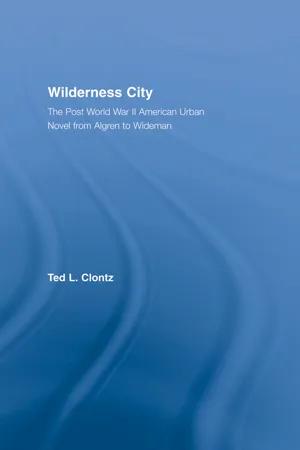
eBook - ePub
Wilderness City
The Post-War American Urban Novel from Nelson Algren to John Edger Wideman
- 180 pages
- English
- ePUB (mobile friendly)
- Available on iOS & Android
eBook - ePub
Wilderness City
The Post-War American Urban Novel from Nelson Algren to John Edger Wideman
Chapter One
Nelson Algren’s No Exit: The Urban Jail
Nelson Algren’s novel The Man with the Golden Arm made a literary splash upon its appearance in 1947, winning the first National Book Award. As critics such as James Giles have pointed out, the work represents a departure from the naturalism practiced in Algren’s earlier work, and it incorporates contemporary French influences from Celine (the dark humor) and from Sartre (the existentialist tinge of the work that also has much in common with Algren’s friend Richard Wright). In this, it differs from two other urban novels that attracted attention in the immediate postwar years, Willard Motleys Knock on Any Door, which is very decidedly naturalistic in a social protest vein, and Ann Petry’s The Street, which is decidedly realistic in conception and execution. The revolutionary nature of The Man with the Golden Arm is illustrated in content and style, beyond Algren’s incorporation of French influences. Part of this revolutionary nature can be seen in Algren’s use of a junky as the main character, a figure who would become almost a trope in postwar literature and film. Change can also be seen in his treatment of what Rotella sees in October Cities as “encapsulat [ting] the transformation of the urban village” (62). Similarly, in a linguistic vein, he uses terms such as “squares” and “cats,” among others, a jazz-based argot that would become more widely popularized in the next decade with the coming of the Beats. Indeed, Maxwell Geismar characterizes Algren’s language as “rich, if not ornate with the idiom of punks, cranks, and petty gangsters” (191) and asserts that “[t]he true comparison of Algren’s work may be with jazz or bebop, or rock and roll” (192). That these characters use this idiom hints at their relative isolation and ghettoization in relation to mainstream culture, just as bebop was in prewar U.S. culture.
Algren’s characters are caught between the disruptions of war and a changing urban environment. In his study, Rotella sees The Man with the Golden Arm, along with Algren’s short story collection The Neon Wilderness and book-length prose poem Chicago: City on the Make, as constituting important documents of the decline of the industrial city, of which Chicago was a prime example, in the aftermath of World War II. For Rotella, these works are narratives of decline, the decline of the inner-city that would, perhaps, reach its nadir in the 1960s and 70s. The urban villages of ethnic immigrants, documented by the sociologists at the University of Chicago, thrived off the industrial city and would slowly begin giving way before the vanishing urban industrial base and programs of urban renewal. These neighborhoods produced material for a naturalistic Chicago literary tradition that included writers such as James T. Farrell, Richard Wright, and, of course, Algren. To use the temporal metaphor found in Rotella’s title and taken from Golden Arm, these neighborhoods are in their autumn of life. Algren’s characters were born into the novel’s world before the disruptions of the Great Depression and World War II; their time-space, or chronotope, in Golden Arm is one that lies between specific cultural eras. Algren was much more interested in these characters’ isolation from mainstream culture, and despite the resonance of Rotella’s metaphor for urban change, they have always existed in an October city, a gray area outside the temporal rhythms and spatial habitats of mainstream culture. Unlike the protagonists of prewar immigrant literature, the lumpenproletariat of Algren’s novel, the children of these immigrants, live lives cut off from the temporal and spatial representations of capitalism, both middle class and working class. The characters’ existence in such temporal and spatial isolation contributes to the unique aesthetic qualities of Algren’s novel. Frankie Machine exists as a homeless wanderer, ironically rooted in a specific place; he is much like the protagonist in Wright’s Native Son without Bigger’s self-awareness. All in all, the characters exist outside what would be considered normal social conceptions of time, in a strange timelessness, as they do jail time in an urban prison. Golden Arm, therefore, exists as a transitional piece of literature, bridging the prewar naturalist, realist, and even modernist visions of the urban environment with works that would come later.
Algren’s novel is contemporaneous with film noir, a genre which shares many of the same qualities as Golden Arm, thereby offering an interesting way of examining the qualities of Algren’s work. Always generating controversy between those who champion or deny its existence, film noir has resisted easy classification of time period or iconography. Most would agree that noir generally represents, somehow, changes in American society during and after the war years. Using Bakhtin’s chronotope, Vivian Sobchack concludes that homelessness and rootlessness are the primary themes of these films. She thereby comes to the following conclusion about the spatial aspects of noir:
These radical grounds and material premises figured concretely before in and to which we should pay heed are the cocktail lounge, the nightclub, the bar, the hotel room, the boarding house, the diner, the dance hall, the roadside cafe, the bus and train station, and the wayside motel. These are the recurrent and determinate premises of film noir and they emerge from common places in wartime and post war American culture that, transported to the screen, gain hyperbolized presence and over determined meaning (130).
The description of the common places of noir resonates with the spaces that the characters of Algren’s novel inhabit: Antek’s Tug and Maul bar, the rented rooms guarded by The Jailer, Schweifka’s card game, and, above all, jail. For a novel set in such an urban environment, Golden Arm’s true oddity lies in the fact that so little of the important action of the novel takes place in the openness of the street, a point to which we shall return later.
Sobchack further describes these claustrophobic, interior spaces as ones that “exist both in the city and the small town where they concretize an existential world in which… ‘there is no place like home’” (137). Furthermore, “these quasi places… substitute perversely for the hospitable and felicitous places and domesticity of a ‘proper’ home in which such quotidian functions as sleeping and eating and drinking are secured and transfigured into intimate social communion” (138). On the other hand, the spaces of noir “substitute impersonal, incoherent, discontinuous spaces and rental space for personal, intelligible, unified and generated space.… They spatially rend and break up the home and continuity, family contiguity, and generational contiguity” (58). The environments of noir “generally all refuse individual and intimacy (as they encourage individual isolation and secrecy)” (139). Sochack sees the bars, boardinghouses, and other structures “as constituting the temporalization of what [she] call[s] loungetime” (156). This perception of time rests outside what most consider normal and therefore, in Bahktin’s terminology, becomes the narrative knot tied and untied by the chronotope present in noir. Especially considering that the films that constitute noir generally present a dark view of humanity lacking redemption, the spaces “that constitute loungetime emerge in their historical coherence as threats to the traditional function, continuity, contiguity, and security of domestic space and time” (157). Furthermore, Sobchack states that “[t]he cycles and rituals of family continuity and generation have no places, and therefore no temporal articulation,” in movies that critics label as noir (158).
The characters in Algren’s novel also spend their time in bars, back-alley gaming rooms, and rented rooms. Algren’s aesthetic and ideological choices in portraying the lowest of the low force him to use similar spaces to define the hopelessness of the characters’ existence in Golden Arm. These spaces are above all claustrophobic, the “hermetic spaces” Sobchack points out in her definition of the noir chronotope, and these characters, as James Giles points out, “endure a submerged, claustrophobic existence” (Horror 57). But while Sobchack offers noir as a manifestation of housing shortages and the rootless disruption caused by war, Algren creates a broader vision concerning his characters and their place in American culture within these claustrophobic spaces. Algren makes clear the sense of homelessness and trapping spaces early in the novel, during the first jail scene. Here, as Frankie “Machine” Majcinek, a small-time card dealer, veteran, and opium addict, and Solly Saltskin, known as Sparrow, a petty crook and dog-napper, mingle with the other prisoners, the narrator steps outside the characters’ perspective to describe the ultimate homelessness of these men in American culture. They share the “secret and special American guilt of owning nothing” and “no longer felt they had been born in America” but “had merely emerged from the wrong side of its billboards” (17). This passage constitutes the harshest, most explicit critique of American culture and society found within Golden Arm; it represents men left homeless beyond the mere lack of domestic home space, of disenfranchised men left spiritually homeless and forgotten. Algren uses some of the scenic trappings of noir to present a harsh general attack on American realities in the postwar world. The war may be over, but nothing substantially has changed for the characters Algren creates. They remain imprisoned in their urban environment where the coming postwar prosperity will never find them.
The characters in Man with the Golden Arm live in domestic spaces and relationships that are far from those considered the norm by the bulk of society. If, as Giles has asserted, these characters can be read as urban grotesques, as Algren’s “idiosyncratic vision [s] of grotesque characters” (Fat Man 97), and that “their grotesque behavior” is written in “a prevailing mode of Absurdist humor” (Fat Man 100), then their domestic relationships exist as a grotesque, not always humorous parody of the typical domestic relationships exemplified by the middle-class mythos. The central “domestic” relationship in the novel is between Frankie and his wife Sophie, or Zosh as he calls her. The relationship between these two rests more on emotional and psychological bondage and guilt rather than any sense of intimacy or support. They live in a rented space, far from the comfortable home of middle-class life and ruled over by Schwabatski the Jailer, who respects the relationship between the two because they fight in private with the door closed. The Jailer delivers his ironic analysis of their relationship, one that Violet repeats later in terms of them wanting to, but not knowing how to “love each other” (32).
Sophie clings to Frankie because she fears the feelings of loneliness she has experienced since childhood, of finally being left “alone in a room like this small room with no one of her own near at all” (33). Her relationship to Frankie, then, is an attempt to escape the metaphorical prison of her being by imprisoning him. Her grotesque view of such relationships as the one she has with Frankie is found in her somewhat delusional comments on the Drunkie John—Molly Novotny relationship as the height of her eventual psychosis nears: “If he loves her, what are a few blows?” (313). The only relationship of which she can conceive between men and women is one of ownership and of use, no matter what physical abuse might go along with this grotesque vision of romantic love. Considering the destitute nature of Algren’s characters, they can only conceive of relationships of ownership. Without the resources granted the upper, middle, and even working classes, they use each other like a natural resource.
Sophie’s own form of personal exploitation is to use Frankie’s guilt-perplexed nature to trap him in a relationship. The fights that frequently occur when Frankie comes back home to their apartment usually result from Sophie trying to force Frankie to pay her more attention, to break her feeling of isolation. The fights stress the lack of domestic social communion and present a grotesque parody of a mutually supportive relationship. The parody reaches its zenith when, in place of the small pup she wants to keep her company, Frankie gets her Rumdum, the hound Sparrow has trained to drink beer and growl at squares, in this case anyone in uniform or anyone the dog senses as holding a regular job. With the addition of Rumdum, the trio, save for the lack of a child, comprise a sort of a parody of the culturally traditional middle-class domestic unit. Frankie, in turn, uses Sophie as one of the crutches to feed his guilt.
Nor is their relationship unusual. None of the characters in this work have anything like the type of domestic relationship Sochack describes in terms of connection to and between home, family and generations. Like the relationship between Frankie and Sophie, the relationship between Drunkie John and Molly is built on use, the only exception being that the exploitation seemingly goes only one way. Although Molly is very young and John is “close to forty,” she supports them both. In addition, she must sit and listen to John as he tells her “all the things she had done wrong since morning” without receiving anything but kicks in return (27). Although Giles has contended that the portrait of Molly is a little too one dimensional in that she represents a false vision of the past for Frankie, his missed or unrealizable opportunities, it is just as likely that her lack of dimensionality results from her lack of a sense of self which would give her more depth as a character. The lack of a sense self would explain why she puts up with Drunkie John and sees hope for a better life in Frankie that does not really exist. Molly continually becomes trapped in situations that go nowhere.
The relationship between Violet and Stash is no better. Stash best represents the vanishing Polish immigrant culture, the “ethnic order, dominated by European immigrant groups that came to work in industrial Chicago in great numbers in the late nineteenth and early twentieth centuries” (Rotella 41). Clearly, Stash has a different set of values than his much younger wife Violet, saving money by buying moldy bread and stew. Until the Battle of the Sandwich, he firmly believes his thrift constitutes the reason Violet married him. To a certain degree, he is right. Their relationship is a subterranean battle for control of their domestic space, as well as his money for which she married him. But when Stash finally succumbs to his obsession with the current temperature by falling out the window, she tires of her lover Sparrow as well, in part because he cannot support her. Once again, these relationships demonstrate a pattern of use and abuse that partially mirrors Carla Cappetti’s comments: “In Algren’s Polish ghetto… [there are] those who live by their old-world truth—pathetically obsolete in the new world and oblivious to the surrounding reality—and those who have adapted to the dominant values of the new world—exploitation, cheating, theft, corruption—and of the city—the law of the jungle, survival of the fittest” (170). Similarly, Stash’s downfall symbolizes the downfall of the Polish immigrant culture, the values to which Cappetti points, and to the urban villages in Rotella’s industrial city, but it is just one of facet of these characters’ urban existence.
Other relationships in the novel, between Antek (the Owner) and his wife and between Violet and the Jailer, seem little better. Antek’s nickname of Owner proves to be a mere façade because, as the reader eventually comes to realize, his wife actually owns the bar, and whenever Antek partakes too much in the stock, she locks him out. When they appear together in the novel, their relationship appears cool, without any real nurturing or understanding between them. On the surface, the eventual relationship between Violet and the Jailer would seem to be that of mutual support, seeing as they have given up drink, have started going to church, and now can be found handing “out literature on Milwaukee” supporting some cause (323). Considering that Frankie is hearing this description through Antek and considering Violet’s past, however, such implied reform seems more likely an Algren parody of the straight lifestyle, one that excludes Frankie and the rest. After her relationships with Stash and Sparrow, Violet has finally found a situation, through the Jailer, where she is in control while being economically supported. The only relationship that approaches an intimate, growing one is the one between Frankie and Molly, and, ironically, he only realizes this moments before the police arrive to break up their “home,” realizing that, “it wasn’t just taking without giving” (326). Still, this is a picture of a relationship based on mutual dependence, hardly that much different from the one between Frankie and Sophie. The differentiation comes in the attitudes of each character toward the relationship: There is a level of giving between them. But considering that Frankie has yet to deal with his guilt and that Molly seems to be spiraling downward toward prostitution, this moment in the relationship should be treated ironically, as the unreal flipside of the grotesque romanticism of Sophie. A true communal, nurturing relationship exists nowhere in this novel; there is no true home in that sense for these characters.
Although Golden Arm shares much in its spatial aspects with film noir, it differs from noir in chronicling the denizens of a particular locality, the Chicago, in particular Polish, ethnic neighborhoods. Even though he leaves the neighborhood to serve in the Army, Frankie is much like the character Bruno “Lefty” Bicek in Algren’s previous 1942 novel, Never Come Morning. As Cappetti points out, for characters such as Frankie and Bruno, “The world… begins [and one might say ends] at the end of the block, wherever there is a change of accents, skin color, and faith” (161). Aside from the drug addiction and the wound, Frankie’s sojourn out of Chicago to serve in the war leaves little trace on him, except for giving him, through his opium addiction, a way to “escape from the perpetual consciousness of the contingency of his being” (Giles, Horror 60). He is so much a part of and tied to the neighborhood he inhabits that he is unable to leave it, and even when in hiding from the police and even after being wounded by a bullet to the heel, he still attempts to return to West Division Street. Therefore, the irony within the novel is that Frankie does have a home of sorts. His home is not any particular establishment, neither the bars nor the room shared with Sophie, but the neighborhood itself. Home and relationships tend to be spaces of imprisonment and so is the neighborhood.
But this neighborhood is not the same one that existed before the war. Elliott Podwill notes, “Many of [Algren’s] first-hand observations of the cultural isolation felt by Polish immigrants and the rootlessness of their Chicago-born children were confirmed by early studies by University of Chicago sociologists during the 1920’s and 1930’s (qtd. in Cappetti 154). The difference lies in the disappearance of that older generation and the neighborhood social order their presence implies, leaving only their rootless children. Frankie and Antek’s fathers belonged to this group of culturally isolated ethnics. As Antek says at the coroner’s inquest to the question of where Frankie’s father was born, “Poland, same as mine. Both dead a long time now” (339). Antek’s statement suggests the lack of generational continuity—the fathers are seldom mentioned—to which Sobchack points as characteristic of noir. And the only character within the novel who suggests this passing generation is the essentially comic figure of Stash. Furthermore, Frankie has no mother, having been raised by either a stepmother or foster mother. His relationship to her is clearly a sore point for him, one that Sophie uses frequently to torment him, pointing out that she refused to come to school when Frankie had been caught gambling, resulting in his being expelled. Frankie in turn points out that she was too embarrassed to appear at school because of her inability to speak English very well (37). Her shame in not being able to speak good English illustrates the cultural isolation of these ethnic communities. The fact that Frankie has lost touch with her, even though he feels she done her best, reinforces the lack of generational and cultural continuity and the isolation of the characters.
In his introduction to Henry Roth’s Call It Sleep, a work set in the ethnic neighborhoods of New York in the early years of the twentieth century, Alfred Kazin notes that it “is not a naturalistic novel, one in which character is shaped entirely by environment. Jews are generally so conscious of the pressure of history that it was a notable achievement for Henry Roth… to put character ahead of environment” (xiii). Looking at Kazin’s statement from another angle, one can see the traditions and continuity that exist within these neighborhoods of first-generation immigrants. In contrast, Algren’s characters lack the continuity and cultural support base that would allow them to hope to escape their situation. Being cut off from such support forces these characters to think only in terms of the current situation facing them, denying them a larger perspective and contributing to the claustrophobic feel of the novel. This lack of continuity is among the “signs of the contraction and dissolution to come” that Rotella claims to find the novel as implicitly treating, even though the system still appeared robust at mid century (58). This lack of continuity contributes to the trapped nature of the characters in Algren’s novel, in their horrid domestic spaces away from the cultural mainstream.
Two other points of comparison with Roth’s work help illuminate the characters’ situation in Algren’s novel, as well as the aesthetic choices he makes. First, Roth’s novel is told from the perspective of a young child, but in Golden Arm, children are almost totally absent. Aside fro...
Table of contents
- Cover
- Title
- Copyright
- Dedication
- Contents
- Acknowledgments
- Introduction
- Chapter One Nelson Algren’s No Exit: The Urban Jail
- Chapter Two Ellison and Pynchon: The Chaotic and Fabulous Cities
- Chapter Three Continuing to Redefine the Urban Time-Space
- Chapter Four Wilderness City
- Chapter Five Re-imagining the Postcolonial City
- Chapter Six John Edgar Wideman: Bringing It All Back Home
- Conclusion
- Notes
- Bibliography
- Index
Trusted by 375,005 students
Access to over 1.5 million titles for a fair monthly price.
Study more efficiently using our study tools.
Frequently asked questions
Yes, you can cancel anytime from the Subscription tab in your account settings on the Perlego website. Your subscription will stay active until the end of your current billing period. Learn how to cancel your subscription
No, books cannot be downloaded as external files, such as PDFs, for use outside of Perlego. However, you can download books within the Perlego app for offline reading on mobile or tablet. Learn how to download books offline
Perlego offers two plans: Essential and Complete
- Essential is ideal for learners and professionals who enjoy exploring a wide range of subjects. Access the Essential Library with 800,000+ trusted titles and best-sellers across business, personal growth, and the humanities. Includes unlimited reading time and Standard Read Aloud voice.
- Complete: Perfect for advanced learners and researchers needing full, unrestricted access. Unlock 1.5M+ books across hundreds of subjects, including academic and specialized titles. The Complete Plan also includes advanced features like Premium Read Aloud and Research Assistant.
We are an online textbook subscription service, where you can get access to an entire online library for less than the price of a single book per month. With over 1.5 million books across 990+ topics, we’ve got you covered! Learn about our mission
Look out for the read-aloud symbol on your next book to see if you can listen to it. The read-aloud tool reads text aloud for you, highlighting the text as it is being read. You can pause it, speed it up and slow it down. Learn more about Read Aloud
Yes! You can use the Perlego app on both iOS and Android devices to read anytime, anywhere — even offline. Perfect for commutes or when you’re on the go.
Please note we cannot support devices running on iOS 13 and Android 7 or earlier. Learn more about using the app
Please note we cannot support devices running on iOS 13 and Android 7 or earlier. Learn more about using the app
Yes, you can access Wilderness City by Ted Clontz in PDF and/or ePUB format, as well as other popular books in History & World History. We have over 1.5 million books available in our catalogue for you to explore.