- 188 pages
- English
- ePUB (mobile friendly)
- Available on iOS & Android
eBook - ePub
Philanthropists and Foundation Globalization
About this book
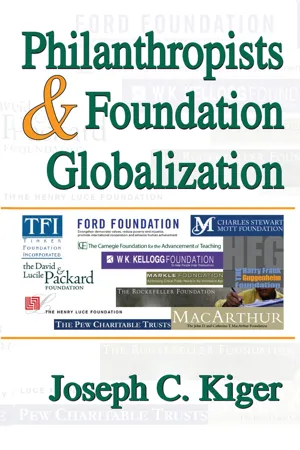
The modern American foundation as an instrumentality for charitable and philanthropic giving is in many ways a unique and complex social/economic/political institution. This is particularly the case for foundations with large assets. As a social phenomenon, the foundation has deep roots in the past. At the beginnings of any degree of civilization charitable giving and rudimentary forms of foundations emerge. This is the case in many regions of the world. The pattern is consistent: once enough property or wealth beyond primitive human needs is accumulated, some of it begins to be set aside for what the donors of such wealth consider worthwhile purposes.The serious literature contributing greatly to public perception of philanthropy and foundations has been relatively sparse. Much of what is available is quantitative and statistical in nature. There has been limited objective attention to the motives or reasons spurring individual philanthropists to engage or not to engage in creating foundations; such motivation needs historical and comparative analysis. Major investigations and studies of foundations, together with ancillary national, regional, and international organizations to facilitate such study, have received spotty consideration.Philanthropists and Foundation Globalization addresses three interrelated aspects of foundation history. First, it reviews biographical-historical profiles of the founding philanthropists and their heirs engaged in international giving. Second, it discusses major governmental and non-governmental investigations and studies of foundations including domestic ones, and also foreign ones in which U.S. participants have played a prominent role, spanning the period 1912 to the present. Third, it chronicles foundation developments and activities in Europe at the close of the twentieth century. The volume provides a historical account of some U.S. foundations' international activity in a particular region in a specific time period and their a
1
Peabody, Sage, Carnegie, and Rockefeller
Peabody
George Peabody rose from a poor background beginning with his birth on February 18, 1795 in South Danvers, Massachusetts. His hometown was later renamed Peabody in his honor in 1868. He started with little formal education and turned into a merchant-financial prince of international stature. In 1814 Peabody moved to Georgetown, in Washington D.C. and entered into a partnership with Elisha Riggs in a dry-goods business. A year later, the firm of Riggs and Peabody relocated to Baltimore, Maryland and Peabody started traveling on the firm’s behalf to Europe during the 1820s and 1830s. By then he had taken up permanent residence in London, although he later made six visits to the United States, and retained his U.S. citizenship throughout the rest of his life. During the 1830s he established George Peabody and Company, a very lucrative and successful enterprise dealing in foreign exchange and American securities. He was able to sell abroad the bonds of Maryland and other states at a considerable profit to himself. Thus, he gradually made the transition from merchant to banker during the years between 1837 and 1845, laid the foundation of his fortune, and from that time forward became the leading financial agent between the United States and England. In 1854 another New Englander, Junius Spencer Morgan, became a junior partner in the Peabody Company and made significant contributions to the financial success of the firm. His more famous son, J. Pierpont Morgan, began his banking career as the New York agent for the Company. This eventually led to the formation of New York’s J.P. Morgan Company and Morgan’s emergence as the dominant financial figure in the United States at the turn of the century.1 Thus, by the 1860s, Peabody had amassed a great fortune for that time running into the millions of dollars.
A key factor in Peabody’s financial success was his acknowledged integrity and honesty in his business dealings; another was the ease with which he moved into and established himself in the top circles of British society. In this same connection, he became a go-between in bringing prominent Americans coming to England into contact with these circles. Much of this was accomplished through lavish receptions and dinners he gave and his Fourth-of-July dinners that developed into a legendary feature of the social season in London.2 When he was in his forties, Peabody made a proposal of marriage to an American woman that was eventually rejected. After that, Peabody never again expressed any interest in getting married.3 His permanent bachelorhood, however, appears to have enhanced rather than detracted from his social dealings. Although throughout his life Peabody provided significant sums benefiting his relatives in the United States, his lack of direct familial ties, coupled with his financial and social activities, undoubtedly contributed to Peabody’s growing interest in devoting portions of his wealth to worthy causes. In the 1850s and 1860s he gave money for a variety of educational and scientific causes in the United States. The major ones included moneys for the establishment of Peabody Institutes in Baltimore, Maryland, and Peabody and Salem, Massachusetts, with amounts totaling $1,400,000; $217,600; and $100,000 respectively; and Peabody Museums at Harvard and Yale Universities, and Salem, Massachusetts, with funds totaling $150,000; $150,000; and $140,000 respectively. In addition, benefactions were provided for hospitals, churches, libraries, historical societies and other worthy causes in England, Europe, and the United States. It was the coming of and the aftermath of the American Civil War, however, that saw the emergence of Peabody as the founder of modern foundation philanthropy and, particularly so, in the international area. The awarding of this title to him was clinched by his setting up of the Peabody Donation Fund in 1862 and the Peabody Education Fund in 1867.
It should be emphasized at this point that, although a New Englander, Peabody’s previously mentioned financial and social activities had always crossed the increasingly sectional divide between the inhabitants of the northern and southern states of the United States. Peabody’s position vis-à-vis the coming of and the prosecution of the American Civil War has been aptly summarized as follows:
Peabody, who had, by temperament, an aversion to extremes of any kind, tried to keep aloof from the feverish partisanship expressed by the people about him, especially by his fellow Americans. He made an effort not to align himself with the abolitionists, though he privately accepted their humanitarian ideals, nor with the states’-rights group. As a result, he was often called a “traitor” by Northerners.
Personally he suffered greatly when hostilities began, and his mental conflict was very painful. As the war progressed, he supported the North, but he could never forget his many Southern friends nor fail to see their point of view....
The Civil War was particularly distressing for Peabody because, rightly or wrongly, he was convinced that the conflict should have been avoided.4
Peabody Donation Fund
For some time, prior to the beginning of the Civil War, Peabody had been considering making some gift for the betterment of the inhabitants of London where he had so long resided and prospered. He looked into an elaborate scheme to set up a water purification plant to pipe pure drinking water for Londoners to fountains located at various places in the city but eventually rejected that idea. A plan to provide educational aid for poor London children was also eventually rejected in favor of what was then considered a more pressing need: the building of improved housing for poor Londoners to replace some of the existing slums. The formal outcome of this plan in 1862 bore the title Peabody Donation Fund wherein Peabody named a small group of American and English friends as self perpetuating trustees, none of whom were then or since family members or related to him, and eventually the Fund consisted of a corpus of $2,500,000 provided by Peabody. The establishment of the Fund came at the time of the Trent Affair, a naval altercation between the United States, Britain, and the Confederate States of America and did much to soften a then hostile official and public attitude in England towards the United States.
The British Charity Commission arranged for the legal acceptance of Peabody’s gift that has been lauded by a student of English philanthropy as:
perhaps the most dramatic event in the history of Victorian housing. It originated in an act of individual philanthropy unparalleled in its time, and the donor attached almost no strings to his benefaction.... His purpose, as his letter to his trustees stated, was “to ameliorate the condition and augment the comforts of the poor” of London … this can still be regarded as one of the more original and productive philanthropies of a century that, with all of its humanitarian and charitable concern, was not conspicuously inventive in its philanthropy.5
At the time Peabody’s liberality was universally acclaimed in England and the press was one in acclaiming his action. For example, the London Times commented:
Many have bequeathed fortunes to charity posthumously, leaving behind what cannot be taken to the grave. But this man gives while he lives to those who can make no return. He gives a fortune so that one part of this vast, ill-built, ill-kept city, which the rich never see, will be more comfortable and respectable for the poor. He does this in a country not his own, in a city he may leave any day for his native land. Such an act is rare in the annals of benevolence.6
Queen Victoria offered him a baronetcy or the Grand Cross of the Bath which he declined but Oxford University awarded him an honorary D.C.L. and the City of London gave him many honors including the erection of a still existing imposing statue of him prominently located next to the Royal Exchange. Peabody had planned well and his Donation Fund was an initial and continuing success through the wise administration of his first and succeeding trustees. By 1882 the fund owned and administered some 3,500 homes; by 1914, 6,400; by 1939, 8,000; and, despite the ravages of World War II, they still stand as monuments to Peabody.
Peabody Education Fund
The Peabody Donation Fund was obviously motivated by his desire to help the poor inhabitants of the foreign city where he had resided and prospered for so many years and it was certainly international in character. His other major foundation, the Peabody Education Fund, established in 1867-1869 to aid the devastated post-Civil War Southern states, technically cannot be considered so. Yet such aid provided by him, while certainly falling within the war motive posited above, could also be viewed as a foreign activity. The Confederate States of America had operated as a separate country from 1861 to 1865.7 The philanthropic aid provided to the former German Democratic Republic by West German foundations beginning as early as 1989-1990 could be viewed as a contemporary analogue.8 In any case, because of its trailblazing character and influence on succeeding U.S. philanthropists, a description of the motive for, founding, method of operation, perception of, and effect of the Peabody Education Fund is provided here.
Following the establishment of the Peabody Donation Fund and prior to a visit to the United States in 1866, it appears that Peabody contemplated providing some similar form of aid for the same purpose for the poor of New York City. After arrival and conversations and correspondence acquainting him with the misery and poverty prevalent in the defeated Confederacy, however, Peabody decided that his aid was much more needed there. He also became convinced that such aid for education would be the best long-range solution for the South’s problems and, probably of equal importance to him, that such aid would contribute to sectional reconciliation following the Civil War and lead to a more reunified United States. His initial endowment of $1 million in 1867 established the Fund, coupled with an additional $1 million two years later, named sixteen distinguished Northerners and Southerners to a board of trustees to carry out its purpose. The Fund’s work was to be conducted through programs which eventually resulted in the setting up and operation of public and normal schools previously lacking in the Southern states. Prior to the Fund’s dissolution in 1914, its activities were capped in 1908 by the establishment in Nashville, Tennessee of the George Peabody College for Teachers. From that time down to the College’s merger with Vanderbilt University in 1979, the College was probably the preeminent institution of its type in the South.
When Peabody died in England in 1869, his death was universally mourned there and in the United States, particularly in the Southern States. As an early biographer of him noted: “The death was most sincerely lamented in all the Southern States, and called forth from the Press, from public authorities, from schools, from individuals, the tenderest expressions of gratitude and love.”9 Although burial in Westminster Abbey had been offered for Peabody’s remains by the Dean and Chapter of the Abbey and endorsed by Queen Victoria, his will specified that he was to be buried in Salem, Massachusetts. Consequently, a memorial service in the Abbey was held in his honor and Queen Victoria expressed a desire that Peabody’s coffin be transported to the United States by Britain’s newest and mightiest warship, the Monarch. There was some U.S. opposition to the proposal because it came at the same time as the diplomatic controversy over American claims for reparations as the result of depredations of the British-built Confederate warship, the Alabama. U.S. President Ulysses S. Grant eventually agreed to the Queen’s proposal, with the understanding, however, that the Monarch be accompanied by an American warship to the United States.
Peabody during his life had only a few detractors in England and the United States regarding his philanthropy: Benjamin Moran, Assistant Secretary of the American Legation in London, and William Lloyd Garrison, the prominent abolitionist New Englander. Moran appears to have been jealous of Peabody’s social and economic success and his easy access to successive ambassadors from the United States to England. He kept a secret diary in which he viewed Peabody as: “heartless, and has never given a farthing in charity that he did not expect three fold return. All his benevolence is based on future personal gain." Moran opined regarding the Peabody Donation Fund that “The appropriation of this Fund, arose from a selfish vanity solely, unattended by a shade of benevolence, and which will never benefit those for whose use it was so pompously announced to be intended.”10 Garrison, in an article following Peabody’s death and significantly entitled “Honored Beyond His Deserts,” stated that vanity was Peabody’s primary motive in giving, offered no praise for the creation of the Peabody Education Fund, and asserted:
During his long years in England he never once aided popular liberty or spoke against slavery. His sympathies were with the pro-slave South right to the outbreak of the rebellion. His patriotic record cannot be examined with any pride or pleasure.... He did not want the Union dissolved; neither did he want the South conquered. He wanted peace which would satisfy the South, leaving slavery i...
Table of contents
- Cover
- Half Title
- Title
- Copyright
- Contents
- Preface
- Introduction
- 1 Peabody, Sage, Carnegie, and Rockefeller
- 2 Harkness, Guggenheim, Mott, Markle, Kellogg, Mellon, Luce, and Ford
- 3 Investigations and Studies
- 4 Rockefellers, Jones, Pew, Starr, Tinker, Packard, and Hewlett
- 5 MacArthur, Soros, Templeton, Kerkorian, Turner, and Gates
- 6 Central and Eastern Europe
- 7 Conclusion
- 8 Index
Trusted by 375,005 students
Access to over 1.5 million titles for a fair monthly price.
Study more efficiently using our study tools.
Frequently asked questions
Yes, you can cancel anytime from the Subscription tab in your account settings on the Perlego website. Your subscription will stay active until the end of your current billing period. Learn how to cancel your subscription
No, books cannot be downloaded as external files, such as PDFs, for use outside of Perlego. However, you can download books within the Perlego app for offline reading on mobile or tablet. Learn how to download books offline
Perlego offers two plans: Essential and Complete
- Essential is ideal for learners and professionals who enjoy exploring a wide range of subjects. Access the Essential Library with 800,000+ trusted titles and best-sellers across business, personal growth, and the humanities. Includes unlimited reading time and Standard Read Aloud voice.
- Complete: Perfect for advanced learners and researchers needing full, unrestricted access. Unlock 1.5M+ books across hundreds of subjects, including academic and specialized titles. The Complete Plan also includes advanced features like Premium Read Aloud and Research Assistant.
We are an online textbook subscription service, where you can get access to an entire online library for less than the price of a single book per month. With over 1.5 million books across 990+ topics, we’ve got you covered! Learn about our mission
Look out for the read-aloud symbol on your next book to see if you can listen to it. The read-aloud tool reads text aloud for you, highlighting the text as it is being read. You can pause it, speed it up and slow it down. Learn more about Read Aloud
Yes! You can use the Perlego app on both iOS and Android devices to read anytime, anywhere — even offline. Perfect for commutes or when you’re on the go.
Please note we cannot support devices running on iOS 13 and Android 7 or earlier. Learn more about using the app
Please note we cannot support devices running on iOS 13 and Android 7 or earlier. Learn more about using the app
Yes, you can access Philanthropists and Foundation Globalization by Joseph Kiger in PDF and/or ePUB format, as well as other popular books in Business & Business General. We have over 1.5 million books available in our catalogue for you to explore.