- 238 pages
- English
- ePUB (mobile friendly)
- Available on iOS & Android
eBook - ePub
About this book
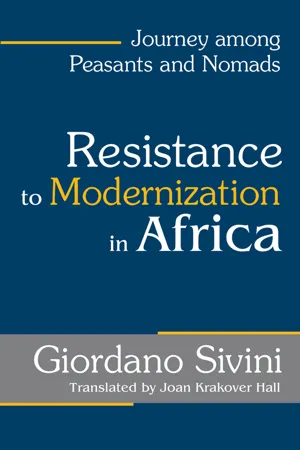
Giordano Sivini has been an international aid consultant for over twenty-five years. Here he channels a 1960s and 1970s idealistic political commitment into fieldwork and the sphere of development from the 1980s to the present. Sivini writes with both passion and cynicism about his experiences with the numerous African aid projects he has been involved with over the years.While the fathers of independence of British and French decolonization wanted to change the colonial conditions of exploitation, Sivini finds that their good intentions have been shipwrecked. Ironically, the longer Sivini served as an aid consultant, the more he found himself dismayed at the various projects that were under way or slated to begin. He perceived some of the projects as grotesque, and, almost all ineffective. The money was wasted on such ventures not because of a particular government's interest in the social effects they would have on the local populace, but because of the direct and indirect benefits the government would receive.Sivini sees international development aid as its own market: development is a commodity that takes the form of large and small projects, and is traded for loans and gifts to generate political and economic advantages for the institutional participants in the exchange. Ultimately, governmental and aid projects often stimulate resistance from the local populace as agencies upset their usual system of production by regimenting peasants to produce for the market, then appropriate the cattle of nomadic pastoralists, villagizing and resettling peasants in areas of high productivity, and exploiting laborers in large farms. This creates social disintegration, mass migration in urban informal economy, and poverty.This is a dynamic and moving analysis of foreign aid that will be of interest to students of African studies, governmental programs, rural development, and political economy.
1
People and Development
Fireworks
At the bend of the Senegal River, a small fort built by General Faidherbe for the French garrison now serves as the headquarters of the Bakel Prefecture. I leave feeling dismayed after talks about the various aid projects underway in this area, all of which I am to visit. I was surprised by one official who dismissed all these projects as “fireworks,” and often “straw fires.”
A Japanese group is installing an extensive cold store; the Peace Corps are digging ponds for freshwater fish farming. USAID, the American government aid agency, is financing the construction of irrigation perimeters, experimenting with the use of solar energy for irrigation, and giving technical assistance for rice production; UNDP (United Nations Development Agency) is training peasants to run the perimeters; the Projet Elevage, also financed by USAID, has plans to rationalize pastures and improve the livestock. The FAO is financing a reforestation project; USAID and the World Bank are trying to rescue the shattered health care system and are supposed to provide funds for building a hospital; a French NGO is trying to improve rain-fed agriculture—which is the basis of the self-subsistence farming economy—by training people to control the runoff of rainwater using metal cages filled with stones despite the fact that these are invariably destroyed by streams swollen by the rare but violent storms.
Some of these projects are run by the local branches of the ministries, others by SAED (Societé d’Aménagement et d’Exploitation des Terres du Delta) the Senegalese public agency concerned with development of the lands along the Senegal River. Still others are carried out by foreign technicians, employed to complement or replace Senegalese personnel. The multiplicity of projects and the crowds of foreign experts are seen by the prefecture officials as the prelude to a great change: a dam at Manantali to harness the watercourses above Bakel and regulate the waters of the fleuve, the Senegal River. The customary systems of agriculture are to be replaced by new ones based on irrigation with motor-pumps. Irrigation costs money, and this causes much anxiety among the emigrants in France; but here in the prefecture nobody worries about the consequences that will follow from the harnessing of the river.
Bakel is the administrative centre of the department. With barely six thousand inhabitants, it stands at the extreme northeast corner of the country, on the Senegal River. On the opposite shore are the Mauritanian Selibabi. Bakel is the centre of the Soninké area, which extends as far as Mali. The people along the fleuve get their living from lands watered by scarce and irregular rains, or fertilized by sporadic overflows of the river. Their precarious existence has led them into commerce and—since the French occupation—into emigration. In the hinterland—the brousse—live the seminomadic Peul herders, scattered in small villages and altogether numbering fifteen thousand inhabitants. The circulation of money in the area is provided by funds sent home by emigrants, the expenditures of foreign technicians, and the income of a few small businesses.
I arrived in Bakel in February 1983 after a ten-hour drive in a Land Rover. I had spent the night in Saint Louis at the Hotel de la Poste where Bernard Tavernier had screened part of Coup de Torchon, a fine film about colonial life. In Bakel I am to stay a few weeks in a rented house with a corrugated iron roof like those built by the emigrants. The rain hammers them with a deafening roar—the old straw roofs, which deadened the sound, have almost disappeared in this area, as they took a lot of work to maintain and by now are a sign of poverty.
The interior is spartan; the wooden furniture, bought in the local market, is shaky because the local craftsmen have not learned to make mortise joints. Electricity comes from a generator and the water from the tap needs to be filtered. Selimata, with her one-year-old baby always on her back, does the housework. Koité, the gardien, takes care of the rest. He goes to market early in the morning and returns for breakfast with a crusty baguette—always forgetting not to carry it in his armpit. At night he sleeps in front of the chicken coop to protect the hens from predators; there is no dissuading him from this guardianship which he says is the only safe system here.
My task is to consider social problems connected with the production of rice under the new irrigation system. There are two bulldozers leveling a large area near the river. This will be divided into four hundred quarter-hectare plots. The water pumped from the river will flow through the main channels dug by machines; then each plot-holder will dig the secondary channels by hand before beginning to cultivate the land.
My research concerns the way the plots are assigned to avoid tensions among the many applicants, and the possibility of integrating rain-fed and irrigated agriculture in this area to improve productivity. An agronomist and a soil expert have been here before me; others are to come. My study is financed by the Italian Cooperation; the results will go to SAED.
In Bakel there is no coordination between groups working in different aid operations except for those run by SAED. They operate in a sort of no man’s land according to the decisions of each funding agency. In the prefecture the officers take only rough note of what they have come to do. The local people seem willing to take part in those initiatives that do not interfere with their habits, and to accept failures with indifference or resignation. In colonial times they were equally excluded from decision making, but their participation was compulsory. Now—as then—the people most interested in these activities are the officials and notables who jockey for small advantages and prestige.
Some of the projects are grotesque.
A group of Japanese technicians are constructing a large prefabricated building with a cold store. The materials came from Japan in containers. Over the construction site waves a Japanese flag, reduced to a tatters by the harmattan, the desert wind, which has impeded their work in the past few months. They speak only Japanese. In the prefecture I was told that the building is part of a chain of cold stores, a gift of the Japanese government, in return the Senegalese government has given permission to fish in its territorial waters.
The cold store is meant to store frozen fish from the Atlantic to be sold in the local market. The refrigeration system is run by a huge generator—the daytime temperature varies from thirty to forty-five degrees. Nobody knows who will pay the running costs, how the fish will get to Bakel, and even at what price the fish can be sold. Up to now the local market has sold only dried fish in small quantities to serve as a condiment. Everyone tells me that the frozen Atlantic fish will find no purchasers except perhaps the foreigners in the aid agencies.
The building, finished a few weeks after my arrival, is being handed over to the mayor of Bakel. It is an awkward gift. Luckily, there is a merchant prepared to rent it—but for a small sum. He is going to use the large courtyard for drying river fish and the cold store for storage (the cooling system has never been turned on since the day it was tested).
While the Japanese were setting up the refrigeration system, some young people from the Peace Corps started a freshwater fish farming project. They persuaded one hundred and fifty people to form a cooperative, dig a large pond near the river, fill it using motor-pumps, and seed it with fry obtained from a station near the estuary of the fleuve. They will be repaid through the sale of the fish, which with three more ponds will amount to fourteen tons a year. None of the Peace Corps youngsters can tell me what the foreseeable market demand for these fish will be, or what will be the threshold of profitability because this problem has not yet been considered. The first harvest was expected in six months but long before that, because of a series of dysfunctions, the project has aborted.
As I worked on my inventory of the various aid ventures, I met a group of experts from an American university, sent by USAID to test the experimental solar power station meant to run the pumps for an irrigation perimeter which has just been finished. This is a good-sized complex of elegant, low buildings with roofs covered with solar panels. A cemetery of containers near the buildings shows that the whole thing came directly from the United States.
We are colleagues: we exchange a few general impressions of the situation. Before leaving they give me, in confidence, a copy of the evaluation report they have just finished. It says that running the complex will be difficult, and in any case absolutely anti-economic; the solar panels will not work when the harmattan blows and covers them with sand, the irrigation can be carried out with an ordinary floating pump, and the foundations of the buildings are threatened by the erosion of the river. They propose to abandon the experiment, reinforce the buildings, and turn them over to SAED, which could use them for offices.
“The only reason we hesitate to make these recommendations,” they conclude, “is that we fear they may be taken as a general condemnation of solar energy. We also realize that our proposal will create an embarrassing situation, but there is reason to think that otherwise this initiative will face a slow and miserable death, and cause even greater disillusionment, embarrassment, and waste.”
The projects I have briefly described have little or no economic impact on the local society; the impact is cultural, as they lead to questioning, skepticism, and criticisms.
The waste of money can be explained by the fact that the government and the Senegalese officials are interested not in the social effects, but in the direct and indirect benefits they can obtain from the projects. The aid world lives on projects but ignores results; gifts or theoretically repayable loans are used to pay foreign experts (who are often unprepared to deal with local problems) and to buy goods from the donor countries.
Cattle and Children
The Projet Elevage, run by USAID, appears to be serious. It has broad ambitions, a good financial endowment, and has been in operation for a few years. Run by a group of expatriates, the person in charge is a young Iranian woman. She lives almost across from me; sometimes she invites me for a drink in the evening, Once I tried three small cups of heavily sugared green tea and stayed awake all night. She speaks about the project and its difficulties. The group has written reports on conditions in the villages of the brousse and she loaned these to me. There are no photocopying machines in Bakel; one must simply read the reports aloud for the cassette recorder.
The Projet Elevage is meant to improve the conditions of the livestock, and this is expected to increase the herders’ willingness to sell cattle on the market. This ignores the fact that cattle are a patrimonial reserve; the only source of relative security in a life strongly conditioned by uncontrollable events. Livestock acts as a sort of flywheel in case of crises, and it cannot be treated independently of other social problems or of the self-subsistence economy. The project’s goal is pursued with no regard for the most elementary needs of the people—which are obscenely neglected. I come to understand this as I move around the villages.
The fundamental problem is water. Water is found almost everywhere at different depths, but the means to extract it are lacking. The people are trapped in a cycle of water use that begins with relative abundance in the rainy season and continues with the search for sources ever more difficult to find and further from the villages. For two or three months the people use wells and swamps; most of the wells are between ten and twenty meters deep, one is fifty meters. All of them date from the colonial period or the early years of independence. As the dry season continues the wells, which are reserved for human use, yield less and refill more slowly. To water the stock the people dig into swamp and stream beds, and when the wells dry up they use that water to drink. If they dig only two or three meters deep they get enough water for a few days; if they go down five or six meters it may last a few weeks. In this case the source is protected by thorny fences to control access. Now we are in the late dry season, and everywhere there are people digging—almost never with shovels because shovels cost money. Stopping to look at our passing Land Rover, they raise cupped hands to their lips with muddy water to slake their thirst.
The transhumance has already begun and will last three or four months. Just a few herders have gone with the cattle; their families stay in the villages where intestinal and urinary diseases are endemic. The Projet Elevage will dig wells only to water the cattle along their journey. The people will use them as well if they are not too far from the villages; otherwise they will probably settle around them breaking the equilibrium between water and pasture.
The cattle in this area are the long-horned n’dama breed. These are preferred to the gobra with their lyre shaped horns. The latter are bigger and produce more milk but have less resistance. Crossing the n’dama with the gobra produces the djakoré breed, which is widespread in the Sahel but not here because the local people consider it unsuitable. Thus, the genetic improvement plans of the Projet Elevage, which aim to extend this breed, are destined to remain on paper.
On the other hand, the herders are keen to participate in the annual campaigns for free vaccination of livestock. The condition of the herds has been improved by this “veterinary revolution” in many countries of sub-Saharan Africa. Some experts maintain that this improvement has increased the people’s willingness to sell cattle. However, one Peul explains to me: “We sell to pay taxes, to buy food and clothes, to treat illness, to improve the village, to pay the costs of emigration. Sales have increased because the need for money has increased.” If he had money, he would buy more livestock, and some of the money sent by emigrants is used for this purpose: “This is our way of saving.”
The women look after the house, thresh millet or sorghum daily, prepare meals, fetch water, do the washing, look after the children who are always with them, cultivate their vegetable plots, at certain times help in the fields, and sell in the market the little they have in order to buy what they need for the family’s consumption. The men see to the herds, the heavy agricultural work, the maintenance of the huts, and the problems of the village. Some emigrate, but among the Peul in this area those are few.
The little girls help their mothers, the boys help their fathers; all take part when necessary in guarding the cattle and the fields. They grow up and learn by working. They go to Koranic schools where they learn verses of the holy book by heart, get used to discipline, and work for the Imam. The director of education in Bakel tells me that families do not want their children to study, though schooling is obligatory. When I mention that in the whole area of the brousse, with a potential population of over a thousand pupils, there is not a single school, he looks angry and explains that the obligation depends “on the availability of structures.”
An elementary school had been opened in Ololdou, the most important village of the brousse, when it was the seat of the subprefecture but after a few years it was deserted by the families. According to the director, this proves that the people prefer to have their children work. The people give me a different explanation. The teachers came from far away and felt imprisoned in the village. They had no motivation and could offer no stimulation, so the children learned nothing.
The illiteracy rate is almost 100 percent among adults and young people, and this is one factor that limits emigration. This situation is quite normal for a country like Senegal, which since independence has never seriously confronted the problem of education. The Mouride Brotherhood, one of the pillars of the government, tries to limit the expansion of public schools in rural areas because they weaken the system of Koranic schools.
The Projet Elevage has an adult literacy program to facilitate relations with the market, but it provides no schooling for children. Nor does anyone take an interest in their health. In the area there is no agency for vaccinating them; the mortality rate in the first year of life is about fifteen percent and remains high throughout childhood. Thanks to the “veterinary revolution,” every year six times as many cattle are vaccinated as children under fifteen years of age.
None of the villages have any medical facilities. The people use traditional medicine, which they consider more effective and cheaper. “If I go to the medicine man he examines me, he advises me, he gives me remedies and teaches me how to use them. If one of my relatives is gravely ill, he gives me hope.” At the dispensary in Bakel, not easy to reach from the brousse, the nurses hand out prescriptions to be taken to the pharmacy. The charges are wildly inappropriate because the prices of medicines—current prices in the capitalist market—are exorbitant for an economy based mainly on self-subsistence. Therefore, they explain to me, “for serious physical ailments we must go to the medicine man, for psychological ills we go to the Imam, for minor problems we go to the dispensary where they might give us a few compresses.”
The Projet Elevage does not concern itself with the health of the herders. Its program is to set up veterinary services in the villages for the cattle.
Development as a Commodity
International development aid is a market in which agencies, governments, and nongovernmental organizations operate. Development is a commodity which takes the form of large and small projects. These are traded for loans and gifts to generate political and economic advantages for the institutional participants in the exchange. The commodity is not immaterial as it incorporates equipment and above all the final recipients.
Not a few projects fail because they are stupidly, naively conceived or based on mistaken technical presuppositions; but nonetheless they are approved by the aid agencies which are solicited by numerous different political and economic interests. They concern recipients (the jargon calls them “beneficiaries”) who are supposed to be included in the process but often stand on the sidelines. They look on and give up trying to understand a world which is not theirs.
Bakel, in many ways, presents a picture of this combination of stupidity and inadequacy. But Bakel is also the place (see chapt...
Table of contents
- Cover
- Half Title
- Title
- Copyright
- Contents
- 1. People and Development
- 2. The Regimentation of the Peasants
- 3. The Government's Obsession with Nomads' Cattle
- 4. Concentration in Villages
- 5. The Resettlement of Peoples
- 6. Hard Labor on the State Farms
- 7. Off the Land
- 8. Economy and Politics in Underdevelopment
- Afterword
- Index
Trusted by 375,005 students
Access to over 1.5 million titles for a fair monthly price.
Study more efficiently using our study tools.
Frequently asked questions
Yes, you can cancel anytime from the Subscription tab in your account settings on the Perlego website. Your subscription will stay active until the end of your current billing period. Learn how to cancel your subscription
No, books cannot be downloaded as external files, such as PDFs, for use outside of Perlego. However, you can download books within the Perlego app for offline reading on mobile or tablet. Learn how to download books offline
Perlego offers two plans: Essential and Complete
- Essential is ideal for learners and professionals who enjoy exploring a wide range of subjects. Access the Essential Library with 800,000+ trusted titles and best-sellers across business, personal growth, and the humanities. Includes unlimited reading time and Standard Read Aloud voice.
- Complete: Perfect for advanced learners and researchers needing full, unrestricted access. Unlock 1.5M+ books across hundreds of subjects, including academic and specialized titles. The Complete Plan also includes advanced features like Premium Read Aloud and Research Assistant.
We are an online textbook subscription service, where you can get access to an entire online library for less than the price of a single book per month. With over 1.5 million books across 990+ topics, we’ve got you covered! Learn about our mission
Look out for the read-aloud symbol on your next book to see if you can listen to it. The read-aloud tool reads text aloud for you, highlighting the text as it is being read. You can pause it, speed it up and slow it down. Learn more about Read Aloud
Yes! You can use the Perlego app on both iOS and Android devices to read anytime, anywhere — even offline. Perfect for commutes or when you’re on the go.
Please note we cannot support devices running on iOS 13 and Android 7 or earlier. Learn more about using the app
Please note we cannot support devices running on iOS 13 and Android 7 or earlier. Learn more about using the app
Yes, you can access Resistance to Modernization in Africa by Giordano Sivini in PDF and/or ePUB format, as well as other popular books in Economics & Development Economics. We have over 1.5 million books available in our catalogue for you to explore.