- 186 pages
- English
- ePUB (mobile friendly)
- Available on iOS & Android
eBook - ePub
About this book
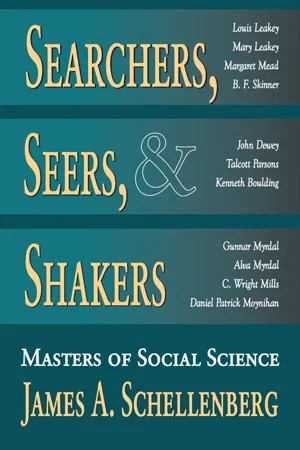
This volume offers intellectual portraits of eleven giants of the modern social sciences. It is bound by two central themes. The first is that there is a fundamental unity behind the various forms of social science. There is a general social science as well as a variety of social science disciplines. The second theme is that a biographical approach is a useful tool for making clear some of the central ideas of social science. By looking at the lives and achievements of selected masters, we should be better able to understand the fundamental nature (or natures) of social science.In order to determine which figures should be regarded as masters Schellenberg defines the three main kinds of work he sees as central for social science. First is the work of basic discovery done by searchers who made especially important contributions to empirical work in the social sciences. The persons he selected for special treatment here are Louis Leakey, Mary Leakey, Margaret Mead, and B. F. Skinner. He then considers the work of theory, choosing for examination seers who had made especially important theoretical contributions: John Dewey, Talcott Parsons, and Kenneth Boulding.Schellenberg next examines those social scientists who worked to seek changes in society. These were the shakers or social reformers. In Schellenberg's view these come in three main subtypes, and he sought to include at least one example of each--Gunnar Myrdal and Alva Myrdal as social engineers, C. Wright Mills as a rebellious social critic, and Daniel Patrick Moynihan as one whose contribution was made more directly into the world of politics.Schellenberg's exploration of the lives of these eleven masters of twentieth-century social science reveals many surprises and ironies. While he points out major contributions, he also has felt free to make criticisms. As he has said: These were all real persons, with failings and foibles, as well as persons of great achievement. I felt that the examination of
Information
Part 1
Introduction
1
The Coming of Social Science
Mathematician and Philosopher
Born in northern France in 1743, he was christened with a long name: Marie Jean Antoine Nicolas de Caritat. Soon, however, he became known as the Marquis de Condorcet, for he was born into the French nobility. His father, a French cavalry officer, died before Condorcet was five years old. His mother, a deeply religious woman, consecrated her frail child to the Virgin Mary and saw that he had the very best education provided by Jesuit schools. To further protect him, she tried to isolate him from other boys and saw that he wore only girls’ clothes till he was nine years old. Extremely shy as a boy, he became as a man what one biographer has described as “extremely refined with a craving for intimacy and affection to which was joined indecision, a certain timidity, and a dangerous impressionability.”1
In 1758, Condorcet was sent to Paris to further his education. His associations at the Jesuit school there were limited mostly to teachers and books. He showed a special interest in mathematics, and presented learned papers in this subject while still a teenager. When he completed his formal education, he decided, much to the dismay of his family, to pursue a career as a professional mathematician. In 1765, he published his first work, Essay on Integral Calculus. Soon he was known as one of the leading French mathematicians and as such was welcomed into the intellectual circles of Paris. He was supported very modestly there through an allowance from his mother.
This was the Age of Enlightenment. Established forms were being questioned everywhere, and in no country was the contrast greater than in France between the new forces and those established by the past. The interests of the rising groups of businessmen, industrialists, and professionals challenged the Old Regime of the monarchy, the Catholic Church, and the privileges of the nobility. In Paris, the intellectual center of the world at that time, it became fashionable to be critical of everything, even in the salons of the nobility. Those persons of letters who led the questioning and promoted a new Age of Reason became known as philosophes. They included leading scholars such as Voltaire, Montes-quieu, Rousseau, Diderot, and Turgot. They also included hundreds of lesser-known intellectuals, and Condorcet soon became one of these.
Condorcet was awkward in the atmosphere of the fashionable gatherings in private salons. He was more at home in the company of individual scholars, who recognized his outstanding ability in mathematics. But he was not content to be just a mathematician; he aspired to become a full-fledged philosopher. Grounded in the rational disciplines of mathematics, he sought to apply the dictates of reason to everything in the world.
Condorcet later was to summarize the central ideas of the philosophes as “always proclaiming the independence of reason and the freedom of thought as the salvation of mankind.” Behind these ideas were the assumptions that nature (including human nature) is fundamentally benign, and that it can be accurately perceived through science and reason when the freedom of thought is allowed to flourish. Furthermore, it was assumed that despite the impediments of traditional forms, humans had certain natural rights upon which a proper social order must be based. Later these became enumerated as the rights of life, liberty, and the pursuit of happiness in the American Revolution’s Declaration of Independence or, in the French Revolution’s Declaration of the Rights of Man and of the Citizen, as liberty, property, security, and resistance to oppression.2
A special boost for the fortunes of the philosophes came in 1774 when one of them, Jacques Turgot, was appointed minister of finance by King Louis XVI. Here was the opportunity to put into practice reform measures inspired by the ideals of free trade. When chosen by Turgot for the post of inspector of the mint (or, in effect, controller general of France), Condorcet was given the opportunity to move into a governmental residence, receive a respectable salary, and take on the mission of economic reform. He wrote papers advocating the abolition of all restrictions on trade and labor and generally helped his friend (Turgot was the fellow philosophe that he most idealized) carry out new economic policies. Pressures from the nobility, however, soon were arrayed against Turgot, and he was replaced after only two years by a man who was more tolerant of internal tariffs. Condorcet immediately resigned his position, writing to Voltaire “We have had a beautiful dream, but it has been brief. I am going back to geometry and philosophy.”3
Later Condorcet was to resume his duties as inspector of the mint, but with fewer opportunities to influence economic policies. Meanwhile, he continued to be recognized as a mathematician and philosopher. Having been elected in 1769 to membership in the French Academy of Science, he served that body as secretary for most of the remaining years of his life.
In 1786 Condorcet met, fell in love with, and married a woman named Sophie, the daughter of the Marquis de Grouchy. She has been described as, at the time, “beautiful, refined, intelligent, enlightened, rich, and twenty-two.” In any event, the two of them appeared to have had a very happy marriage, blessed by one child, a daughter born in 1790. The Condorcet household, inspired by the grace of the young wife and with the increasingly free spirit of the husband, became a center for gatherings of the intelligentsia of Paris. Distinguished guests from other countries were also made welcome, including Adam Smith of Great Britain and Thomas Jefferson from America.4
The Revolutionary
Condorcet had been an advocate of social revolution long before the beginning of the French Revolution, and he also favored rather drastic measures for political reform. But he was a pacifist by nature, and his public statements never supported violent methods of change. The political system he favored—before the Revolution—could be best characterized as a constitutional monarchy. It should include, he felt, such forms as the direct election of national legislators from those who held property, decentralized forms of local government, a minimum of governmental restrictions in economic affairs, women’s suffrage, full citizenship rights for members of all races, universal public education, and an absolute freedom of thought. He was strongly opposed to any recognized political role for the Church. All of these were clear elements of Condorcet’s political philosophy before the Revolution.
In most basic respects Condorcet’s political philosophy remained unchanged until the time of his death. He was always the rationalist, calmly trying to identify through intellectual analysis the best forms of political organization and action. But he also changed in important ways, coming to advocate the removal of the monarchy and the establishment of a national democracy.
Condorcet was the only one of the philosophes to take an active part in the French Revolution, since by then all other major figures of that movement had died. Condorcet was not at first in favor of the move when, facing economic woes, the king called for a meeting of the Estates General in 1789, since that body recognized the formal power of the nobility and clergy. He would have preferred a more direct role for popular participation. But when the Third Estate seceded from the Estates General to form the National Assembly, Condorcet fully approved. He took the opportunity to draft a rather elaborate Declaration of Rights which he proposed to the Assembly, and this later became summarized by a more simply stated Declaration of the Rights of Man and the Citizen.
Impressed by the popular uprising which led to the Fall of the Bastille on July 14, 1789, Condorcet soon became convinced that the monarchy should be replaced by a republican form of government. He renounced his noble title and became elected, in 1791, to the municipal council of Paris. In this role he sought to influence the national reforms of the newly established Constituent Assembly. His plan for governmental finance was approved by the Assembly in 1791. During the short period of the Legislative Assembly (October 1791, to September 20, 1792) he became a more active leader, serving eventually as president of that body. Condorcet then kept busy drafting proclamations and making addresses, but he was not very persuasive. His manner of speaking has been described as “cold and awkward,” with gestures “restrained and weary” and lacking “spontaneity and variety.” Nevertheless, he was highly respected because of his reputation and character.5
When elections to the new National Convention were held late in 1792, Condorcet was easily elected to a seat. But the uprising of the Paris mob had grown, and he was confused by the sudden declaration of the Republic on September 21. He opposed the subsequent attempts to try (and eventually behead) the king. The Convention soon became the setting for a fierce battle between two factions, the Girondins and the more radical Jacobins. Condorcet avoided any formal tie to either group, though it soon became clear that the Jacobins considered him part of the enemy. Nevertheless, he attempted to draft a constitution for the Republic. It was a lengthy document which won the support of most Girondins, but the Jacobins were harshly critical. Their leader Robespierre had only contempt for the document. He told Condorcet that it appeared “designed not for mankind, but for the rich, for monopolists, for stock jobbers, and for tyrants.”6
Jacobin leaders drafted a new constitution, which was formally approved on June 24, 1793. The Girondins, now expelled by the Convention, were subject to trial as traitors to the Republic. Condorcet wrote energetically against the new constitution, and for these efforts, on July 8, he was added to the list of those subject to arrest. In hopes of aiding him to escape the guillotine, his friends arranged that he find refuge in a small pension kept by a Madame Vernet. As the weeks there turned into months, he determined to make use of his time by writing.
Condorcet's Vision
During the nine months he was in hiding at the home of Madame Vernet, Condorcet frequently heard news about formerly close associates who met their death at the guillotine. That too, it appeared, would be his fate, if and when he might be found. But he sought to put his time to more creative use than worries about his personal safety. Using whatever materials he could find for writing, he began to record his own experiences, seeking to justify the role he had played. But he soon abandoned this attempt in favor of something much more ambitious. He would put the Revolution itself into its broad historical context. Never mind the tragic events then being experienced by his country and by himself personally; he could spend his time contemplating the broader issues about human existence. By retelling his version of the history of the world, he could show how the future was bound to be brighter. He could show how the ideals of the Revolution—that faith directed to Nature, Reason, and Humanity rather than the old religious ideas—would prove triumphant in the end.
Condorcet’s Sketch of an Historical Picture of the Progress of the Human Mind divides human history into nine main periods or epochs. These show how mankind has gradually increased in the knowledge of the world and has made this knowledge ever more useful for human society. For example, his eighth epoch began with the invention of printing and continued until the philosophical contributions of René Descartes. Printing became a way that knowledge could be preserved and given almost unlimited circulation. This diffusion of knowledge made it impossible for significant contributions to be lost and helped to develop a better educated populace. Further, it provided for more rational discourse and inspired new scientific contributions, such as those of Copernicus and Galileo.7
After Descartes, ever more rational discourse could be encouraged. This led to the discovery of basic laws of the universe by Isaac Newton. Also, the fundamental laws of the mind, based on the human senses and their combinations, were put forward by John Locke. Such psychological knowledge could lead to truth in the social sciences as certain as were the truths of natural science. This great ninth epoch brought us to the French Revolution, which, with its great ideals of reason and freedom, would usher in a new pattern of society.
The next epoch would be one of almost unlimited progress, with human equality (between nations, between classes, and between individuals) as a key theme. True, there would continue to be setbacks now and then. Progress, though it “at present may appear chimerical,” will inevitably be the story of the future. Truth, he said, “in spite of the transient success of prejudices, and the support they receive from the corruption of governments or of the people, must in the end obtain a durable triumph” for “nature has indissolubly united the advancement of knowledge with the progress of liberty, virtue, and respect for the natural rights of man.”8
The main theme of his essay, as stated in its introduction, is that “no bounds have been fixed on the improvement of the human faculties; that the perfectibility of man is absolutely indefinite; that the progress of this perfectibility, henceforth above the control of every power that would impede it, has no other limit than the duration of the globe upon which nature has placed us.”9
Such is the vision of scientific optimism produced by Condorcet as he hid from his enemies during the most violent period of the French Revolution. His optimism was based primarily on the growth of knowledge made possible by modern science. But it was also based on the methods and ideas of science extending more and more into the realm of human society. He thus envisaged the development of a social science tied together firmly with the advances of natural science. For man is a part of nature, and the methods of science must be extended to humans and their society as well as to the study of physical matter in motion. His prophecies concerning the betterment of humanity reserved a clear place for the development of social science.
As news came of many of his former associates being executed, Condorcet became increasingly concerned about his safety. He was also especially concerned about the safety of his benefactress, for Madame Vernet would surely be punished if found to be harboring a fugitive. Perhaps it is characteristic of Condorcet that he seemed more concerned about another person than for his own life as he began plans for an escape.
Madame Vernet strongly opposed his leaving. She said to him: “The Convention has the power to put you outside the law, but it has not the power to put you outside of humanity. You will remain.”10
Finally, eluding his protector, Condorcet left the house in disguise. For several days he avoided capture, then was discovered after hungrily seeking food at an inn. His stay in prison was brief, for the very next morning, on April 8, 1794, he was found dead in his cell. Apparently (though some scholars have speculated otherwise) his death was a case of suicide.
Condorcet’s great legacy was his Progress of the Human Mind, first published the year after his death. It is generally seen as his primary contribution to social philosophy and to social science. We may, however, mention another of his writings which even now in the early twenty-first century, remains as a contribution to social science. In 1785 he wrote his Essay on the Application of Analysis to the Probability of Majority Decisions. This work was clearly mathematical in nature, but it was intended for social science applications. Here he introduced what has become known as “Condorcet’s Paradox,” the demonstration that majority voting was subject to certain possible inconsistencies. Considering three candidates for an office, A, B, and C, a majority might prefer Candidate A to B; at the same time a majority might prefer B to C, and still another pairing might prefer C to A. This possible lack of consistency posed, in Condorcet’s view, a real problem for democratic elections.
Condorcet also worked out a rational method for dealing with such electoral problems. It has become known as the “Condorcet Method,” which uses pair-wise comparisons as a key part of voting. It has given rise to several variations discussed by modern theorists of voting procedures. Never mind that no nation today uses elections based directly on the methods Condorcet promoted, his enunciation of the mathematical problems in counting votes are still important in the literature of game theory.11
After the Revolution
The French Revolution was one of the great watersheds of Western thought. It had been based on ideals of liberty, equality, and fraternity, in turn seen as expressions of an underlying devotion to human reason and natural law. These ideals did not die with the rise of Napoleon (indeed, Napoleon used them as part of the ideology for his rule) or with the restoration of the monarchy which followed his rule. At the same time, a revulsion against the excesses of the revolution strengthened the resolve of conservatives to resist new ideas. France in particular became a battleground between liberals and conservatives—a split which has continued well beyond the nineteenth century.
There was no doubt about the sympathies of the family into which Auguste Comte was born. They were Roman Catholic and Royalist. Despite the fact that his father was a government employee in the Department of Taxation and thus part of Napoleon’s rule, he did everything possible to see that his son would not be contaminated by the radical movements then afoot. In this his success was short-lived.
Born Jan...
Table of contents
- Cover
- Half Title
- Title
- Copyright
- Contents
- Preface
- Part 1: Introduction
- Part 2: Discoverers
- Part 3: Theorists
- Part 4: Reformers
- Part 5: Conclusions
- Notes
- Bibliography
- Index
Trusted by 375,005 students
Access to over 1.5 million titles for a fair monthly price.
Study more efficiently using our study tools.
Frequently asked questions
Yes, you can cancel anytime from the Subscription tab in your account settings on the Perlego website. Your subscription will stay active until the end of your current billing period. Learn how to cancel your subscription
No, books cannot be downloaded as external files, such as PDFs, for use outside of Perlego. However, you can download books within the Perlego app for offline reading on mobile or tablet. Learn how to download books offline
Perlego offers two plans: Essential and Complete
- Essential is ideal for learners and professionals who enjoy exploring a wide range of subjects. Access the Essential Library with 800,000+ trusted titles and best-sellers across business, personal growth, and the humanities. Includes unlimited reading time and Standard Read Aloud voice.
- Complete: Perfect for advanced learners and researchers needing full, unrestricted access. Unlock 1.5M+ books across hundreds of subjects, including academic and specialized titles. The Complete Plan also includes advanced features like Premium Read Aloud and Research Assistant.
We are an online textbook subscription service, where you can get access to an entire online library for less than the price of a single book per month. With over 1.5 million books across 990+ topics, we’ve got you covered! Learn about our mission
Look out for the read-aloud symbol on your next book to see if you can listen to it. The read-aloud tool reads text aloud for you, highlighting the text as it is being read. You can pause it, speed it up and slow it down. Learn more about Read Aloud
Yes! You can use the Perlego app on both iOS and Android devices to read anytime, anywhere — even offline. Perfect for commutes or when you’re on the go.
Please note we cannot support devices running on iOS 13 and Android 7 or earlier. Learn more about using the app
Please note we cannot support devices running on iOS 13 and Android 7 or earlier. Learn more about using the app
Yes, you can access Searchers, Seers, and Shakers by James A. Schellenberg in PDF and/or ePUB format, as well as other popular books in Social Sciences & Sociology. We have over 1.5 million books available in our catalogue for you to explore.