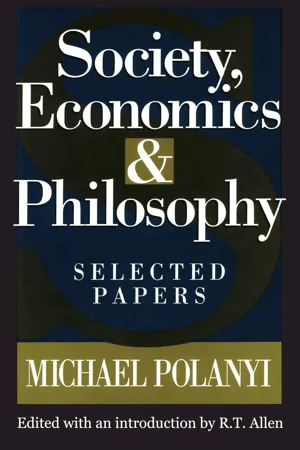
Society, Economics and Philosophy represents the full range of Polanyi's interests outside of his scientific work: economics, politics, society, philosophy of science, religion and positivist obstacles to it, and art. Polanyi's principal ideas are contained in three essays: on the scientific revolution, the creative imagination and the mind-body relation. Precisely because of Polanyi's work in the physical sciences, his writings have a unique dimension not found in other advocates of the market and too infrequently found even in philosophers of science.Polanyi was a powerful critic of totalitarianism and of the deficiencies of the usual defenses of freedom which helped to prepare the way for it. Freedom, he argued, can be based only upon truth and dedication to transcendent ideals, not upon skepticism, utilitarianism and the liberty of doing merely as one pleases. At a time when easy slogans about socialism were dominant in intellectual circles, epitomized by Sidney and Beatrice Webb, and when calls for the central planning of scientific research were made by such as J.D. Bernal, Polanyi exposed their errors and showed that science can flourish only in a free society.More radically than even von Mises and Hayek, Polanyi showed that an industrial economy can operate only polycentrically, that central planning is logically impossible, and that what was called by that name in the Soviet Union was in reality no such thing. Likewise, scientific research can proceed, not by a central plan, but only by the spontaneous self-adjustment of separate initiatives to discover a common reality. Against the positivism dominant within philosophy of science, he argued that the notion of reality must be restored and made central. Yet physical sciences, he also argued, are only one branch of science, and the sciences of life and mind are logically richer and more complex and cannot be reduced to the former, nor mind to body or to computers, nor art to its ph
- 403 pages
- English
- ePUB (mobile friendly)
- Available on iOS & Android
eBook - ePub
About this book
Information
Part I
Political Questions
Introduction to Part I
The eight articles included in Part I range from Polanyi's earliest, apart from scientific publications, published in 1917, to one of his last, published in 1970. They are all responses to the momentous events in the twentieth century: the political and moral collapse of the First World War, the rise of totalitarianism and the passions that drove and supported it, and the position and tasks of Jews in the modern world.
The first two are included because of the light they throw upon the development of Polanyi's thinking about society and politics and because they have never before appeared outside Hungary and in English. The third, 'Jewish problems', appears because it expresses Polanyi's views upon matters that touched him personally.
With 'The struggle between truth and propaganda' (1936) and 'The rights and duties of science' (1939), we come to the events which led Polanyi once more to write and publish upon matters outside of his professional work in natural science: the Marxist demand for the planning of science along with everything else and the need, in the face of that threat, to defend the freedom of scientific research and with it freedom in society at large and in the market economy that supports it. 'The rights and duties of science' could also have be placed in Part III, but it has been included here because of the political context of its account of science and how it differs from applied science.
We then jump over several other essays on political matters, which have been reprinted in Polanyi's books or include nothing of wider interest that is not found elsewhere, to three articles which develop Polanyi's account of 'moral inversion' as first presented in 'The magic of Marxism' [74] (PK pp.226-48). The modern world is replete with explicit expressions of contempt for morality and its restraints and with explicit avowals of unscupulousness and ruthlessness, bom of scepticism and accompanied by assertions of the 'honesty' of those attitudes in contrast to the 'hypocrisy' and 'dishonesty' of explicitly moral appeals. In 'The magic of Marxism' Polanyi explained how the explicit avowal of unscrupulousness and violence is accompanied by a tacit use of moral appeals. This conjunction, Polanyi explains, 'enables the modern mind, tortured by moral self-doubt, to indulge its moral passions in terms which also satisfy its passion for ruthless objectivity' (PK p.228), especially when, as in Marxism, the latter are identified with something taken to be simple fact, e.g., the Marxist laws of history and the inevitable arrival of the classless society. Though they overlap with that article, and with 'Beyond Nihilism' [95] and 'The message of the Hungarian revolution' [121], and with each other, they each add some tiling to Polanyi's account of the great evils that have beset our era.
1
To the Peacemakers: Views on the Prerequisites of War and Peace in Europe
Huszadik Század was founded by Oskár Jászi, who, with Count Mihály Károlyi, founder of the Hungarian Independence Party, attended the Conference of the League of Lasting Peace held in Bern in November 1917 at which he propounded his scheme for a federated Austro-Hungarian empire, later a Danubian federation. Apart from the personal interest of this plea, this article is also noteworthy for its prophetic recognition of the error of concluding peace in the spirit of war.
When Will it Come to an End?
For many months now a great many outstanding men have been struggling all over the world to break a path to peace and to rescue us, the peoples of Europe, from the devastation in which we have become more and more deeply entangled each day. At the outset most of us believed that the first self-determination of peoples and the first manifestation of the idea of peace would put an end to the war at an irresistible speed. However, in spite of this and being bitterly worried, we have to see the obstacles become daily more powerful, and a successful outcome to the work of the peace delegates looks more and more unlikely. And one breaks out in angry words: Do our delegates consider their work in the right way? Does the true spirit of peace live in these men? Has the vision of a new age in the future been opened before their eyes?
Each question entails new doubts. What, so far, have they mostly talked about? First the various peace conditions: Alsace, Trentino, indemnity to Belgium and Serbia; after that, arbitration and arms limitations.
Even the sequence indicates the unfortunate and sterile spirit of these talks!
The delegates of all peoples ought, first, to agree on the institutional bases of an unshakeable system of international law, and then the questions relating to the dignity and integrity of States would settle themselves; but, in spite of this, once plunged into conflicts in a war-like spirit, they will not be able to establish a firm basis for international peace, without which, as governments have already declared, a short cease-fire would be possible but no peace could ever be achieved that would mean tranquillity and prosperity for Europe.
For, who determines the peace conditions determines also the war conditions. Thus, the first result of the peace talks, on this interpretation, has been only the declaration of this: that the territorial affiliation of Trentino, the question of Alsace, some millions of indemnity, were sound and just reasons for bringing about the war. Yet the foundations of the future tranquillity of Europe cannot be laid in the spirit of such a declaration, and, as long as we are informed by this spirit, the war goes on. It would be a disastrous mistake, if the those preparing the peace, were, like typical diplomats, to see their mission as being to try to heal the injuries inflicted by European States on each other's sovereignty, since they would thereby only admit what they ought to struggle against. For, as long European States continue to possess their present unlimited sovereignty, this war will go on. And peace will come when and only when we, the peoples of Europe, have become aware of the idea of the internal co-operation and a close system of law and order among European States, and, accordingly, controversies about power, have disappeared from our agenda.
To develop this position will be my task in what follows.
The Causes of the War
Let us examine, first, what the sovereignty of a European State consists of today and what its effects are.
The territory of Europe is divided among six large States, each of which is prepared to raise an army of 6 to 10 million soldiers. The people of every State esteem the greatness and wealth of their own State much more than those of any other State, and if a foreign State seeks to impair this greatness and wealth all the people of each State are willing to send all their army for to fight the menacing neighbour. Thus, like competitors, each State must be permanently on stand-by both to defend its territory and, on occasion and by a swift invasion, to enlarge it. It is for this same reason that States must keep their power, plans and alliances secret from each other, and it also entails that this secret power be placed in the hands of 2-3 men, if possible.
The six secretive centres of incalculable devastation in Europe thus formed have certainly kept the peoples of Europe in mutual fear and uncertainty. An army endowed with motor transport can invade the larger part of a neighbouring country within a few days. Thus preparations must be prevented by quicker preparations and invasions by a quicker invasions; no power can avoid this. This is an outline of the origins of the war.
And why just now, not sooner or later, did the war start?
Because recent decades European States have become more dangerous to each other as a result of the technical development of railways, motor vehicles and artillery. This has finally brought European States to a position where, lest they be accused of negligence, they could not do other than invade the territory of a neighbouring country in order to prevent the enemy's attack.
Lest there be any mistake, I shall explain this statement in more detail. Thus, I do not claim that the existence of two sovereign States on the globe necessarily means eternal war between them! Even though it is certain that there will always be a legitimate distrust between two States, which fosters the germ of war, if both adversaries are hardly able to pose a sudden threat to each other, and if it takes weeks or months to launch their armies against each other, no serious word can then be voiced for the argument that it is the prevention of an enemy invasion that makes it a duty for the leaders of each State to overrun an adversary. However, if the war breaks out, the distrust will be but an insignificant cause among many others, and the real causes will be material or moral ambitions which they seek to realise by waging war.
In contrast, European States are at the opposite extreme by virtue of the unprecedented expansion of the danger of one to another. It was just under these circumstances that mutual and legitimate precautions must have exploded into declarations of war in the quickening succession of effects and counter-effects. In this situation the much mentioned causes of the war, i.e. moral and material war ambitions must be considered as of secondary importance as giving the last impetus the jolt that was to overthrow the balance of power.
Daily we feel more strongly that the world war is a fatal catastrophe of quite particular importance, that it is essentially different from any kind of war waged in the past. Accordingly, the significant trait of it is as follows: the world war essentially and first of all is not a complex of campaigns (as we thought it to be), but the only stable situation which corresponds to the principle of the sovereignty of European States in respect of their actual danger.
However much this assumption may perhaps seem to be a paradox, let us remember that the first event of the war was actually an invasion, with thousands of motorised vehicles, that was so powerful and lightning-fast that even the Reichstag was informed about it only when and as the Chancellor made the statement: 'Our troops crossed the Belgian border last night'. An irresistible drive on Paris must have been planned that would have decided the war within ten days. And it is also certain that this attack would have prevented a similar shock-action of the enemy, that is, the invasion by the Russians of East Prussia, which would have been really fatal to the Germans.
Nonetheless, the fact that the German attack was but the ultimate result of legitimate and preventive actions will become clear if we put aside our common mistrust for a moment and listen to the great powers' own arguments. Each of them says that it was not it who started the war, and plainly demonstrates that the other side had previously taken measures which had put it into jeopardy. It does not follow from this that either one or the other, or both of them, is lying. The facts they put forward are all beyond doubt, so the correct conclusion is that both of them are right. It is true that Germany could not wait once Russia had mobilised, and Russia had mobilised because Austria had mobilised, and Austria could not wait for Serbia had offended her and her authority was at stake. All this is not, of course, to say that the 'sufficient cause' was (Gavrilo) Princip, but, on the contrary, I am saying that in whatever direction one follows the series of mutual alarms which exploded into war, the series of causes leads to smaller and smaller events which cannot be considered as being 'sufficient causes' of the subsequent actual events, and, therefore, the sufficient cause is the situation itself in which small events can trigger epidemics of distrust epidemics which increase like avalanches. This state of affairs consists, as I said above, in the power of European States that are able at any moment to cast all their devastating forces on dieir neighbours, and that power is but a logical consequence of the idea of unlimited sovereignty, i.e. that the greatness and welfare of one's own state is more important than those of the others.
Who is to Blame for the War?
The start of the peace talks is encumbered by the fact that the hostile parties want, first, to make clear 'who is to blame for the war'. They cannot agree on this question because both sides are caught in their policy started at the outset of the war, and therefore the one accuses the other. Yet, one state seems to have no more right to accuse the other than a brick under the ruins of a collapsed house which would blame the others for the collapse.
The peace delegates, I think, are right if they want to start with an investigation into the causes of the war. For the causes of the outbreak of the war do not cease to exist even now and because of them the war is still going on. So the politicians of the peace should not cling to the declarations made at the outset of the war. When the world gets to be out of joint and runs in an unknown new age, they should not search for formulae of political consistency. Only then will they get rid of the ridiculous obsession about which particular states caused the disaster. The cause of the catastrophe has been the old-fashioned setting of Europe: die existence of six great powers of unlimited sovereignty within a confined space. And we, the people of Europe, are to be blamed for the war, for we believe in these six great powers.
Who is Responsible for Furthering the War?
As long as the great European powers do not renounce the free exercise of their power, all their honest endeavours for peace will be fruitless. For any peace that could be concluded now would merely restore the circumstances as they were before the war, i.e. the situation of which the burdens and dangers propelled us into war. Since that time the burdens and dangers have got heavier: the great European powers have become more dangerous to each other, their production of arms, artillery and trained troops has been multiplied. They fear more from each other, and they have a hundred times more reason for it than before the war. On this basis peace cannot be concluded. The soldiers can withdraws from each other for a breathing-space at best and only in order to be able to attack each other anew and with more force. And please do not object against us that the powers have taken to heart the lesson from their actual costs and now will find it hard to go to war. Have we seen that the neutral states have learned anything from the damage that we have suffered? Have not they joined in the war one after another? There is no question about it: the state, the 'people's machine', cannot be instructed, since it can work only in the way that its structure requires.
Before the war the situation of the peoples in Europe was like that of a mountain climber who has come on the frozen shelf of a cliff. By any movement by which he may try to escape from his disastrous situation he would slip further and further down the slope. What should he do? Shall he succumb there on the frozen shelf? No, he tries to perform his last movement. And falls down...
Yet, suppose that the climber m danger should stay on the wall of the shelf because of a miracle and succeed in climbing back onto the edge, or, to put it otherwise, that Europe should succeed in concluding peace on the bases of the status quo. Has our man learned to sit peacefully on the frozen shelf? Will he behave more prudently? No, he will wriggle and then fall down again.
Why do you, politicians of peace, leaders of Europe, want us to climb back onto the ledge of the cliff onto which we have fallen, back onto the fatal edge? Take us to the place where a path leads out from the depths onto the rich lowlands.
The State—A Religious Idea
Among many critical points that can be brought against me, I shall deal only with one. I have to hark back to the point where the commonplace causal argument diverges from mine. This point can be found where we feel we have come to a deadlock after having followed the argument of official declarations or else we finally across either the bullet of (Gavrilo) Princip or the passport of Major Tankosic*, or some other event of infinite insignificance. At this point the public at large (which is always sceptical and contrary, and does not want to believe that governments are as stupid as it says they are) will continue to argue as follows: since it is impossible that they could push the world into catastrophe for such a nothing, the official statements must accordingly be lies, and the real causes are material and moral aspirations: Alsace, Berlin, Baghdad! The Yugoslav question! Irredentism. The Eastern question! Briefly, a hundred slogans which were shouted out loud at the outset of the war.
I do not want to deny that the public was right to point out these causes (slogans about which were, by the way, disseminated quite certainly by the governments themselves among the citizens). The public was wrong only in that they considered the war to have been an undertaking embarked upon for the realisation of these slogans. Or else, we are wrong if we understand the word 'undertaking' in terms of its ordinary meaning, i.e. as a deliberated activity aiming at human interests.
To make this point clear I have to develop my own position about these goals of the war. I described above the nature of State sovereignty as the jealous love of people for the greatness and wealth of their own State. I omitted the analysis of the term 'greatness and wealth of the State', the meaning of which does not present itself by itself. Well, these slogans—Alsace, Constantinople, Salonika, etc.—have actually the meaning that we understand by them. Up to this point I am on the same track as public opinion but henceforth we take leave from each other.
The commonplace opinion is that putting these slogans into effect serves die interests of the State's population or, at least, that of class within it. Nevertheless, about this opinion many outstanding minds, from Voltaire to Norman Angell†, have convincingly demonstrated that it must be considered as being completely wrong with respect to the disasters of war and its blind chances. And those who have not yet been convinced by these authors that the war is a bad business must be convinced by now, in the fourth year of the war (when property to a value of 300 billion has been destroyed, 10 millions ...
Table of contents
- Cover
- Half Title
- Title
- Copyright
- Contents
- Acknowledgments
- Introduction
- Part I: Political Questions
- Part II: Economic and Social Theory
- Part III: The Theory and Practice of Science
- Part IV: Mind, Religion, Art
- Appendix I: An Annotated Bibliography of Michael Polanyi's Publications on Society, Economics, and Philosophy
- Appendix II: Summaries of Papers Not Republished Either above or in Polanyi's Books
- Index
Trusted by 375,005 students
Access to over 1.5 million titles for a fair monthly price.
Study more efficiently using our study tools.
Frequently asked questions
Yes, you can cancel anytime from the Subscription tab in your account settings on the Perlego website. Your subscription will stay active until the end of your current billing period. Learn how to cancel your subscription
No, books cannot be downloaded as external files, such as PDFs, for use outside of Perlego. However, you can download books within the Perlego app for offline reading on mobile or tablet. Learn how to download books offline
Perlego offers two plans: Essential and Complete
- Essential is ideal for learners and professionals who enjoy exploring a wide range of subjects. Access the Essential Library with 800,000+ trusted titles and best-sellers across business, personal growth, and the humanities. Includes unlimited reading time and Standard Read Aloud voice.
- Complete: Perfect for advanced learners and researchers needing full, unrestricted access. Unlock 1.5M+ books across hundreds of subjects, including academic and specialized titles. The Complete Plan also includes advanced features like Premium Read Aloud and Research Assistant.
We are an online textbook subscription service, where you can get access to an entire online library for less than the price of a single book per month. With over 1.5 million books across 990+ topics, we’ve got you covered! Learn about our mission
Look out for the read-aloud symbol on your next book to see if you can listen to it. The read-aloud tool reads text aloud for you, highlighting the text as it is being read. You can pause it, speed it up and slow it down. Learn more about Read Aloud
Yes! You can use the Perlego app on both iOS and Android devices to read anytime, anywhere — even offline. Perfect for commutes or when you’re on the go.
Please note we cannot support devices running on iOS 13 and Android 7 or earlier. Learn more about using the app
Please note we cannot support devices running on iOS 13 and Android 7 or earlier. Learn more about using the app
Yes, you can access Society, Economics, and Philosophy by Michael Polanyi in PDF and/or ePUB format, as well as other popular books in Social Sciences & Sociology. We have over 1.5 million books available in our catalogue for you to explore.