- 175 pages
- English
- ePUB (mobile friendly)
- Available on iOS & Android
eBook - ePub
About this book
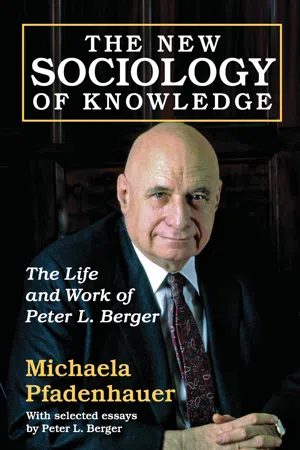
A classical sociologist can be defined as someone whose works occupied a central position among the sociological ideas and notions of an era. Following this criterion, Michaela Pfadenhauer demonstrates the relevance of Peter L. Berger's work to the sociology of knowledge. Pfadenhauer shows that Berger is not only a sociologist of religion, but one whose works are characterized by a sociology-of-knowledge perspective.Berger stands out among his fellow social scientists both quantitatively and qualitatively. He has written numerous books, which have been translated into many languages, and a multitude of essays in scholarly journals and popular magazines. For decades, he has played a role in shaping both public debate and social scientific discourse in America and far beyond.As a sociologist of knowledge, Berger has played three roles: he has been a theoretician of modern life, an analyst of modern religiosity, and an empiricist of global economic culture. In all areas, the focus on processes rather than status quo is characteristic of Berger's thinking. This book provides an in-depth view on the critical thinking of one of the most important sociologists that present times has to offer. It includes four written essays by Berger.
Information
1 Beginnings of the New Sociology of Knowledge: Influences, Teachers, and Collaborators
The clarity and frequency with which Peter L. Berger refers in his works to the intellectual currents that nurtured his sociology testifies to the influence of the sociology of knowledge on his self-concept. These references reveal—to others and to himself—that he is a child of a particular time, and that he acknowledges the zeitgeist that shaped his thinking. The intellectual traditions that influenced Berger most are associated mainly with the names Max Weber, Emile Durkheim, Karl Marx, Arnold Gehlen, George Herbert Mead, Alfred Schutz, and William James.1
The “theory for the sociology of knowledge” formulated in The Social Construction of Reality. A Treatise in the Sociology of Knowledge (Berger & Luckmann 1966a: 185) is a systematic integration of key elements of interpretive sociology, structural functionalism, early Marx’s philosophy of history, symbolic interactionism, philosophical anthropology, and phenomenology. While Berger’s main influence was Max Weber, his coauthor Thomas Luckmann’s thinking was shaped more by Alfred Schutz’s mundane phenomenology, even before he systematized the Schutzian approach in The Structures of the Life-World (Schutz & Luckmann 1973).
The following statement illustrates just how fundamental Berger considers Weber’s influence to be, not only on his sociological theory but also on his methodology, which he outlined in particular in Sociology Reinterpreted (Berger & Kellner 1981). For an intellectual who mistrusts -isms as a matter of principle, it is almost tantamount to a confession:
At my age I am no longer a champion of orthodoxies, except for Weberianism, of which I have been a devoted follower since my student days. That means that, in absolute fidelity to Max Weber, I believe in “value-free” social science. (2008a: 198; our translation)
This quotation reveals not only the dominant influence of Max Weber’s understanding of science, but also the kind of legitimation pressure that Berger is under. This pressure stems from the fact that he is a social scientist who regards himself as a sociologist and an ethicist—to wit, a social ethicist in the literal sense of the word—and he has never forbidden himself to pronounce value judgments on social phenomena.
Berger’s affinity with Max Weber was fostered by his Doktorvater Carl Mayer, who was his most important teacher at the Graduate Faculty of the New School in New York. In the preface to Invitation to Sociology (1963: viii), Berger pays tribute to him:
In all my thinking on my chosen field I owe an immense debt of gratitude to my teacher Carl Mayer. If he should read this book, I suspect that there will be passages that will make him raise an eyebrow. I still hope that he would not regard the conception of sociology here presented as too much of a travesty on the one he has been conveying to his students.
His extensive reading of Weber’s works had not only a methodological (cf. Chapter 5 below) but also a programmatic impact on Berger’s work. Hence, he does not dispute the fact that CURA’s agenda can be described as neo-Weberian (cf. Chapter 4 below). Moreover, when developing their theory for the sociology of knowledge, Berger and Luckmann took as one of their starting points Max Weber’s postulate that “both for sociology in the present sense, and for history, the object of cognition is the subjective meaning-complex of action” (Weber 1978 [1922]: 13).
However, in their reformulation of the sociology of knowledge (Berger & Luckmann 1966a), the authors did not limit themselves to Max Weber’s position. Rather, they integrated Weber’s “marching orders for sociology” with those given by Emile Durkheim, although the two approaches had hitherto been considered to be largely incompatible. In The Rules of Sociological Method (1938 [1895]: 14), Durkheim states: “The first and most fundamental rule is: Consider social facts as things.” The combination of these two perspectives yielded Berger and Luckmann’s famous question for sociological theory:
How is it possible that subjective meanings become objective facticities? Or, in terms appropriate to the afore-mentioned theoretical positions: How is it possible that human activity (Handeln) should produce a world of things (choses)? In other words, an adequate understanding of the “reality sui generis” of society requires an inquiry into the manner in which this reality is constructed. This inquiry, we maintain, is the task of the sociology of knowledge. (1966a: 18)
The notion that Weber and Durkheim’s positions were compatible may also have been influenced by the authors’ reception of Werner Stark’s book The Sociology of Knowledge: An Essay in Aid of a Deeper Understanding of the History of Ideas (1998 [1958]). Although Stark regards “the theory of functional integration as the substantial truth in matters of social determination,” he supplements it with recourse to Max Scheler and Max Weber:
. . for both taught that ideas came into existence under the aegis of guiding values, and values, in their very nature, are never “pure ideas” of the Platonic variety, residing in a metaphysical empyrean without reference to human affairs, but [are] always calls to a definitive mode of action as well as sources of a definite mode of thought, continually giving birth at the same time to subjective beliefs and attitudes and to objective features of life. (ibid., 272)2
Berger and Luckmann were introduced to Durkheim’s sociology at the Graduate Faculty of the New School, especially by Albert Salomon, who convinced them of the validity of a number of Durkheim’s key theses—first and foremost the insight that social facts must be considered as things, and that a society’s ability to function depends on a common set of values. In Modernity, Pluralism, and the Crisis of Meaning (1995a: 54), a publication they coauthored many years later, Berger and Luckmann refer explicitly to Durkheim’s concept of conscience collective, which René KÖnig (1976: 323) describes as the “essential precondition of all social life” and as an “entity that makes rules of behavior” (our translation). However, this does not imply the authors’ espousal of the strongly criticized theory of collective consciousness, but rather of what Durkheim called représentations collectives. This term refers to the collective ideas—that is, the common beliefs, norms, and values—of a community. Nonetheless, Berger and Luckmann remained committed to methodological individualism, arguing that the sociology of knowledge must concern itself with the socially transmitted meaning that Alfred Schutz calls “knowledge”— that is, the social stock of knowledge comprising general and special knowledge. Although this social stock of knowledge is greater than the sum of the subjective stocks of knowledge, it does not constitute a collective consciousness. Even though knowledge is for the most part socially transmitted, “its emergence as meaning is, however, due also to the original processes of constitution of the individual consciousness” (Knoblauch 2005: 121; our translation).
As in Durkheim’s case, Berger and Luckmann are confronted with the question of how order or stability can be ensured in a modern society that is no longer characterized by common moral foundations. They recognize a solution to this social problem in entities that mediate between society (or general rules) and individuals (or individualized reality). Durkheim calls these entities “intermediary groups”; Berger and Luckmann (1995a: 53) use the term “intermediary institutions.”
And, finally, like Durkheim, Berger was also searching for inner-worldly transcendence. While Durkheim was motivated by a desire to overcome the secular crisis that ensued after the French Revolution (cf. König 1976: 335), Berger—at a time when even theology was suffused with secularizing notions—was searching in normal human experiences for phenomena that appeared to point to another reality and that could therefore be interpreted as “signals of transcendence” (Berger 1969a: 53).
However, the influence of Alfred Schutz and—mainly via Schutz— William James on Berger’s thinking with regard to transcendence is also apparent. According to Schutz (Schutz & Natanson 1982: 207ff.) and James (2007 [1890]: 291), man is confronted not by one reality, but by many realities or “sub-universes.” While the existence of a supernatural reality beyond the reality of everyday life constitutes Berger’s main theological theme, the focus of his confrontation with modernity and individuation is on how people cope with what Alfred Schutz (1oc. cit.) termed the “multiple realities” in this world. His in-depth analysis of Robert Musil’s novel The Man Without Qualities (cf. Berger 1970b, 1998e) helped him to gain an understanding of Schutz’s concept (see Chapter 2 below).
It was also Alfred Schutz who introduced Berger to phenomenology as a pre- or protosociologically necessary enterprise that serves to “clarify the foundations of knowledge in everyday life, to wit, the objectivations of subjective processes (and meanings) by which the intersubjective commonsense world is constructed” (Berger & Luckmann 1966a: 20). From the outset, Berger’s interest in phenomenology was limited to those philosophical aspects that he deemed useful for sociological theory.3 Luckmann, on the other hand, immersed himself much more deeply in the philosophical program of phenomenology. Berger recalls that, “Unlike others with whom I worked in the early stages of my career (notably Thomas Luckmann and Maurice Natanson), I never entered in great depth into the Husserlian universe of discourse; Alfred Schutz was my major connection with the latter, and . . . this always left me in the antechamber rather than the inner sanctuary of the phenomenological edifice” (1986d: 223).
Both Max Weber and Alfred Schutz exerted an important influence not only on Berger’s sociological theory building but also on his methodological understanding. Indeed, Berger probably owes his awareness of the need for conceptual clarity to Weber and Schutz. Moreover, he recalls that Schutz’s requirement that PhD exam candidates summarize the key findings of their dissertation in three sentences at the beginning of their doctoral examination was instrumental in encouraging him to express his thoughts with clarity and brevity.
In connection with their reception of symbolic interactionism, Berger and Luckmann (1966a: 193–94, Note 25) explicitly refer to Friedrich Tenbruck, whom they credit in particular with “drawing heavily and successfully upon Mead and the Meadian tradition in the construction of sociological theory.” The ideal types of the social distribution of knowledge described in The Social Construction of Reality are derived from Tenbruck (cf. Knoblauch 2005: 162–63). Berger’s collaboration with Tenbruck originally came about via Luckmann. He kept it up while he was working on the research project at the Protestant Academy in Bad Boll. However, it fizzled out eventually because the working relationship became somewhat difficult for all concerned.
It should be clear by now that Thomas Luckmann has been Peter L. Berger’s most important collaborator. As mentioned earlier, they first met at a philosophy seminar given by Karl Löwith at the New School. Berger recalls that the seminar was quite boring and that he noticed Luckmann, who was trying to keep awake by doodling. This encounter marked the beginning of a deep friendship and a productive scientific collaboration that yielded—to mention just one, albeit very successful, result—The Social Construction of Reality (Berger & Luckmann 1966a). Writing about this collaboration, Luckmann (2001: 17–18) recalls the “breathtaking speed with which Berger hammered away at the typewriter, when, in the grip of inspiration, he put to paper a formulation to be used in one of our joint texts.” Most importantly, however, this collaboration was marked by great synchrony and harmony. Both men share not only a common mother tongue, experience of emigration, enthusiasm for the Habsburg—k.u.k—monarchy, and an affinity with certain philosophical and scientific traditions but also a fundamental consensus. In his laudatory speech on the occasion of the award of the Paul Watzlawick Ring of Honor to Berger in Vienna in 2008, Luckmann stated succinctly, “In other words whatever, or whoever, he found stupid, I found stupid, and vice versa. It must have been a pre-scientific elective affinity that stemmed from our different, but at the same time common, Kakanian roots.”
While it was Berger, a confessed Protestant with a long-standing interest in philosophical questions, who got Luckmann, a confessed Catholic, interested in the sociology of religion (Berger & Luckmann 1963d, 1966c), it was Luckmann who fostered Berger’s receptiveness to phenomenology and the problems of identity (Berger & Luckmann 1964b, 1966b). The two men later went separate ways in the sociology of religion insofar as their names now stand for two distinctly different concepts of religion (cf. Chapter 3 below). That this dissent did not undermine their consensus on other matters is illustrated, for example, by the fact that almost thirty years after The Social Construction of Reality (1966a) they coauthored quite an abstract study on Modernity, Pluralism, and the Crisis of Meaning (1995a), which was commissioned by the Bertelsmann Foundation. As in the case of The Limits of Social Cohesion (1997b), it was submitted as a report to the Club of Rome.
The Limits of Social Cohesion was a study of eleven countries with normative or political conflicts. The project was directed by Berger; both Luckmann and Hansfried Kellner were involved in an advisory capacity. Kellner was also a member of what Berger (2011: 80–81) jestingly calls the “clique” that came up with the idea for The Sociological Construction of Reality (1966a). In the end, that project was realized by Berger and Luckmann only, as the other members of the group—Kellner, Maurice Natanson, and Stanley Pullberg—were occupied with other projects.4 Berger collaborated with Kellner on an article entitled “Marriage and the Construction of Reality. An Exercise in the Microsociology of Knowledge” (1964). In retrospect, this is quite amusing because Berger was married to Kellner’s sister.5 The collaboration with Kellner, which was strengthened—or, at least, not weakened—by their family ties, also yielded Sociology Reinterpreted. An Essay on Method and Vocation (Berger & Kellner 1981). The book was a statement of their understanding of sociology, and, as evidenced by its explicitly exhortative character (“. . . what sociologists do, . . . what they are, . . . and what they should do and be” [ibid., 2]), it was addressed to sociologists in the making.
Berger’s wife Brigitte participated in the conversations of the clique, many of which took place in Mexico, where the Berger family spent the summer months between 1969 and 1972 at the invitation of Ivan Illich. As mentioned earlier, Illich ran a think tank called the Centro Intercultural de Documentación (“Intercultural Documentation Center”) in Cuernavaca. Influenced by their discussions with Illich about Latin America’s development problems, the Bergers and Hansfried Kellner started working on The Homeless Mind: Modernization and Consciousness (1973a) while in Mexico. Despite the fact that the two men held increasingly opposing views, Illich strongly impressed Berger, who admired the fact that he had formed his opinions independently of any ideological camp.
In 1972, Peter and Brigitte Berger published a textbook entitled Sociology: A Biographical Approach, in which basic sociological phenomena were presented in the order in which they would be encountered in the course of an individual biography. Some ten years later, the Bergers coauthored The War over the Family: Capturing the Middle Ground (1983a). The book provoked fierce controversy—not only in the doctrinaire feminist milieu in which Brigitte Berger had unwittingly, and unwillingly, landed when she took up the post of sociology chairman at Wellesley College in 1979, but also in conservative circles (cf. Berger 2011: 155).
Berger’s close friendship with Richard Neuhaus, a Lutheran minister who later converted to Catholicism, was of great importance when it came to analyzing theological and religious issues. What the two men had in common was their critical attitude toward the Protestant church that prompted them to initiate the Hartford Appeal for Theological Affirmation (cf. 1976a). What divided them was the fact that, when Neuhaus converted to Catholicism, he could not understand why Berger did not display the same religious rigor and follow suit.
When he founded the Institute for the Study of Economic Culture (ISEC) at Boston University in 1985, Berger extended the scope of his collaborations internationally and interdisciplinarily. His modus operandi as director of ISEC (and its reincarnations IRWA and CURA) was to have the field research for the institute’s projects conducted and coordinated by recognized experts on the research topic in question (see Chapter 4 below). This gave rise to a network in which several members were integrated on a permanent basis. These members included, for example, David Martin, an expert on Pentecostalism in Latin America; Ann Bernstein, an expert on the situation in South Africa; Bob Weller, who specialized in developments in Southeast Asia; Grace Davie, an expert on European secularization; and the Islam expert Robert Hefner, who later succeeded Berger as director of the Institute on Culture, Religion and World Affairs (CURA). Moreover, Berger cooperated on a one-off basis with other scholars, for example Samuel Huntington, with whom he codirected the project that yielded Many Globalizations (Berger & Huntington 2002a).
The list of Berger’s main academic collaborators would not be complete without Anton Zijderveld, a scholar who came from theology to sociology, and who holds doctoral degrees in both sociology and philosophy. As mentioned earli...
Table of contents
- Cover Page
- Title Page
- Copyright Page
- Preface
- Introduction and Biographical Overview
- 1 Beginnings of the New Sociology of Knowledge: Influences, Teachers, and Collaborators
- 2 Modernity and Pluralism
- 3 Religion and Desecularization
- 4 Culture and Socioeconomic Change
- 5 Knowledge and Reality
- 6 Reception and Impact of the New Sociology of Knowledge
- Reference
- Bibliography of Peter L. Berger’s Contributions to this Book
- Index
Trusted by 375,005 students
Access to over 1.5 million titles for a fair monthly price.
Study more efficiently using our study tools.
Frequently asked questions
Yes, you can cancel anytime from the Subscription tab in your account settings on the Perlego website. Your subscription will stay active until the end of your current billing period. Learn how to cancel your subscription
No, books cannot be downloaded as external files, such as PDFs, for use outside of Perlego. However, you can download books within the Perlego app for offline reading on mobile or tablet. Learn how to download books offline
Perlego offers two plans: Essential and Complete
- Essential is ideal for learners and professionals who enjoy exploring a wide range of subjects. Access the Essential Library with 800,000+ trusted titles and best-sellers across business, personal growth, and the humanities. Includes unlimited reading time and Standard Read Aloud voice.
- Complete: Perfect for advanced learners and researchers needing full, unrestricted access. Unlock 1.5M+ books across hundreds of subjects, including academic and specialized titles. The Complete Plan also includes advanced features like Premium Read Aloud and Research Assistant.
We are an online textbook subscription service, where you can get access to an entire online library for less than the price of a single book per month. With over 1.5 million books across 990+ topics, we’ve got you covered! Learn about our mission
Look out for the read-aloud symbol on your next book to see if you can listen to it. The read-aloud tool reads text aloud for you, highlighting the text as it is being read. You can pause it, speed it up and slow it down. Learn more about Read Aloud
Yes! You can use the Perlego app on both iOS and Android devices to read anytime, anywhere — even offline. Perfect for commutes or when you’re on the go.
Please note we cannot support devices running on iOS 13 and Android 7 or earlier. Learn more about using the app
Please note we cannot support devices running on iOS 13 and Android 7 or earlier. Learn more about using the app
Yes, you can access The New Sociology of Knowledge by Michaela Pfadenhauer in PDF and/or ePUB format, as well as other popular books in Social Sciences & Sociology. We have over 1.5 million books available in our catalogue for you to explore.