- 347 pages
- English
- ePUB (mobile friendly)
- Available on iOS & Android
eBook - ePub
About this book
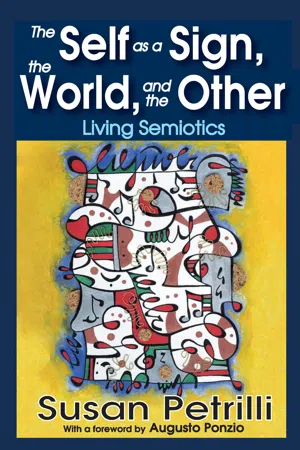
Ostentation of the Subject is a practice that is asserting itself ever more in today's world. Consequently, criticism by philosophers, psychologists, sociologists, and anthropologists has been to little effect, considering that they are not immune to such practices themselves. The question of subjectivity concerns the close and the distant, the self and the other, the other from self and the other of self. It is thus connected to the question of the sign. It calls for a semiotic approach because the self is itself a sign; its very own relation with itself is a relation among signs. This book commits to developing a critique of subjectivity in terms of the material that the self is made of, that is, the material of signs.Susan Petrilli highlights the scholarship of Charles Peirce, Mikhail Bakhtin, Roland Barthes, Mary Boole, Jacques Derrida, Michael Foucault, Emmanuel Levinas, Claude Levi-Strauss, Maurice Merleau-Ponty, Charles Morris, Thomas Sebeok, Thomas Szasz, and Victoria Welby. Included are American and European theories and theorists, evidencing the relationships interconnecting American, Italian, French, and German scholarship.Petrilli covers topics from identity issues that are part of semiotic views, to the corporeal self as well as responsibility, reason, and freedom. Her book should be read by philosophers, semioticians, and other social scientists.
Information
1
The Sign “Self” and Its Interpretations
Each man has an identity which far transcends the mere animal; – an essence, a meaning subtile as it may be. He cannot know his own essential significance; of his eye it is eyebeam.
(Charles S. Peirce, “Consciousness and Language,” CP 7.591, c.1867)1
Les sciences humaines doivent se convaincre que la réalité de leur objet d’étude n’est pas tout entière cantonnée au niveau où le sujet la perçoit.
(Claude Lévi-Strauss, Mythologiques 4, L’homme nu, 1971: 570)
1.1 The Lifeworld as Semiosis
The general title of this chapter indicates my intention to explore that particular sign through which we each identify ourselves—that is to say, the sign “self.” This sign is not just a grammatical category; it is not just a pro-noun. More than this, it signals a role, a part, a position; and each one of us can perform that role, that part, that position in different ways. Therefore, any “interpretation” of the sign “self” in the title of this chapter is not just an interpretation necessary for this sign in order to have meaning. More than this, in the current context “interpretation” also implies “performance.” Each one of us performs roles associated with the self. And to perform a role usually means either to identify with it or, less commonly, to do what Bertold Brecht advised the actor to do: stray from it, take one’s distances from it, recite it from the outside.
All this means to discover the self in its otherness—not only the otherness of the other from self, but also the otherness of the other of self. The self is other, “autrui,” as Emmanuel Levinas says. To recognize this means to take a critical stance toward one’s very own identity, toward the roles it performs, never taking them seriously, even adopting an ironic and parodic attitude toward them. From this point of view, the Russian philosopher Mikhail M. Bakhtin would speak of “extralocalization,” “exotopy.” As amply demonstrated by Bakhtin, extralocalization is a necessary condition for both the aesthetic and the ethic attitude. Without extralocalization, listening to the other, opening to the other, recognition of the other are not possible. If the self does not consider itself as other from self, it will never succeed in opening to the other—if not in those hypocritical forms that go under the name of tolerance.
The above considerations are intended as the premise for this chapter and those that follow, indicating the course I wish to take in this book and the sense in which I intend to develop the topic under discussion.
The expression “lifeworld” is recurrent in modern-contemporary philosophy. Lebenswelt: this concept is central to Edmund Husserl’s phenomenology. Nor did Husserl fail to relate his own phenomenological analyses of the lifeworld to the study of signs, meaning, and sense (Zeichen, Bedeutung, Sinn).
In contemporary semiotics, above all with Sebeok and his “semiotics of life” or “global semiotics” (Sebeok 2001), the relation between signs and life has qualified itself ever more in the sense that for signs to exist, there must exist life; therefore organisms, living beings. And vice versa: for life to exist, there must exist signs.
At this point, a few considerations on the expression “semiosis” are in order. This term is specific to the general science of signs, or “semi-otics,” standing for a situation in which sign activity or sign processes occur. And given that these situations and processes occur only in the organic world, the claim, following Thomas A. Sebeok, is that semiosis and life converge or, rather, mutually imply each other. Again, whether signs exist or not outside our planet—that is to say, in other worlds beyond our own world—is a wide-open question (Petrilli & Ponzio 2007a; Petrilli 2010a).
What is certain is that semiosis has undergone an evolutionary process that converges with the evolutionary processes of life, involving all living beings—with the difference that evolution in the human world from the hominid to homo sapiens sapiens has also involved transiting from nature to culture. Such transition has opened to extraordinary developments in semiosis, characterized by an ever-greater capacity for the production of signs on signs, “signs about signs.” These developments are connected with the capacity for conscious awareness and for self-consciousness (Morris 1949). In other words, as the human being has taken shape through evolution, not only has it emerged as an animal capable of making an immediate use of signs, but also of using signs to reflect on signs. This particular semiosic capacity specific to human beings has been denominated “metasemiosis” or “semiotics.” From this point of view, the science-denominated “semiotics” is a high-level development in evolution, reached on the basis of a capacity inherent in the human being now defined as a “semiotic animal” (Deely, Petrilli, Ponzio 2005; also Deely 2010a).
In light of present-day information, what this leads to is that at least one link in the semiosic loop—that is, one link in sign processes (metaphors apart)—is necessarily a living and terrestrial entity, even if just a portion of an organism or an artefactual extension fabricated by a hominid. After all, semiosis is terrestrial biosemiosis (Cobley 2000, 2002). Corollaries to Sebeok’s pivotal axiom that semiosis and life coincide include: semiosis is the criterial feature that distinguishes the animate from the inanimate; sign processes have not always existed in the course of the development of the universe; sign processes and the animate originated together with the development of life (see infra, 2.1.).
From all this, it follows that the self in its biological, cultural, and social aspects (which in real life processes cannot be separated from each other) can only be fully understood in the lifeworld context of semiosis, whether we refer to it directly or indirectly.
In his 1975 book, Trattato di semiotica generale (A Theory of Semiotics), Umberto Eco assigned what today is recognized as belonging to biosemiotics to “the lower threshold of semiotics.” But this meant to exclude whatever belongs to the “lower threshold” from the specific interests of semiotic theory. At the same time, Eco also left aside a ghost that can be glimpsed hovering in the background—namely the human subject as the actor of semiotic practice. According to Eco, the subject of semiotics, where “subject” is understood in the sense of subject-matter, topic, and protagonist, is semiosis. However, this does not mean to have to necessarily deal with the relation between semiosis and life or between semiosis and the concrete subject with its biological and historico-social conditionings.
In his subsequent works, Eco to an extent recovers what he had placed beyond the limits of semiotics in his Trattato. This is not our topic here. But what I do wish to underline in terms of this argument is that semiotics reduced to anthroposemiotics persists in proposing a vision of semiosis that is anthropocentric and oversimplified. And the consequences that ensue for our conception of the self, of its relation to the sign and to the other, are hardly acceptable in scientific terms.
Thanks to Sebeok above all and to his present-day continuators, we now know that contrary to the Saussurean approach to sign studies, the study of signs cannot be limited to the “science qui étude la vie des signes au sein de la vie sociale” (Saussure 1916: 33). In Sebeok’s view, zoosemiosis and biological foundations form the very epicenter of human signifying and communication processes, and, no doubt, zoosemiosical—or, rather, biosemiosical communication—must also be taken into account for a fuller understanding of specifically human bodies and signs.
1.2 Signs of the Self and the Self as a Sign
Human sign processes are endowed with a capacity for opening to the other, for creativity and critical interpretation, for continuous verification and revision. Therefore, the propensity for questioning interpretations and habits, for interrogating certainties and beliefs is in the nature of the human sign as we are describing it. In other words, the human sign understood as a critical “interpretant- interpreted” sign (cf. infra, 1.9.) is equipped for an existential adventure where stability, conviction, and truth are continuously called to issue and put into crisis. Human signs, where “human” is understood both in the sense of the signs that humans engender as well as of the values they express, are characterized by instability, uncertainty, and restlessness (cf. infra, ch. 7).
Therefore, that the self is associated with the sign, that the self is formed of signs, implies that the self as a sign is also appropriately characterized in terms of instability, indeterminacy. The self is endowed with a capacity for transcendence with respect to the logic of identity. As such it cannot be reduced to identity—that is, to social roles and functions oriented by the logic of identity.
In other words, the self cannot be identified with the position of subject. As a subject, the self, the I, calls for something in the position of object to depend on. A subject is only a subject relative to an object. Charles S. Peirce characterized this type of relationship in terms of duality, mutual dependency. But the self is capable of transcendence with respect to the object and to its function as a subject, which places it in a situation of otherness—not “relative otherness,” but “absolute otherness.” It is in the relation to the other, in the relation of other to other, autrui, including the self as other—a relation that cannot be reduced to the subject-object paradigm—that the self manifests itself in its absolute otherness, as other with respect to another. In the other-to-other relation, signs recover their capacity for opening, their pliability, plasticity, the unpredictability of sense with respect to meanings that have been fixed and accorded. Said differently, this relation flourishes outside the subject-object paradigm. It is oriented by the logic of otherness and concerns the relation of single to single, unique to unique. This relation is discussed by Levinas in Totalité et infini (1961) and in Autrement qu’être, ou au-delà de l’essence (1974), but Peirce before him had already begun outlining something similar through his interpretation of the sign as something that cannot be reduced to a mere exchange relation among preconstituted parts (Petrilli 2005b).
In terms of interpretive activity, which includes inferential processes of the abductive type, the self completes, organizes, and relates data that would otherwise appear fragmentary and partial. With the acquisition of experience that always tends to be innovative and qualitatively superior in contrast to original input, the self emerges as an open process in transformation, continuously reinventing itself.
As should be clear by now, the signs of the self—which are inevitably signs of the relation with the other—take form and substance precisely in the encounter with the other, according to the logic of otherness. The signs of the self lead outside and beyond the sign’s identity, beyond the logic of equal exchange among signs and sign components. For Peirce as much as for Welby (his companion in writing), as much as for Bakhtin and also Morris (Peirce’s direct successor in certain aspects), signs of the self and the self as a sign, as sign material, cannot be reduced to the logic of symmetrical or equal exchange between speaker and listener, utterer and interpreter, between encoding sign and decoding sign. Otherness and innovation, which means to say vagueness and excess logic, are in the very nature of the sign, of sign materiality, of semiosis and the dynamic and dialogic relation among signs.
From a Peircean perspective, characterization of the sign in terms of an open chain of interpretants is associated with conceptualization of the self as a process in becoming that is neither predetermined nor fixed. Insofar as the self is not given once and for all, but rather is in continuous trans/formation, it cannot withdraw from ongoing deferral processes among signs forming the open semiosic flux. The self attempts to barricade itself behind the boundaries of being and identity, where it seeks refuge, as when we become members of a class or group of some sort and demand recognition as this or that. But despite this, the self can be constructed and reconstructed only in translative/interpretive processes that connect thought-signs to interpretants in open-ended chains of deferrals from one sign to the next. It follows that the self cannot be reduced to the categories of being, to social roles and definitions sanctioned by the logic of identity; the self cannot comply with the logic of identity.
Insofar as it is sign matter that means to be grounded in otherness and dialogism, insofar as it converges with open semiosic processes, the self cannot avoid shifting outside the places and categories of being, outside roles and definitions in spite of its efforts to barricade itself within those very places. The Greek etymology of the word “dialogue,” therefore “dia-logism,” renders the idea of shift, displacement, deferral, movement, crossing over, transcendence; to evoke Bakhtin, dialogism implies otherness, intercorporeity, and extralocalization. In other words, dialogue or dialogism as we are describing it is connected with the logic of otherness, absolute otherness, involving a movement toward the other beyond closed and monologic identities, beyond assemblages, groups, classes, affiliations, beyond roles; it implies encounter, movement toward the other, the condition of otherwise than being.
1.3 The Self in-between Bodies and Signs
The main authors referred to in this book have already been presented and are named here once again for their special relevance to our theme. Charles S. Peirce explains “self-consciousness” in terms of the relation between the interpretant self and the interpreted self. This approach is associated with his dialogical conception of the sign and is already traceable in his early writings. He also emphasizes the “material quality” of signs, therefore of all sensation, feeling, and memory as well as of logical truth—ideas are always incarnate (CP 5.287–313). Even an abstract formula is supported by some sort of material such as chalk on a blackboard, ink on paper, or the voice that is phonic material connected with a body—and insofar as it is a voice, it is always a unique voice, an unrepeatable voice. Peirce’s approach can be associated with Bakhtin, who focused strongly on corporeity and maintained that “dialogue among ideas” is the result of abstracting from “dialogue among voices,” which means to abstract from the body. But as both Peirce and Bakhtin demonstrate, real dialogue, substantial dialogue, is not possible among disembodied minds.
Other authors referred to as signposts throughout this book include Victoria Welby, the ideator of “significs,” an expression she introduced in 1894 for her own special approach to the theory of sign, meaning, and communication, which she also described as a philosophy of interpretation, translation, and significance. Significs studies the conditions that make sign and meaning possible, their principles and foundations (see Welby 1896, now in Petrilli 2009: 430–439). Welby addressed problems of meaning, metaphor, and interpretation, understanding and translation, sense and significance highlighing the material constitution of signifying processes, with special reference to the biological component in the life of the self and of the sign. Emmanuel Levinas also thematizes the role of the body in his reflections on the self. Again, the materiality of the body renders the self unique. By virtue of the body, the self is unreplaceable; it enters a relation of otherness with the other (that is, “absolute otherness” in contrast to “relative otherness,” cf. infra, 1.4). Charles Morris authored a book that indicates this opening in the title: The Open Self (1948). The self moves toward the world, its vocation is the other—in other words, to say that the other is constitutive of the self, and for the self to recognize as much is decisive for even its very own health. Thomas Sebeok describes human signs and their specificity, comparing them to the signs of other animal species. He underlines continuity in difference and at once the condition of involvement and participation of human species-specific signs with the signs of all other life forms on earth.
All this points to the possibility of describing the self as an interpretant-interpreted relationship, as an incarnate entity, intercorporeal and intersubjective sign materiality that not only relates to external bodies and signs but is itself a body in semiosis, a body-sign. As should be clear by now, the body does not imprison the self but, on the contrary, renders it open, exposed to the other as it interrelates with other bodies and other selves.
The self subsists, acts, expresses, and communicates to the extent that it relates intercorporeally with other selves, other body-signs in the great semiosic network where bodies and signs cannot be separated if not by abstraction, for reasons of analysis. Intercorporeity and intersemioticity emerge as two distinctive features of subjectivity. The body plays a pivotal role in the development of consciousness, whether the conscious or the unconscious. As self-other, I-other, as interrelation among interpretant signs and interpreted signs, consciousness is incarnate consciousness, where the body is a necessary condition for the full development of potential consciousness and of the sign materiality that constitutes the human being.
Peirce developed a semiotic approach to subjectivity, which means to say he redefined the self in a semiotic key: the self is a sign or, rather, a sign relation, therefore it cannot be conceived separately from sign material; the self converges with the verbal and nonverbal language it uses and is at once transcendent with respect to the latter. The self is in semiosis, in the relation among signs; it consists of a potentially infinite number of signifying trajectories that unfold in the dynamics of the interrelationship between utterance and interpretation. In an early essay of 1868, “Some Consequences of Four Incapacities,” Peirce states that
The man-sign acquires information, and comes to mean more than he did before. But so do words . . . Man makes the word, and the word means nothing which the man does not make it mean, and that only to som...
Table of contents
- Cover Page
- Title Page
- Copyright Page
- Dedication Page
- Contents
- Foreword
- Acknowledgments
- Introduction: To Begin from a Semiotic Perspective
- 1 The Sign “Self” and Its Interpretations
- 2 A Terminological and Conceptual Intermezzo
- 3 The Inner-Outer Illusion
- 4 The Self as Opening to the Other
- 5 Self, Other, and Values
- 6 The Self in Language and Communication
- 7 Critique of Identity: For an Extracommunitarian Self
- 8 Self, Freedom, and the Word’s Otherness
- Small Glossary
- References
- Index
Trusted by 375,005 students
Access to over 1.5 million titles for a fair monthly price.
Study more efficiently using our study tools.
Frequently asked questions
Yes, you can cancel anytime from the Subscription tab in your account settings on the Perlego website. Your subscription will stay active until the end of your current billing period. Learn how to cancel your subscription
No, books cannot be downloaded as external files, such as PDFs, for use outside of Perlego. However, you can download books within the Perlego app for offline reading on mobile or tablet. Learn how to download books offline
Perlego offers two plans: Essential and Complete
- Essential is ideal for learners and professionals who enjoy exploring a wide range of subjects. Access the Essential Library with 800,000+ trusted titles and best-sellers across business, personal growth, and the humanities. Includes unlimited reading time and Standard Read Aloud voice.
- Complete: Perfect for advanced learners and researchers needing full, unrestricted access. Unlock 1.5M+ books across hundreds of subjects, including academic and specialized titles. The Complete Plan also includes advanced features like Premium Read Aloud and Research Assistant.
We are an online textbook subscription service, where you can get access to an entire online library for less than the price of a single book per month. With over 1.5 million books across 990+ topics, we’ve got you covered! Learn about our mission
Look out for the read-aloud symbol on your next book to see if you can listen to it. The read-aloud tool reads text aloud for you, highlighting the text as it is being read. You can pause it, speed it up and slow it down. Learn more about Read Aloud
Yes! You can use the Perlego app on both iOS and Android devices to read anytime, anywhere — even offline. Perfect for commutes or when you’re on the go.
Please note we cannot support devices running on iOS 13 and Android 7 or earlier. Learn more about using the app
Please note we cannot support devices running on iOS 13 and Android 7 or earlier. Learn more about using the app
Yes, you can access The Self as a Sign, the World, and the Other by Susan Petrilli in PDF and/or ePUB format, as well as other popular books in Philosophy & Philosophy History & Theory. We have over 1.5 million books available in our catalogue for you to explore.