- 206 pages
- English
- ePUB (mobile friendly)
- Available on iOS & Android
eBook - ePub
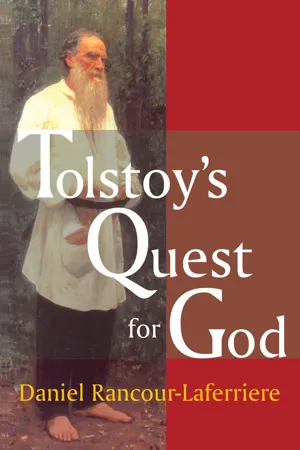
Tolstoy's Quest for God
About this book
The religious dimension of Tolstoy's life is usually associated with his later years following his renunciation of art. In this volume, Daniel Rancour-Laferriere demonstrates instead that Tolstoy was preoccupied with a quest for God throughout all of his adult life. Although renowned as the author of War and Peace, Anna Karenina, The Death of Ivan Ilych, and other literary works, and for his activism on behalf of the poor and the downtrodden of Russia, Tolstoy himself was concerned primarily with achieving personal union with God.Tolstoy suffered from periodic bouts of depression which brought his creative life to a standstill, and which intensified his need to find comfort in the embrace of a personal God. At times he was in such psychic pain he wanted to die. Yet Tolstoy felt that he deserved to suffer, and he learned to welcome suffering in masochistic fashion. Rancour-Laferriere locates the psychological underpinnings of Tolstoy's suffering in a bipolar illness that led him actively to seek suffering and self-humiliation in the Russian tradition of holy foolishness. With voluntary suffering, and Jesus Christ as his model, Tolstoy advocated nonresistance to evil, and in his daily life he strove never to return evil actions or words with physical or verbal resistance. On the other hand, being bipolar, Tolstoy in some situations would drift in a manic direction, indulging in delusions of grandeur. Indeed, the aging Tolstoy occasionally went so far as to equate himself with God, as can be seen from his diaries and personal correspondence.The pantheistic world view which Tolstoy achieved at the end of his life meant that God was within himself and within all people and all things in the entire universe. By this time Tolstoy was also utilizing images of a mother to represent his God. With this essentially maternal God so conveniently available, there was nowhere Tolstoy could be without Her. For, in the end, Tolstoy's quest for God was a
Information
1
Tolstoy Records His Religious Crisis
“Живъ Богъ, жива и душа моя."
—Снегирев
(“As long as God lives, so lives my soul."
—Snegirev)1
Remembering His Childhood
Late in 1879 Lev Tolstoy set to work on something that would be quite unlike anything he had ever published before. The personal spiritual concerns of the author of War and Peace and Anna Karenina could occasionally be glimpsed in characters like Pierre Bezukhov, Andrei Bolkonsky, Anna Karenina, or Konstantin Levin. But now that famous author of novels was writing about himself directly, without the cover of fictional personae. Confession (Ispoved’) is just what its title suggests—a spiritual disclosure, an acknowledgement of past sinfulness, and an attempt at an act of contrition. Only in this case Tolstoy is not speaking privately to a priest, but is telling the whole world his sins—and much else as well. He is writing in the well-established mode of autobiography which had been initiated by Saint Augustine’s Confessiones (written in 397), and continued by the idol of his younger days Jean-Jacques Rousseau in Confessions (1782).2 Confession is a good place to begin a study of Tolstoy’s religious views, for it is, in effect, a résumé of his religious past, as well as an introduction to what would later become his religious teachings.3
There is an exhibitionistic tinge to Confession, but that aspect of the work is fully justified by the author’s already established fame. Tolstoy is not some random stranger but a public figure whose personal life really is of interest. There is also a masochistic quality to the way Tolstoy repeatedly flagellates himself in the work for what he considers his past evil ways.4 That too is justified, if only by the religious genre marking of the title. The way to (attempt to) dispose of sins is to confess them.
As a child, Tolstoy, like all the children of the Russian gentry, was baptized and was taught the fundamentals of Russian Orthodox Christianity. By the time he was a grown man, however, he no longer believed in God. Indeed, long before he grew up he was questioning the existence of God:
I remember when I was eleven years old a high school boy named Volodinka M., now long since dead, came to see us one Sunday and announced the latest discovery made at school. The discovery was that there is no God and that everything we were being taught was pure invention (this was in 1838). I remember my older brothers taking a great interest in this news and even allowing me to join in the discussion. We all, I remember, became very excited and took the news as something very enthralling and entirely possible.5
The “long since dead” Volodinka who reported the news about God’s non-existence was one Vladimir Alekseevich Miliutin, who later became a fairly well-known academic, and who committed suicide in 1855.6 There is thus the gentle hint of a connection between suicide and the question of God’s existence already at the beginning of Confession. This connection will prove to be less tenuous, and truly essential, as we will see.
In an earlier variant of the passage quoted Tolstoy says of Volodinka that “we did not believe him.”7 Tolstoy’s memory of whether he did or did not believe Volodinka thus seems to be a bit shaky. Whatever the case, the young Tolstoy’s belief in God was itself rather shaky. As a child he “never believed very seriously,” he says, for he merely trusted in what his elders told him, and “this trust was very unstable.”8 He learned his catechism as he was supposed to, but when still quite young he also read and was amused by Voltaire (famous for his 1769 quip in the Epître CIV à l’auteur du livre des trois imposteurs: “If God did not exist, it would be necessary to invent him”).9 Christian belief, or at least the possibility of that belief—existed alongside worldly preoccupations. The young Tolstoy eagerly absorbed all that his socio-cultural world had to offer, including the contradictions built into it. He would sort things out later, in such autobiographical works as Confession and What I Believe, and in the diaries.
The early loss of a belief in God was a conscious phenomenon, but something of that belief nonetheless lingered on at an unconscious level:
The religious instruction communicated to me since childhood faded, as it does with others, only with the difference that since I had begun to read and think a great deal while still very young, my abdication of religious faith became conscious very early [ochen’ rano stalo soznatel’nym]. When I was sixteen I ceased saying my prayers, and I stopped going to church or fasting of my own accord. I no longer believed in what I had been taught as a child, but I did believe in something. What I believed in I could in no way have said. I believed even in God, or rather I did not deny God, but what kind of God I could not have said; neither did I reject Christ or his teachings, but what I understood by the teachings again I could not have said.10
Tolstoy is not contradicting himself here so much as he is reporting on the two contradictory processes that were going on in his psyche as a child. He knows he no longer believed in God already from an early age, yet he also knows he still believed in this God. It is just that the two processes coexisted at two levels within him. The first process—belief in God—is negated by the second process, but is not eliminated by it. The first process remains, even though it is not (yet) speakable: “what kind of God I could not have said.” One of the purposes of Tolstoy’s autobiographical writing is to achieve an ability to speak about this first process, to say—if only in writing—“what kind of God” (“kakogo Boga”) he believed in. In other words, Tolstoy is setting about the task of dredging up previously unspeakable, repressed material from his unconscious. He is engaging in a public (although clinically interminable) self-analysis.11
Tolstoy not only denies that he denied God, he adds that he did not deny Christ as well: “neither did I reject Christ.” This is an interesting juxtaposition. The Russian Orthodox Church teaches that Christ is God, Incarnate, that is, the second person of the Holy Trinity. By placing his denial of his denial of Christ in parallel with his denial of his denial of God, Tolstoy is suggesting at the very least a similarity between Christ and God. He is raising the possibility that Christ is God, or that God is Christ, or both.
For now, however, that possibility lies dormant as he moves on in the next paragraph to describe the idols he came to worship as the Russian Orthodox God receded from his life. It is the paragraph which concludes the first chapter of Confession, that is, the childhood chapter of Tolstoy’s life:
Now, looking back at that time, I can clearly see that the only real faith I had, apart from the animal instincts motivating my life, was a faith in perfection. But what this perfection consisted of, and what its aim was, I could not have said. I tried to perfect myself intellectually and studied everything I came upon in life. I tried to perfect my will, setting myself rules I tried to follow. I perfected myself physically, practicing all kinds of exercises in order to develop my strength and dexterity, and I cultivated endurance and patience by undergoing all kinds of hardship. All this I regarded as perfection. The beginning of it all was, of course, moral perfection, but this was soon replaced by a belief in general perfection, that is a desire to be better not in my own eyes or before God but in the eyes of other people. And very soon this determination to be better than others became a wish to be more powerful than others, i.e., more famous, more important, wealthier.12
Again Tolstoy seems to contradict himself. Whereas before he had said that he both had faith in God and did not have faith in God, now he says that his “only real faith” (“edinstvennaia istinnaia vera”—emphasis added) had been his faith in perfection (“vera v sovershenstvovanie”).13
What Tolstoy means, of course, is faith in self-perfection. He wanted to make himself as perfect as possible, and indeed the term he eventually comes to favor in his religious writings is “self-perfection.” For example, he writes in his diary on 3 February 1898, “the goal of life is self-perfection [samosovershenstvovanie].”14 From a psychoanalytic viewpoint, such a concern is narcissistic in nature, that is, it is very much focused on the self. Even a non-psychoanalytic contemporary such as Dmitrii Merezhkovskii referred to Tolstoy as “an eternal Narcissus.”15 Tolstoy himself was aware of his “egoism” (“egoizm,” as he repeatedly calls it in the diaries), and of the need to “break away from this terrible intoxication with myself, with my ‘I’,” as he writes on 26 June 1908.16 At times, when he was very upset and unable to test external reality in a meaningful way, he would make some extraordinarily narcissistic statements—such as this diary entry for 15 August 1910: “How strange, I love myself, but nobody loves me.”17 For most of his life, however, Tolstoy’s narcissism was not so extreme as to prevent him from functioning in the real world, and indeed certain aspects of his creativity owed much to the narcissistic personality disorder he suffered from.18
Tolstoy at Prayer
In order to perfect oneself, there has to be a model. Even narcissism requires a reflection. When Tolstoy is a believer, the model is God. To be perfect is to be as perfect as God, or rather, to approach the perfection of God, for even in his most grandiose moments Tolstoy does not claim he has actually attained divine perfection. In Confession Tolstoy does mention God, who is one possible model of “moral perfection.” In a variant text he mentions “some kind of religious love of what is good, a striving for moral perfection”19 which lived in him from an early age.
The divine model never disappeared permanently, despite the periods of apparent agnosticism or even atheism during Tolstoy’s lifetime. Evidence of a belief in God turns up sporadically in the young Tolstoy, and later in the mature novelist before his spiritual crisis of the late 1870s. After he works through the crisis God becomes a more or less permanent fixture in Tolstoy’s mind until his death in 1910.
An important component of the interaction Tolstoy has with this God may be characterized as prayer.20 Tolstoy recalls praying to God to help him pass an exam for getting into the university. This would have been in May of 1844, when he was age fift...
Table of contents
- Cover
- Half Title
- Title
- Copyright
- Contents
- Acknowledgements
- Introduction
- 1. Tolstoy Records His Religious Crisis
- 2. Tolstoy Attacks the Russian Orthodox Church
- 3. Tolstoy Tells Us What He Believes
- 4. Pantheistic Finale
- Bibliography
- Index
Trusted by 375,005 students
Access to over 1.5 million titles for a fair monthly price.
Study more efficiently using our study tools.
Frequently asked questions
Yes, you can cancel anytime from the Subscription tab in your account settings on the Perlego website. Your subscription will stay active until the end of your current billing period. Learn how to cancel your subscription
No, books cannot be downloaded as external files, such as PDFs, for use outside of Perlego. However, you can download books within the Perlego app for offline reading on mobile or tablet. Learn how to download books offline
Perlego offers two plans: Essential and Complete
- Essential is ideal for learners and professionals who enjoy exploring a wide range of subjects. Access the Essential Library with 800,000+ trusted titles and best-sellers across business, personal growth, and the humanities. Includes unlimited reading time and Standard Read Aloud voice.
- Complete: Perfect for advanced learners and researchers needing full, unrestricted access. Unlock 1.5M+ books across hundreds of subjects, including academic and specialized titles. The Complete Plan also includes advanced features like Premium Read Aloud and Research Assistant.
We are an online textbook subscription service, where you can get access to an entire online library for less than the price of a single book per month. With over 1.5 million books across 990+ topics, we’ve got you covered! Learn about our mission
Look out for the read-aloud symbol on your next book to see if you can listen to it. The read-aloud tool reads text aloud for you, highlighting the text as it is being read. You can pause it, speed it up and slow it down. Learn more about Read Aloud
Yes! You can use the Perlego app on both iOS and Android devices to read anytime, anywhere — even offline. Perfect for commutes or when you’re on the go.
Please note we cannot support devices running on iOS 13 and Android 7 or earlier. Learn more about using the app
Please note we cannot support devices running on iOS 13 and Android 7 or earlier. Learn more about using the app
Yes, you can access Tolstoy's Quest for God by Daniel Rancour-Laferriere in PDF and/or ePUB format, as well as other popular books in Literature & Literary Criticism. We have over 1.5 million books available in our catalogue for you to explore.