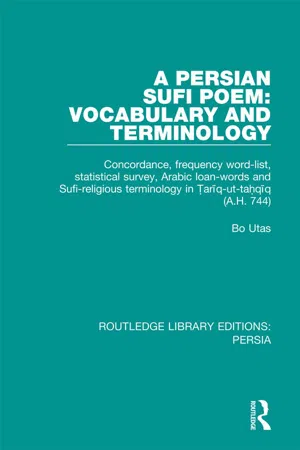
Vocabulary and Terminology: Concordance, frequency word-list, statistical survey, Arabic loan-words and Sufi-religious terminology in Ṭarīq-ut-taḥqīq (A.H. 744)
Vocabulary and Terminology: Concordance, frequency word-list, statistical survey, Arabic loan-words and Sufi-religious terminology in Ṭarīq-ut-taḥqīq (A.H. 744)
This book, first published in 1978, treats methods of describing the total and special vocabularies of a given text and demonstrates a procedure of description of the vocabulary of the Sufi Mathnavi poem ?ar?q-ut-ta?q?q, composed in the middle of the fourteenth century. The book gives a complete concordance, also indicating inflexional forms, and a complete frequency word-list of this New Persian text. The word-lists are followed by a statistical survey of the general vocabulary, the Arabic loan-words and the Sufi-religious terminology.
Ṭarīq ut-taḥqīq is partly an ethico-religious, partly a Sufi didactic poem. Its Sufi terminology is to a great extent identical with its general religious terminology. It seems impossible to separate the two. In this investigation they will be studied together under the designation Sufi-religious terminology or vocabulary.
An exact delimitation of a terminology of this character is probably impossible. Previous investigators in this field (see below) have generally avoided taking a direct stand on this difficult problem. The terminological nature of certain words has been taken for granted, which means that the process of selection of the terms has been directed by intuitive criteria. This may lead to acceptable results for most purposes, but the aims of the present study being to a certain extent quantitative and statistical, it has been judged necessary to establish explicit criteria for the selection of terms. In order to keep the focus on the terminology actually in use in the discussed text (as opposed to possible occurrences in the text of a generally current Sufi-religious terminology), it was desirable to find criteria which are relatively independent of external factors. The set of criteria established for this purpose is described below. The given definitions are far from being incontestable and should be considered as tentative, but once established they have been applied as strictly as possible. This has doubtless led to a number of cases where the inclusion or exclusion of a word seems peculiar, but for quantitative reasons it has been necessary to make a choice in each case and to base that choice on the explicit criteria only.
The main criterion is the “religious charge” of a word. This is taken to mean the use of a word in a religious context, so that it has either a positive or a negative sense religiously – in opposition to words/uses relating to worldly affairs or neutral religious circumstances, considered to have the religious charge zero. A word is considered a Sufi-religious term if it is found to be used with a religious charge once or more than once in the text. In combinations of words through iḍāfah or other close grammatical ties, only one of the words in a religiously charged expression is generally considered a term. The other word/words is/are considered to be only “coloured” by the charge of the term in question.
It will be noticed (see further Chapter VI.D.) that the terms tend to occur in pairs, either antithetically (“antonyms”, generally positive with negative) or correlatively (“paronyms”, positive with positive or negative with negative) or, but seldom, synonymously.1 This quality is used as a supplementary criterion for the selection of terms, so that the occurrence of a word in apparent antonymity, paronymity or synonymity with a word otherwise defined as a term will quality this word, too, as a term.
Only nouns and adjectives are included, with the exclusion of proper names, titles, compound words containing a proper name or title, quotations in Arabic and compound words held together with Arabic grammatical devices. Arabic duals, broken plurals and elatives and Persian comparative and superlative forms are counted as separate words and are given separate entries in the list of terms (with reference to the ground form entry).
These rules lead to a number of consequences that may seem less fortunate. A number of words that obviously belong to the religious sphere are excluded from the “terminology” under investigation. The most important of those words are the following:
ʿamal, action
ʿālam, world
ʿīsī (ʿīsā), Jesus
ajal, hour of death
alast, the Primal Convenant
arsalnā, “We sent” (i.e. the wisdom of the Prophet)
asfal us-sāfilīn, the lowest hell
auṣāf, attributes
ādam, human being, Adam
āfarīniš, creation
bātin, inside, internal
bīm, fear
but-kadah, idol-temple
čār-yār, the four (first) caliphs
daʿvat, invitation, propaganda
dil-sūxtah, bereaved
fadāʾil, virtues
fasād, corruption
fiṭrat, nature, creation
gūr, grave
hayūlā, matter
habīb, Muhammad
hašr, resurrection
ḥāl, state
ḥujjat, proof
iblīs, Iblis (Satan)
i
bāt, affirmation
jahd, exertion
Jānn, genii (pi. of 3inn) .
jilvah, manifestation
jismānī, corporeal
kaʿbah, Kaaba
kalām, word (of God, the Koran)
ṭilism, spell
kalīm, Moses
kasb, acquisition
kaun, existence
kaunain, the two existences
kāʿināt, created beings
kull, all, universal, universe
kun, “be!” (i.e. creation)
lauḥ, (the guarded) tablet
maḥšar, the last judgment
majbūr, constrained
majrūḥ, wounded
makān, place, space
makārim ul-axlāq, the noblest virtues
xāṣ ul-xāṣ, the super-elect
manzil, halting-place
maqām, station
Masīḥ, Messiah
masjid, mosque
Miḥnat, probation
mumkināt, contingencies
munazzah, exempt, pure
murīd, disciple
muxtār, free (in one’s action)
nafy, negation
Nušūr, resurrection
qaḍā, (God’s) decree, fate
qahr, (conquering) force
qiyāmat, resurrection
rāhib, monk
rūzgār, fortune, age
rūzī, daily bread, lot
subḥānī, “glory to me”
sūrah, Sura
šarr, evil
tasnīm, Tasnim (fountain in Paradise
ṭavāf, circumambulation
umīd, hope
ū, He (i.e. God)
valīyu’llāh’, friend of God, saint
vaqf, endowment
vaqt, time
vājib ul-vujūd, the necessary being
xair , good
xalīl, Abraham
xalq, creation, creatures
xarābāt, tavern
xāliq ul-xalq, the Creator
xātam, seal (of the prophets)
xirqah, patched (Sufi) frock
zamān, time
ẓāhir, outside, external
On the other hand, a number of ad-hoc compositions like falakpāyah,malak-sāyah, xujastah-pai, xujastah-qadam, and long compounds like bī-mi
l-u-šibh have been included.
Another difficulty is found in the fact that only separate words are counted and treated. Compound concepts, like ʿaql-i kull (universal reason), ʿuqūl-i ūlā (first reasons), nafs-i kull (universal soul) and nafs-i ammārah (commanding soul), are mentioned only under the main word (ʿaql, ʿuqūl, nafs, etc.) in the list of terms.
Metaphoric use of words and compound expressions also presents some difficulty. Generally, metaphors, images and similes are treated in the same way as other words and groups of words with regard to their religious charge. Thus, e.g., bādah-yi šauq (148) gives only šauq as a term, bādah az jām-i maʿrifat (381) only maʿrifat, bādah … a-z xum-i tahqīq (430) only tahqīq, luqmah az sufrah-yi ṭarīqat (445) only ṭarīqat, mai zi-xum- xānah-yi ḥaqīqat (445) only ḥaqīqat, luqmah az sufrah-yi balā (673) only balā, mai zi-xum-xanāh-yi riḍā (673)only riḍā, and mai-i viṣāl-i qidam (430) both viṣāl and qidam (based also on other occurrences).
This means that metaphors and images not used independently cannot be included in the terminology, while independent metaphors may be conceived of as religiously charged. But in such cases the word occurs in a complete and integrated sense in which the metaphoric use is scarcely obvious, as e.g. dad, dadī, dil-sitān, dil-šikasta...
Table of contents
Cover
Half Title
Title Page
Copyright Page
Table of Contents
I. INTRODUCTION
II. CONCORDANCE
III. FREQUENCY WORD-LIST
IV. STATISTICAL SURVEY OF THE GENERAL VOCABULARY
V. THE ARABIC LOAN-WORD VOCABULARY
VI. THE SUFI-RELIGIOUS VOCABULARY
VII. BIBLIOGRAPHY
APPENDIX: Critical text of Ṭarīq ut-taṬqīq
Trusted by 375,005 students
Access to over 1.5 million titles for a fair monthly price.
Study more efficiently using our study tools.
Frequently asked questions
Yes, you can cancel anytime from the Subscription tab in your account settings on the Perlego website. Your subscription will stay active until the end of your current billing period. Learn how to cancel your subscription
No, books cannot be downloaded as external files, such as PDFs, for use outside of Perlego. However, you can download books within the Perlego app for offline reading on mobile or tablet. Learn how to download books offline
Perlego offers two plans: Essential and Complete
Essential is ideal for learners and professionals who enjoy exploring a wide range of subjects. Access the Essential Library with 800,000+ trusted titles and best-sellers across business, personal growth, and the humanities. Includes unlimited reading time and Standard Read Aloud voice.
Complete: Perfect for advanced learners and researchers needing full, unrestricted access. Unlock 1.5M+ books across hundreds of subjects, including academic and specialized titles. The Complete Plan also includes advanced features like Premium Read Aloud and Research Assistant.
Both plans are available with monthly, semester, or annual billing cycles.
We are an online textbook subscription service, where you can get access to an entire online library for less than the price of a single book per month. With over 1.5 million books across 990+ topics, we’ve got you covered! Learn about our mission
Look out for the read-aloud symbol on your next book to see if you can listen to it. The read-aloud tool reads text aloud for you, highlighting the text as it is being read. You can pause it, speed it up and slow it down. Learn more about Read Aloud
Yes! You can use the Perlego app on both iOS and Android devices to read anytime, anywhere — even offline. Perfect for commutes or when you’re on the go. Please note we cannot support devices running on iOS 13 and Android 7 or earlier. Learn more about using the app
Yes, you can access A Persian Sufi Poem by Bo Utas in PDF and/or ePUB format, as well as other popular books in Social Sciences & Regional Studies. We have over 1.5 million books available in our catalogue for you to explore.