- 14 pages
- English
- ePUB (mobile friendly)
- Available on iOS & Android
eBook - ePub
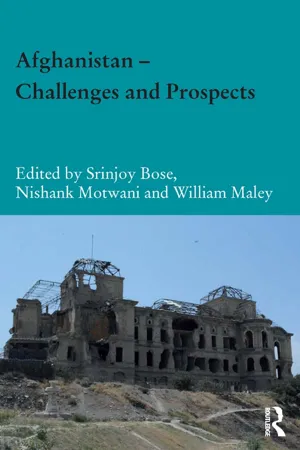
Afghanistan – Challenges and Prospects
About this book
After decades of turmoil a new phase is opening up for Afghanistan, in which a new generation comes to the fore as many of the key players from earlier phases, including foreign interventionist powers, leave the scene. Although this new phase offers new possibilities and increased hope for Afghanistan's future, the huge problems created in earlier phases remain. This book presents a comprehensive overall assessment of the current state of politics and society in Afghanistan, outlining the difficulties and discussing the future possibilities. Many of the contributors are Afghans or Afghan insiders, who are able to put forward a much richer view of the situation than outside foreign observers.
Information
1 Contextualising Afghanistan’s transitions
Influences and challenges
Winston Churchill once remarked that the Germans had done enough for the history of the world. Many Afghans, when looking back over the past four decades, may well feel that they, too, have contributed more to world history than could reasonably be expected of them. Yet the responsibility for making history rarely falls equally upon all. While many of the Afghan and international actors who contributed to the country’s troubles are now gone, many of the problems they created remain. A new generation of Afghans carries the burden of making political, social and economic transitions work, in an unpromising context for which they were not responsible and in a globalising world that they did not create. This book draws upon this new generation, as well as upon long-standing observers of Afghanistan, to shed light on the challenges that Afghanistan faces as ‘transition’ under a new leadership leads to the shrinking of the major international, and specifically US, presence that has been a dominant feature of its experience since Operation Enduring Freedom overthrew the Taliban regime in 2001.1
Afghanistan has undoubtedly had a turbulent history since its emergence as a distinct unit in the mid-eighteenth century, and it is tempting to view that history as fundamentally constraining the kinds of options from which Afghans can choose when seeking to craft their own futures. This is in significant ways a dangerous view to advance. The eighteenth and nineteenth centuries, and even the twentieth century, offer poor guides to the possibilities of the twenty-first century, and it is incentive structures created since 2001, rather than memories of past ‘golden ages’, that most powerfully determine where Afghanistan is likely to go. These incentive structures in turn owe a great deal to the forces of globalisation that have brought dramatic changes to Afghanistan since Operation Enduring Freedom reopened it to the world. Nonetheless, there are elements of Afghanistan’s more recent history that do have ongoing effects. Decades of war have broken down old institutions and networks, created new political actors and interests, and made people rationally wary of trusting their fellows, leading in turn to an erosion of social capital.
The fundamental, overwhelming trigger of Afghanistan’s current predicaments was the Communist coup of April 1978, followed by the Soviet invasion of Afghanistan in December 1979.2 While the roots of these developments were themselves complex, together they tipped Afghanistan into the equivalent of a social and political abyss from which it has long struggled somehow to extricate itself. The Communist coup brought to office a relatively small group of ideologues whose crude Marxist theorising had little light to shed on Afghanistan’s complex social realities. As a result, the popularity of the new regime plunged, revolts against its policies broke out in various parts of the country, and ultimately the USSR invaded with a view to saving the regime from the fate that seemed shortly to await it.3 Yet all the Soviet invasion had to offer was a life-support system. The mere presence of Soviet troops ruined the prospects that the puppet regime headed by Babrak Karmal would be able to secure legitimacy, and the Soviet invasion elevated Afghanistan to the status of a theatre of competition between the USSR and the USA, which saw the Soviet move into Afghanistan as an expansionist development threatening wider US interests. Not surprisingly, a new Soviet leadership eventually opted to withdraw Soviet forces, and the cessation of Soviet aid at the end of 1991 led directly to the collapse of the Communist regime in April 1992.4
A major consequence of these events was the substantial collapse of the Afghan state. Until 1992, this was disguised by the USSR’s ongoing assistance, but the moment this was cut off, the deeper problems of state cohesion came to the surface. By 1992 the Communist regime, headed by Dr Najibullah, had used Soviet assistance to purchase the prudential loyalty of power holders in critical parts of the country. With the cessation of these resource flows, these power holders realigned, largely along ethnic lines, leading also to the disintegration of the Afghan Army. The beneficiaries of this were the resistance commanders and parties (Mujahideen) that had taken shape in the 1980s to oppose the Soviet presence and the Communist regime.5 Over time, in a number of cases these resistance actors had become the recipients of significant loyalty from elements of the Afghan population, allowing them to claim degrees of legitimacy well exceeding what any of the Communists were capable of claiming. But that said, the resistance was never a united force, and within a short time of the collapse of the Communist regime one Pakistan-backed party, the Hezb-e Islami of Gulbuddin Hekmatyar, commenced rocketing Kabul – the main symbol of state authority – in order to ensure that no other resistance party would be able to claim credit for stabilising the country.
Pakistan was an important force at this point, because following the Communist coup and even more importantly the Soviet invasion, millions of Afghan refugees had fled to Pakistan. Out of an estimated pre-war Afghan population of 13.05 million people, some 6.2 million were to be found in Pakistan on 1 January 1990.6 This experience of forced migration not only caused massive social disruption within Afghanistan, but also empowered Pakistan as a frontline state, since the Afghan resistance parties to which the USA wished to transfer weapons had bases and supply chains in Pakistan, and recruited from the so-called ‘Refugee Tented Villages’ established on Pakistani soil. Unfortunately, Pakistan’s generosity in this respect also led it to the conviction that it was entitled to determine the character that the post-Communist regime in Afghanistan should take. At one level this was understandable, since Pakistan was reluctant to witness the resurgence of tensions with Afghanistan that had marked much of Pakistan’s life since its establishment in 1947; but this conviction totally overlooked the ground reality that, having just rid themselves of Soviet domination, Afghan leaders were in no mood to be subordinated to Islamabad.
The upshot was not just regrettable, but deeply tragic. The Pakistan-supported Hezb-e Islami was an extremist group with a dictatorial leader, and ordinary Afghans had little disposition to go down the path it offered. As a result, the Hezb, while more than capable of raining terror on the residents of Kabul, proved notably unequal to the task of holding or administering territory. It was this failing that in 1994 prompted Pakistan’s Interior Minister, Major-General Naseerullah Babar, to throw his ministry’s support behind a new force that came to be known as the Taliban.7 To the consternation of Pakistan’s Foreign Ministry, Babar referred regularly to the Taliban as ‘our boys’.8 Facing opponents exhausted by years of conflict, the Taliban, drawing upon pupils from Pakistan-based madrassas (or religious training colleges) and upon fresh equipment provided by their patrons, succeeded in taking over Kandahar in 1994, Herat in 1995, and finally Kabul in 1996. They proved, however, to be antediluvian in their social and political views, which blew their chances of securing international recognition; and increasingly they resorted to terror to protect their position, with some 2000 ethnic Hazaras being massacred by the Taliban in just three days in Mazar-e Sharif in August 1998.9 Even their Pakistani patrons found them difficult to handle.10 Increasingly, they associated with fringe groups in the Muslim world, and this culminated in their fatal linkage with Osama bin Laden, leading directly following the 9/11 terrorist attacks to Operation Enduring Freedom and the ultimate overthrow of the Taliban regime.
One final longer term influence to bear in mind was very substantial disruption to the economic life of the country. In some parts of Afghanistan, the sheer physical damage from bombardment was enormous. In a more insidious fashion, large refugee movements and internal displacement detached young people from the opportunity to learn in situ the skills required to sustain agriculture or pastoral industries. Furthermore, the degradation over time of the country’s infrastructure affected the cost structures and economic viability of a number of industries and enterprises, even if they had not been directly targeted during the course of war. Thus, while Afghans are in many respects intensely entrepreneurial, they face a burden of considerable weight in seeking to give effect to their entrepreneurial impulses.
Some key influences on Afghanistan’s coming phase
The coming years are likely to be some of the most important in Afghanistan’s recent transition. The departure of Hamid Karzai from the Presidential Palace, of which he was the main occupant from December 2001, has provided one element of transition, although reports continue to surface of plotting by his retinue.11 Afghanistan’s President from 2014, Dr Ashraf Ghani, is a very different person, a technocratic intellectual rather than a politician from the Mujahideen era. Another element has been the substantial withdrawal of the foreign forces that played multiple roles in seeking to guarantee Afghan security and foster reconstruction in areas most damaged by the war.12 Yet the prospects for the future are in substantial measure likely to be shaped by the legacies of Karzai’s tenure in office, and some of the key influences on the future arising from the period from 2001 to 2014 need therefore to be identified. Seven in particular stand out.
First, during the period since 2001, Afghanistan has developed a political system of a neopatrimonial character that has seen formal institutions intertwined with informal practices of patronage and clientelism.13 (Karzai was actually encouraged to take this path by US Defense Secretary Donald Rumsfeld, who naively viewed Afghanistan as akin to Chicago under Mayor Richard J. Daley in the 1960s, and argued that Karzai ‘should learn to use patronage and political incentives’.14) As a result, some of the most notable strengths of an institutionalised political system such as clarity over roles and responsibilities have not been realised. This in turn has fostered practices inimical to political institutionalisation, notably epic levels of fraud contaminating the 2009 and 2014 presidential elections, the latter of which saw the electoral authorities themselves thoroughly compromised.15 When such pathologies emerge, a number of consequential problems can arise. On the one hand, ordinary people may react with disgust, realising that their votes no longer matter and that power is asymmetrically distributed in favour of the well connected. On the other hand, at the elite level the message that goes out is that playing the neopatrimonial game is the way to succeed. When this is the case, correcting the course of the ship of state may prove very difficult. Finally, in a neopatrimonial system the rule of law as a principle constraining the exercise of power is typically weak, and high levels of impunity are enjoyed by those with friends in the right places.
A second challenge comes in the form of diminished levels of trust. Neopatrimonialism, with its emphasis on personalistic networks and its tendency towards nepotism, is itself a reflection of the way in which decades of conflict have made it potentially very imprudent for people to trust those to whom they are not tightly linked. In other words, civic trust, which is a form of social capital, has given way to face-to-face trust.16 When this happens, it is very difficult to secure the degree of cooperation at elite levels on which the stable conduct of political life arguably depends.17 Nor can one reasonably expect that this problem will be swiftly overcome, since it is rationally grounded in what have often been the bitter personal experiences of key political actors. This (predictable) problem was greatly compounded by the adoption in the 2004 Afghan Constitution of a presidential system that concentrates a great deal of formal power in the hands of one office holder. Such a ‘winner takes all’ system is virtually the last that should be chosen for a divided country in which levels of civic trust are low,18 and the acute tensions that have surrounded the two most recent presidential elections are very much a reflection of this problem.
Third, and again not surprisingly, identity politics has increasingly surfaced in Afghanistan, not so much in political discourse which happily still tends to avoid the more rampant ethnic vocabularies that have been used in other conflict situations, but certainly in endeavours to mobilise elements of the population. Once again, presidential elections have proved destructive in this respect. While the patterns of support for candidates in the April 2014 first round of presidential voting suggested that at the margins at least, ethnic blocs were eroding, at the June 2014 second round of voting ethnicity was much more prominent a factor, especially for the fraudsters. In such circumstances, it is not just disappointment on the part of individual candidates that poses a problem; it is equally the difficulty that even statesmanlike candidates may experience in controlling the passions of their followers who may see fraud as a device for securing exclusive power for one ethnic group at the expense of others. Where this is the case, ethnic identities can rapidly cascade to enjoy a salience that they have long been denied, and this is one of the last things that would benefit Afghanistan in the post-2014 transition period.
A fourth influence on the transition comes in the form of criminal mafias that have flourished since 2001, especially in the context of the opium industry.19 Given the weakness of the rule of law in Afghanistan, this is hardly surprising. Through the use of intense coercion, the Taliban regime in the year prior to its overthrow had reduced Afghanistan’s opium output to negligible levels, although this was most likely because large stocks of raw opium had already accumulated and the Taliban believed they would be able to win some kudos internationally at minimal cost. In the immediate aftermath of the overthrow of the Taliban regime, there was a window of opportunity to block the revi...
Table of contents
- Cover
- Half Title
- Title Page
- Copyright Page
- Dedication
- Table of Contents
- List of illustrations
- Notes on contributors
- 1 Contextualising Afghanistan’s transitions: influences and challenges
- 2 Neither war nor peace
- Part I The politics of the state
- Part II State, society and governance
- Part III Social change
- Part IV Afghanistan and the world
- Index
Trusted by 375,005 students
Access to over 1.5 million titles for a fair monthly price.
Study more efficiently using our study tools.
Frequently asked questions
Yes, you can cancel anytime from the Subscription tab in your account settings on the Perlego website. Your subscription will stay active until the end of your current billing period. Learn how to cancel your subscription
No, books cannot be downloaded as external files, such as PDFs, for use outside of Perlego. However, you can download books within the Perlego app for offline reading on mobile or tablet. Learn how to download books offline
Perlego offers two plans: Essential and Complete
- Essential is ideal for learners and professionals who enjoy exploring a wide range of subjects. Access the Essential Library with 800,000+ trusted titles and best-sellers across business, personal growth, and the humanities. Includes unlimited reading time and Standard Read Aloud voice.
- Complete: Perfect for advanced learners and researchers needing full, unrestricted access. Unlock 1.5M+ books across hundreds of subjects, including academic and specialized titles. The Complete Plan also includes advanced features like Premium Read Aloud and Research Assistant.
We are an online textbook subscription service, where you can get access to an entire online library for less than the price of a single book per month. With over 1.5 million books across 990+ topics, we’ve got you covered! Learn about our mission
Look out for the read-aloud symbol on your next book to see if you can listen to it. The read-aloud tool reads text aloud for you, highlighting the text as it is being read. You can pause it, speed it up and slow it down. Learn more about Read Aloud
Yes! You can use the Perlego app on both iOS and Android devices to read anytime, anywhere — even offline. Perfect for commutes or when you’re on the go.
Please note we cannot support devices running on iOS 13 and Android 7 or earlier. Learn more about using the app
Please note we cannot support devices running on iOS 13 and Android 7 or earlier. Learn more about using the app
Yes, you can access Afghanistan – Challenges and Prospects by Srinjoy Bose,Nishank Motwani,William Maley in PDF and/or ePUB format, as well as other popular books in Social Sciences & Ethnic Studies. We have over 1.5 million books available in our catalogue for you to explore.