eBook - ePub
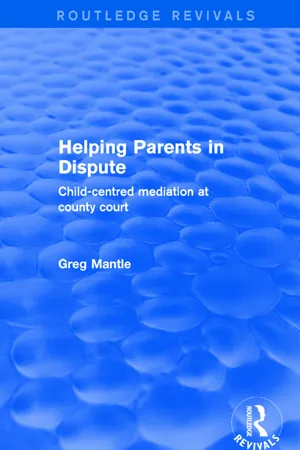
Revival: Helping Parents in Dispute (2001)
Child-Centred Mediation at County Court
- 198 pages
- English
- ePUB (mobile friendly)
- Available on iOS & Android
eBook - ePub
About this book
This title was first published in 2001. When marriages break down, most parents experience difficulty in agreeing on contact or residence arrangements for their children. Family Courts Services provide mediation as a way of resolving differences and many parents accept this offer of assistance. Featuring extensive empirical research, this book examines the effectiveness of family mediation services and challenges the view that court-based interventions are unlikely to be successful.
Trusted by 375,005 students
Access to over 1.5 million titles for a fair monthly price.
Study more efficiently using our study tools.
Information
1 Introduction
Family mediation is a relatively new development, even when its immediate predecessor, ‘family conciliation’, is taken into account. Nevertheless, over the past three decades, the settling of disputes between parents by ‘informal’ methods, rather than via more traditional, legalistic routes, has rapidly come to prominence. There are at least two crucial caveats to such statements: first, the emergence of family mediation in the West may, in fact, be traced back to much earlier times; and, second, mediation has been practised in other parts of the world as far back as the fifth century BC (Parkinson, 1997, pp.2–3).
Family dissolution is frequently associated with high levels of antagonism and conflict between parents, and the space to find mutually-acceptable arrangements, as to where children will live and when they will be able to spend time with their non-resident parent, may become considerably reduced. The importance of being able to reach a settlement on such matters is widely recognised, as are the consequences for children being exposed to parental conflict pre- and post-separation (Rodgers and Pryor, 1998, pp.41–42). The need for some form of external intervention – the provision of information, support services, counselling or dispute resolution via the courts, therapy or mediation – is therefore readily apparent, although the focus in the UK has to date been mainly on providing specialist services to parents rather than to children. The direct involvement of children, affected by the separation of their parents, in the processes aimed at achieving agreement on residence and contact arrangements remains largely undeveloped, although there are indications that this state of affairs may be changing (Robinson, 1999).
Mediation has become an attractive option to more formal methods of dispute resolution in a wide range of fields, including: criminal justice, bringing victims and offenders together (Marshall and Merry, 1990; Wright 1996; Strang and Braithwaite, 2000; Wynne, 2000); peer mediation in schools (Hartop, 1996; Bitel and Rolls, 2000; Lawrence, 2000); and industrial and commercial sectors (Donahey, 1995; Newman, 2000; Reynolds, 2000). There is evidently considerable value in being able to set family mediation within this wider frame of reference but there is also a need to differentiate it from related, informal procedures that may be employed. ‘Negotiation’ is usually understood as a way of solving conflicts by the disputants themselves – parents often reach an agreement without involving solicitors or mediators. ‘Arbitration’ may be defined as involving a neutral third party who, having heard all sides to the dispute, provides a final decision. This is similar to the process of legalistic ‘adjudication’ – sometimes referred to as ‘litigation’, although this latter term may perhaps be more helpfully defined as the act of bringing or contesting a lawsuit. The difference between arbitration and legalistic adjudication is that the former, although structured, may be much less regulated than the courtroom, with its set procedures and exacting rules of evidence. ‘Mediation’ may thus be conceptualised as a means of helping parties in dispute reach a settlement, the terms of which are decided by the disputants rather than by the mediator(s). Mediators do not expect to adjudicate, rather she or he manages negotiations between, usually, two parties who are in dispute. However, disputants, especially those who are unfamiliar with the role of mediation, frequently do expect mediators to ‘judge’ and this proclivity is recognised within the professional literature as a potential obstacle to proceedings (Haynes, 1993, p.6).
Mediation may also be distanced conceptually from ‘therapy’ and, in the context of family court dispute resolution, this produces a helpful triadic frame of mediation, judicial intervention and therapeutic approaches. Mediation may thus be regarded as an alternative to therapy as well as an alternative to legalistic adjudication. It is important to acknowledge that family court practitioners have a long-standing tradition of employing methods rooted in social work and psychodynamics in their work with families: their understanding of, and opinions about, mediation will therefore be set within this practice heritage and broader assumptive world. Some practitioners have argued for the greater use of therapeutic approaches in cases where mediation appears inappropriate because of the level of antagonism between parents (Waite, 2000). In such situations, judicial intervention is the norm, involving calls to the disputants to ‘put the child's needs first’ and, possibly, the imposition of various discomforts and sanctions. Protagonists of therapy take the view that such a legalistic approach is doomed to failure because it addresses only the symptoms of the conflict, rather than the underlying causes: mediation, even if possible, would likewise be deemed too superficial.
Positioning mediation within this analytical framework, as an alternative to both judicial and therapeutic responses, readily brings to mind the potential utility of a political metaphor for understanding organisational behaviour within the family court environment (Morgan, 1986, pp.141–198). Decisions about which of the three available options for dispute resolution to employ for a particular case would thence be perceived as having political, as well as ‘professional’, dimensions. The query ‘Who is mediation for?’ thus begs a number of key questions about the relative powers and accountabilities of the various stakeholder groups concerned: for example, practitioners might be tempted to categorise a couple as unsuitable for mediation, perhaps with an accompanying rationale emphasising the level of antagonism between the two parties, in order to enhance their ‘success rate’ within an organisational context that stipulates targets and standards for performance. The organisational politics of family dispute resolution and, relatedly, of family mediation has, to date, been afforded little attention in the literature.
Of course, even within the context of family disputes, the term ‘mediation’ has been applied to a wide range of different practices. There are many types of mediation. There is also disagreement about whether or not particular practices of dispute resolution should actually be classified as ‘mediation’. Writing about mediation thus runs the risk of over-generalisation and it is therefore important to define as clearly and as early as possible the parameters of the work. This is a book about one specific type of family mediation, namely ‘county court dispute resolution’, that is carried out on court premises by family court service officers and, although some wider relevance seems inevitable, no general application nor pertinence is uncritically proffered.
Characteristics of County Court Mediation
Mediation has two main forms: ‘child-centred’, which is concerned solely with assisting parents to make arrangements about, mainly, residence and contact for their children – and ‘all issues’ or comprehensive mediation, which also includes financial and property matters. This essay is concerned solely with child-centred mediation that ensues on county court premises and follows receipt of an application for an order under section 8 of the Children Act 1989. Most of the applications included in the Essex study (see below) had been made by a natural parent of the child/children concerned: about two thirds of ‘couples’ had been married, while about one third had not been married, but had cohabited. While the focus of the work is on ‘county courts’, it is acknowledged that mediation also takes place under the auspices of family proceedings courts. Similarly, the specification of location – ‘county court premises’ – is made within a recognisance that mediation may also take place elsewhere.
Mediation may also be classified by the number of sessions or meetings that are offered in order to reach a settlement. Lindstein and Meteyard (1996) distinguish four such types: single consultation, short-term, medium-term and long-term. The definitions offered by the authors for these categories are difficult to decipher from the text but it is possible to say that by ‘short-term’ they mean two sessions. Lindstein and Meteyard respond to the apparent conceptual proximity of single consultation and short-term as follows:
Two sessions may seem like a very short series and hardly much different from a single consultative session. But in fact, agreeing to meet a second time can make a decisive difference and may signify the start of a constructive process (p.39).
This book addresses the practice of employing a single consultation in order to resolve a dispute between parents. Although a number of cases in the Essex study did involve further mediation meetings, the research focus is on the initial session, because that is where an agreement had been reached. Subsequent settlements reached by the couple, during the study time period, were not treated as constituting a survey ‘case’ within the research frame.
Mediation has been and is provided by a range of different agencies and traverses a number of different professional disciplines. Some mediation services operate independently, others are provided by charitable bodies, and some are statutory. Some mediators are counsellors, others are lawyers, perhaps with a particular interest in the resolution of financial disputes. Many are family court service officers employed by area probation services, at the time of writing, although soon to become members of the Children and Family Court Advisory Support Service (CAFCASS). This book is concerned with the mediation services provided at county courts by family court officers.
The number of mediators involved in any one session offers a further way of categorising practice: co-mediation, the employment of two practitioners, may usefully be distinguished from sole reliance on one mediator. Having two mediators present, one female and one male, may be understood as a way of avoiding a ‘gender-imbalance’. Furthermore, in cases of co-mediation, both mediators may have similar roles or they may have different roles – co-mediation may embrace mediators from different disciplines, say counselling and the law, or both mediators may come from the same profession. This essay examines the use of sole and co-mediation by family court service officers.
Finally, it is important to acknowledge the widespread acceptance that mediation is, and that it should be, entirely voluntary. In other words, parents should not be obliged to undertake mediation: put sharply, mediation and coercion may be regarded as incompatible. However, in reality, ‘mediation’ can be formally required: Robinson (1999, p.133) refers to services in California, for example, that operate on such a non-voluntary basis and she usefully points out that much of the extant research in this field has been conducted in the United States. It is important therefore, given the international audience of this book, to state that the work is concerned solely with voluntary mediation, in the sense that parents are not formally required to submit to it. However, the issue of participation is much broader. There is a need to go beyond the limits of ‘formal requirement’ because parents may well feel that they ‘ought’ to take their respective disputes to mediation, even though no such stipulation exists. Some may even fear the predicted reaction of officialdom should they not do so. These are key sensitivities, bringing user/consumer constructions of the basis of mediation to the foreground of consideration and prompting a set of searching questions. Who, for example, do mediators represent? What powers are they perceived to command? Does their heralded association with ‘court’ announce special privilege? How might refusal be met and what consequences could ensue? The pertinence of such questions has been sharpened by recent developments such as the provision of compulsory ‘information meetings’ under section 13 of the Family Law Act 1996 (Cretney, 2000, p.70; McCarthy, 2000). At time of writing, this section of the Act has yet to be implemented, although pilot schemes have been instigated in order to establish how best to deliver the meetings. Piloting is also underway in relation to section 29 of the 1996 Act, amending section 15 of the Legal Aid Act 1988, so as to make eligibility for legal aid conditional on the applicant having attended a meeting with a mediator, in order to assess the suitability of mediation. Mediators have argued strongly that this requirement does not mean that mediation will no longer be voluntary in such cases (Stevenson, 2000, p.40) and, in a formal sense, this is probably accurate. However, Section 29 includes the following precept:
…if mediation does appear suitable, to help the person applying for representation to decide whether instead to apply for mediation…
and much would appear to hang on the interpretation of the verb ‘help’ therein. Clearly, the emphasis for the mediator undertaking the assessment has been placed on encouraging a decision for, rather than against, mediation. Disputants may therefore feel under no little pressure to opt in favour of mediation. As yet, the available empirical evidence from the pilots suggests that this is unlikely to be happening: the vast majority of people attending an information meeting do not proceed to mediation (80 per cent – Davis, 1999, p.631; 93 per cent – McCarthy, 2000, p.553). Nevertheless, the issue of voluntariness will no doubt continue to feature prominently in mediation discourse. Similarly, the relationship between mode of funding and ‘choice’ must remain a matter of public concern. As Liebmann (2000, p.13) points out, wealthier people may retain the options of mediation or employing a lawyer, while poorer individuals may be ‘encouraged’ to go to mediation. Men, who are more likely than their ex-partners to be able to afford both legal representation and mediation fees, are also (further) advantaged.
In regard to the Essex study population, it is not possible to provide figures pertaining to the proportions of mediation disputants respectively state- and self-funded. However, it is possible to say that, on the basis of the interview and postal survey data collected, some parents had been financed via legal aid while others had been self-funded. In a formal sense, all disputants attended mediation on a voluntary basis, although the research data suggests that some may have felt obliged to participate for one reason or another.
Introducing the Chapters
Chapter 1 defines the focus of the book and considers how the need for mediation might be gauged. Chapter 2 reviews traditional wisdom about the significance and effectiveness of mediation, and argues the case for an expansion of the current measures of efficacy to include the duration of mediation settlements. The question of whether or not agreements stand the test of time has, to date, received little attention in professional and academic literatures: chapter 2 not only sheds some light on why this omission may have occurred but also begins to pave the way for widespread recognition of the ‘persistence of settlement’ as a valid criterion of success in mediation practice. The assumption made by central government, that court-based mediation is less likely to be effective than services otherwise delivered, is also shown to be worthy of considerable circumspection.
Chapter 3 takes a look at mediation from the father's perspective. The issue of contact between children and their fathers is presently of enormous interest and debate, and this chapter makes a substantial contribution through an exploration of the views and preoccupying concerns of male service users in regard to mediation outcomes and processes. The presumption that contact must be beneficial is critically examined and the chapter concludes that the lack of a clear picture of what productive, post-divorce fatherhood might look like is unhelpful to parents and to mediators. Chapter 3 also addresses the case of resident fathers and points to the need for further study of the utility of traditional concepts of ‘mothering’ in the area of sole male parenting. Relatedly, a search for the rationale of the non-resident mother's right to contact is commended.
Chapter 4 considers the safety and utility of mediation in cases involving intimate partner violence, drawing upon the views of women service users in the contexts of shared waiting areas and seating arrangements during mediation. Women who have suffered violence are likely to feel very anxious about meeting their ex-partner and this chapter relates a series of harrowing experiences that serve to pose sharp questions for current mediation practice, especially the use of confrontational, face-to-face’ seating formats during sessions. The acceptability of the notion of ‘domestic violence’, commonplace in professional and academic discourse, is also revisited.
Chapter 5 takes a look at the parts played by lawyers and judges in mediation, through the eyes of the parents who are seeking solutions to their contact and residence disputes. The consequences for mediators of only one of the two parents being legally represented are addressed. Many lawyers continue to be ambivalent about the position of mediation in divorce proceedings and chapter 5 considers why this should be so. The ramifications of mediating within a court ambience are also considered: notions and effects of formality and gravity are reviewed.
Chapter 6 examines key contemporary assumptions concerning ‘best practice’ in mediation. The phenomenon of co-mediation is scrutinised. Attention is paid to the preparation of parents for their mediation meeting and to the expectations that they bring. The setting and policing of ‘rules of engagement’ are reviewed in the light of user testimony. Chapter 6 also addresses the professionalisation of mediation work, its pursuit of ‘neutrality’ and detachment, and how such developments may be perceived by those on the receiving end of practice. Important questions are raised about the delivery of service to minority sections of the community. Finally, the involvement of the child in mediation is examined and doubts are raised about the prospect of hearing the voice of the child in present county court practice.
In conclusion, chapter 7 offers an evaluation of current county court mediation policy and practice, with an eye to the early years of the new unified agency, CAFCASS, launched in April 2001. The efficacy of child-centred mediation in this setting is reconsidered and assumptions made by government are critically revisited. Finally, county court practice is reviewed within the conceptual context of informalism.
The Essex Study
Although a comprehensive account of the Essex study research is provided in Appendix 1, it may be helpful to give a brief outline of the study at this introductory point in the writing. A large-scale postal survey of parents who had reached full agreement at county court mediation was undertaken during the period from 1 October 1999 to 30 September 2000, the primary ambitions of the work being to evaluate user/consumer perspectives on the significance, duration, outcomes and effects of those agreements, and to consider potential implications for policy and practice. The research approach was to attempt ‘complete coverage’, rather than to sample: all parents and carers reaching full agreement at mediation sessions, conducted at the four county courts in Essex, over a period of 12 months, were initially included. A number of potential participants in the study were not contactable ...
Table of contents
- Cover
- Half Title
- Dedication
- Title Page
- Copyright Page
- Table of Contents
- Foreword by Elizabeth Silverwood-Cope
- Acknowledgements
- List of Abbreviations
- 1 Introduction
- 2 The Significance and Duration of Agreements Reached in Midiation
- 3 Fathers and Fairness
- 4 Mediation and Violence
- 5 Solicitors, District Judges and Courtrooms
- 6 The Best and Worst of Mediation
- 7 Conclusion: Future Family Mediation
- Bibliography
- Appendix 1: The Essex Study
- Appendix 2: Case Studies
- Index
Frequently asked questions
Yes, you can cancel anytime from the Subscription tab in your account settings on the Perlego website. Your subscription will stay active until the end of your current billing period. Learn how to cancel your subscription
No, books cannot be downloaded as external files, such as PDFs, for use outside of Perlego. However, you can download books within the Perlego app for offline reading on mobile or tablet. Learn how to download books offline
Perlego offers two plans: Essential and Complete
- Essential is ideal for learners and professionals who enjoy exploring a wide range of subjects. Access the Essential Library with 800,000+ trusted titles and best-sellers across business, personal growth, and the humanities. Includes unlimited reading time and Standard Read Aloud voice.
- Complete: Perfect for advanced learners and researchers needing full, unrestricted access. Unlock 1.5M+ books across hundreds of subjects, including academic and specialized titles. The Complete Plan also includes advanced features like Premium Read Aloud and Research Assistant.
We are an online textbook subscription service, where you can get access to an entire online library for less than the price of a single book per month. With over 1.5 million books across 990+ topics, we’ve got you covered! Learn about our mission
Look out for the read-aloud symbol on your next book to see if you can listen to it. The read-aloud tool reads text aloud for you, highlighting the text as it is being read. You can pause it, speed it up and slow it down. Learn more about Read Aloud
Yes! You can use the Perlego app on both iOS and Android devices to read anytime, anywhere — even offline. Perfect for commutes or when you’re on the go.
Please note we cannot support devices running on iOS 13 and Android 7 or earlier. Learn more about using the app
Please note we cannot support devices running on iOS 13 and Android 7 or earlier. Learn more about using the app
Yes, you can access Revival: Helping Parents in Dispute (2001) by Greg Mantle in PDF and/or ePUB format, as well as other popular books in Social Sciences & Social Work. We have over 1.5 million books available in our catalogue for you to explore.