eBook - ePub
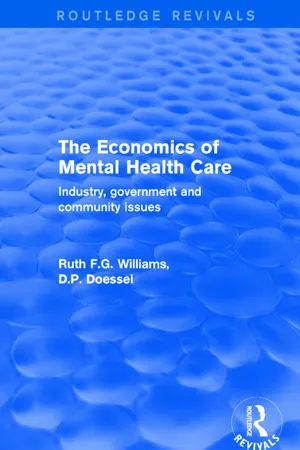
The Economics of Mental Health Care
Industry, Government and Community Issues
- 294 pages
- English
- ePUB (mobile friendly)
- Available on iOS & Android
eBook - ePub
About this book
This title was first published in 2001. This original study of mental health care presents a conceptual approach to the nature of the industry's multiple outputs. It pays special attention to the economic role of government, and also uses conventional economic theory to analyze the fact that the needs and wants of people with mental illnesses and their care-givers are frequently neglected.
Trusted by 375,005 students
Access to over 1.5 million titles for a fair monthly price.
Study more efficiently using our study tools.
Information
Subtopic
Social WorkIndex
Social Sciences1 Economics and Mental Health Care
Introduction
The major mental illnesses and disorders cause suffering world-wide, regardless of socioeconomic group. Of a population of 19 million in Australia, around 500,000 people are thought to be sufferers of major mental illnesses and disorders. Schizophrenia, for example, affects more Australians than many other better-known illnesses and conditions, around one per cent of the population. The World Health Organization reports that the prevalence rate, that is, the frequency of cases of all mental illnesses and disorders present at any one time in populations world-wide, is remarkably high: one person in every five.
The nature and impact of expenditures upon services and support for mental illnesses is something of an enigma. The 1993 Report of the National Inquiry into the Human Rights of People with Mental Illness (commonly called ‘The Burdekin Report’)(Human Rights and Equal Opportunity Commission, 1993) indicates that the annual outlays by governments throughout Australia is some $3.45 billion each year on ‘services and income support’ for people with mental illnesses and disorders. Another estimate of the level of spending on mental health and related services is provided by the 1996 National Mental Health Report (Mental Health Branch Commonwealth Department of Health and Aged Care, 1998, p.15). This is a lower estimate, which excludes income support, of $2.07 billion, and it totals spending on ‘mental health and related services’ in 1996–97 by Commonwealth, state and territory Governments and by private hospitals. For an overview of the Australian mental health system, see Whiteford, Thompson and Casey (2000). The entire expenditure in Australia arising from mental illnesses and disorders is yet unknown: it includes Commonwealth, state and territory Government funding; voluntary agency funding; and an unknown level of support from family and friends. But the standard of living and the level of well-being of people with mental illness, especially the serious conditions, is known to be far from satisfactory.
This study is undertaken for the purpose of clarifying economic behaviour arising from mental illnesses and disorders. This economic behaviour relates both to individuals themselves, whose well-being is impaired and whose standard of living is deplorable in many instances, and to other people and institutions. In elaborating this purpose, a description is given of some of the forces behind both private sector activity, including voluntary support, and government involvement in this area of the health sector. In particular, a conceptual approach is taken towards describing various aspects of current trends in levels of funding, as well as the composition of services consumed by the mental health care sector. In such a conceptual work as this, model-building is involved. Model-building is a first step in giving answers to questions such as this one: what can society look to purchase from its services and strategies for people with mental disorders and illnesses? This study gives an economic framework for examining what is being produced in this sector. In taking a conceptual approach, this study is not involved, for example, in cost-effectiveness analysis or collection of data for statistical analyses. Before any evaluation study or statistical/econometric analysis of costs is undertaken, it is best to ask, ‘What is produced? What is being evaluated? What economic arrangements create well-being in the mental health sector?’
Economic concepts are involved in examinations of expenditures in mental health care. There is, however, little economic understanding of the mental health sector, and some of the theoretical and empirical problems posed by this sector challenge the frontiers of economic understanding. Hoary problems seem to beset anyone who is involved with this sector: those who suffer from a condition; those who provide services to them; and economists too.
Mental Illnesses and Disorders
For an economist to attempt to define mental disorder would be to step into a minefield of medical, legal, social and ethical judgements that change with time and context. Yet it is initially adequate to state that mental disorder is a state of disarray in the functioning of the mind or psyche, and that it is a very general term referring to a diverse group of conditions or illnesses.1 Disagreement in the mental health literature arises over what the mind is, or the psyche; over how to explain and investigate personality and to treat aberrations; and over which professions are best at performing which tasks (Spitzer and Klein, 1978; Reich, 1981).
Some Basic Points2
Mental illnesses are very disabling. Although all humans experience deep, uncontrollable and exaggerated feelings of tension, fear, depression or sadness, for a variety of reasons such feelings can become so distressing for some individuals that they cannot cope with day-to-day activities such as going to work, preparing meals, enjoying leisure time, or relating to others. Individuals suffering these states are given a diagnosis from one of the neurotic disorder groups that include anxiety, obsessional states, neurotic depression and phobias. See also American Psychiatric Association (1994). A hallmark of neurosis is that the individual is aware that his or her distress is out of proportion to reality (Rosenhan and Seligman, 1984, p. 192).
There are more serious disorders, the psychotic disturbances. Individuals may suffer disturbances of their higher mental processes, particularly thinking, speaking, feeling and testing reality. They are out of touch with a real world that people generally seem able to experience. If a person is unable to sense and test reality, this causes confusion and an inability to make sense of one’s surroundings. This can be so real to many such individuals that they may explain their surroundings or cope with themselves by developing false ideas, ideas of persecution, of grandeur or of guilt, or they may see, hear, taste, smell or feel things which are not present. In the most severe cases, individuals may behave in ways that appear strange and disturbing to others. In less severe cases, individuals seem just to be different, as if somehow they are ‘marching to a different drum’.
These ‘more serious’ conditions are the psychotic disorders. The distinction between psychosis and neurosis is not always clear. In the absence of complete understanding of mental illnesses and their causes, this is not unexpected. Historically, the use of these terms has changed quite considerably since ‘psychosis’ was coined in 1845. The distinction, although generalised (and perhaps blurred), is useful (Beer, 1990).
Most sufferers of psychotic disorders are afflicted with one of four conditions: schizophrenia, bipolar affective disorder, psychotic depression and dementia.3 The schizophrenias are a group of conditions where a person’s feelings, thoughts and behaviour become fragmented, disorganised, no longer integrated (Kenny and Whitehead, 1973, p. 50). Some people think a common feature of schizophrenia is the problem of ‘split personality’, that is, of one person leading two lives. This is a misunderstanding of schizophrenia. More commonly, the symptoms may involve an individual’s speech becoming illogical; he or she may face an inability to experience emotions; initiative can become blunted; decision making and planning often is a burden; and ‘withdrawal’ may be experienced. With schizophrenia, particular behaviour and emotions seem inappropriate to an onlooker, especially in instances when some individuals suffer delusions and hallucinations. Table 1 gives an example of the diagnostic criteria for schizophrenia from the Diagnostic and Statistical Manual of Mental Disorders, fourth edition, (DSM-IV).
Table 1.1 Diagnostic criteria for schizophrenia
A. Presence of characteristic psychotic symptoms in the active phase: either (1), (2) or (3) for at least one week (unless the symptoms are successfully treated);
1. two of the following:
a. delusions
b. prominent hallucinations (throughout the day for several days for several times a week for several weeks, each hallucinatory experience not being limited to a few brief moments)
c. incoherent or marked loosening of associations
d. catatonic behaviour
e. flat or grossly inappropriate affect
2. bizarre delusions (i.e. involving a phenomenon that the person’s culture would regard as totally implausible, e.g. thought broadcasting, being controlled by a dead person)
3. prominent hallucinations [as defined in (1)(b) above] of a voice with content having no apparent relation to depression or elation, or a voice keeping up a running commentary of the person’s behaviour or thoughts, or two or more voices conversing with each other.
B. During the course of the disturbance, functioning in such areas as work, social relations, and self-care is markedly below the highest level achieved before the onset of the disturbance (or, when the onset is in childhood or adolescence, failure to achieve expected level of social development).
C. Schizoaffective Disorder and Mood Disorder with Psychotic Features have been ruled out, i.e. if a Major Depressive or Manic Syndrome has been ever present during an active phase of the disturbance, the total duration of all episodes of a mood syndrome has been brief relative to the total duration of the active and residual phases of the disturbance.
D. Continuous signs of the disturbance for at least six months. The six-month period must include an active phase (of at least one week, or less if symptoms have been successfully treated) during which there were psychotic symptoms characteristic of schizophrenia (symptoms in A), with or without prodromal or residual phase, as defined below.
Prodromal phase: A clear deterioration in functioning before active phase of the disturbance that is not due to disturbance of mood or to Psychoactive Substance Use Disorder and that involves at least two of the symptoms listed below.
Residual phase: Following the active phase of the disturbance, persistence of at least two of the symptoms noted below, these not being due to a disturbance in mood or to a Psychoactive Substance Use Disorder.
Prodromal or Residual Symptoms:
1. marked social isolation or withdrawal
2. marked impairment in role functioning as wage-earner, student, or home-maker
3. markedly peculiar behaviour (e.g. collecting garbage, talking to self in public, hoarding food)
4. marked impairment in personal hygiene and grooming
5. blunted or inappropriate affect
6. digressive, vague, overelaborate, or circumstantial speech, or poverty of speech, or poverty of content of speech
7. odd beliefs or magical thinking, influencing behaviour and inconsistent with cultural norms, e.g. superstitiousness, belief in clairvoyance, telepathy, ‘sixth sense’, ‘others can feel my feelings’, overvalued ideas, ideas of reference
8. unusual perceptual experiences, e.g. recurrent delusions, sensing the presence of a force or person not actually present
9. marked lack of initiative, interests, or energy Examples: Six months of prodromal symptoms with one week of symptoms from A; no prodromal symptoms with six months of symptoms from A; no prodromal symptoms with one week of symptoms from A and six months of residual symptoms.
E. It cannot be established that an organic factor initiated and maintained the disturbance.
F. If there is a history of Autistic Disorder, the additional diagnosis of Schizophrenia is made only if prominent delusions or hallucinations are also present.
Source: American Psychiatric Association (1994, pp. 194–95).
A disorder in which the person suffers extreme disturbances of mood is currently called bipolar affective disorder, to replace the more pejorative term, manic-depression. There are two mood states, the manic state in which the individual’s behavioural state is elated far more than what could be warranted, and the depressed state where the individual experiences exaggerated feelings of pessimism, becoming withdrawn and under-active. Episodes of illness may be mild or severe, may vary in their duration and may involve one or both of the mood states. In between episodes, the person can be free of symptoms.
Psychotic depression, or unipolar affective depression, is a mood (affective) disorder that may be differentiated from neurotic depression. That is, there is an internal stress or disease (as opposed to stresses external to the person) which results in deep misery and overwhelmingly unrealistic feelings of personal worthlessness. With everything seeming hopeless, individuals dread the future and death often seems the only solution. Psychotic depression is one of the more successfully treated mental disorders (Kenny and Whitehead, 1973, p. 57; Rosenhan and Seligman, 1984, p. 325).
The dementias are a grouping of conditions and they can arise from a number of causes, including head injury, various medical conditions and the ageing process (though it is not an inevitable consequence of ageing). Dementia is a failure of the brain function and involves intellectual and memory problems, confusion and changes in personality.
Most individuals would prefer to be without the suffering that accompanies mental disorder. They cannot just ‘pull themselves together’, just as will-power alone cannot cure diabetes or a broken wrist. Mostly, people are treated effectively outside hospital and never need to be admitted. Many people experience just one episode of a mental disorder; a small percentage of people suffer recurrent episodes; a smaller percentage face mental illness all their lives. In some cases, symptoms are so disturbing to the sufferer or to others that treatment is undertaken in a health establishment that also provides residential facilities, often only for a limited term. Most wards in psychiatric hospitals are not locked since most mentally ill individuals are no more dangerous or violent than other members of the community. In fact, they are more likely to be vulnerable and afraid. However, recent findings would indicate a sub-group that is more dangerous than the rest of the general population, and that usually the diagnosis of psychiatric illness involves substance abuse as well (Torrey, 1994). This sub-group is subject to addiction as well as mental disorder.
Relating to people who have a mental illness is most difficult when unpleasant behaviour is occurring. Either the symptoms of mental illnesses or the individual’s own adaptations to the symptoms they suffer,4 or both together, can result in undesirable, at times obnoxious, behaviour. Such behaviour may not occur cont...
Table of contents
- Cover
- Half Title
- Dedication
- Title Page
- Copyright Page
- Table of Contents
- List of Figures
- List of Tables
- Foreword
- Acknowledgements
- List of Keywords
- Introduction
- 1 Economics and Mental Health Care
- 2 Some Methodological Issues
- 3 The Welfare Economics of Mental Health Care
- 4 A Survey of the Economics of Mental Health Care
- 5 The Outputs of Mental Health Care: I
- 6 The Outputs of Mental Health Care: II
- 7 The Role of Government in Mental Health Care: A Normative Analysis
- 8 Mental Health Care in the Household Sector
- 9 Multiple Inputs: The Role of Social Capital in Community-Based Strategies
- 10 Co-Production and Community-Based Services
- 11 Summary and Future Research
- References
- Name Index
- Subject Index
Frequently asked questions
Yes, you can cancel anytime from the Subscription tab in your account settings on the Perlego website. Your subscription will stay active until the end of your current billing period. Learn how to cancel your subscription
No, books cannot be downloaded as external files, such as PDFs, for use outside of Perlego. However, you can download books within the Perlego app for offline reading on mobile or tablet. Learn how to download books offline
Perlego offers two plans: Essential and Complete
- Essential is ideal for learners and professionals who enjoy exploring a wide range of subjects. Access the Essential Library with 800,000+ trusted titles and best-sellers across business, personal growth, and the humanities. Includes unlimited reading time and Standard Read Aloud voice.
- Complete: Perfect for advanced learners and researchers needing full, unrestricted access. Unlock 1.5M+ books across hundreds of subjects, including academic and specialized titles. The Complete Plan also includes advanced features like Premium Read Aloud and Research Assistant.
We are an online textbook subscription service, where you can get access to an entire online library for less than the price of a single book per month. With over 1.5 million books across 990+ topics, we’ve got you covered! Learn about our mission
Look out for the read-aloud symbol on your next book to see if you can listen to it. The read-aloud tool reads text aloud for you, highlighting the text as it is being read. You can pause it, speed it up and slow it down. Learn more about Read Aloud
Yes! You can use the Perlego app on both iOS and Android devices to read anytime, anywhere — even offline. Perfect for commutes or when you’re on the go.
Please note we cannot support devices running on iOS 13 and Android 7 or earlier. Learn more about using the app
Please note we cannot support devices running on iOS 13 and Android 7 or earlier. Learn more about using the app
Yes, you can access The Economics of Mental Health Care by Ruth Williams,Doessel in PDF and/or ePUB format, as well as other popular books in Social Sciences & Social Work. We have over 1.5 million books available in our catalogue for you to explore.