Chemistry and Technology of Plant Substances
eBook - ePub

Chemistry and Technology of Plant Substances

Chemical and Biochemical Aspects

  1. 358 pages
  2. English
  3. ePUB (mobile friendly)
  4. Available on iOS & Android
eBook - ePub

Chemistry and Technology of Plant Substances

Chemical and Biochemical Aspects

About this book

Chemistry and Technology of Plant Substances: Chemical and Biochemical Aspects demonstrates the progress and promise of developing new chemical substances from renewable sources of chemical raw materials. The volume brings together new achievements in the field of research and processing of plant raw materials and the synthesis of natural compounds for the production of biologically active substances and drugs. The volume looks closely at the rational use of renewable raw materials, which is the source of new compounds and intermediates for the chemical industry. It covers a wide range of problems associated with the use of the components of plants to produce new substances with a wide variety of purposes.

According to the latest estimates, plants form about a million chemical substances. In some cases, plant products have pharmacological or biological activity that can be of therapeutic benefit in treating diseases. In addition, due to the structural diversity of plant material, chemical synthesis is easily reachable. Synthetic analogs of natural products with improved potency and safety can be prepared by chemical synthesis. Such synthetic analogs are safer for humans. Plant materials are often used as starting points for drug discovery. Chemistry and Technology of Plant Substances: Chemical and Biochemical Aspects presents the theoretical trends and recent practical achievements on complex processing of plant-based raw materials. Low molecular weight components, isolated from plant material, are widely used in fine organic synthesis. High molecular weight polysaccharides of conifers and other greens, such as pectin and hemicellulose, are the basis for the creation of anticoagulants and other drugs. The range of research papers presented in the book is quite wide: from fundamental and applied problems of wood chemistry and organic synthesis to biological activity of natural compounds.

The book provides valuable information for those skilled in organic chemistry, chemical engineers, researchers and scientists as well as for faculty and upper-level students.

This volume, Chemistry and Technology of Plant Substances: Chemical and Biochemical Aspects, was created on the initiative of Emanuel Institute of Biochemical Physics of the Russian Academy of Sciences (Moscow) and the Institute of Chemistry of Komi Scientific Center of Ural Branch of the Russian Academy of Sciences (Syktyvkar).
Frequently asked questions

Yes, you can cancel anytime from the Subscription tab in your account settings on the Perlego website. Your subscription will stay active until the end of your current billing period. Learn how to cancel your subscription.
At the moment all of our mobile-responsive ePub books are available to download via the app. Most of our PDFs are also available to download and we're working on making the final remaining ones downloadable now. Learn more here.
Perlego offers two plans: Essential and Complete
  • Essential is ideal for learners and professionals who enjoy exploring a wide range of subjects. Access the Essential Library with 800,000+ trusted titles and best-sellers across business, personal growth, and the humanities. Includes unlimited reading time and Standard Read Aloud voice.
  • Complete: Perfect for advanced learners and researchers needing full, unrestricted access. Unlock 1.4M+ books across hundreds of subjects, including academic and specialized titles. The Complete Plan also includes advanced features like Premium Read Aloud and Research Assistant.
Both plans are available with monthly, semester, or annual billing cycles.
We are an online textbook subscription service, where you can get access to an entire online library for less than the price of a single book per month. With over 1 million books across 1000+ topics, we’ve got you covered! Learn more here.
Look out for the read-aloud symbol on your next book to see if you can listen to it. The read-aloud tool reads text aloud for you, highlighting the text as it is being read. You can pause it, speed it up and slow it down. Learn more here.
Yes! You can use the Perlego app on both iOS or Android devices to read anytime, anywhere — even offline. Perfect for commutes or when you’re on the go.
Please note we cannot support devices running on iOS 13 and Android 7 or earlier. Learn more about using the app.
Yes, you can access Chemistry and Technology of Plant Substances by Alexander V. Kutchin, Lyudmila N. Shishkina, Larissa I. Weisfeld, Alexander V. Kutchin,Lyudmila N. Shishkina,Larissa I. Weisfeld in PDF and/or ePUB format, as well as other popular books in Medicine & Biochemistry in Medicine. We have over one million books available in our catalogue for you to explore.

Information

PART I
Components of Plant Origins: Synthesis, Modification, and Properties

CHAPTER 1


SYNTHESIS AND TRANSFORMATIONS OF 2,3-SECOTRITERPENE DERIVATIVES OF BETULIN

IRINA A. TOLMACHEVA1*, NATALIA V. GALAIKO1, EKATERINA V. IGOSHEVA1, ANASTASIYA V. KONYSHEVA1, ALEXEY V. NAZAROV1, GULNAZ F. KRAINOVA1, MARINA N. GORBUNOVA1, EUGENE I. BOREKO2, VLADIMIR F. EREMIN2, and VICTORIA V. GRISHKO1
1Institute of Technical Chemistry, Ural Branch, Russian Academy of Sciences, 3, Academician Korolev St., Perm 614013, Russia
2The Republican Research and Practical Center for Epidemiology and Microbiology, 23, Filimonov St., Minsk 220114, Republic of Belarus
*Corresponding author. E-mail: [email protected]

CONTENTS

Abstract
1.1 Introduction
1.2 Synthesis of the Basic 2,3-Secotriterpenoids
1.3 Synthesis of A-Pentacyclic Triterpene α,β-Alkenenitriles
1.4 Synthesis, Transformation and Biological Evaluation of 2,3-Secotriterpene Acetylhydrazones and their Derivatives
1.5 Synthesis and Antiviral Activity of C-3 and/or C-28-Substituted 2,3-Secotriterpenoids
1.6 Synthesis of Triterpene A-Condensed Azoles
1.7 Conclusions
Acknowledgments
Keywords
References

ABSTRACT

The review is devoted to the results of our studies on the synthesis and modification of 2,3-secotriterpene compounds. The original 2,3-secotri- terpenoids were synthesized by Beckmann fragmentation of the A-ring of available derivatives of betulin (betulonic acid, its methyl ester and allobetulone). Directed chemical modification of the initial 2,3-secotriter- penoids has resulted in a wide spectrum of mono- and bi-functionalization products as well as products of heterocyclization and recyclization of the A-ring. Compounds with high antiviral and cytotoxic activity among the obtained products were found.

1.1 INTRODUCTION

Pentacyclic triterpenoids of natural and semisynthetic origin are characterized by their high biological activity as a result of the fact that these compounds can be obtained from readily available sources. Typical representatives of this group of triterpenoids are betulin, a major component of birch bark Betula, and its derivatives betulinic and betulonic acids. These compounds are perspective candidates for synthesis of therapeutically active agents [16]. The majority of the known reactions of betulin, and its derivatives are carried out at C-3, C-28, and C-30 carbon atoms which occur without affecting the carbon skeleton. Examples of rearrangement of the carbon skeleton of lupane triterpenoids are less common, in particular the A-ring fragmentation with the A-secoderivatives formation by chemical [710], photochemical [11, 12], and microbiological [13] transformations. The production of various ring-A-secoderivatives which are characterized by different biological activity [8, 14, 15] and modification of secoderivatives via the introduction of various pharmacophoric groups usually results in the enhancement or variation of biological activity of the obtained compounds [2, 16].
The goal of the present review was to generalize the obtained results of own researches on the synthesis and chemical modification of 2,3-seco- triterpene compounds that resulted to a wide spectrum of linear and cyclic heteroatom 2,3-secotriterpene derivatives. Compounds featured by anticancer and antiviral action have been revealed among the produced 2.3. seco- and A-pentacyclic derivatives.

1.2 SYNTHESIS OF THE BASIC 2,3-SECOTRITERPENOIDS

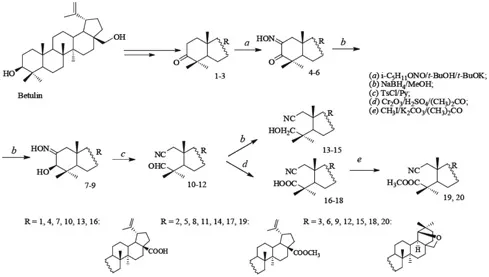
According to the published data, the most common strategy for the synthesis of A-secotriterpenoids used an approach based on the Beckmann rearrangement, such as oxidative cleavage of relevant diosfenols or the Beckmann fragmentation of ketoximes [17]. We have studied the Beckmann fragmentation of betulonic acid (1), its methyl ester (2), and allobetulone (3), which are obtained from the readily available lupane triterpenoid betulin. α-Hydroxyoxime (7-9) were converted into the corresponding 2,3-secoaldehydonitriles (10-12) by the action j9-tolu- enesulfonic acid chloride. 2,3-Secotriterpene hydroxynitriles (13-15) and carboxynitriles (16-18) were obtained by reduction or oxidation of the C-3-aldehyde group of the aldehydonitriles (10-12). Compounds (17, 18) were converted into the corresponding methyl esters (19) and (20) under classical alkylation conditions by methyliodide [1820] (Fig. 1.1).
image
FIGURE 1.1 Scheme of synthesis of the basic 2,3-secotriterpenoids (10-20) [1820].
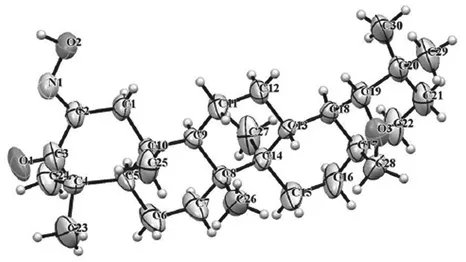
Structures of 2-hydroximino-3-oxo derivatives (4-6) with anticonfiguration of the oxime group were additionally confirmed by X-ray structural analysis (XSA) for 18αH-oleanane ketoxime (6) [21] (Fig. 1.2).
image
FIGURE 1.2 Molecular structure of ketoxime (6) with representation of the atoms by thermal vibration el...

Table of contents

  1. Cover
  2. Half Title
  3. Title Page
  4. Copyright Page
  5. ABOUT THE EDITORS
  6. Table of Contents
  7. List of Contributors
  8. List of Abbreviations
  9. From Fundamental Science to New Technologies
  10. Preface
  11. Introduction
  12. Part I: Components of Plant Origins: Synthesis, Modification, and Properties
  13. Part II: Biological Activity of Plant Substances
  14. Glossary
  15. Index