eBook - ePub
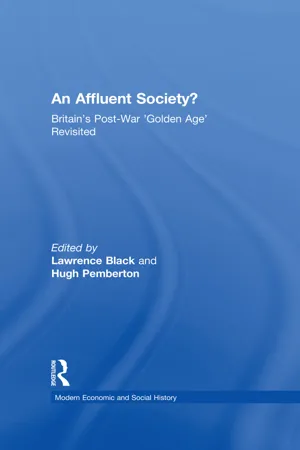
An Affluent Society?
Britain's Post-War 'Golden Age' Revisited
- 272 pages
- English
- ePUB (mobile friendly)
- Available on iOS & Android
eBook - ePub
About this book
During an election speech in 1957 the Prime Minister, Harold Macmillan, famously remarked that 'most of our people have never had it so good'. Although taken out of context, this phrase soon came to epitomize the sense of increased affluence and social progress that was prevalent in Britain during the 1950s and 1960s. Yet, despite the recognition that Britain had moved away from an era of rationing and scarcity, to a new age of choice and plenty, there was simultaneously a parallel feeling that the nation was in decline and being economically outstripped by its international competitors. Whilst the study of Britain's postwar history is a well-trodden path, and the paradox of absolute growth versus relative decline much debated, it is here approached in a fresh and rewarding way. Rather than highlighting economic and industrial 'decline', this volume emphasizes the tremendous impact of rising affluence and consumerism on British society. It explores various expressions of affluence: new consumer goods; shifting social and cultural values; changes in popular expectations of policy; shifting popular political behaviour; changing attitudes of politicians towards the electorate; and the representation of affluence in popular culture and advertising. By focusing on the widespread cultural consequences of increasing levels of consumerism, emphasizing growth over decline and recognizing the rising standards of living enjoyed by most Britons, a new and intriguing window is opened on the complexities of this 'golden age'. Contrasting growing consumer expectations and demands against the anxieties of politicians and economists, this book offers all students of the period a new perspective from which to view post-imperial Britain and to question many conventional historical assumptions.
Chapter 1
Introduction — the Uses (and Abuses) of Affluence
And so the Britons were gradually led on to the amenities that make vice agreeable – arcades, baths and sumptuous banquets. They spoke of such novelties as ‘civilization’, when really they were only a feature of enslavement. (Tacitus, ‘Agricola’, 21)1
Analyses of post-war Britain have mainly adopted (sometimes explicitly but often implicitly) an international or comparative perspective that has centred on discussions of national decline: economic, military, diplomatic, imperial or cultural. Recently, contemporary historians such as Jim Tomlinson have begun to argue for a focus on ‘declinism’ rather than ‘decline’. Ironically, however, such scholars continue to work within the parameters of decline as the core concept for the study of post-war British history. The core premise of this collection is that attention to affluence can enrich historians’ understanding of post-war Britain. This requires a shift in focus to the domestic rather than the international. Such a shift radically alters the analytical perspective: emphasizing absolute growth over relative decline; highlighting the enormous improvement in British living standards that took place in the post-war years; and emphasizing the widespread cultural consequences associated with the growth of post-war consumerism.2
The paradox of absolute growth versus relative decline
That the post-war ‘golden age’ of British economic development and the concomitant advent of the ‘affluent society’ should have coincided with the publication of new comparative data revealing both Britain’s relative economic decline and an acceleration in that decline is the great paradox of modem British social and economic history. This paradox lies at the heart of this book. A number of its chapters highlight the existence and the profound economic, social and political significance of rising popular consumerism, improving health and life expectancy, and rising living standards and expectations. Shifting the focus towards affluence in this way questions the usefulness of a language of decline, even of relative decline, to characterize a period that saw unprecedented economic growth. Nevertheless, the collection does not seek to supplant entirely a narrative of ‘relative decline’ with one of ‘affluence’, since the fact of relative decline remains; instead it sets out to use affluence to unpack and explore the nuances of this debate, the complexities of the post-war period, and the paradox of affluence in the face of relative decline.
This paradox is well personified by Harold Macmillan in the latter half of the 1950s. The Prime Minister profited politically from association with the phrase ‘most of our people have never had it so good’, coined in a 1957 speech to the electors of Bedford. The remark, plucked out of context, seemed to many to be simply a justified acknowledgement of Britain’s new ‘affluent society’ and it became the leitmotif of the Conservatives’ 1959 election campaign; exemplified by the slogan ‘Life’s better with the Conservatives. Don’t let Labour ruin it’. What has too often been forgotten, however, and what was sometimes overlooked at the time was that Macmillan went on to say ‘… what is beginning to worry some of us is “Is it too good to be true?” or perhaps I should say “Is it too good to last?”’.3
The paradox of rising affluence coincident with growing pessimism might be understood as the product of different experiences: of elites and the people, or in terms of the differing history of Britain and of Britons. In comparative economic and imperial terms Britain might have been in decline, but the full employment, the availability of consumer durables, and the benefits of the post-war welfare state were palpable. This inconsistency did not escape contemporaries. As early as 1950, Michigan University economist, Clare Griffin, noted: ‘the worker is told Britain is poor … but the worker doesn’t feel poor. He has more money than before and his job is more secure’. Official ‘propaganda appeals are being applied in one direction while his personal interests point in the opposite direction.’ The spending and leisure that full employment and the welfare state allowed created an anxiety, expressed by Griffin, that workers might opt for relaxation over output, threatening economic competitiveness; and that anxiety that grew as the 1950s progressed.4
Declinism
The fear expressed by Macmillan that there was something rotten at the heart of the British economy in the 1950s, that economic success contained within it the seed of its own destruction, was a common one at the time. A growing fixation with decline (particularly economic, but military, colonial and cultural too), what Tomlinson has termed the ‘new declinism’, is a remarkable feature of the period.5 It can be found in the records of government, employers associations and trade unions, and permeated contemporary broadsheets and ‘quality’ periodicals. The mood was one of, ‘What’s wrong with Britain?’, as an influential early-1960s Penguin series was entitled.6 The crescendo of anxieties about relative decline prompted Macmillan to complain in his diary for 1962: ‘If only all the people who write, lecture, broadcast and even preach about economic growth did some useful work, the increase in manpower would perhaps enable us to achieve it.’7 So pervasive was the ‘declinist’ narrative, both at the time and subsequently that it has tended to dominate analysis of developments in the 1950s and 1960s.
As Tomlinson has pointed out, the declinist narrative constructed during the 1970s and 1980s owed a great deal to the Thatcherite backlash against the post-war political settlement.8 Historical works, notably Martin Wiener’s account of the lack of entrepreneurial instincts and the rural nostalgia endemic in English culture; Rubinstein’s case that commerce and finance out-ranked manufacture (differing from Wiener’s emphasis, but fitting Thatcherite prejudices nonetheless) and Corelli Barnett’s audit of Britain’s loss of economic, military and imperial power, were prominent in this narrative. National decline was taken as read in this analysis - though there was less of a consensus about its precise causes or chronology. The political agenda of much of this work was transparent, targeting ‘one nation’ Conservatism as much as social democracy. As Paul Addison argues, ‘used in this context the “decline of Britain” is not a historical fact but a highly partisan interpretation in which the loss of social and imperial ascendancies is equated with the decline of Britain both at home and abroad.’9 However, the Thatcherite or New Right context alone cannot explain why decline has retained such currency.
Since the late 1950s, the declinist narrative has also had a purchase on the left. From popular works in the 1960s and 1970s (such as the writings of Anthony Hartley, Michael Shanks, and Anthony Sampson) to Will Hutton in the 1990s, left intellectuals have not only subscribed to, but been key sponsors of the decline concept.10 Perry Anderson, in his 1964 New Left Review essay ‘Origins of the Present Crisis’, shared Shonfield, Shanks and Hartley’s identification of the ‘secular decline of the British economy’, but felt they described symptoms more than explained causes. Rejoining the debate in the 1980s, Anderson approvingly cited the explanations forwarded by Barnett, Wiener and Rubinstein. Anderson, echoing Barnett’s Audit of War, located the roots of decline in the legacy of the industrial revolution.
In explaining decline, therefore, both camps have stressed the specific development of industrial capitalism in Britain - fashioned by class structure, empire, the balance of finance and manufacturing, culturally skewed against modernity and prone to nostalgia for a lost (and largely mythical) rural idyll. Its causes peculiar to British culture, this was a ‘very British’ decline and also one partially blamed on Britons in both versions. Anderson’s ‘supine proletariat’ were Barnett’s ‘segregated, subliterate … proletariat.’ In this sense both New Left and New Right shared a working assumption of post-war British ‘decline’. Whatever else, this demonstrates the eclectic sources and force of declinism.11
That decline has been so embroiled in political debates should make historians wary of accepting it at face value, to be proved or rejected. The idea and fear of decline has been rife in Western culture and historical writing for a long time, certainly long before British de-colonization and relative economic decline. Declinism then was, on the one hand, a state of mind, disclosing much about the assumptions through which the meanings of this period were constructed. As Dintenfass argues, when discussing the language of the decline debate, ‘the narrative constructions to which pessimists and optimists [about Britain’s economic performance] alike necessarily resorted … indicate that the parties to this dispute unknowingly occupied a good deal of common ground’.12 On the other hand, historians should be interested in how declinism (the assumption of national decline as the problematic) underpins a host of political projects, from Macmillan’s modernization of Britain and Wilson’s ‘white heat’ scientific and technological revolution, to Thatcher’s economic rationalization.
Affluence - an alternative narrative?
The concept of ‘declinism’ is a welcome attempt to break out of the sterile ‘decline’ debate. Yet, because that debate is its starting point, the declinism thesis is itself rooted in arguments about Britain’s performance relative to other countries.13 The problem is that the analysis remains focused too much on international comparisons and too little on the domestic experience. Shifting to a domestic (and simultaneously less elitist, less economic) perspective might cast post-war Britain in a much more positive light than that which characterizes both the ‘declinist’ literature and the literature of‘declinism’.
Richard Weight, for instance, has made a case for a British cultural renaissance in the 1960s, centred around popular culture and crafting a post-imperial focus for national identity.14 This foreshadowed the Blair government’s promotion of ‘Cool Britannia’ in the late-1990s, and its focus on the ‘creative economy’ of information technology, the arts, design and culture. Less decline and fall, in this analysis what was being witnessed was Britain’s transition from an industrial to post-industrial, more democratic, even post-modern economy.15 This is not to deny the fact of Britain’s relative decline but to point out that on the domestic front relative decline manifested itself as a rather pleasing decay, accompanied as it was by unprecedented popular wealth and health. Though not, it has to be said, by much if any increase in the happiness of the average British citizen since affluence bred a new range of discontents and entailed a new set of social costs.16 This was less decline than a shift to post-industrial consumption patterns. It is on this that historians should perhaps focus rather than continuing to be transfixed (like contemporaries) by decline - for which social change could all too easily be mistaken.
Of course, as a number of chapters in this book show, affluence was not evenly distributed around Britain or amongst Britons: patterned as it was by region, gender, generation, class and a host of other variables. It was itself a relative concept - referring not to the experience of a wealthy elite, but to that of the mass of Britons. It was not that the rich were extinct, although it seemed that way to some, but that affluence had a quite demotic, democratic emphasis. Affluence did little to erase quantitative inequalities, but the absolute shift in spending power extended the ownership of luxuries from the elite to the mass. As US management guru Peter Drucker saw it (cold war-style) in 1960, ‘Automobiles and traffic jams are mightier levellers than Karl Marx’.17
Affluence, then, is at once potentially an alternative to the dominant historical narrative about post-war Britain and a refinement of the ‘declinism’ thesis. But it can be more than this, for the phenomenon of affluence was the source of contemporary debates traversing political, economic, social and cultural spheres. It has the potential to allow historians to do likewise, to a much greater extent than historical writing on post-war Britain in either of these two schools of thought. Using affluence as an ‘organizing perspective’ can therefore allow historians to respond to the recent and increasingly loud calls for a more integrated approach to contemporary history.18 To this end, this volume consciously brings together social, cultural, welfare, political and economic historians to reconsider our understanding of Britain’s post-war ‘golden age’.19
Another use of ‘affluence’ is its potential to confront a further charge some...
Table of contents
- Cover
- Half Title
- Title
- Copyright
- Contents
- List of Figures, Tables and Plates
- General Editor’s Preface
- Acknowledgements
- List of Contributors
- 1 Introduction - The Uses (and Abuses) of Affluence
- 2 Affluence, Conservatism and Political Competition in Britain and the United States, 1945-1964
- 3 Modernizing Britain’s Welfare State: The Influence of Affluence, 1957-1964
- 4 The Forgotten Revisionist: Douglas Jay and Britain’s Transition to Affluence, 1951-1964
- 5 Total Abstinence and a Good Filing-System? Anthony Crosland and the Affluent Society
- 6 The Impression of Affluence: Political Culture in the 1950s and 1960s
- 7 Affluence, Relative Decline and the Treasury
- 8 Economists and Economic Growth in Britain, c. 1955-65
- 9 The Polyester-Flannelled Philanthropists: The Birmingham Consumers’ Group and Affluent Britain
- 10 Anticipating Affluence: Skill, Judgement and the Problems of Aesthetic Tutelage
- 11 ‘Selling Youth in the Age of Affluence’: Marketing to Youth in Britain since 1959
- 12 Losing the Peace: Germany, Japan, America and the Shaping of British National Identity in the Age of Affluence
- Bibliography
- Index
Trusted by 375,005 students
Access to over 1.5 million titles for a fair monthly price.
Study more efficiently using our study tools.
Frequently asked questions
Yes, you can cancel anytime from the Subscription tab in your account settings on the Perlego website. Your subscription will stay active until the end of your current billing period. Learn how to cancel your subscription
No, books cannot be downloaded as external files, such as PDFs, for use outside of Perlego. However, you can download books within the Perlego app for offline reading on mobile or tablet. Learn how to download books offline
Perlego offers two plans: Essential and Complete
- Essential is ideal for learners and professionals who enjoy exploring a wide range of subjects. Access the Essential Library with 800,000+ trusted titles and best-sellers across business, personal growth, and the humanities. Includes unlimited reading time and Standard Read Aloud voice.
- Complete: Perfect for advanced learners and researchers needing full, unrestricted access. Unlock 1.5M+ books across hundreds of subjects, including academic and specialized titles. The Complete Plan also includes advanced features like Premium Read Aloud and Research Assistant.
We are an online textbook subscription service, where you can get access to an entire online library for less than the price of a single book per month. With over 1.5 million books across 990+ topics, we’ve got you covered! Learn about our mission
Look out for the read-aloud symbol on your next book to see if you can listen to it. The read-aloud tool reads text aloud for you, highlighting the text as it is being read. You can pause it, speed it up and slow it down. Learn more about Read Aloud
Yes! You can use the Perlego app on both iOS and Android devices to read anytime, anywhere — even offline. Perfect for commutes or when you’re on the go.
Please note we cannot support devices running on iOS 13 and Android 7 or earlier. Learn more about using the app
Please note we cannot support devices running on iOS 13 and Android 7 or earlier. Learn more about using the app
Yes, you can access An Affluent Society? by Lawrence Black,Hugh Pemberton in PDF and/or ePUB format, as well as other popular books in History & World History. We have over 1.5 million books available in our catalogue for you to explore.