eBook - ePub
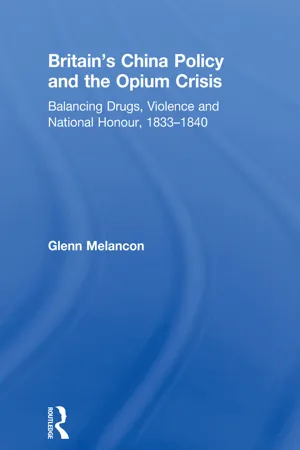
Britain's China Policy and the Opium Crisis
Balancing Drugs, Violence and National Honour, 1833–1840
- 166 pages
- English
- ePUB (mobile friendly)
- Available on iOS & Android
eBook - ePub
Britain's China Policy and the Opium Crisis
Balancing Drugs, Violence and National Honour, 1833–1840
About this book
The first Opium War (1840-42) was a defining moment in Anglo-Chinese relations, and since the 1840s the histories of its origins have tended to have been straightforward narratives, which suggest that the British Cabinet turned to its military to protect opium sales and to force open the China trade. Whilst the monetary aspects of the war cannot be ignored, this book argues that economic interests should not overshadow another important aspect of British foreign policy - honour and shame. The Palmerston's government recognised that failure to act with honour generated public outrage in the form of petitions to parliament and loss of votes, and as a result was at pains to take such considerations into account when making policy. Accordingly, British Cabinet officials worried less about the danger to economic interests than the threat to their honour and the possible loss of power in Parliament. The decision to wage a drug war, however, made the government vulnerable to charges of immorality, creating the need to justify the war by claiming it was acting to protect British national honour.
1 Introduction
The first Opium War (1840-1842) was a defining moment in Anglo-Chinese relations, and since the 1840s the histories of its origins have been straightforward narratives. Generally, they argue that in the early nineteenth century northern merchants and industrialists, the new dynamic players in the British economy, forced Parliament to abolish the East India Company's monopoly of the China trade. After the abolition act took effect in 1834, the newly created British Trade Commission actively pressed for a formal commercial treaty and even sought an excuse to wage war to force the Chinese into submission. British officials, merchants and industrialists wanted to break down the Chinese government's restrictions on trade, known as the Canton system, thus opening China's market to goods produced by Britain's expanding industrial economy. Simultaneously, British merchants in the Far East increased their illegal sale of Indian-grown opium in China. Opium sales generated revenue for the British-run government in Bengal and paid for Chinese tea, a highly prized commodity in Great Britain. The Chinese government, however, tried to stop the importation of the illicit drug, finally seizing £2 million worth of British- owned opium in 1839. The Chinese government had played straight into Great Britain's hands. The British cabinet turned to its military to protect opium sales and to force open the China trade.1
Underlying these arguments is the assumption that the primary motivation driving both British mercantile and governmental interests was economic in nature. As Peter Fay explained in his analysis of the decision to wage war, 'What finally dominated the discussion, however, was not the war-or-peace aspect of the China question, but the pounds, shillings, and pence of it.'2 Historians have reached such conclusions because they have relied too heavily on the Jardine Matheson archive. Jardine Matheson was one of the largest agency houses in Canton at the time of the war, and its records are certainly necessary for any study of Anglo-Chinese relations. What is missing, however, is an analysis of the private papers of British officials. This oversight is analogous to guessing how the mechanisms of a clock work by simply looking at the movement of its hands.3 Moreover, by placing so much emphasis on evidence from this one source, previous historians have overestimated the role William Jardine and James Matheson played in designing British foreign policy and have missed key pieces of evidence in the archive itself. For example, Michael Greenberg states that 'they were quite successful in influencing Palmerston and in dominating British policy behind the scenes', and Hsin-pao Chang goes even further, stating that Palmerston' depended almost exclusively' on their firm for intelligence from Canton.4 Although they ultimately won the support of Lord Melbourne's Whig ministry (1835-1842), that support was not a foregone conclusion, and there is little evidence for such bold assertions.
The belief that the British government went to war to defend and expand trade became widespread because it fitted neatly into the earlier twentieth-century historians' understanding of British society. Until recently the established interpretations in British history argued that in the late eighteenth and early nineteenth centuries the British witnessed the final decay of traditional society and the emergence of a modern nation. As industry and commerce replaced agriculture as the most significant aspect of the economy, the rural, aristocratic community of the ancien regime gave way to the urban, middle-class society of the Victorian period. Following the political and economic policies and values of the middle class, British imperial power reached its apogee. During the mid-1970s, however, a new explanation of nineteenth-century British social structure began to emerge which challenged this standard interpretation. Denying the centrality of modernization to the experience of life in the first half of the nineteenth century, these historians view Britain in the 1830s as a predominantly traditional society. The landed aristocracy remained the dominant order economically, socially and politically. Although northern industrialists began their challenge to Britain's aristocratic order in this period, the limited scope of industrial growth inhibited their ability to win approval for middle-class initiatives at the highest levels of government.
One of the major points of contention between these two sets of assertions is the nature of the nineteenth-century economy.5 The standard interpretation emphasizes the industrial revolution. Between 1760 and 1840 the English economy changed from hand production, using human or animal power to make unique goods in a family setting, to mass production, using machine-generated power to make standardized goods in factories. The change in production caused the economy to 'take-off as it moved beyond providing subsistence needs for a local community to providing consumer goods for the society at large and for export abroad. Displaced rural labourers left the familiar surroundings of the traditional family economy to work in the unsafe factory system, which concentrated all aspects of production around the steam engine. According to these interpretations, overseas trade performed an essential service, providing markets for Britain's expanding industrial economy.6
Critics of this interpretation argue that while industrialization began in the early nineteenth century, the change affected a relatively small percentage of the total economy. Only 10 to 12 per cent of the English labour force worked in modern factories; the remainder stayed engaged in agriculture or in traditional trades. Textile production, the most widely used example of industrialization, centred around Lancashire. It employed one-half of the industrial work force, but represented 7 per cent of British national income.7 When iron and steel are added to textile production, total industrial output still only represented less than one-fourth of total manufacturing output in 1840. The results of these studies show a rate of growth considerably slower and more constant in the total economy than the rate advanced by advocates of an industrial take-off theory. Consequently, as historians downplay the importance of industrialization to the total economy, they similarly diminish the significance previously attributed to foreign markets for manufactured goods.8
The dominance of the industrial take-off theory has shaped the standard interpretations of early nineteenth-century social structure. Social historians have tended to find the origins of modern English social relationships in this period. National class divisions, based on the new urban industrial experience, replaced paternalistic social relationships derived from life in small rural communities. With the decline of traditional relationships the landed aristocracy abdicated responsibility to the rising capitalist middle class, which struggled to maintain its hegemonic position in society against the new industrial working class. Each class had unique values that necessarily produced conflict among the various social groups and their belief systems.9
Like their counterparts in economic history, some social historians have questioned the validity of viewing early nineteenth-century social relationships in modern terms.10 Revisionists downplay the division of English society along economic lines — land, capital and labour — and examine society in terms of governors and governed, idle and industrious orders, or privileged few and the people. Those with political power dominated those without, and a life of leisure commanded more prestige than did working for a living. In this type of society the traditional aristocracy still played the dominant role. Domination involved more than simply exploitation; it dictated a responsibility to the lower orders. Contemporaries thus did not view as natural the conflict among the various orders of society. Animosities grew out of t he perceived abuse of political power and the failure to reconcile the various interests of the community, rather than the misuse of economic power."
Standard interpretations of domestic politics during the late 1830s contrast sharply with the revisions taking place in economic and social histories. Political histories commonly argue that in the second half of the 1830s the foundations of the modern British two-party system developed. They define a 'party' as a structured organization with a clear ideology. The Liberal Party, according to this analysis, advocated progressive reform of the constitution and attracted its support from large urban and non-English (Irish, Scottish and Welsh) constituencies. The Conservative Party, drawing its support from small boroughs and English counties, opposed constitutional reform but admitted the necessity of practical reforms. Once party members entered the House of Commons, they seldom voted across party lines; party organization and ideology instilled this discipline.12
Such modern definitions of party organization and ideology have not stood unchallenged. Challengers to the prevailing interpretation prefer a narrower, and more traditional, definition of party politics. Instead of two all-encompassing parties, revisionists focus on smaller groups of politicians held together by key aristocrats through bonds of family and friendship. These historians also reject the artificial lines created by the yes-or-no nature of parliamentary divisions lists. By examining the ideological differences within the 'Liberal' and 'Conservative' parties, one finds that a combination of interests could produce the perception of a 'two-party system'. Various blocs on both sides of Parliament joined forces to gain divergent goals by the same means.13
The conventional explanations of British imperial history reflect the standard versions of economic, social and political histories. Proponents of a 'free trade imperialism' theory argue that British politicians encouraged an aggressive overseas policy in order to expand foreign markets for the new industrial economy. Unlike their aristocratic predecessors, who sought a formal imperial structure, early- and mid-Victorian leaders followed a laissez-faire policy which favoured informal economic control to accomplish their imperialistic goals. Events around the world drew British forces into areas whose political leaders refused to cooperate with the agents of the informal empire. This theory emphasizes the role of British officials and citizens abroad and their relationship to indigenous collaborators. It suggests that if overseas officials called for help, or got into trouble with native administrations, then the British government sat ready to use force.14 Most critics of 'free trade imperialism' do not challenge their antagonists' assumptions about the nature of early nineteenth-century English society. They continue to set English overseas exploits within the context of an industrial middle-class society. An ideology based on laissez-faire economics, however, precluded the possibility of government intervention in order to advance foreign trade. Foreign wars represented an exception, not the rule.15
Peter Cain and Anthony Hopkins, recognizing the new work of economic and social historians, do set imperial activity within the context of an aristocratic society. Rejecting the notion that the needs of northern industrialists motivated economic expansion, Cain and Hopkins developed the idea of 'Gentlemanly Capitalism'. During the course of the eighteenth century, bankers and commercial capitalists, those who could best afford the lifestyle of gentlemen, entered into Britain's ruling elite by supporting the growth of a 'Fiscal-Military State' — the apparatus needed to finance continental wars, to pay for government patronage and to collect excise taxes.16 These gentlemen, located in or near the City of London, exercised considerable influence in Whitehall and led the drive toward imperialist expansion. Parliamentary leaders - landed aristocrats - took this advice, because 'successful expansion, reinforced by colonial acquisitions, generated profits and revenues, helped to service the national debt, and contributed to employment and political stability'.17
The remterpretation of British economic, social and political history provides an opportunity to look again at the origins of the Opium War because they point to an alternative set of social ideals, Cain's and Hopkins's concept of'Gentlemanly Capitalism' would seem like a logical starting point, but their theory, like so many others, assumes that humans are driven p primarily by material interests. This proposition is questionable at best. While one cannot ignore the monetary aspects of the opium question, economic interests should not overshadow another important traditional aspect of British foreign policy - honour and shame.18 Generally...
Table of contents
- Cover
- Half Title
- Dedication
- Title
- Copyright
- Contents
- Acknowledgements
- 1 Introduction
- 2 The Great Reform Act and Deregulation of the China Trade
- 3 'China Belongs to Palmerston'
- 4 Internal Dissension
- 5 Failure to Take Heed
- 6 Crisis of Confidence
- 7 The Decision to Wage War
- 8 'The Opium and the China Question'
- 9 Conclusions: Historians and the Opium War
- Bibliography
- Index
Trusted by 375,005 students
Access to over 1.5 million titles for a fair monthly price.
Study more efficiently using our study tools.
Frequently asked questions
Yes, you can cancel anytime from the Subscription tab in your account settings on the Perlego website. Your subscription will stay active until the end of your current billing period. Learn how to cancel your subscription
No, books cannot be downloaded as external files, such as PDFs, for use outside of Perlego. However, you can download books within the Perlego app for offline reading on mobile or tablet. Learn how to download books offline
Perlego offers two plans: Essential and Complete
- Essential is ideal for learners and professionals who enjoy exploring a wide range of subjects. Access the Essential Library with 800,000+ trusted titles and best-sellers across business, personal growth, and the humanities. Includes unlimited reading time and Standard Read Aloud voice.
- Complete: Perfect for advanced learners and researchers needing full, unrestricted access. Unlock 1.5M+ books across hundreds of subjects, including academic and specialized titles. The Complete Plan also includes advanced features like Premium Read Aloud and Research Assistant.
We are an online textbook subscription service, where you can get access to an entire online library for less than the price of a single book per month. With over 1.5 million books across 990+ topics, we’ve got you covered! Learn about our mission
Look out for the read-aloud symbol on your next book to see if you can listen to it. The read-aloud tool reads text aloud for you, highlighting the text as it is being read. You can pause it, speed it up and slow it down. Learn more about Read Aloud
Yes! You can use the Perlego app on both iOS and Android devices to read anytime, anywhere — even offline. Perfect for commutes or when you’re on the go.
Please note we cannot support devices running on iOS 13 and Android 7 or earlier. Learn more about using the app
Please note we cannot support devices running on iOS 13 and Android 7 or earlier. Learn more about using the app
Yes, you can access Britain's China Policy and the Opium Crisis by Glenn Melancon in PDF and/or ePUB format, as well as other popular books in History & World History. We have over 1.5 million books available in our catalogue for you to explore.