eBook - ePub
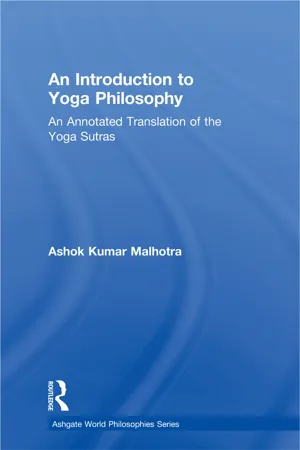
An Introduction to Yoga Philosophy
An Annotated Translation of the Yoga Sutras
- 120 pages
- English
- ePUB (mobile friendly)
- Available on iOS & Android
eBook - ePub
About this book
With its promise of personal improvement, physical well-being and spiritual enrichment, yoga is enjoying a resurgence in popularity at the turn of the third millennium. To unravel the mystery of the discipline, its philosophies and relevance in contemporary life, the original text of the Yoga Sutras of Patanjali must be explored. This book offers the first accessible translation and commentary on Patanjali's Yoga Sutras. An introductory section examines the multidimensional aspects of yoga as philosophy, psychology, science, and religion, as well as exploring popular versions of yoga in the West. The core of the book offers a new translation of the entire text of the Yoga Sutras, in a language that is clear and comprehensible to students. Commentaries are presented to highlight the meaning of various statements (sutras) and key themes are outlined via sectional summaries. A full glossary of key words and names is also provided. Concluding chapters look at yoga in contemporary life, revealing the popularity of yoga in the 21st century through Star Wars, and exploring yoga's connection to health and science, contrasting yoga's holistic view of healing with that of the limited view of present day medical science. Sample physical, breathing and meditation exercises are provided. An Introduction to Yoga Philosophy offers a comprehensive introduction to the Yoga Sutras text of Patanjali to all students and interested readers of Indian philosophy and religion, world religions, east-west psychology, and mysticism.
Information
PART I
The multidimensionality of Yoga
CHAPTER ONE
An interdisciplinary approach to understanding Yoga
The discipline of Yoga has enchanted readers and practitioners for centuries. It has more adherents now than ever before. What are the reasons for this enchantment and enthusiasm? Is it the mystique associated with the discipline, or the multi-sided content, or the step-by-step procedural practice that has drawn scholars, followers and curiosity seekers to it? Scholars have revealed their interest through the presentation of a multiplicity of interpretations; while followers make enthusiastic claims about the benefits accrued from its practice, curiosity seekers are attracted to it because of their expectation of an 'instant high'. Depending upon one's background and intentions, Yoga has something for everyone whether they are psychologists, philosophers, scientists, religionists or practitioners. As a body of knowledge about the mysterious nature of existence and a practical method to realize this wisdom here and now, Yoga offers an integral approach. In an artistically crafted system, Yoga brings together the disciplines of philosophy, psychology, science and religion. All of these fields are intertwined in the system of Yoga, providing unique yet related ways of unravelling the mystery of human existence. Since Yoga is one of the most ancient and enduring disciplines of India, it must be understood that we are engaging in a subject that is not just a philosophy or a psychology, but a path of salvation as well. In Yoga, philosophy, psychology and science come together to provide myriad ways to disclose the mystery of human existence.
Let us first analyse the literal meanings of philosophy, psychology, science and Yoga. The term 'philosophy' is derived from the words philia meaning love and sophia meaning wisdom. Philosophy, then, is the 'love of wisdom' or a continuous and spontaneous zest for intellectual inquiry. A philosopher is one who is deeply involved in critical inquiry about the justification of things, ideas and disciplines. Every discipline has a philosophical aspect, and it is the work of the philosopher to examine this feature. For example, when a psychiatrist becomes aware of the presuppositions of his discipline and brings them to the critical scrutiny of his intellect, he is no longer acting as psychiatrist but as philosopher. Similarly, when an artist starts actively wondering about art itself and asks herself about the nature, function and criticism of art, she has moved from the domain of art into the domain of philosophy. In the same way, it can be argued that historians, lawyers, mathematicians and other professionals reach a point in their respective disciplines where they cannot help becoming philosophers.
The term 'psychology' derives its meaning from the words psyche and logos. The history of the word psyche has been the history of our changing views of the human being. Originally, in Greek mythology, psyche was regarded as the personification of the soul, depicted as a young woman with butterfly wings, something that has everlasting enchantment, but cannot be grasped without disciplined effort. In religion, psyche became the soul and was regarded as a force separate from the body, which survived death. Later it came to be identified with the spirit, which as a life force guided the emotions and essential bodily movements. During the sixteenth century, it came to mean the mind or the thinking component of a human being. More recently, it has been identified with consciousness as distinguished from other facets of a human being such as body, sensing, perceiving and thinking. In the twentieth century, it was referred to as the personality or the self. From all these descriptions, we can deduce that psyche is the principle of consciousness, referred to as mind, soul, spirit or self. Logos, on the other hand, means reasoning, inquiry or discourse. Putting the two together, psychology becomes the study of consciousness or the self.
The word 'science' is derived from scientia, meaning knowledge. However, it is a special kind of knowledge, gained through the controlled observation of facts. It not only describes and explains facts, but offers predictions of their future behaviour as well. Its results are publicly shareable, linguistically expressible, quantitatively measurable and experimentally testable, that is its results can be expressed through ordinary language, measured through empirical instruments, conveyed through the tools of mathematics and logic, tested in a laboratory setting and replicated in another laboratory by another experimenter.
Before we can decide whether or not philosophy, psychology and science are suitable concepts to associate with Yoga, we must first specify the meaning of that term. The word Yoga is derived from the Sanskrit yuj, which has been variously interpreted by different scholars and thinkers. One of these meanings implies a union or an assimilation of two seemingly different entities. In this context, Yoga means the union of the essential self of a human being with the essence of the universe. This popular interpretation of Yoga suggests that the essential human spirit and the spirit of the universe are identical in nature. Human ignorance with respect to this essential fact results in the belief that a human being is separated from the essence of the universe. Yoga provides a method to realize this union between the human spirit and that of the universe.
The other meaning of yuj appears to be the direct opposite of the first because it implies a disunion of seemingly similar things. According to this interpretation, a human being is a combination of a material organism and pure consciousness. The everyday, 'average' existence, where each human being is trained and conditioned to accept and conform to arbitrary linguistic distinctions, social, cultural and scientific values as well as personal likes and dislikes, leads one to accept one's bodily and mental existence as the only reality. One thinks of consciousness as a byproduct of biophysical processes. The aim of Yoga is to help each human being to break these artificial barriers of language, society and personal idiosyncrasy. Yoga provides a step-by-step procedure to dismantle the fetters of these conditioning elements so that the individual may realize the separate existence of one's reality, which is pure consciousness. Once the individual grasps that he is essentially pure consciousness different and separate from psychophysical processes, he is disunited from his false notions. At the same time the individual is also united in his thoughts, feelings, emotions and actions to his real self.
Since Yoga deals with consciousness in both its empirical and transcendental aspects, as well as in its intimate relationship to the self, it is clearly a system of psychology. Moreover, it also offers a step-by-step method through which one can perfect one's body and mind for enlightenment to take place here and now. Furthermore, the Yoga method can be used by anyone and its results can be replicated. Thus, it appears that Yoga is both a psychology and a science. Now a question can be raised, in what sense does philosophy enter into it? As pointed out earlier, each discipline, scientific or otherwise, has a philosophical aspect. When the theoretician, the teacher or the practitioner becomes self-reflective of her specific discipline and attempts to examine critically its assumptions, concepts and goals, at this point she becomes a philosopher. Similarly, underlying the psychological science of Yoga is the philosophical attitude that is involved in the definition, meaning, method and goals of Yoga. It not only examines the assumptions, concepts and aims of Yoga, but also provides a justification for them. Thus, we can say that in the Yoga system, philosophy, psychology and science are intertwined, and that they complement each other, embellishing the value of the discipline.
CHAPTER TWO
Yoga as philosophy
The systems of Yoga and Samkhya, which were created during the period 500-200 BC, have been studied together in the Indian philosophical tradition. One of the main reasons for this juxtaposition is the fact that the Samkhya philosophers offer a metaphysical view of reality, which is eagerly adopted by the Yoga system, whereas the Yoga thinkers provide a step-by-step method to achieve enlightenment, which is accepted by the Samkhya system. Since one offers a theory while the other a practical method, they complement each other and are studied as a complete system. Because Yoga borrows the Samkhya view of reality, it will be worthwhile to present a summary of the main points.
The Samkhya view of reality
According to the Samkhya thinkers, the universe consists of two separate realities: Purusha and Prakriti. Purusha is designated as pure consciousness whereas Prakriti is regarded as the unconscious material reality. As pure consciousness, Purusha is called a witness, a seer, an experiencer and an enjoyer of the artifacts of the material Prakriti. In contrast, as the unconscious material reality, Prakriti is the objective reality that is witnessed, seen, experienced and enjoyed by Purusha. Moreover, Purusha is considered to be immortal, spiritual and free, whereas Prakriti is regarded as mortal, material and determined.
The Samkhya thinkers hold that the interaction between the dialectically opposed realities of Purusha and Prakriti gives rise to all material and psychological forms in the universe. A human being is an interesting combination of these two contrary realities. As Purusha, a human being is pure consciousness or conscious self, and as Prakriti, a human being is a psychophysical self. The Samkhya thinkers assert that though a human being possesses a dual nature, his essential self is Purusha and not Prakriti. When we ignore the presence of pure consciousness {Purusha) in us and believe that our essence is nothing more than the psychophysical self {Prakriti), this leads to physical, mental and spiritual suffering. The mistaking of the immortal, spiritual and free for the mortal, material and determined is the main reason for this suffering. Thus, the goal of the Samkhya philosophy is to prepare the individual for discriminative knowledge, which is the realization that one's true nature is the immortal and free Purusha rather than the mortal and determined Prakriti. This discriminative knowledge equals enlightenment.
What is the reason for this mistaken identity? The Samkhya thinkers offer their theory of the evolution of the universe as an explanation for this confusion. In its unadulterated form, Purusha is pure consciousness. Similarly, in its primal form, Prakriti is a harmonious unity of three qualities of pleasure (sattva), pain (rajasa) and indifference (tamasa). Because of their close proximity, Purusha looks at Prakriti. This witnessing of Purusha upsets the balance of the three qualities in the heart of Prakriti and is responsible for starting the process of evolution.
The first to arise are the three mental evolutes of intelligence (buddhi), ego-sense (ahamkara) and understanding (manas). The second to appear are the twenty physical evolutes, consisting of the five sense organs, the five motor organs, the five essences and the five elemental substances. In a human being, the three mental evolutes of intelligence, ego-sense and understanding make up the ordinary consciousness (chitta) whereas the twenty physical elements constitute the body. These twenty-three evolutes that make up the mind-body complex constitute the psychophysical self (Prakriti), whereas Purusha comprises the conscious self of a human being. According to Samkhya philosophers, since all consciousness belongs to Purusha, its activity of looking at the intelligence, ego-sense, understanding, five sense organs and five motor organs makes them conscious. Though these evolutes of Prakriti have only borrowed consciousness, they begin to believe that consciousness is their sole property rather than that of Purusha. This mistaken belief of the psychophysical self that it is the source of all conscious activity leads us to ignore the presence of Purusha within and to accept ourselves as nothing more than the mind-body complex. This conviction leads to a fall from the level of spiritual and free Purusha to that of material and determined Prakriti. According to the Samkhya system, this mistaken belief is at the heart of all human suffering. One can eradicate this misery through discriminative knowledge, which amounts to accepting one's real nature as Purusha as distinct from Prakriti. This discriminative knowledge is conducive to the blissful state of enlightenment.
The Samkhya system suggests the path of Gnana Yoga or path of knowledge to achieve this discriminative knowledge. Since people have different abilities, this path is unsuitable for all those not possessing the required intellectual endowments. Furthermore, this path is too theoretical to appeal to a majority of people whose inclinations are pragmatic. In contrast, the Yoga system, which accepts the Samkhya metaphysics wholeheartedly, contributes its own practical method consisting of a step-by-step procedure to achieve the highly sought-after discriminative knowledge of one's real self (Purusha) as distinct from the psychophysical self (Prakriti).
CHAPTER THREE
Yoga as science
As mentioned earlier, the word 'science' refers to a specialized form of knowledge that is gained through observation and is tested by experience. Science utilizes the empirical method to describe and explain facts and offers predictions of their future behaviour. Its results can be verified and replicated by other researchers. Those who regard Yoga as science believe that the content, method and results of the system are empirically based and can be tested through experience. In their opinion, the Yoga masters were the first great scientists, who researched the inner world of human beings before any psychologist came to the scene. Their succinct description of levels of consciousness, clear explanation of the causes of affliction and a step-by-step procedure to eliminate suffering are clear indications of Yoga being a science.
Yoga compares the mind to a stormy ocean, which is agitated by sensations, perception, emotions, images, ideas and values. Since we are taught to identify ourselves with the state of our mind, we become whatever our mind is sensing, feeling, imagining or thinking at any moment. Because our mind is constantly bombarded by information, originating from internal or external sources over which we have no control, it is in a state of restlessness. The condition of our mind colours our view of what we are. If we are feeling agitated or morose, stressful or helpless, happy or sad, we identify ourselves with this particular state of the mind. Since a great part of our life is spent believing that we are nothing more tha...
Table of contents
- Cover
- Title
- Copyright
- Dedication
- Contents
- Preface
- Part I The multidimensionality of Yoga
- Part II A new rendition of the Yoga Sutras with commentary
- Part III Yoga and health
- Part IV Yoga and Yoda
- Glossary
- Bibliography
- Index
Trusted by 375,005 students
Access to over 1.5 million titles for a fair monthly price.
Study more efficiently using our study tools.
Frequently asked questions
Yes, you can cancel anytime from the Subscription tab in your account settings on the Perlego website. Your subscription will stay active until the end of your current billing period. Learn how to cancel your subscription
No, books cannot be downloaded as external files, such as PDFs, for use outside of Perlego. However, you can download books within the Perlego app for offline reading on mobile or tablet. Learn how to download books offline
Perlego offers two plans: Essential and Complete
- Essential is ideal for learners and professionals who enjoy exploring a wide range of subjects. Access the Essential Library with 800,000+ trusted titles and best-sellers across business, personal growth, and the humanities. Includes unlimited reading time and Standard Read Aloud voice.
- Complete: Perfect for advanced learners and researchers needing full, unrestricted access. Unlock 1.5M+ books across hundreds of subjects, including academic and specialized titles. The Complete Plan also includes advanced features like Premium Read Aloud and Research Assistant.
We are an online textbook subscription service, where you can get access to an entire online library for less than the price of a single book per month. With over 1.5 million books across 990+ topics, we’ve got you covered! Learn about our mission
Look out for the read-aloud symbol on your next book to see if you can listen to it. The read-aloud tool reads text aloud for you, highlighting the text as it is being read. You can pause it, speed it up and slow it down. Learn more about Read Aloud
Yes! You can use the Perlego app on both iOS and Android devices to read anytime, anywhere — even offline. Perfect for commutes or when you’re on the go.
Please note we cannot support devices running on iOS 13 and Android 7 or earlier. Learn more about using the app
Please note we cannot support devices running on iOS 13 and Android 7 or earlier. Learn more about using the app
Yes, you can access An Introduction to Yoga Philosophy by Ashok Kumar Malhotra in PDF and/or ePUB format, as well as other popular books in Theology & Religion & Religion. We have over 1.5 million books available in our catalogue for you to explore.