This revised translation of the classic 1998 Une histoire de l'archivistique provides a wide-ranging international survey of developments in archival practices and management, from the ancient world to the present day.
The volume has been substantially updated to incorporate recent scholarship and provide additional examples from the English-speaking world. These new additions complement the original text and offer a broad and up-to-date survey, with examples spanning Europe, Africa, Asia and North and South America. The bibliography has also been updated with new material and supplementary English language sources, making it an accessible and up-to-date resource for those working and researching in the field of archives and archival history.
This book is an essential reference volume for both archivists and historians, as well as anyone interested in the history of archives.
The history of archives, and of their management in the ancient world, is comparatively recent as a discrete area of research. Though valuable studies exist, it is still not possible to give a wholly reliable overview or make wholly plausible comparisons.1 The wide-ranging account given in this introductory chapter is therefore both cursory and provisional. It attempts to highlight the evidence that does exist and while the examples can only be limited, they are drawn from across the most important ancient civilisations of antiquity.
1.1 Before records, before writing: signs and symbols2
1.1.1 Durability and permanence
Early humans, wherever located, all showed the same urge to make marks or leave foot or handprints in order to transmit information. Cave art, whether intended as a memorising or magical act, remains the most beautiful example of this impulse. Notable rock paintings are found throughout the world, from Scandinavia, France and Spain – Cro-Magnon examples are thought to date back 40,000 years – to Nubia, Brazil and Argentina as well as in Australia and China. But there are more recent examples: the most recent rock art in the Ndedema Gorge, South Africa, may date to the sixteenth or seventeenth centuries CE, while paintings and carvings were still being made during the eighteenth and nineteenth centuries by indigenous peoples throughout North America.
1.1.2 Petroglyphs
One of the largest groups of rock carvings (or petroglyphs) can be found in what is now alpine Italy. The collection, recognised as a UNESCO World Heritage site, comprises more than 140,000 symbols and figures carved primarily between 8,300 and 500 BCE, though additions continued to be made through the Roman, medieval and early modern periods. The carvings show not only human figures and objects of daily life – including agriculture, navigation and ritual – but also include a whole series of spectacular carvings of a topographical character. These so-called mappiforms, often several metres long, resemble maps and mark land divisions.
The most extraordinary of these is the Bedolina map, dated variously between the fifteenth and eighth centuries BCE, which appears to shows a village with six buildings (at least) and 30 fields and, apparently, a network of trackways:3 whether or not it is a land survey or other cadastral record, it clearly held some kind of meaning or memory for the community. A wall painting from the early urban centre of Çatal Hüyük, now Turkey, dated to around 6,200 BCE is also claimed (not without dispute) as a similar, but even earlier, example of a rock ‘map’.4
1.2 The Ancient Near East: Mesopotamia (Sumeria, Akkadia, Babylonia and Assyria)
1.2.1 The dawn of writing – and of records
The urge to record was an early and automatic one: a human compulsion to organise the world, to put things in order and make lists, as complete and detailed as possible. The Near East was once considered the sole cradle of writing though it is now acknowledged that writing emerged independently in Mesopotamia, Egypt, China and Mesoamerica.5 The most commonly found writing support, the clay tablet, appears to have developed from the earlier use of clay for tokens, or counters, to represent types and numbers of commodity.6 In Mesopotamia (now southern Iraq/south-west Iran) and specifically the city of Uruk, the cuneiform writing system grew out of the development of early written signs on a clay tablet to represent the amount and type of commodity. Cuneiform spread throughout the Ancient Near East and Egypt, and was to remain the most widely used system of writing in those areas for nearly 4,000 years; the earliest accurately dated examples, around 3300 BCE, come from Egypt (see section 1.5 below) as well as from Mesopotamia itself. The largest number of clay tablets found, around 40,000, were excavated from the Sumerian city of Ngirsu or Girsu (modern Tell Telloh in Iraq); more than 25,000 have so far been located at Nineveh (today Kuyundjik). But to date, the greatest archaeological discoveries to bear on the history of archival practice have been those at Mari (now in Syria) and, even more so, at Ebla.
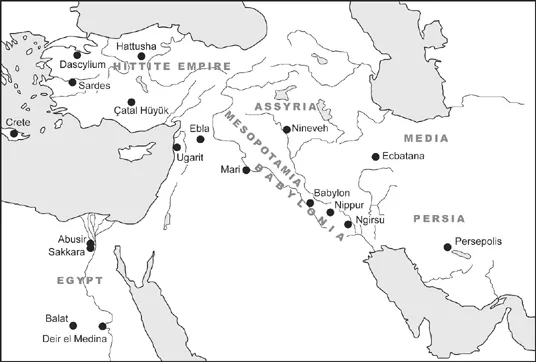
Figure 1.1Near and Middle Eastern sites mentioned in this chapter.
There is extensive evidence for the importance attached to authenticity. Tablets bearing a seal impression (often from a rolled cylinder seal) have been found at Uruk and Susa, at Nineveh (in Iraq), at Choga and Godin Tepe (now Western Iran) and at Habuba Kabira in northern Syria; the seals themselves, often hollow allowing them to be worn on a cord or as jewellery, are a common archaeological find. As a further security measure, the tablets themselves were often encased in a clay ‘envelope’: the envelope bore the same information as the inner tablet, ensuring that any tampering with that outer envelope would be obvious when the intended recipient broke it to read the tablet within.7
1.2.2 Ebla: the archive room
Around 3000 BCE the town of Ebla (now Tell Mardikh, around 60 km south of Aleppo, Syria) was a flourishing urban centre. Excavations, first started around 1964, revealed that this powerful city-state was destroyed by fire around 2300 BCE (following invasion by an Akkadian army); among the initial finds were 17,000 tablets and tablet fragments, representing some 5,000 original single documents, in the king’s palace.8
The archival importance of Ebla lies in the extraordinary fact that these tablets, although they had fallen to the floor because of the collapse of the shelving, ended up more or less in their original order. It was therefore possible to understand how they had been arranged. At least three levels of shelves, one above the other could be distinguished within the main archive room. The room itself was connected to the royal audience hall, a layout also found in the royal palaces of Mari and Ugarit (see below). The tablets had been placed upright on the shelves, one in front of the other, and leaning against the wall. Other smaller tablets were stored in earthenware jars and in baskets.
They were arranged on the basis of their contents, so, for example, accounts were differentiated from royal decrees and each record type was separated from the others. Within each series of documents, arrangement was not necessarily chronological. No finding aid has yet been discovered. These are certainly archives, documents retained for administrative purposes, rather than a library of literary productions. They relate, in particular, to the distribution of textiles and the distribution and export or delivery of metal objects (silver and gold). There are also some records of agricultural production and foodstuffs and a relatively small number of royal letters or royal decrees. The records kept together in the main room are a homogenous corpus – perhaps describable as a fonds – deriving from the palace administration. In two further rooms fitted out for the purpose were found other types of document, though the origin of these was more varied: administrative, economic or religious texts, letters and so on.
The Ebla discovery is one of the greatest accumulations of records from this era so far discovered. At the same time, given that the tablets appear to date from a single period of around 40 years (c.2350–2300 BCE) it appears that the archive itself was not particularly long-lived, and a similar limited time span is typical of most of the archives or record groups discussed here.
1.2.3 Mari and Nippur
Mari (now Tell Hariri, Syria, towards the Iraqi border) was conquered by the Babylonian empire in c.1760 BCE. Excavations of the palace of the king Zimri-Lim (c.1782–1759 BCE) revealed more than 20,000 clay tablets, often described as an extensive administrative archive.9 The tablets were consolidated into three main categories: those relating to internal government, to diplomacy and to the economy. It is clear that while the majority of records were retained for only short periods there was also some attention given to the arrangements for their retrieval: a letter from the royal steward records how he identified ‘two chests containing the tablets … that were sealed’.10
Beyond the palaces, temples were as much centres of economic activity as of religious activity and possibly offered a more stable environment for record-keeping. There are instances of archival accumulations extending for far l...
Table of contents
Cover
Half Title
Title Page
Copyright Page
Table of Contents
List of figures
Introduction to the French edition (1998)
Introduction to the English edition
1 The ancient world
2 The classical world: from Greek city states to the Roman empire
3 Archives and archival practices in Asia and Africa, antiquity to the eighteenth century
4 Archives and archival practices in the Americas, to the eighteenth century
5 In the chanceries and muniment rooms of medieval Europe from the fifth to the fifteenth centuries
6 Buildings and equipment in Western Europe, late antiquity to the seventeenth century
7 The defining era: Simancas, the Habsburgs and the sixteenth century
8 State bureaucracy and archival centralisation in early modern Europe
9 Being an archivist in early modern Europe
10 Methods and techniques for classification and arrangement in the fifteenth to the eighteenth centuries
11 Legislation, literature and practice in the nineteenth and twentieth centuries
12 Buildings and readers in the nineteenth and twentieth centuries
13 Archives destroyed, protected and reconstituted in the nineteenth and twentieth centuries
14 The rise of a profession in the nineteenth and twentieth centuries
15 From mutual assistance to international networks in the nineteenth and twentieth centuries
16 Conclusion: the value of the historical perspective
Afterword to the English edition
Index
Trusted by 375,005 students
Access to over 1.5 million titles for a fair monthly price.
Study more efficiently using our study tools.
Frequently asked questions
Yes, you can cancel anytime from the Subscription tab in your account settings on the Perlego website. Your subscription will stay active until the end of your current billing period. Learn how to cancel your subscription
No, books cannot be downloaded as external files, such as PDFs, for use outside of Perlego. However, you can download books within the Perlego app for offline reading on mobile or tablet. Learn how to download books offline
Perlego offers two plans: Essential and Complete
Essential is ideal for learners and professionals who enjoy exploring a wide range of subjects. Access the Essential Library with 800,000+ trusted titles and best-sellers across business, personal growth, and the humanities. Includes unlimited reading time and Standard Read Aloud voice.
Complete: Perfect for advanced learners and researchers needing full, unrestricted access. Unlock 1.5M+ books across hundreds of subjects, including academic and specialized titles. The Complete Plan also includes advanced features like Premium Read Aloud and Research Assistant.
Both plans are available with monthly, semester, or annual billing cycles.
We are an online textbook subscription service, where you can get access to an entire online library for less than the price of a single book per month. With over 1.5 million books across 990+ topics, we’ve got you covered! Learn about our mission
Look out for the read-aloud symbol on your next book to see if you can listen to it. The read-aloud tool reads text aloud for you, highlighting the text as it is being read. You can pause it, speed it up and slow it down. Learn more about Read Aloud
Yes! You can use the Perlego app on both iOS and Android devices to read anytime, anywhere — even offline. Perfect for commutes or when you’re on the go. Please note we cannot support devices running on iOS 13 and Android 7 or earlier. Learn more about using the app
Yes, you can access A History of Archival Practice by Paul Delsalle,Margaret Procter in PDF and/or ePUB format, as well as other popular books in Languages & Linguistics & Library & Information Science. We have over 1.5 million books available in our catalogue for you to explore.