eBook - ePub
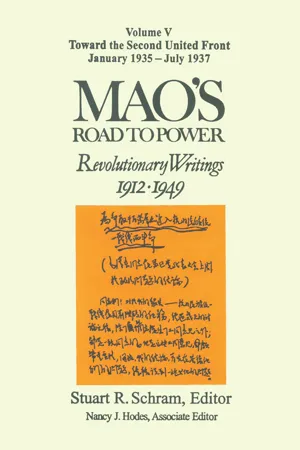
Mao's Road to Power: Revolutionary Writings, 1912-49: v. 5: Toward the Second United Front, January 1935-July 1937
Revolutionary Writings, 1912-49
- 848 pages
- English
- ePUB (mobile friendly)
- Available on iOS & Android
eBook - ePub
Mao's Road to Power: Revolutionary Writings, 1912-49: v. 5: Toward the Second United Front, January 1935-July 1937
Revolutionary Writings, 1912-49
About this book
This projected ten-volume edition of Mao Zedong's writings provides abundant documentation in his own words regarding his life and thought. It has been compiled from all available Chinese sources, including the many new texts that appeared in 1993, Mao's centenary.
Information
1936
Dispositions Regarding the Operations of the First Army Group and of the Twenty-fifth Army
(January 5, 1936, 2:00 P.M.)
Peng and Yang, Zuo and Nie, Xu and Cheng, Guo and Zhu:1
1. In order to bring about a balanced development toward the south of the soviet areas to the east and to the west of the Luo River, to develop the soviet areas farther southward in general, to make it more difficult for the enemy coming from the south to launch a northward attack, and to reduce the threat from the enemy forces in Shanxi, the tasks of the First Army Group and the Twenty-fifth Army2 are, passing in and out between the five xian towns of Luochuan, Baishui, Chengcheng, Hancheng, and Yichuan, to expand the soviet areas, expand the Red Army, expand anti-Japanese propaganda, and raise adequate funds for battle.
2. Deployment: Place the main forces to the east and south of the mountain range situated between the Luo River and the Yellow River. In principle one unit is to be stationed to the east and an initial-stage soviet area is to be created along the mountain range, and handed over to the local troops to continue its development in depth.
3. The time to start the movement southward is the 18th, and to end it, the 25th, so as to prepare for a new operational task beginning on the 26th.
4. The headquarters of the Front Army can remain as before near Ganquan.
5. Peng is the one to plan and issue orders to carry out the details of deployment.
6. Before commencing its operations, the Twenty-fifth Army is to choose ten of the better Party members from southern Shaanxi, preferably including people from the xian of Ningshan, Zhen'an, and Shangnan, and send them to the Shaanxi-Gansu Provincial Committee so that they may be assigned to work in southern Shaanxi.
7. The Provincial Committee should send local cadres and local troops to operate together with the First Army Group and the Twenty-fifth Army to develop and take charge of the soviet areas.
8. Yang should have a plan for political work.
| Mao [Zedong] | Zhou [Enlai] |
Our source for this document is Mao Zedong junshi wenji, Vol. 1, pp. 426-27, where it is reproduced from a copy in the Central Archives.
1. Peng and Yang are Peng Dehuai, the commander-in-chief of the main Red Army force, which had now resumed the name of First Front Army, and Yang Shangkun, the head of the Political Department. For a biography of Yang, see above the relevant note to the text of December 24, 1935. Zuo and Nie are Zuo Quan (1906-1942), a native of Hunan, and Nie Rongzhen, who were, respectively, chief-of-staff and political commissar of the First Front Army's First Army Group. Xu and Cheng are Xu Haidong and Cheng Zihua, who were, respectively, commander and political commissar of the Fifteenth Army Group of the First Front Army. Guo and Zhu are Guo Shushen and Zhu Rui, respectively heads of the Political Department of the First Army Group and of the Fifteenth Army Group of the First Front Army.
2. The Red Army's Twenty-fifth Army had been established in Hubei in late 1932. After the Long March it was combined in September 1935 with the Twenty-Sixth and Twenty-Seventh armies of Shaanxi and Gansu to form the Fifteenth Army Group. The Twenty-fifth Army itself became the Seventy-fifth Division. Here Mao is using the old designation, as he often did during this transitional period.
Approval of Dispositions for the Northern Expeditionary Army1 to Attack the Enemy's Reinforcements
(January 7, 1936, 9:00 A.M.)
Liu, Song:2
1. In order to provide more room for maneuver to the forces that are lying in wait to ambush the enemy, we agree that the northern expeditionary army should change the direction of its operations to Hanjiacha3 and Shipaizi. If the enemy has completed most of his fortifications in this area, then attack should be changed to encirclement, and preparations made to attack the enemy's reinforcements. If the enemy has already withdrawn you should press on toward Hengshan and engage the enemy's reinforcements.
2. To encircle the enemy's fortifications and cities and towns it is necessary to cut his communication lines, which enable the enemy to increase his reinforcements quickly. In attacking the enemy's reinforcements, whether they are large or small, it is necessary to operate with the main forces, surround them from both wings (with a primary direction of attack, naturally), and completely cut off the enemy's escape route so that his forces will be eliminated all at once and none of them escapes the net.
| Mao [Zedong] | Zhou [Enlgi] |
Our source for this text is Mao Zedong junshi wenji, Vol. 1, pp. 428-29, where it is reproduced from a copy in the Central Archives.
1. The Northern Expeditionary Army (also called the Northern Route Army) had been set up in December 1935 to defend the Shaanxi-Gansu Soviet Area against threats from Guomindang forces. It was composed of the Twenty-eighth Army, the Seventy-eighth Division, and a cavalry regiment.
2. Liu and Song are Liu Zhidan, commander of the Twenty-eighth Army, and Song Renqiong, political commissar of the same army. For their biographies, see the relevant notes to the text dated December 17, 1935.
3. Hanjiacha is a village located in the central part of Hengshan xiari in Shaanxi Province.
Dispositions for Wiping Out Yuan Kezheng's Regiment and Other Units
(January 9, 1936, 8:00 P.M.)
To Peng, Xu, and Cheng, and for transmittal to Zuo and Nie:1
1. Apart from Yuan's enemy regiment2 and five companies of the 684th Regiment, today (the 9th) two battalions of the 630th Regiment and four battalions of the 117th Division were added, making in all three regiments and five companies. What is the situation today? It is hoped that Xu and Cheng will inform Peng and also let me know.
2. Xu and Cheng, Zuo and Nie should, in accordance with the telegram of 7:00 A.M. on the 9th from Peng and Yang regarding deployment,3 resolutely destroy this enemy. The troops should be concentrated for this purpose. If Zuo and Nie have not yet arrived, then a small unit may pin down the enemy's main force while our largest main force surrounds one of the enemy's regiments and wipes it out. If Zuo and Nie and the Thirteenth Regiment have arrived, then the plan of surrounding and eliminating the enemy's main force is to be adopted.
3. When is it estimated that Zuo and Nie can reach Luoshengzhen? Please have Peng inform me.
Mao
Our source for this text is Mao Zedong junshi wenji, Vol. 1, pp. 430-31, where it is reproduced from a copy in the Central Archives.
1. Peng is Peng Dehuai. Xu and Cheng are Xu Haidong, Commander of the First Front Army's Fifteenth Army Group, and its political commissar, Cheng Zihua. Zuo and Nie are Zuo Quan and Nie Rongzhen, mentioned above in the text of January 5, 1936.
2. The reference is to the 685th Regiment of the 129th Division of the Guomindang's Sixty-seventh Army, commanded by Yuan Kezheng.
3. The reference is to a telegram from Peng Dehuai and Yang Shangkun to Xu Haidong and Cheng Zihua, to be copied and transmitted to Zuo Quan and Nie Rongzhen and reported to Mao Zedong and Zhou Enlai. The telegram ordered the Seventy-fifth Division of the Fifteenth Army Group, together with the Second Division and the Thirteenth Regiment of the First Army Group, to annihilate the enemy advancing toward Sanhuangzhang and Yongxiangzhen.
Rest, Train, and Prepare to Take On New Tasks
(January 13, 1936, 8:00 P.M.)
To Peng [Dehuai], Zuo [Quan] and Nie [Rongzhen], Xu [Haidong] and Cheng [Zihua], Chen and Peng:1
1. Zuo and Nie should be able to reach Luoshengzhen today. The Fourth Division has already arrived at Wuzhuangzhen.
2. All units of the First Army Group and Fifteenth Army Group should be concentrated in Luoshengzhen and Xianguzhen and the nearby areas. They are not to go far from these places, and should emphasize rest and physical strength, training in offensive battle, and politically raising to the highest level feelings of resistance to Japan and condemnation for the Chinese traitors, and are not to be distracted by other work.
3. The Fourth Division should remain close to the main force, and should be commanded by Zuo and Nie.
4. Be prepared to carry out a new task beginning on the 18th, securing enough good food for five days to use during the march.
5. Three clinics have already set out for Qiaojiazhuang and Bauonggou. Peng is requested to check and see whether they have arrived, and to order them to begin taking in wounded soldiers at once so as to relieve the field hospital and the troop station hospital. They are to reach Mazijie by the 19th.
6. Whether or not Ganquan comes into our hands, the current tasks of the Eighty-first Division and the First Regiment must be brought to completion by the 19th, and preparations made for new operations.
7. If Ganquan is not taken, the one regiment of the Twenty-ninth Army that is already concentrated is to be responsible for surrounding the city. Peng is requested to order this regiment immediately to set out for Ganquan.
8. The two army groups are to terminate all unfinished matters in the rear immediately. All personnel capable of moving with the troops must concentrate at Mazijie by the 19th, but those in Linzhenzhen are to remain where they are.
Mao
Our source for this text is Mao Zedong junshi wenji. Vol, 1, pp. 432—33, where it is reproduced from a copy in the Central Archives.
1. Chen and Peng are Chen Guang and Peng Xuefeng, respectively commander and political commissar of the Fourth Division of the First Front Army's First Army Group.
Letter from the Red Army to All Officers and Men of the Northeastern Army Concerning Its Willingness to Join with the Northeastern Army in Resisting Japan
(January 25, 1936)
To Deputy Commander Zhang, Chairman Yu, Army Commander Wang, Army Commander He, Army Commander Dong, and Army Commander Wan,1 and for transmission to all divisional and regimental commanders and all officers and men of the Northeastern Army:
It has already been over four years from "September 18th" to the present. In these four years, not only have our thirty million compatriots of the Three Northeastern Provinces been turned into ghosts under the butcher knives of the Japanese imperialist bandits, or pieces of meat on their chopping blocks. In addition, the provinces of Rehe, Chahar, and Hebei have been occupied one after the other. The whole of North China is about to become a second "Manchukuo." The "long-term resistance" of Chiang Kaishek's Nanjing government has proved to be in reality nothing but permanent nonresistance. Chiang Kaishek is the greatest Chinese traitor to sell out his country that China has known since ancient times, and he is about to sell out the whole of China to Japanese imperialism.
Under orders from Chiang Kaishek's Nanjing government not to resist, the Northeastern Army has given up your own native villages and your own land and property, leaving behind your own parents, wives, brothers, and sisters to be trampled, oppressed, raped, and slaughtered by the Japanese imperialist bandits. How heartrending and detestable it is to think about these things! The Japanese imperialist bandits and the chief traitor, Chiang Kaishek, are the absolutely irreconcilable enemies of your Northeastern Army. You should pledge yourselves to fight to the death to overthrow Japanese imperialism and the chief traitor, Chiang Kaishek, and to recover our Three Northeastern Provinces and the whole of North China!
Because the overwhelming majority of the officers and men of the Northeastern Army wish to fight Japanese imperialism, and to fight to the death against it, the Japanese imperialist bandits and the head traitor, Chiang Kaishek, do not like the Northeastern Army. Ever since the Northeastern Army withdrew from the Three Northeastern Provinces, Chiang Kaishek has never given them space and time for rest and reorganization. He does not want the Northeastern Army to fight Japanese imperialism, but rather wants them to fight the Red Army, because the Red Army opposes Japanese imperialism and the selling out of the country by Chiang Kaishek and the Guomindang! One day he orders the Northeastern Army to Hubei, Henan, and Anhui to fight the Red Army, and the next day he transfers it again to Gansu and Shaanxi to fight the Red Army. He wants Chinese people to kill one another savagely. He wants the Northeastern Army, which is willing to resist Japan, to fight the Red Army, which is resolved to resist Japan, so that Japan will be happy and the Northeastern Army will suffer casualties and losses. What do you think—is Traitor Chiang Kaishek's vicious plot detestable or not?
Not only does Chiang Kaishek want the Northeastern Army to fight the Red Army, but he is oppressing the Northeastern Army in every way. He has not assigned the Northeastern Army a good location, but has sent them to the two extremely poor provinces of Shaanxi and Gansu. He was not even willing to allocate the relatively rich and populous portions of these two provinces, southern Gansu and southern Shaanxi, to the Northeastern Army. His treatment of the officers and soldiers of the Northeastern Army is extremely unfair. The pay of the officers and ...
Table of contents
- Cover
- Half Title
- Title
- Copyright
- Contents
- Acknowledgments
- General Introduction: Mao Zedong and the Chinese Revolution, 1912—1949
- Introduction: The Writings of Mao Zedong, 1935—1937
- Note on Sources and Conventions
- 1935
- 1936
- 1937
- Bibliography
- Index
- About the Editors
Trusted by 375,005 students
Access to over 1.5 million titles for a fair monthly price.
Study more efficiently using our study tools.
Frequently asked questions
Yes, you can cancel anytime from the Subscription tab in your account settings on the Perlego website. Your subscription will stay active until the end of your current billing period. Learn how to cancel your subscription
No, books cannot be downloaded as external files, such as PDFs, for use outside of Perlego. However, you can download books within the Perlego app for offline reading on mobile or tablet. Learn how to download books offline
Perlego offers two plans: Essential and Complete
- Essential is ideal for learners and professionals who enjoy exploring a wide range of subjects. Access the Essential Library with 800,000+ trusted titles and best-sellers across business, personal growth, and the humanities. Includes unlimited reading time and Standard Read Aloud voice.
- Complete: Perfect for advanced learners and researchers needing full, unrestricted access. Unlock 1.5M+ books across hundreds of subjects, including academic and specialized titles. The Complete Plan also includes advanced features like Premium Read Aloud and Research Assistant.
We are an online textbook subscription service, where you can get access to an entire online library for less than the price of a single book per month. With over 1.5 million books across 990+ topics, we’ve got you covered! Learn about our mission
Look out for the read-aloud symbol on your next book to see if you can listen to it. The read-aloud tool reads text aloud for you, highlighting the text as it is being read. You can pause it, speed it up and slow it down. Learn more about Read Aloud
Yes! You can use the Perlego app on both iOS and Android devices to read anytime, anywhere — even offline. Perfect for commutes or when you’re on the go.
Please note we cannot support devices running on iOS 13 and Android 7 or earlier. Learn more about using the app
Please note we cannot support devices running on iOS 13 and Android 7 or earlier. Learn more about using the app
Yes, you can access Mao's Road to Power: Revolutionary Writings, 1912-49: v. 5: Toward the Second United Front, January 1935-July 1937 by Zedong Mao,Stuart Schram in PDF and/or ePUB format, as well as other popular books in Politics & International Relations & International Relations. We have over 1.5 million books available in our catalogue for you to explore.