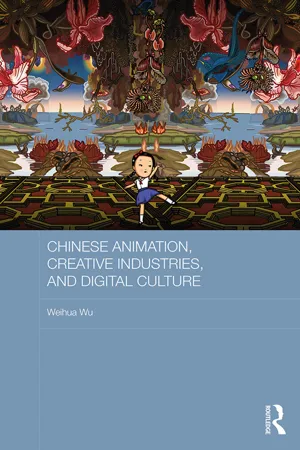
This book explores the development of the Chinese animation film industry from the beginning of China's reform process up to the present. It discusses above all the relationship between the communist state's policies to stimulate "creative industries", concepts of creativity and aesthetics, and the creation and maintenance , through changing circumstances, of a national style by Chinese animators. The book also examines the relationship between Chinese animation, changing technologies including the rise first of television and then of digital media, and youth culture, demonstrating the importance of Chinese animation in Chinese youth culture in the digital age.
- 194 pages
- English
- ePUB (mobile friendly)
- Available on iOS & Android
eBook - ePub
Chinese Animation, Creative Industries, and Digital Culture
About this book
Information
1
Introduction
Animation reveals the unique and ambivalent sociocultural characteristics in the unfolding of media and film history in contemporary China. It represents a paradigm of visual phenomenology that constructs the missionary agenda to fulfill the need to nurture spectatorship with an educational purpose as well as the desire for successful socialist ideology. It creates a genre of cinematic and national aesthetic within an active field that frames both the demanding pursuit of visual modernity and the chaotic discourse of the cultural industry which, especially in the past thirty years, has directed its unsettling industrialized practices within the broad scope of cultural changes that have affected China. Both this pursuit and this discourse can be regarded as perspectives for understanding the indigenous identity of Chinese animation, which now shows its potential to present a dynamic image factory product consumed by the largest audience in the world. To some extent, the foundation of such understanding, reading, and theorizing of Chinese animation is becoming intertwined with efforts to make sense of the practical interactions among several crucial phenomena in the contemporary Chinese imagination of the political economy of Chinese film and the rising authority of the culture industry, where it has been intricately struggling with the dialogue of modernity and postmodernity and the rise and death of individual autonomy in the wave of mobilization of the iGeneration, which has been creating a landscape of independent animation of its own. The above will be the primary concerns of my thinking and writing in this book, in which I will focus on the problematic of the cultural redefinition of animation and its relationships with other recent trends in Chinese society, in order to illustrate the interpretive horizon of Chinese animation at the turning point where capitalism meets socialism, neoliberalism encounters digitalization, and spectator-ship faces the iGeneration youth.
The present age of rereading and renarrating of the story of Chinese animation has been understudied but overinterpreted in broad new terms. Chinese animation could be a cultural weapon in a war without gunsmoke (Sun, 2011). It is the one and only soft power China could easily build upon in the field of cultural industry (Jin, 2012). It represents a unique channel for transnational communication carrying the Chinese ethnic aesthetic (Guo, 2003; Sun, 2011). It is a minzu/ethnic visual heritage embedded with the values of Chineseness, which is perhaps unique in the one-hundred-year history of Chinese film (Zhang, 1981; Yin, 1997; Zhang, 2002; Jing, 2 004). It is already considered a pioneer of Chinese digital culture (Wu and Fore, 2005; Wu, 2005). However, it is burdened with a cultural catachresis and is located within a metaphoric category in Chinese film studies (Wu, 2009).
During the past thirty years, Chinese animation has undergone a process of rapid economic and organizational restructuring, driven by political, sociocultural, and technological transformation. The globalization-influenced shift of socialist-political ideology today has focused within the newly conceptualized “animation industry,” where a loosening political regulatory framework has involved more than the singularity of the Chinese Communist Party’s (CCP) state discourse. This phenomenon, together with the emergence of digitalized techno-culture and a commodified form of individuality, has reoriented the cultural specifics of Chinese animation. This has resulted in substantial changes to the ethnographic mapping of animation narrative and spectatorship. The escalating emphasis on consumer-based commerce in the post–Cultural Revolution Reform Era has resulted in two forms of uncertainty, one in relation to the market for animation and the other in relation to the question of censorship and the continuing pressure to make politically correct animation. These ambiguities have led both individual and corporate creators of animation in China to diversify visual formats and distribution windows and to make the mode of production more efficient and streamlined, in part by taking advantages of overseas opportunities for animation processing.
Animation production experienced rapid growth and marketization in the increasingly digitalized sector during the 1990s, responding especially to the growth of ideologies of individuality and to the rise of both the challenge of, and the enthusiasm for, the industrialization of animation as a nationalized cultural product since 1997. The rising tide of individuality is associated with the new affluence of urban iGeneration culture, which has emerged from everyday practices of amateur online video production and sharing and the sudden boost of the Flash technology–based cyber-animation community. Individual independent animators and small studios have, in the shadow of the mainstream animation studios, made much progress since 1997 in fabricating an alternative animation network in cyberspace, owing to the nationwide popularity of the personal computer and the advent of the Internet in China. The call for cultural industrialization connects the intriguing dynamics of both the death and rebirth of Chinese animation to the double-edged sword of discourse and the nationwide practice of creative cultural industry. An emerging body of media and technology studies has begun to investigate the effects of these changes on the production styles and visual paradigms of those involved in digitalized animation production environments and the cultural industries more broadly than it previously had.
Therefore, it also has been the coming age of redefining animation culture and its aesthetic, determined by the indefinable audience who was raised as the reinventing-China generation (Clark, 2005), the urban generation (Zhang, 2007), the postsocialist audience (Berry, 2004), and the i Generation (Johnson et al., 2014) in the post-Mao high-culture-fever (Wang, 1996) nation and the cultural-industry-driven period.
M. D. Johnson has anchored iGeneration cinema on the timeline at the point “when digital image-making technologies and internet connectivity made more dispersed modes of production, distribution and consumption possible.”
[T]he iGeneration continues to overlap with what film studies scholars call China’s “Sixth/Urban Generation” and with the country’s contemporary commercial film market. When we speak of iGeneration cinema, we are speaking specifically of three key developments in cinematic and moving image culture: (1) the emergence of new, non-industry producers and venues as key “nodes” within the Chinese cinema and moving image scene; (2) the ubiquity of digital and internet-based technologies; and (3) the globalization of individualization and experience under conditions of “neoliberalism with Chinese characteristics.”
(Johnson et al., 2014, p. 4)
The terrain of animation during the past three decades has been structured not only by the burgeoning practitioners of meishu film and animated film but also, gradually, by the writings of digital frontier vanguards who have brought critical issues to the surface concerning the existing hierarchies and visual paradigms that are significant “Chinese characteristics.”
Despite enormous commercial interest in the new technological landscape of contemporary animation filmmaking, little attention has been paid to the aesthetic reconstructing of visual narrative in industrialized productions today. Animation and related forms of visual representation have been underappreciated in China, largely due to their association with children’s entertainment, folkloric storytelling, and the didactic paradigm. The problematic is, as Paul Wells has noted of the cultural scenario of animation from the United States, that
Even in a contemporary period when animation enjoys increased critical attention, however, the idea that a “cartoon” can support aesthetic and cultural analysis, and demonstrate valid positions about social preoccupations is often met with doubt and incredulity.
(Wells, 2002, p. 2)
The studies of animation in China have encountered ambiguities of location and credulity since the early pioneering period of Chinese animation’s art and language. Animation studies are awkwardly situated in relation to the overwhelming commercial discourse of the “animation industry,” which has contained historical blind spots in Chinese film studies, but the recent years of massive growth of animation education in Chinese universities have shown a phenomenal reorientation of animation studies.
In 1985, the American animator Milt Vallas traveled around China in order to search for possibilities for co-productions with animation studios in the United States. After his trip, Vallas observed that “The growth of the animation and broadcast industries in China is reflective of the overall changes that have occurred in the economy specifically, and throughout Chinese society in general” (Vallas, 1998, p. 13). This claim relies on factors that extend beyond those covered in the usual formal studies of Chinese animation, and include the dynamics of the policy specifically affecting the culture industry and the approaches to globalization in China, which also can be found in other varieties of Chinese film study. One of the key assertions of this study is that the transformation of meishu film into the state discourse of the animation/cultural industry is intimately connected to the transitions of Chinese society. These transitions are themselves part of the reordering of cultural paradigms, media practices, and power relations, especially with respect to their ideological and aesthetic dimensions. After a consideration of the concepts of a national film genre and ethnographic visual representation, these themes of transformation are addressed here through an examination of specific aspects of the visual narrative of animation, beginning with the resurgence of ideas of national characteristics and style – ideals advanced by Mao Zedong’s “Talks at the Yan’an Forum on Literature and Art” and promoted repeatedly throughout the history of Chinese animation.
Today Chinese animation exists as a means of cinematic experience, as an independent format of visual culture, as iGeneration identity, and as a vivid example of cultural industry to fulfill the upside-down call of the Chinese dream. These threefold forms involve contradictory goals. With the globalization of consumer markets and the technology of streaming media, the animation industry has shown the potential to become an important sector of China’s cultural consumption machinery. Animation as a new genre of iGeneration culture has its roots in the uniqueness of the cultural identity of shanke (web-based Flash animators), online creators, independent filmmakers, and avant-gardes. These are the practitioners of new Chinese animation. And animation, as a form of individualized cinematic experience, has found ways to engage in social discourse through small-scale, independently generated narratives rather than through institutionalized cinematic representations. Together, the threefold struggle generates a visual and cultural map for the ambivalent transformation of Chinese animation. This map allows us an understanding of how Chinese audiences and youth – who had generally been regarded as the only audience of animation/meishu film/cartoon/comic/pictorial novels – now engage with the political, sociocultural, and technological sectors through the writing and rewriting of Chinese animation.
Animation in China has become a major component of numerous digital entertainment environments (including games, advertising, music videos, and educational applications, as well as online applications more obviously derived from traditional narrative forms) and platforms (from Xbox to smartphone and from computer to television). My descriptions and analysis in this study, therefore, draw upon different expressive domains in pursuit of both factual data and meanings.
The game-land that is boosted both on the Internet and on smartphones not only constitutes a symbolic linkage between the commodified power of animation representation and the contextualized authority of Chineseness but also helps spread a new form of discourse to a sociocultural “battlefield,” where the illusion of a transmedia world and the lure of a consumer virtual world together represent the most successful case today of China’s digital cultural capital. The game industry has encouraged the fashioning of a visual heterotopia in Chinese cyberspace, within which the pleasure of animation spectatorship has functioned.
Yet, writing on contemporary Chinese animation presents a problematic that has arisen within the subculture and in new media studies: How do we distinguish the authenticity of “new animation” from the authority of the “old school”? And how do we distinguish web-based animation cultures from an already-declined “old” animation heritage that has become absorbed and twisted by the mainstream activities of the market? From the perspective of cultural semiotics and postmodern reflections on modernization, these questions constitute the unfinished business of animation study in China. Both the old school and the new generation have interlocked with forms of modernity in conjunction with different historical moments and sociocultural points of view. The practices of generations of Chinese animators, from those of the Wan Brothers to those of today’s Flash animators, and from those of the cultural workers of the Chinese School1 to those of practitioners working in the commercial animation market, have collectively produced a powerful ethnographic narration, across which the visual forms of Chinese animation persist as forms of social practice. This is why, for instance, I found the 2001 Unrestricted New Image Festival, the 2005 Minjian (“unofficial” – literally, “among the people” or “within popular space” [民间]) Transformer Exhibition, and the state-sponsored international animation festivals and industry forums that followed to be so emblematic. The rise of the “new image” and minjian are areas for dialogue concern ing the shift of Chinese society to a more liberal iGeneration level, in this heyday of Internet and computer culture. The “new image” label hints at qualities of independence and individuality embedded (at least as ideas) in the everyday experience of ordinary people and everyday social practices. The events mentioned above remind us that there are alternative voices in Chinese youth subcultures that are capable of revaluing, renarrating, and relocating the significance of Chinese animation by using it to overpower the mainstream visual hegemony of the neoliberal marketplace. Meanwhile, the festivalgoing fever and the imagination that has been part of the evolution of Chinese animation have allowed predictions of the day when the chaos of the culture industry surpasses the national aesthetic style of the old school and the experimental practice and representation of independent animation, along with the cultural agency of iGeneration animators, and finally merges with all of them in what we call the upcoming age of Chinese animation industry.
Recently, writers on Chinese cultural studies have turned their concerns to the convergence of industrialization and postmodern practice, and they have created a theoretical approach which has brought new meanings to the development of new technologies, emerging subjectivities, and a new public sphere on the Internet. Paul Pickowicz and Chris Berry have drawn attention to the cultural significance of Chinese film “by explicitly invoking its etymological roots in postmodernism” (Berry, 2004, p. 13), and others have commented on China’s transition and the Chinese filmmaking in the age of global capital (Xiao, 2011). This study attempts to understand Chinese animation within the problematic of cultural capital and to explore the relationships among a visual genre, a national state, and the reconfiguration of modernity, in order, hopefully, to penetrate the ideological mask of the culture industry overburdened by Chinese animation.
This book is based on observations and analyses of recent works in animation and cultural criticism. The perspectives represented and contexts considered are the result of an effort to provide an interdisciplinary research model. At the same time, I hope to bring together work concerning digital subcultures in China and work explicitly concerned with capitalist culture and globalization in order to explore the following basic questions:
- What kinds of structural transformations have occurred in Chinese animation and related areas, in the context of a globalized neoliberal society?
- How do ongoing sociocultural transitions affect animation as a form of visual expression, and is it possible to develop a new, interdisciplinary cultural mechanism for studying animation, especially in the relationships between mainstream and subcultural expression and in those between new media study and film theory?
In addressing these questions, I intend to draw attention to several aspects of “new” Chinese animation that seem to have been overlooked in the past. Hence, each chapter of this book situates a phenomenological sample of the dig...
Table of contents
- Cover
- Title
- Copyright
- Contents
- List of figures
- Acknowledgments
- 1 Introduction
- 2 Catachresis and metaphor in theorizing Chinese animation
- 3 The state, animation spectatorship, and cultural dislocation in the Reform Era
- 4 New image, old discourse: the post-meishu reorientation
- 5 Everyday practices of the iGeneration in cyberspace: Flash Empire and Chinese shanke
- 6 Resistance as hegemony: the coming age of Chinese independent animation
- Conclusion
- Film and television show index
- Subject index
Trusted by 375,005 students
Access to over 1.5 million titles for a fair monthly price.
Study more efficiently using our study tools.
Frequently asked questions
Yes, you can cancel anytime from the Subscription tab in your account settings on the Perlego website. Your subscription will stay active until the end of your current billing period. Learn how to cancel your subscription
No, books cannot be downloaded as external files, such as PDFs, for use outside of Perlego. However, you can download books within the Perlego app for offline reading on mobile or tablet. Learn how to download books offline
Perlego offers two plans: Essential and Complete
- Essential is ideal for learners and professionals who enjoy exploring a wide range of subjects. Access the Essential Library with 800,000+ trusted titles and best-sellers across business, personal growth, and the humanities. Includes unlimited reading time and Standard Read Aloud voice.
- Complete: Perfect for advanced learners and researchers needing full, unrestricted access. Unlock 1.5M+ books across hundreds of subjects, including academic and specialized titles. The Complete Plan also includes advanced features like Premium Read Aloud and Research Assistant.
We are an online textbook subscription service, where you can get access to an entire online library for less than the price of a single book per month. With over 1.5 million books across 990+ topics, we’ve got you covered! Learn about our mission
Look out for the read-aloud symbol on your next book to see if you can listen to it. The read-aloud tool reads text aloud for you, highlighting the text as it is being read. You can pause it, speed it up and slow it down. Learn more about Read Aloud
Yes! You can use the Perlego app on both iOS and Android devices to read anytime, anywhere — even offline. Perfect for commutes or when you’re on the go.
Please note we cannot support devices running on iOS 13 and Android 7 or earlier. Learn more about using the app
Please note we cannot support devices running on iOS 13 and Android 7 or earlier. Learn more about using the app
Yes, you can access Chinese Animation, Creative Industries, and Digital Culture by Weihua Wu in PDF and/or ePUB format, as well as other popular books in Social Sciences & Ethnic Studies. We have over 1.5 million books available in our catalogue for you to explore.