- 243 pages
- English
- ePUB (mobile friendly)
- Available on iOS & Android
eBook - ePub
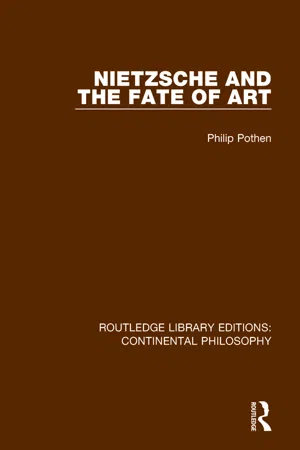
Nietzsche and the Fate of Art
About this book
This title was first published in 2002. Challenging the accepted orthodoxy on Nietzsche's views on art, this book seeks both to challenge and to establish a new set of concerns as far as discourses on Nietzsche's thoughts on aesthetics are concerned, whilst at the same time using such insights to illuminate more central concerns of Nietzsche scholarship, such as the will to power, the illusion/truth question, the eternal return, the death of God, tragedy, Wagner. Following the development of Nietzsche's thoughts on art from his earliest writings to his last, Pothen counters traditionally accepted interpretations by suggesting a need to recognize the deep suspicion and at times hostility that Nietzsche displays towards art and the artist throughout his text by emphasising the philosophical arguments underlying this deep suspicion, and by viewing this tendency as something deeply connected to the other areas of his thought. Readers with interests in Nietzsche studies, aesthetics, German philosophy, and the philosophy of music, will find this a particularly invaluable and distinctive contribution to Nietzsche scholarship.
Information
Chapter 1
Miracles, Metaphors and The Birth of Tragedy
The preface to the second edition of The Birth of Tragedy published in 1886 indicates to us that Nietzsche had the most serious misgivings about his first published work. Not only this, for there can be no doubt that he was entirely aware that he had subsequently turned against not only its general style and outlook, but also many of its central tenets, and in the most unmistakable manner. And yet, the fact that the second edition was published at all, and with few revisions beyond the addition of this preface, establishes too the general contention that Nietzsche had no wish entirely to disown the work, that in spite of his most serious objections to it, it was nevertheless to be read as a statement of his point of departure as a philosopher, as an important step in his development and, for all its faults, as a text intrinsic to his oeuvre.1 Perhaps, as the philosopher of amor fati – the doctrine that prescribes that one should love one’s fate – Nietzsche was in no position finally to disown any of his past writings nor, indeed, any of his past actions. But if this is the case why, then, did Nietzsche not simply stay silent about it? Instead, Nietzsche wishes, in 1886, to confront not so much the arguments in that work but rather their ill-health, his stylistic excesses, as well as to present what he has subsequently learnt of himself. It is a text that seeks to establish, at different times, both detachment and connection, a species, perhaps, of that relationship of distance whose pathos is, for Nietzsche, one of self-assumed, although deserved and hard-won, elevation and superiority.2
These initial and general observations concerning the place of BT in Nietzsche’s text need not and should not, however, be thought of as determining in any sense our own reading of that work, for it could be said that the Preface to the 1886 edition of BT might be no less a product of strategic manoeuvrings and textual machinations than the work of 1872 has been seen to be.3 But these general considerations should allow us, at the very least, to reinforce, on the one hand, the evident fact that the Nietzsche of the 1880s has clearly cast off much of the philosophical underpinnings of his first work and is entirely aware that he has done so and to reinforce, on the other hand, the equally evident point that Nietzsche nevertheless wishes to maintain full responsibility for it and, indeed, to assert that what is wrong with it is not so much that what the author said in it was wrong, that he should not have said it, but rather that ‘he should have sung’ (Attempt at a Self-Criticism, 3). As important, although perhaps more contentious than these general remarks, is the suggestion Nietzsche can be seen to be making throughout the Preface and in his later texts as a whole, that what is needed to reconcile these two principles outlined above is the acknowledgement that a text requires to be read in such a way that its inner contradictions, its silences, it evasions, its rhetorical stance are read and interpreted too, quite as much as what might be called the argumentation with which the text might seem most overtly to be concerned (see De Man, 88). The most obvious and well-known of these suggestions is the remark that what BT is primarily concerned with is, in fact, a subject with which the original text seems to have little to do, namely, morality, or indeed, Christianity (BT 5; see also EH VI, 2). But there are, indeed, others, and we will look at these more closely in due course.
While such an approach has become an overarching principle of deconstructive modes of interpretation, Nietzsche’s suggestions have duly been taken up by a range of commentators, including some not normally associated with such approaches, who have seen in BT, in its curious and often contradictory celebrations of Wagner, Schiller, Kant, Schopenhauer, the German Volk and much else, and in Nietzsche’s subsequent, or even contemporaneous, rejection of these and other themes in his notebooks,4 the occasion for a more closely argued reading of the text, one that attempts to understand the text in terms of Nietzsche’s overall philosophical development.5 What I hope to do in this chapter is to attempt to highlight and to analyse some of these themes, and in particular those that will remain themes of Nietzsche’s thoughts on art, to see both how they subsequently develop and yet how in many respects they also remain the same, how it is that, in spite of the enormous changes that Nietzsche’s thought undergoes during this time, certain continuities will nevertheless remain apparent from the time of BT up to EH, and how it is that Nietzsche can, in the 1886 Preface, near the end of his productive life, at one and the same time both appear to reject and yet still claim as his own this extraordinary text.
Apollo contra Dionysus
The relationship between the Dionysian and the Apollinian is central to the argument of BT. As principles of artistic productivity – the one of music, ecstasy, madness, collectivity, Rausch, and the other of dream, appearance, healing, Schein and individuation – it is these fundamental impulses which, when united, bring about the ‘miracle’ of Greek tragedy (BT, 1). And yet, as impulses diametrically opposed to one another, this miracle remains at the same time stubbornly inexplicable, even, it might be said, impossible. Nietzsche himself wrestles with the need both to emphasize the greatest distance between the two impulses in order to give their apparent union a sufficiently primordial basis, to show that their marriage is an extraordinary one, and yet at the same time, to narrow the gap sufficiently in order to account for their reconciliation, since this is, of course, the very purpose of the text itself. He talks at the outset of their ‘perpetual strife’ [fortwährenden Kampfe] (1), the fact that they are in ‘tremendous opposition’ [ungeheurer Gegensatz], that they remain ‘openly at variance’ [in offnen Zwiespalt], and indeed of the ‘metaphysical miracle’ [metaphysischer Wunderaht] of their reconciliation,6 such that we come to wonder how, on the face of it, the Dionysian can ever be revealed in Apollinian dream images at all (2). Later, the opposition is seen to be ‘more hazardous and even impossible’ [bedenklicher und sogar unmöglich], their union a ‘mystery’ (10) and while Nietzsche points to the periodic exchange of gifts between the deities which later represented a ‘reconciliation’ [Versöhnung], at bottom, however, he claims, ‘the chasm [Kluft] was not bridged over’ [nicht überbrückt] (2). And yet Nietzsche does, as he must, bridge this chasm, on this occasion, for example, with an appeal to an intuition which, even in a work thoroughly imbued with an intuitive, imaginative, even poetic spirit, nevertheless still appears somewhat inexplicable, if not incredible. After echoing an earlier point concerning the ‘astonishment’ (2) with which the Apollinian Greek must have beheld the terrible and terrifying Dionysian – an astonishment parallel, perhaps, to Nietzsche’s own, and ours, that such a ‘miracle’ could have occurred at all – Nietzsche writes:
The effects wrought by the Dionysian also seemed ‘titanic’ and ‘barbaric’ to the Apollinian Greek; while at the same time he could not conceal from himself that he, too, was inwardly related to those overthrown Titans and heroes. Indeed he had to recognize even more than this: despite all its beauty and moderation, his entire existence rested on a hidden substratum of suffering and of knowledge, revealed to him by the Dionysian. And behold: Apollo could not live without Dionysus (4).
There are two important points to be made concerning this passage: firstly, it seems that the Apollinian is here already counted in with the Dionysian even before its moment of reconciliation. The recognition of a certain relationship between the Apollinian Greek and Dionysian suffering and knowledge precedes their reconciliation in tragedy; indeed the latter is dependent, it would seem, on the former since the passage implies the necessity for this Apollinian recognition, or ‘self-knowledge’ (4). Another example of this ‘conflation’ of the two spheres otherwise considered to be ‘in tremendous opposition’ is the following passage:
Apollo … appears to us as the apotheosis of the principium individuationis, in which alone is consummated the perpetually attained goal of the primal unity, its redemption [Erlösung] through mere appearance. With his sublime gestures, he shows us how necessary is the entire world of suffering, that by means of it the individual may be impelled to realize the redeeming vision (4).
There is much in this account of the Apollinian that one might be excused in thinking belonged properly to the Dionysian: the necessity of suffering – later, unequivocally given over to the Dionysian (10) – the emphasis on redemption, and most crucially, the culmination of the process in the primal unity; and yet this last comes about as the result of the principium individuations and not any reference to Dionysian Rausch.7 Also, when Nietzsche, as in the following passage, points to degrees of refinement in pre-tragedy Dionysian rituals, he is, perhaps unconsciously, pointing to the fact that the Dionysian too must contain elements of the Apollinian if they are ever finally to become conjoined:
we need not conjecture regarding the immense gap which separates the Dionysian Greek from the Dionysian barbarian. From all quarters of the ancient world – to say nothing here of the modern – from Rome to Babylon, we can point to the existence of Dionysian festivals, types which bear, at best, the same relation to the Greek festivals which the bearded satyr, who borrowed his name and attributes from the goat, bears to Dionysus himself (2).
If each impulse contains enough of the other to moderate it to such an extent, Nietzsche nowhere mentions how such conjunctions differ from their final and momentous conjunction in tragedy, or rather, perhaps, the implication is that the difference between the Apollinian and the Dionysian is one of degree, and yet Nietzsche cannot say this for the simple reason that he is strongly committed to the idea that the difference is quite definitely one of kind. The ambiguity at the heart of this relationship is, it would seem, an entirely necessary one; as I have said, Nietzsche must, at one and the same time, lay open the basis for a reconciliation by, for example, pointing to a certain thematic and conceptual species-likeness, while at the same time insisting that they represent an opposition, and one that only very rarely finds itself dissolved in union. This difficulty leads to the curious counterpoint in the text, already noted, between, firstly, the attempt at explanation of the reconciliation of Apollo and Dionysus and the subsequent birth and then rebirth of their offspring, and secondly, the wonder, the astonishment that such an extraordinary hybrid – itself, perhaps, the centaur, half-Dionysian animal, half-Apollinian human – could ever have issued at all.8
The second point concerning this passage about the recognition by the Apollinian Greek of a certain Dionysian substratum inside him is that it is also clear that Nietzsche once again worries deeply over this union: not only has it been achieved too easily, but now, in addition, it has not accounted sufficiently for the fundamental supremacy of one of the antagonists, the Dionysian. Nietzsche writes, but now in an almost interrogative form that appears to reflect his own doubts concerning the implications both for the Apollinian as supposed equal partner in this marriage and, more generally, for this extraordinary but still putative union he must finally bring about:
And let us ask ourselves what the psalmodizing artist of Apollo … could mean in the face of this demonic folk-song. The muses of the arts of ‘illusion’ paled before an art that, in its intoxication spoke the truth (4).
And where Apollo did withstand the onslaught of Dionysus, Nietzsche claims, ‘the authority and the majesty of the Delphic god exhibited itself as more rigid and menacing than ever’, implying, perhaps, that where these two impulses met, the reaction was one of repulsion rather than one of an attraction of opposites. Whether this is the case or not, the Doric, it seems, is the best example of this principle, an art ‘so defiantly prim and so encompassed with bulwarks’, an art born out of defiance of the Dionysian rather than an augmentation with it. Later, Dionysus is seen to overcome the Apollinian once again and the opposition is stated in, it would seem, uncompromising manner:
accordingly we recognize in tragedy a sweeping opposition of styles [durchgreifenden Stilgegensatz]: the language, colour, nobility, and dynamics of speech fall apart into the Dionysian lyrics of the chorus and, on the other hand, the Apollinian dream world, and become two utterly different [völlig gesonderte] spheres of expression (8).
The Dionysian now emerges as the true hero of tragedy; indeed, the drama of individuation appears now to have shifted to it from its earlier focus in the Apollinian:
That he [Dionysus] appears [erscheint] at all with such epic precision and clarity [Deutlichkeit] is the work of the dream-interpreter, Apollo, who...
Table of contents
- Cover
- Half Title
- Title Page
- Copyright Page
- Table of Contents
- Acknowledgements
- Abbreviations
- Introduction
- Chapter 1 Miracles, Metaphors and The Birth of Tragedy
- Chapter 2 Nietzsche, Hegel and the ‘Death of Art’
- Chapter 3 Zarathustra the Godless and the Monological Work of Art
- Chapter 4 The Will to Power and Art
- Chapter 5 Genealogy, Disinterestedness and the Judgement of Taste
- Chapter 6 Decadence, Wagner and the End of Art
- Conclusions: The Fate of Art
- Appendix ‘French Nietzsches’, Madness and the Work of Art
- Bibliography
- Index
Trusted by 375,005 students
Access to over 1.5 million titles for a fair monthly price.
Study more efficiently using our study tools.
Frequently asked questions
Yes, you can cancel anytime from the Subscription tab in your account settings on the Perlego website. Your subscription will stay active until the end of your current billing period. Learn how to cancel your subscription
No, books cannot be downloaded as external files, such as PDFs, for use outside of Perlego. However, you can download books within the Perlego app for offline reading on mobile or tablet. Learn how to download books offline
Perlego offers two plans: Essential and Complete
- Essential is ideal for learners and professionals who enjoy exploring a wide range of subjects. Access the Essential Library with 800,000+ trusted titles and best-sellers across business, personal growth, and the humanities. Includes unlimited reading time and Standard Read Aloud voice.
- Complete: Perfect for advanced learners and researchers needing full, unrestricted access. Unlock 1.5M+ books across hundreds of subjects, including academic and specialized titles. The Complete Plan also includes advanced features like Premium Read Aloud and Research Assistant.
We are an online textbook subscription service, where you can get access to an entire online library for less than the price of a single book per month. With over 1.5 million books across 990+ topics, we’ve got you covered! Learn about our mission
Look out for the read-aloud symbol on your next book to see if you can listen to it. The read-aloud tool reads text aloud for you, highlighting the text as it is being read. You can pause it, speed it up and slow it down. Learn more about Read Aloud
Yes! You can use the Perlego app on both iOS and Android devices to read anytime, anywhere — even offline. Perfect for commutes or when you’re on the go.
Please note we cannot support devices running on iOS 13 and Android 7 or earlier. Learn more about using the app
Please note we cannot support devices running on iOS 13 and Android 7 or earlier. Learn more about using the app
Yes, you can access Nietzsche and the Fate of Art by Philip Pothen in PDF and/or ePUB format, as well as other popular books in Philosophy & Philosophy History & Theory. We have over 1.5 million books available in our catalogue for you to explore.