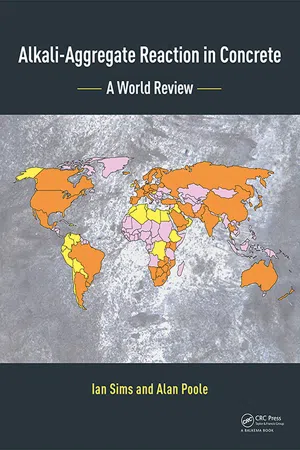
Alkali-Aggregate Reaction in Concrete
eBook - ePub

Alkali-Aggregate Reaction in Concrete

A World Review

  1. 768 pages
  2. English
  3. ePUB (mobile friendly)
  4. Available on iOS & Android
eBook - ePub

Alkali-Aggregate Reaction in Concrete

A World Review

About this book

Alkali-Aggregate Reaction in Concrete: A World Review is unique in providing authoritative and up to date expert information on the causes and effects of Alkali-Aggregate Reaction (AAR) in concrete structures worldwide. In 1992 a first edition entitled The Alkali-Silica Reaction in Concrete, edited by Professor Narayan Swamy, was published in a first attempt to cover this concrete problem from a global perspective, but the coverage was incomplete. This completely new edition offers a fully updated and more universal coverage of the world situation concerning AAR and includes a wealth of new evidence and research information that has accumulated in the intervening years.

Although there are various textbooks offering readers sections that deal with AAR deterioration and damage to concrete, no other single book brings together the views of recognised international experts in the field, and the wealth of scattered research information that is available. It provides a 'state of the art' review and deals authoritatively with the mechanisms of AAR, its diagnosis and how to treat concrete affected by AAR. It is illustrated by numerous actual examples from around the world, and comprises specialist contributions provided by senior engineers and scientists from many parts of the world.

The book is divided into two distinct but complementary parts. The first five chapters deal with the most recent findings concerning the mechanisms involved in the reaction, methods concerning its diagnosis, testing and evaluation, together with an appraisal of current methods used in its avoidance and in the remediation of affected concrete structures. The second part is divided into eleven chapters covering each region of the world in turn. These chapters have been written by experts with specialist knowledge of AAR in the countries involved and include an authoritative appraisal of the problem and its solution as it affects concrete structures in the region.

Such an authoritative compilation of information on AAR has not been attempted previously on this scale and this work is therefore an essential source for practising and research civil engineers, consultant engineers and materials scientists, as well as aggregate and cement producers, designers and concrete suppliers, especially regarding projects outside their own region.
Frequently asked questions

Yes, you can cancel anytime from the Subscription tab in your account settings on the Perlego website. Your subscription will stay active until the end of your current billing period. Learn how to cancel your subscription.
No, books cannot be downloaded as external files, such as PDFs, for use outside of Perlego. However, you can download books within the Perlego app for offline reading on mobile or tablet. Learn more here.
Perlego offers two plans: Essential and Complete
  • Essential is ideal for learners and professionals who enjoy exploring a wide range of subjects. Access the Essential Library with 800,000+ trusted titles and best-sellers across business, personal growth, and the humanities. Includes unlimited reading time and Standard Read Aloud voice.
  • Complete: Perfect for advanced learners and researchers needing full, unrestricted access. Unlock 1.4M+ books across hundreds of subjects, including academic and specialized titles. The Complete Plan also includes advanced features like Premium Read Aloud and Research Assistant.
Both plans are available with monthly, semester, or annual billing cycles.
We are an online textbook subscription service, where you can get access to an entire online library for less than the price of a single book per month. With over 1 million books across 1000+ topics, we’ve got you covered! Learn more here.
Look out for the read-aloud symbol on your next book to see if you can listen to it. The read-aloud tool reads text aloud for you, highlighting the text as it is being read. You can pause it, speed it up and slow it down. Learn more here.
Yes! You can use the Perlego app on both iOS or Android devices to read anytime, anywhere — even offline. Perfect for commutes or when you’re on the go.
Please note we cannot support devices running on iOS 13 and Android 7 or earlier. Learn more about using the app.
Yes, you can access Alkali-Aggregate Reaction in Concrete by Ian Sims, Alan Poole, Ian Sims,Alan Poole, Ian Sims, Alan B. Poole in PDF and/or ePUB format, as well as other popular books in Physical Sciences & Chemistry. We have over one million books available in our catalogue for you to explore.

Information

Publisher
CRC Press
Year
2017
Print ISBN
9780367573331
eBook ISBN
9781317484417
Edition
1
Subtopic
Chemistry
Chapter 1

Introduction, Chemistry and Mechanisms

Alan B. Poole

1.1 Background

Several varieties of concrete were used as construction materials by the Romans. The development of concrete based on hydraulic cement similar to that used at the present time dates from the 19th Century. Since then a great number of technological improvements have occurred, extending the varieties of cements and hence concretes available today. In one form or another, concrete has become an essential and ubiquitous constructional material across the modern world.
Along with the technological refinements, a basic scientific understanding of the nature of this material has been developed, including the realisation that certain problems can and do occur, some of which can lead to its premature deterioration and failure.
One such problem arises from an injudicious selection of aggregate and cement types when designing and mixing the concrete. Although the concrete may initially meet all the required specifications of strength development and quality, after several years of service, it has been found that a few concretes begin to expand and crack, necessitating expensive remedial work or replacement. The particular problem involved is referred to as Alkali-Aggregate Reaction (AAR); and constitutes the subject of the present volume. This book updates and replaces the first edition entitled ‘The Alkali-Silica Reaction in Concrete’ (Editor: R.N. Swamy, 1992); and offers a greatly extended world coverage of AAR, including a global review of the problem and some of the possible solutions currently available.
AAR in concrete was first observed and identified in North America during the late 1930s and the first comprehensive scientific investigations describing the reaction and its effects were published by Stanton in December, 1940. Stanton investigated a number of occurrences of expansion and cracking leading to failures in concrete pavements in California, and found that the problem developed only when certain types of mineral components were present in the aggregates, and only when cement alkalis exceeded some minimum threshold percentage concentration. The reaction between the aggregate and the alkali gave rise to the name “alkali-aggregate reaction”. His findings encompassed a great deal of detailed information regarding the nature and practical significance of the reactions taking place, and included early versions of test methods that later became standards, and of methods of preventing or at least mitigating the results of the reactions. In a recent appreciation, Thomas (2011); suggested that the impact of Stanton’s findings could not be overstated. Prior to his publication, aggregate was considered to be an inert filler, but afterwards it was realized that some aggregates were not suitable for use in concrete without taking special precautionary measures. Of course, Stanton’s findings that cement alkalis could influence the durability of concrete caused great concern for the cement manufacturing companies and perhaps the most disturbing implication of Stanton’s study was that concrete could “fail… even if it is exposed to only normal curing and weathering conditions”.
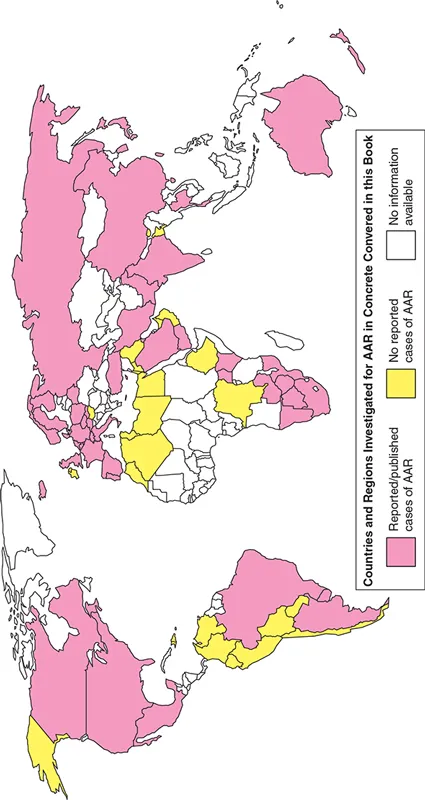
Since this early work a tremendous volume of research into causes, effects, avoidance and possible solutions to the problem of AAR in concrete has been undertaken. This work has been driven in part by the major costs involved in making good the damage AAR can cause, but also by the world-wide extent of the problem, AAR being found to occur in so many countries (see Figure 1.1);. Despite the fact that the actual occurrence of damaging AAR in concrete structures is relatively rare and seemingly spasmodic, the repair or replacement of affected structures involves a major expense for their owners.
Figure 1.1 A world map indicating countries and areas or regions where cases of AAR in concrete structures have been identified, investigated, reported or where avoidance specifications are in place.
Most of the research into this problem has taken place since the Second World War, giving rise to an extensive technical literature numbering several thousand research papers and technical reports. An important source of information concerning this work has been in the form of the proceedings of a series of International Conferences on AAR (‘ICAARs’);. The first of these was held in Copenhagen in 1974 and the 15th was held in Sao Paolo, Brazil in 2016. In addition, numerous national specifications and guidance documents for avoiding AAR have been published and will be referred to in later chapters of his book.
This second edition offers an up-to-date general overview of research into AAR in concrete. The coverage includes methods of diagnosis and testing (Chapter 2);, a discussion of ‘alkali-carbonate reaction’ (Chapter 3); and conclusions concerning the prevention, mitigation and management of affected concrete (Chapters 4 and 5);. The later chapters (6 – 16); then review AAR affected concrete and how the problem is dealt with in the different countries and regions of the world. The world map shown in Figure 1.1 illustrates the countries where AAR has been investigated or reported. Text-Box 1.1 lists the countries and regions where AAR has been investigated. It gives an indication of potentially reactive aggregate types and an indication of the reported cases and types of structures affected in the different regions.
Text-Box 1.1 A summary listing of countries and regions detailed in later chapters where examples of AAR in structures have been reported, or where potential for AAR has been investigated.
Country/Region Examples of potentially Reactive aggregate types Some Reported Case of AAR Comments and References Chapter
Europe 6,7 & 8
Austria Sedimentary sands and gravels Roads, pavements dams Quartzite and gneisses identified as reactive 8
Belgium Quaternary sands and gravels, argillaceous limestone, quartz diorite, dacite Bridges, bridge decks, hydro structures 150 structures affected Denmars (2012); 8
Cyprus Crushed opaline siliceous limestone, river and beach gravels Marine structures buildings Poole (1975); Siliceous reef limestone aggregate with high water absorption (3.3); 8
Czech Republic Granodiorite, quartzite, phyllite, acid volcanics, quartz-feldspar tuffs, siliceous limestone Highway structures, bridges, airport pavements, dams, tunnels Cryptocrystalline quartz identified as reactive in a range of rock types 8
Denmark Opaline flint, calcareous flint, microporous flints Swimming pools Bridges, roads Cements low alkali, external sources may contribute alkali. Marked pessimum behaviour. Rapid reaction. Nielson et al. (2004); 7
France Siliceous limestone, quartzite, Rhône gravels, meta-granite and gneiss in Alpine region Dams, bridges, retaining walls ASR in over 400 structures, 10 demolished. Most in N. France and Brittany. Some cases complicated by DEF and sulfate attack 8
Finland Pre-Cambrian gneiss, cataclasites, mylonites Bridges, housing, industrial buildings 70+ structures identified. Confused with freeze-thaw. Air entrainment & ggbs in common use. Local cement high-alkali. Pyy et al. (2012); 7
Germany Opaline sandstone, flint, greywacke, siliceous limestone Bridges, highway pavements, precast slabs First identified early 1950s, typically rapid reaction time 8
Hungary Sands and gravels, carbonates and volcanics None reported Only andesite potentially reactive. Common use of ggbs cementreplacement 8
Iceland Sea dredged basalt, andesite, rhyolite, aggregates containing secondary opal Domestic housing, hydraulic structures, pavements Early cements are high alkali. Fly ash, pozzalans & silica fume in common use. Wigum et al. (2009/10); 7
Italy River sands and gravels and carbonates containing chert, jasper, chalcedony Residential and industrial buildings, pavements Barisone, G. & Restivo, G. (1992b); 8
Netherlands River sands and gravels Bridges, viaducts, tunnel linings Sea dredged gravel non-reactive common use of pfa. Broekmans (2002); 8
Norway Sandstones, greywacke, claystone, mylonite, cataclasite, acid volcanics Bridges, hydraulic structues, precast units, foundations, pipes, dams Typically slowly reacting, use of fly ash in cement to mitigate ASR. Wigum et al. (2004); 7
Poland Sands and gravels containing opal and chalcedony, sandstone, siliceous limestone and dolomite Viaducts, buildings, precast elements Large producer of aggregates, but variable quality. Góralczyk (2001); 8
Portugal Granitoid types, basalts Dams, bridges Mostly slow reaction ASR (Silva et al., 2016); Dolomite + crypto crystalline silica are potentiallyreactive. 8
Republic of Ireland Chert and greywacke None reported Some high alkali cements 6
Slovenia River sands and gravels, opaline breccia Concrete columns ASR in floor due to crushed glass contamination 8
Spain Quartzite, granodiorite, granite, monzonite, schist, slate Hydraulic structures, dams, bridges Quartzite and monzonite with micro and crypto crystalline quartz fast reacting others slow 8
Sweden Gravels with porous flint, limestone with ...

Table of contents

  1. Cover
  2. Half Title
  3. Title Page
  4. Copyright Page
  5. Table of Contents
  6. Preface
  7. Editors and Authors
  8. Acknowledgments
  9. 1. Introduction, Chemistry and Mechanisms
  10. 2. Assessment, Testing and Specification
  11. 3. So-Called Alkali-Carbonate Reaction (ACR)
  12. 4. Prevention of Alkali-Silica Reaction
  13. 5. Diagnosis, Appraisal, Repair and Management
  14. 6. United Kingdom and Ireland
  15. 7. Nordic Europe
  16. 8. Mainland Europe, Turkey and Cyprus
  17. 9. Russian Federation
  18. 10. North America (USA and Canada)
  19. 11. South and Central America
  20. 12. Southern and Central Africa
  21. 13. Japan, China and South-East Asia
  22. 14. Australia and New Zealand
  23. 15. Indian Sub-Continent
  24. 16. Middle East & North Africa
  25. Index