![]()
Part I
Introduction
![]()
1 The Millennial city, shaped by contradictions
Markus Moos, Deirdre Pfeiffer and Tara Vinodrai
Interest in the Millennials has grown substantially over the past decade as this group of young adults enters housing and labour markets. Yet, we lack systematic insight into how Millennials are shaping how we live and plan our cities, and how planning from previous eras is shaping these patterns as well. This book fills this gap by bringing together novel research on 1) planning for generational change; 2) young adult labour and housing market transformations; 3) changing transportation patterns arising from generational change; and 4) the implications of generational change for the future of the North American city.
The Millennial generation exhibits contradictions. Millennials in the USA and Canada are the most highly educated generation in human history. Yet, Millennials are entering housing and labour markets when secure, long-term employment and low-cost housing are scarce, leading Millennials to live at home longer than previous generations. The Millennial generation is socially differentiated, shaped by increasing urban diversity, socio-economic divisions, and segregation (Pitter & Lorinc, 2016). For instance, a young urban professional and waiter may be similarly educated, but the young waiter may live in the young professional’s basement apartment and struggle to pay the rent that builds the young professional’s wealth.
Growing inequality within the Millennial generation is an outcome of neoliberal restructuring, which since the late 1970s has replaced large parts of the welfare state with institutions aimed at making individuals more robust to economic adversity in a more competitive economic landscape (Hackworth, 2007). Ironically, economic adversity and competition have heightened under neoliberal governance (Peck & Tickell, 2002; Peck, 2005; Peck, Theodore, & Ward, 2005). Education is a more important predictor of earnings for the Millennials than it was for the Baby Boomers, which reflects the ways in which neoliberal restructuring has contributed to greater intra-generational inequality (Moos, 2014).
Inequality is increasing across all generations, not solely the Millennials. Yet Millennials face special challenges by coming of age during a time of increasing societal change. Many in the Baby Boomer generation were able to comfortably afford homeownership and find secure work with only a high-school diploma. Over the course of the Baby Boomers’ careers, skills requirements changed and the economy restructured from one based on physical labour (e.g. manufacturing) to one based more on emotional and knowledge-based work (e.g. higher and lower-end services). Many entry level jobs today require a bachelor’s degree; many jobs with low educational requirements are now automated. Technological developments have amplified the pace of these changes (Moos, 2012). Generational analysis is gaining importance in this context (Vanderbeck, 2007; Moos, 2012), as two cohorts of young only ten years apart may face a city, economy, and labour and housing markets that not only offer different kinds of opportunities and risks but also have restructured in ways that change the qualifications and resources required for success (Furlong & Cartmel, 2007).
Urban and regional geographies reflect the contradictions of the Millennial generation. Growing social inequalities arising from changes in the economy and labour markets place pressures on opposite ends of the housing market. The influx of young adults into central cities through “youthification” (Moos, 2016) means cities have simultaneously become playgrounds for young professionals and refuges for low-income earners looking for cheap apartments. Transportation patterns have shifted in the wake of these migrations. Planners and urban policymakers have responded to these changes in an entrepreneurial manner by advocating for urban amenities, density, walkability and transit-oriented development in cities, and select accessible suburbs. These actions largely benefit well-to-do Millennials and reflect the broader neoliberal project, by restructuring central cities around entertainment, bars and restaurants, and other recreational amenities (Peck & Tickell, 2002; Brenner & Theodore, 2002; Moos, 2012). This competitive urban landscape, particularly in redeveloping central cities, rewards Millennials who had the privilege to prepare for the increasingly competitive housing and labour market through higher educational attainment, the luck of the birth lottery through access to parental support, or ever-increasing debt (Moos, 2012). This landscape shames Millennials who fall through the cracks as being individually responsible.
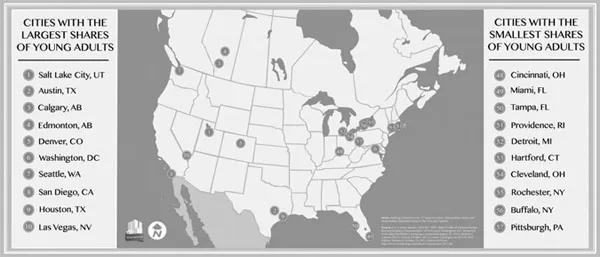
Millennials are not evenly distributed across cities in the USA and Canada. Figure 1.1 shows the metropolitan areas with the highest and lowest share of young adults. Cities with high concentrations are those with strong or emerging knowledge-based economies, but also those with strong natural resource-based economies. The young adult years are typically a time when people are most mobile, and are attracted to cities with job opportunities. However, a large share of these cities have an existing or growing concentration of urban amenities in their cores that attract Millennials. On the opposite end of the spectrum, the cities with the lowest share of young adults are primarily in the Rustbelt. Miami is likely on this list due to its sizeable older population rather than an absence of a younger population.
A city’s regional context matters in planning for Millennials. Planning the Millennial city in Detroit, Buffalo or Cleveland is not the same thing as in Portland, San Francisco or New York. Nor would cities with similar shares of Millennials necessarily face similar kinds of issues. For example, Seattle and Houston have similar shares of Millennials; however, this has more to do with the young seeking an urban lifestyle in the former than it does in the latter. The Millennial city, and its local expression and contingencies, is more than just the revealed preferences of one particular generation: It is the outcome of years of restructuring in governance, the economy and urban policy that will shape cities and planning for generations to come.
Figure 1.1 Fifty-seven largest US and Canada metropolitan areas by share of young adults (25 to 34 years of age)
This book is the first to substantiate, debate and interrogate the past, present, and future of the Millennial city for planning and policy. Our 24 North American contributors include some of planning’s most respected academics, emerging junior scholars and household names in public policy research. The book is organized by three overarching themes (Economy, Housing and Mobility), and concludes by looking forward to “what’s next”. Before we turn to the description of each of these themes, we first provide some definitions and justification for a generational (and demographic) lens on cities.
Defining generations
“Generations” is a contentious concept. This is because the concept of generations relies on the idea that specific events and circumstances shape life experiences, outcomes, and even personality traits amongst those born during a similar time period (Ryder, 1965; Moos, 2012). What constitutes a generation, and whether there is any sort of internal uniformity that overrides other factors of social differentiation, are common criticisms of generational analysis. The research presented in this book adopts the view that each cohort of young people (defined as those who were born during the same time period in similar geo-political contexts, grow up, go to school, and enter housing and labour markets under similar conditions) face more similar opportunities and challenges compared to another cohort of young adults that precedes or follows them. Of course, these opportunities and challenges are still experienced differently by young adults, due to their varying socio-economic characteristics, gender identities, sexual orientations, ethnicities and other dimensions of social differentiation, which need consideration.
Thus, more narrowly defined, generational analysis is an entry point to examining how a cohort of people responds to particular circumstances and may share similar constraints, opportunities and/or preferences. It is not a de facto assertion that “all Millennials are the same”. This approach requires careful elaboration of contextual factors alongside the study of generational differences. This approach does not support a global view of generational analysis that, for example, the Millennial generation in Asia and Africa can be lumped with those in Europe and North America. Our book is thus restricted to analysis of generational change in the USA and Canada. If carefully contextualized, the findings likely do have some applicability to other Western contexts, particularly the United Kingdom or Australia that have some similarities in their housing and labour markets.
Table 1.1 Definition and size of generations (in millions) in the USA (2015) and Canada (2016) Generation | Born | US Population | Canadian Population* |
Millennials | 1981 to 1997 | 75.4 (23%) | 7.5 (21%) |
Generation X | 1965 to 1980 | 65.8 (20%) | 7.2 (20%) |
Baby Boomers | 1946 to 1964 | 74.9 (23%) | 9.6 (27%) |
Silent Generation | 1928 to 1945 | 27.9 (9%) | 3.7 (10%) |
Total | | 321 (100%) | 36 (100%) |
Since the concept of generations is socially constructed, there is therefore no “exact” boundary. Definitions of Millennials vary throughout the book due to data constraints and research objectives but generally follow those outlined in Table 1.1 where Millennials are those born between 1981 and 1997. This age range follows the definition derived by the Pew Research Center (Fry, 2015), which analyses similarities in “demographic, attitudinal and other evidence on habits and culture” to determine when a generation begins and ends.
Some researchers consider all Millennials, while others chose to focus on young adults 25 to 34 years of age, the latter being a useful way to study Millennials who have in general completed post-secondary education, and are likely entering housing and labour markets for the first time. This approach suggests that young adults are “canaries in the mine”, in that comparison of young adult cohorts under different economic circumstances can provide insight on the negative socio-economic developments that require policy intervention (Myles, Picot, & Wannell, 1993). Younger households are more exposed to economic shocks than established households.
Demography is not destiny, but it matters
It is often said that “demography is destiny”. Overused and ill-defined, the phrase nonetheless provides a convenient point of departure for considering the dialectic relationship between generational change and the city. The phrase has at least two meanings. The first meaning of the phrase is that being born into a particular generation shapes economic prospects. Easterlin (1987), for example, has suggested that smaller birth cohorts have higher economic prospects than larger ones due to the resulting labour shortages. However, decades of empirical work in geography, planning, and urban and social studies suggest that social class, gender and race/ethnicity are more critical causal drivers of individual prospects than cohort size. The second meaning of the phrase is that demographic trends shape urban spatial structure, such as housing and labour markets and transportation behaviours (e.g. Foot & Stoffman, 1996). Existing research suggests that cohort size helps to shape urban spatial structure (Chapter 2). There is growing evidence that our cities are becoming more “generationed”, socially and spatially, as each generation of young adults face different opportunities and constraints and as lifestyle and age have become more important determinants of cities’ social geographies (Moos, 2014).
This book attempts to advance understanding of the generational drivers of urban social and economic differentiation. Our position is that demography as generational change matters but only as one of several broader socio-economic structures, all historically produced and reproduced, which determine future outcomes. Accounts of class, gender and racial dimensions of cities often end without consideration of their intersection with generational dimensions. Adding a generational lens ends great value to social science research. We must thus consider the ways class, gender, race/ethnicity and generational factors intersect (Furlong & Cartmel, 2007). Demography is not destiny but it matters, and it likely will continue to matter more and more in shaping cities.
Book themes and organization
Our book explores various facets of the generationed city, with a specific emphasis on Millennials, their experiences and preferences, and how those shape and are shaped by the city. The two remaining introductory chapters continue to build a conceptual framework for the book that we have started to describe here. The key tenets of this framework are recognition of: 1) the importance of generational change as one among several processes of urban change; 2) the dialectical relationship between urban and generational change; 3) the ways planning responds to and contributes to generational change; 4) the local and the more global impacts on cities and Millennials; and 5) the internal diversity of Millennial experiences despite sharing similar structural conditions.
Chapter 2, by Pierre Filion and Jill Grant, starts us off with a big picture discussion of the age-related factors that impact the evolution of cities. In particular, their work is context setting for the chapters that follow later on Millennial housing and mobilities (Parts 3 and 4 of the book). Filion and Grant define generation further as a concept distinct from cohort and other more generic demographic variables. The chapter considers in particular the predominant planning paradigms that have shaped the evolution of the urban structures across the North American landscape, and the ways these structures have both shaped and have been shaped by generational change. Importantly, Filion and Grant demonstrate the ways in which several factors must align for generational change to actually materialize in urban (and societal) change.
In Chapter 3, Tara Vinodrai considers the ways cities have been built for particular kinds of Millennials under the “creative cities” p...