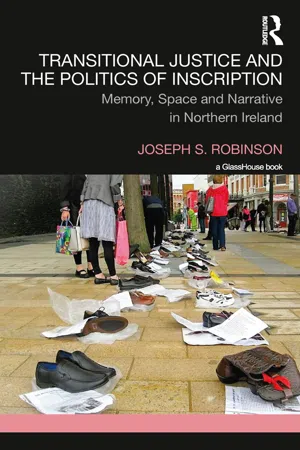
Taking Northern Ireland as its primary case study, this book applies the burgeoning literature in memory studies to the primary question of transitional justice: how shall societies and individuals reckon with a traumatic past? Joseph Robinson argues that without understanding how memory shapes, moulds, and frames narratives of the past in the minds of communities and individuals, theorists and practitioners may not be able to fully appreciate the complex, emotive realities of transitional political landscapes. Drawing on interviews with what the author terms "memory curators," coupled with a robust analysis of secondary literature from a range of transitional cases, the book analyses how the bodies of the dead, the injured, and the traumatised are written into - or written out of - transitional justice. The author argues that scholars cannot appreciate the dynamism of transitional memory-space unless they first engage with the often silenced or marginalised voices whose memories remain trapped behind the antagonistic politics of fear and division. Ultimately challenging the imperative of national reconciliation, the author argues for a politics of public memory that incubates at multiple nodes of social production and can facilitate a vibrant, democratic debate over the ways in which a traumatic past can or should be remembered.
eBook - ePub
Transitional Justice and the Politics of Inscription
Memory, Space and Narrative in Northern Ireland
- 244 pages
- English
- ePUB (mobile friendly)
- Available on iOS & Android
eBook - ePub
Transitional Justice and the Politics of Inscription
Memory, Space and Narrative in Northern Ireland
Chapter 1
How will ‘we remember them’?
Revisiting the reports
The fallacy of the full stop
In 1997 then Secretary of State for Northern Ireland Mo Mowlam appointed Sir Kenneth Bloomfield as Northern Ireland’s Victim’s Commissioner. Mowlam tasked Bloomfield with producing a report designed to “Look at the possible ways to recognise the pain and suffering felt by victims of violence arising from the troubles of the last 30 years … [and] to examine the feasibility of providing greater recognition for those who have become victims” (Bloomfield, 1998a, p. 8). Bloomfield’s subsequent report, entitled We Will Remember Them, was published in April 1998 to coincide with the adoption of the Agreement. It remains arguably the most important official effort to deal with the traumatic legacy of the Troubles, and to recognise its impact on Northern Irish, Irish, and British individual victims and survivors.
Bloomfield’s ‘Summary of Recommendations’ is an interesting and revealing text. The specific language used seems to couch the recommendations in the form of polite suggestions, and where the words approach an issue of political volatility, they dissolve into frustrating equivocation. In some sense, this should come as no surprise. The Agreement itself contained no concrete mechanism for confronting the legacies of past violence; indeed, it seems to have conveniently sidestepped these issues and essentially shunted them into Bloomfield’s lap (Bell, 2002). Of the mere three points regarding ‘victims of violence’ in the Agreement’s text (6.11–6.13), one is especially telling: “The participants believe that it is essential to acknowledge and address the suffering of the victims of violence as a necessary element of reconciliation. They look forward to the results of the work of the Northern Ireland Victims Commission” (i.e. Bloomfield and his staff). The crafters of the Agreement believed that issues surrounding the past in Northern Ireland were so volatile and so divisive, any inclusion of them in the Agreement would potentially derail the entire Peace Process (Powell, 2009). The solution seems to have been to put them off to the side in the hope that Bloomfield could ‘sort that all out’.
Bloomfield’s prose is robust and confident when he stands on the firmer ground of advocating for financial support, resource allocation, psychological care and rehabilitation, and increased access to trauma services for victims and survivors. However, when the Report’s recommendations approach questions of justice, accountability, and truth recovery, they tend to vaguely gesture towards a future context when such questions could begin to be explored and to suborn such questions to an alleged social imperative of ‘reconciliation’. But here is the paradox: reconciliation in a transitional society is rarely (if ever) realistically achieved, to say nothing of the essential emptiness and malleability of the term itself; and the notion of a truly post-conflict and post-sectarian future in Northern Ireland is consistently thwarted by the policies and actions of those perpetrators (and perpetrator-victims) who have enjoyed a de facto immunity from any type of social, legal, or political accountability. De facto immunity in Northern Ireland in turn allows former violence-producers the freedom to inscribe their particularistic conflict narratives into public space and public discourse relatively unfettered, though not, as we shall see, unchallenged.
But this may not be entirely the fault of the Agreement, Bloomfield, the pseudodemocratic and overtly anti-pluralist consociational structure of the Agreement, or any of the parade of civil servants and foreign academics who also tried (and failed) to reckon with Northern Ireland’s violent and traumatic past. It may also be laid at the feet of a failure of transitional justice as a paradigm to move beyond thinking of memory, victimhood, placemaking, and inscription as peripheral to or less important than the ‘puzzlingly irreconcilable’ goals of institutional design, national reconciliation, and justice and accountability (Leebaw, 2008). It may also be laid at the feet of a transitional justice imagination that consistently dichotomises between ‘good’ survivors and ‘bad’ survivors. The former are those who accept and work within the unfolding transitional reality, make places that conform to the supposed imperative of ‘moving on’, ‘looking forward’, ‘forgiveness’, and ‘reconciliation’, and inscribe said places with the narratives of hope and harmony. The latter are those who resist such a consensus being imposed upon them, who create places of irruption, melancholia, and indignation, and inscribe them with a narrative focused on the festering and undressed wounds still scoring and pockmarking transitional space (for a closely related argument, see Acorn, 2004). Writes Brewer (2010, pp. 166–167):
Honouring the sacrifice of dead/survivors, however, does not involve them becoming such a weight that they preclude the living from moving on … a redirection of society’s public gaze seems appropriate, with sights set determinedly on the future not the past … the cult of the dead harbours conflict not peace.
Brewer’s epistle finds its closest approximation in the German concept of Schluβstrich – ‘to draw a final line’ under the past (Till, 2005, p. 1)1 – and ironically seems to misapprehend the field of social memory studies from whence it draws its ostensible support. It also hearkens back very closely to Marx writing in the 18th Brumaire and his denunciation of memory as false consciousness. Memory, according to Marx, was fundamentally reactionary, the ‘reactionary cult of the past’, that prevented the French populace from learning the new language of socialism (Marx 1999 [1852], p. 6, cited in Misztal 2003, p. 42). Brewer argues that memory is only of use in transitional societies if it is “functional for post-violence societies” (Brewer, 2010, p. 192) and, presumably, only recounted by those who inhabit “socially functional public victimhood” (Brewer, 2010, p. 166). For Brewer (2010, p. 193), functional memory is that which is resolutely forward-looking; he refers to it as “re-remembering, turn[ing] the past into something pivotal for the future”, a process in which social memory is manipulated into something which does not interfere with the business of moving on through sound public policy.
Writing with his lens completely focused on Northern Ireland’s uneasy relationship with social memory, Brewer fails to see how his call for ‘socially functional memory’ carries with it totalitarian undertones. “Socially functional memory”, writes Brewer citing Michael Ignatieff (1993), is that which “releases society from the cult of the dead” (Brewer, 2010, p. 166). He goes on to suggest that this does not mean that victims/survivors should be silenced, but then exposes his preference for such a silencing by clearly advocating the use of public purse strings (i.e. to starve oppositional victims and survivors groups of public funding) to force victims/survivors to move on from the past and be accountable to and for the future. But who decides what is ‘socially functional’? And how, in a supposed modern democracy, does seeking justice for murders in spite of the weight of a regressive peace architecture run counter to social functionality? The fact that mass murders, bombings, and maimings have not been addressed in any modicum of fashion in Northern Ireland, coupled with the presence in government of political parties both directly and indirectly responsible for such widespread violence, suggests perhaps that the blame for what is socially dysfunctional in Northern Ireland does not lie exclusively with victims and survivors’ groups.
Brewer also seems to replace the ‘cult of the dead’ with the ‘cult of the future’. Looking briefly at other examples, Bogdanov (2010, p. 79) suggests the:
psychological orientation of Soviet people towards the future was a crucial aspect of Soviet ideology that was constantly reinforced. Whatever reservations one might have … future developments were all pre-scripted, and all that was needed for the realisation was the ability to wait and the strength to endure.
Rene Lemarchand (2005, 2006) argues that the Kagame regime in Rwanda has ruthlessly suppressed any social memories or narratives that run counter to their narrative of national unity, justifying its draconian memory laws on the supposed functional necessity of the future and the unifying Banyarwanda project. Brewer’s argument also eerily echoes the attempts of transitional politicians in a wide variety of contexts to impose a ‘full stop’ on politically uncomfortable remembrance of past violence and inscribe the pacto del olvido, the ‘pact of forgetting’.2 The crux of the pacto del olvido was that certain remembrance practices, including those demanding justice and accountability for past crimes, would get in the way of the difficult work of the post-authoritarian future. If we truly wish to understand the central role of memory in post-conflict societies, we as scholars must engage with it honestly, and not confine those whose memories do not conform with our futurist visions to the pathologised peripheries, or read them as wholly the unwitting dupes of the antipluralist projects of instrumentalist political elites.3 If this book succeeds in its central arguments, I intend to show how and why perspectives in Northern Ireland reminiscent of Schluβstrich, socially functional victimhood, or the pacto del olvido are misguided, oppressive, and paradoxically run counter to ‘reconciliation’, whatever that term may in fact be said to mean. In doing so, I see ‘reconciliation’ in Northern Ireland (and in other transitional societies) as one of the ‘master narratives’ so cogently criticised by Kirk Simpson. He writes (2009, p. 57):
Governments or policymakers that seek to induce collective political, cultural, or social amnesia through the use of conformist ‘master narratives’ of the past … risk repeating the offences of despotic groups by revictimising, objectifying, and restigmatising victims of conflicts.
Bloomfield’s Report attempted to grant victims and survivors better access to care, support, and financial aid. In these respects, while its recommendations remain only partially realised (O’Connor & O’Neill, 2015), it is hard to find fault with its intentions. However, there are important reasons why the Bloomfield Report, in terms of serving as a pathway to either justice or reconciliation, has largely fallen by the wayside, along with similar reports, similar findings, and similar recommendations made by Archbishop Robin Eames and Dennis Bradley (2009) and the aborted efforts of the US academics Richard Haass and Meaghan O’Sullivan. All fundamentally underestimated the need to address the difficult memories of the Troubles in public space. Transitioning to a new political or social order partially lifts the veil of silence surrounding the past and confronts political actors and citizens with the problem of representing the past. And Northern Ireland, like all transitional societies, will have to find some way to reckon with the bodies of the dead and the living, and the traumatic and disruptive ‘spectral traces’ they leave on societies and space (Jonker & Till, 2009).
Victimhood
Jeffrey & Candea (2006, p. 287) provide an excellent brief summation of the difficult victimhood questions facing transitional societies:
Why might people seek to be recognised as victims? How do claims to passive victimisation come up against counter-claims of agency or perpetration? How should we relate to claims of subalterneity when such claims are also deployed by states and powerful groups? How should we attend to expressions of suffering when such expressions obscure or deny others’ suffering?
McEvoy and McConnachie (2012, 2013) argue that victimhood in transitional societies is often a dialectic that constructs victimhood as the obverse of the dominant group representation of the perpetrator (see also Christie, 1986). Victimhood becomes innocence, innocence becomes defined as the categorical rejection of a dominant perpetrator, and all of the unsettling complexities inherent in transitional space are written out and suborned to the unambiguous line between victim and perpetrator, guilt and innocence. It may be almost trite to say it, but clearly transitional societies struggling to emerge from civil wars, dictatorships, ethnic cleansings, and/or widespread internecine atrocities do not render themselves neatly into such simplistic categories, and individuals and groups who deploy such categories often flounder logically when their protective logic is pierced by disconfirming information. To construct such a duality invariably requires that certain Northern Irish politicians and victims and survivors groups gloss over, ignore, or selectively not see a complex web of moral culpability and traumatic fragmentation. McEvoy and McConnachie are certainly correct to say this occurs regularly in transitional societies like Northern Ireland; however, an analytic focus on this prominent dialectic at the expense of other potentialities often forgets that the victims and survivors of the Troubles are a diverse population whose needs, rights, and desires do not always overlap. Many may stridently advocate for justice, truth, vengeance, accountability, and demand that they be recognised as categorically ‘innocent’ and those who harmed or are alleged to have harmed them categorically ‘guilty’, but many others in turn may deploy narratives that question the innocence/guilt dialectic in its entirety. And still others simply wish to be left alone, to work through their pain, to move on, or to grieve privately and draw at least a personal line under the trauma of the past.
This is the divisive social reality that first Bloomfield, and later Eames–Bradley, nervously waded into. In Section 2.14 of his report (1998a, p. 14), Bloomfield first attempts to bridge the divide between a morally unambiguous distinction between guilt and innocence and the ambiguous realities of post-Troubles space:
One of the most sensitive issues I have been obliged to confront is that of blame. Many people feel that any person engaged in unlawful activity who is killed or injured in pursuit of it is a victim only of his own criminality and deserves no recognition for it … I would, however, make the point that any individual’s involvement in unlawful activity does not lessen the grief and loss of close family who mourn him or her.
Here, while Bloomfield clearly resists a purely relativistic stance on victimhood (which should be unsurprising considering Bloomfield himself escaped an IRA assassination attempt), he seeks to soften this by empathising the shared experience of grief and loss of those left behind. Later in the Report, his prose sways towards the elegiac (1998a, p. 23).
We need to truly remember those who have suffered, to grieve at this side of the communal grave, to reflect on the truth of what occurred and to move forward from there. Above all, we have to persuade our children how costly and counter-productive it would be to pursue the animosities of the past.
Bloomfield thus seeks to break out of the dialectic through a rhetorical appeal to shared experience and the necessity of a shared future. But in doing so, he cannot adequately confront questions of justice, accountability, or truth recovery. All he can do is plant his flag firmly on the much less controversial ground of advocating for better financial and psychological support for victims and survivors. But the Report’s inability to even engage with these questions is troubling, especially for a document expected (unrealistically) to fill the gaping holes in the Agreement around how to reckon with the past (see Bloomfield 1998b). And by eliding the complex modalities of victimhood and perpetration, it paradoxically strengthens the dialectic it hopes to surmount. Behind the rhetorical flourish, many victims and survivors groups simply saw another attempt to foist an unacceptable equivalence on them – a moral and practical equivalence between those who took life in the service of a political cause and those who did not.
As such, many CNR and PUL victims and survivors groups used their responses to strengthen their particularistic and exclusionary legitimacy claims. A group representing CNR survivors of state violence and closely associated with Sinn Féin, Relatives for Justice, claimed that Bloomfield had side-stepped and disregarded their constituency’s need to understand the circumstances of the killings of their loved ones and as such was merely another layer of an ongoing political minimalisation of the guilt of the British state (O’Tuama, 1998). PUL victims and survivors groups representing mainly victims of republican violence also vociferously rejected the Report, again because of what they perceived as an erasure of the unimpeachable moral delineation between perpetrator and victim (McDowell, 2007; Smyth, 1998).
Eames–Bradley takes a...
Table of contents
- Cover
- Half Title
- Series Information
- Title Page
- Copyright Page
- Epigraph
- Contents
- List of figures
- Acknowledgements
- Glossary of terms and acronyms
- Introduction: A short history of the Troubles
- Chapter 1 How will ‘we remember them’?: Revisiting the reports
- Chapter 2 On social memory
- Chapter 3 State of exception
- Chapter 4 Empathic dissonance and the hierarchy of victims
- Chapter 5 Social hauntings, places of memory
- Chapter 6 The politics of inscription
- Chapter 7 It should never be lost
- Chapter 8 We are all, potentially, homines sacri
- Bibliography
- Index
Trusted by 375,005 students
Access to over 1.5 million titles for a fair monthly price.
Study more efficiently using our study tools.
Frequently asked questions
Yes, you can cancel anytime from the Subscription tab in your account settings on the Perlego website. Your subscription will stay active until the end of your current billing period. Learn how to cancel your subscription
No, books cannot be downloaded as external files, such as PDFs, for use outside of Perlego. However, you can download books within the Perlego app for offline reading on mobile or tablet. Learn how to download books offline
Perlego offers two plans: Essential and Complete
- Essential is ideal for learners and professionals who enjoy exploring a wide range of subjects. Access the Essential Library with 800,000+ trusted titles and best-sellers across business, personal growth, and the humanities. Includes unlimited reading time and Standard Read Aloud voice.
- Complete: Perfect for advanced learners and researchers needing full, unrestricted access. Unlock 1.5M+ books across hundreds of subjects, including academic and specialized titles. The Complete Plan also includes advanced features like Premium Read Aloud and Research Assistant.
We are an online textbook subscription service, where you can get access to an entire online library for less than the price of a single book per month. With over 1.5 million books across 990+ topics, we’ve got you covered! Learn about our mission
Look out for the read-aloud symbol on your next book to see if you can listen to it. The read-aloud tool reads text aloud for you, highlighting the text as it is being read. You can pause it, speed it up and slow it down. Learn more about Read Aloud
Yes! You can use the Perlego app on both iOS and Android devices to read anytime, anywhere — even offline. Perfect for commutes or when you’re on the go.
Please note we cannot support devices running on iOS 13 and Android 7 or earlier. Learn more about using the app
Please note we cannot support devices running on iOS 13 and Android 7 or earlier. Learn more about using the app
Yes, you can access Transitional Justice and the Politics of Inscription by Joseph Robinson in PDF and/or ePUB format, as well as other popular books in Law & Criminal Law. We have over 1.5 million books available in our catalogue for you to explore.