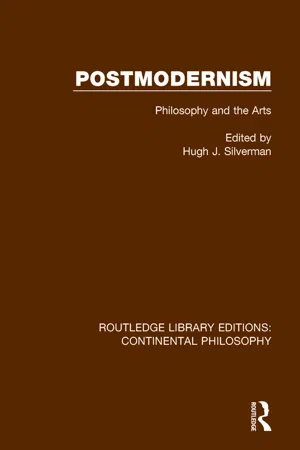
This book, first published in 1990, addresses the broad cultural phenomenon that is postmodernism. The first part of the book raises some general theoretical questions about postmodernism – its language and its politics, for example. The second section attends to particular 'sites', namely the various arts themselves and the philosophical understanding of them. Here one finds specific readings of architecture, painting, literature, theatre, photography, film, television, dance and fashion.
- 318 pages
- English
- ePUB (mobile friendly)
- Available on iOS & Android
eBook - ePub
About this book
Information
PART I
PROBLEMATICS
Chapter 1
BACK TO THE FUTURE
Mark C. Taylor
IThe return of time
He was locked in combat with something inaccessible, foreign, something of which he could say: That does not exist . . . and which nevertheless filled him with terror as he sensed it wandering [errer] about in the region of his solitude. Having stayed up all night and all day with this being, as he tried to rest, he was suddenly made aware that an other had replaced the first, just as inaccessible and just as obscure, and yet different. It was a modulation of that which did not exist, a different mode of being absent, another void in which he was coming to life. Now it was certain, something was approaching him, standing not nowhere and everywhere, but a few feet away, invisible. . . . He felt ever closer to an ever more monstrous absence that took an infinite time to meet. He felt it closer to him every instant and kept ahead of it by an infinitely small but irreducible splinter of duration.1
Modernism . . . Postmodernism. What is the difference? The difference might involve the question of difference itself. The question of difference, however, is inseparable from the question of presence or, more precisely, the question of the possibility or impossibility of presence. To interrogate presence is to question both space and time. To think difference—the difference that marks the margin between modernism and postmodernism, it is necessary to refigure space by imagining time without presence. Time that lacks the present implies a space that is never present (though it is not simply absent). The space of postmodernism is “the becoming-time of space and the becoming-space of time.”2 As Thomas the Obscure suggests, to approach this uncanny non-place, one must err back to the future.
How can the timely spacing of a present that is never present be thought? By following the trace of Maurice Blanchot's “différence,” which is the little-known precursor of Jacques Derrida's “différance,” the becoming-time of space and the becoming-space of time can be thought by rethinking Nietzsche's eternal return. If modern philosophy “ends” with the arrival of Hegel, postmodern non-philosophy “begins” with the return of Nietzsche. Nietzsche's return is, impossibly, always already before Hegel's arrival.
Nietzsche (if his name serves to name the law of the Eternal Return) and Hegel (if his name invites thought concerning presence as all and the all as presence) permit us to sketch out a mythology: Nietzsche can only come near Hegel, but it is always before and always after Hegel that he comes and comes again. Before: because, while thought of as absolute, presence has never reassembled within the accomplished totality of knowledge; presence knows itself to be absolute, but its knowledge remains a relative knowledge since it is not carried out in practice, and thus it knows itself only as a present that is not practically satisfied, not reconciled with presence as all: thus Hegel is still only a pseudo-Hegel. And Nietzsche always comes after, because the law that he bears presumes the accomplishment of time as present and, in this accomplishment, presumes its absolute destruction, so that thus the Eternal Return, affirming the future and the past as sole temporal instances and as identical, unrelated instances, freeing the future of all present and the past of all presence, shatters thought until this infinite affirmation will return infinitely in the future to that which under no form and in no time would know how to be present, just as that which, past and never having belonged in any form to the present, reverts infinitely to the past.3
Coming after Hegel, Nietzsche exposes the immemorial before that the System is constructed to recollect. This unrepresentable anarchie, which is always (the) outside of thought, is nonetheless thought in what Blanchot labels the “non-conceptualizable concept” of the Eternal Return. “The ‘re’ of the return inscribes as ‘ex,’ opening of all exteriority: as if the return, far from putting an end to it, marks exile, the commencement in its recommencement of exodus. To return, that would be to return again to ex-centering oneself, to erring. Only the nomadic affirmation remains” (PA, p. 49). When re-turn is eternal, the ex-teriority, ex-centricity, ex-ile, ex-odus, ex-cess, ex-position, and ex-pense of erring are unavoidable.
Considered in relation to other interpretations of Nietzsche, Blanchot's account of the Eternal Return is undeniably backwards. For most commentators, the horror of the Eternal Return grows out of the prospect of an endless recurrence of what is present here and now. Blanchot, by contrast, does not interpret the future as a re-presentation of the present but reads the future in the past and the past in the future in order to approach the present by way of the detour through past and future. If return is eternal, it will not only never end but it never began in the first place.4 In the absence of any true origin, nothing is original, which is not to imply that the origin is merely nothing. When nothing is original, (le) tout is secondary. If, however, all is secondary, something is always missing and everything is always lacking. To think this “lack [manque]” is, for Blanchot, to think what Western philosophy has left unthought.
That which is always already missing is a past that is “infinitely past” because it was never present in the first place. What has not been present cannot be re-presented. In Blanchot's rereading of Nietzsche's Eternal Return, the irreducible anteriority of the past repeatedly recurs as “the terrifyingly ancient [l'effroyablement ancien]” that is not subject to Er-inner-ung. Since the absolutely ancient can be neither re-collect-ed nor re-member-ed, it is irrevocable.
The irrevocable is thus not at all or not only the fact that what has taken place has taken place forever; that is perhaps the means—strange, I admit—for the past to warn us (while sparing us) that it is the void and that the falling due [echéance]—the infinite, fragile fall—that it designates, this pit [puits], is the depth of that which is without bottom. It is irrevocable, indelible, yes: ineffaceable, but because nothing is inscribed there (PA, p. 24).
“Le vide du puits, la profondeur de ce qui est sans fond”: the void of the pit, the depth of that which is without bottom is la tombe marking le non-lieu where (the) all falls [tombe]. L'espacement of this tombe is a time without present. The Not [Le Pas] of this strange space-time is le pas au-delà.
Time, time: the step/not beyond [le pas au-delà], which is not accomplished in time, would lead outside of time, without this outside being timeless, but there where time would fall, fragile fall, according to this “outside of time in time” toward which writing [écrire] would draw us, if it were permitted of us, vanished from us, from writing the secret of the ancient fear (PA, p. 8).
Since the “outside of time in time” is never made present, the tombe remains—remains empty. Le reste of the empty tombe is le puits surrounded but not contained by the pyramid.5
The writing covering the pyramid is hieroglyphic. The message re-turned from the desert of Egypt by the latter-day Moses is that hieroglyphs are images—the images of desire that are the non-stuff of which dreams are made. The terrifyingly ancient never actually appears; it only reappears as the dream of the “is” that is not, and the Not that “is.” The presence of this dream is the dream of the present in which presence appears but a phantasm. Nietzsche's immemorial law “suspends or makes disappear every present and all presence”—especially the presence of Hegel (PA, p. 26).
The time of time's absence is not dialectical. In this time what appears is the fact that nothing appears. . . . The reversal which, in the absence of time, constantly sends us back to the presence of absence, but to this presence as absence, to absence as affirmation of itself, an affirmation where nothing is affirmed, where nothing never ceases to affirm itself in the torment of the indefinite—this movement is not dialectical. Contradictions do not exclude each other in it, nor are they reconciled.6
In the irreconcilable contradiction of “an outside of time in time,” the past for which we long “is” always future and the future we ardently desire “is” always past. In the absence of a past that was never present, the dream of presence returns eternally to create the nightmare of a future that never arrives. If the encounter with the past has never taken place, the past is, paradoxically, always still to come. “L'avenir,” in other words, is “à venir.”
Under the law of the return, where, between past and future nothing joins [se conjuge]—how to jump from one to the other, while the rule [of law] does not permit the passage—how would this jump be possible? Past would be the same as future. Thus there would only be one sole modality, or a double modality functioning in such a way that identity, differed or deferred [différée], would regulate difference. But such would be the exigency of the return: it is under a false appearance of the present that the past-future ambiguity would invisibly separate the future from the past (PA, pp. 21–2).
Inasmuch as “the law of the Return” is eternal, it exhibits a ceaseless compulsion to repeat itself. As the play of Freud's Little Hans suggests, the repetition compulsion is tied to death. By repeating the impossibility of presence, the law of Eternal Return implies the inescapability of death. Absolute past and infinite future coincide in the “eternal beginning and eternal end,” which is, in Mallarmé's terms, the “Act of Night.” The time of this dark act is “Midnight.”
“Certainly a presence of Midnight subsists.” But this subsisting presence is not a presence. The substantial present is the negation of the present. It is a vanished present. And Midnight, where first “the absolute present of things” (their unreal essence) gathered itself together, becomes “the dream of a Midnight vanished into itself”: it is no longer a present, but the past, symbolized, as is the end of history in Hegel, by a book lying open upon the table. . . . Night is the book: the silence and inaction of a book when, after everything has been proffered, everything returns into the silence that alone speaks—that speaks from the depth of the past and is at the same time the whole future of the word. For the present Midnight, that hour at which the present lacks absolutely, is also the hour in which the past touches and, without the intermediary of any present time, immediately attains the extremity of the future. And such, as we have seen, is the very instant of death, which is never present, which is the festival of the absolute future, the instant at which one might say that, in a time without present, what has been will be (SL, pp. 113–4).
Death is the absolute future in which the absolute past approaches, but only approaches, for death is never present. The time of death and dying “is the abyss of the present, the reign of a time without a present” (SL, p. 117). In early as well as late writings, Heidegger argues that to think after the end of philosophy, one must rethink being in terms of time. Time appears radical only in relation to death. Da-sein, Heidegger maintains, must be understood as “being-toward-death.” To think time as death and death as time is to unthink being by uncovering fort in da and Nein in Sein.
Echoing Heidegger, Blanchot stresses the unsettling interplay of time and death. Being, which is never present as such, is a tendency toward l'avenir. From this point of view, being is being-toward “the nonarrival of that which comes toward [advient]” (PA, p. 132). By interpreting the absolute future, which approaches without arriving, in terms of “death and dying [la mort et mourir],”7 Blanchot is led to an unexpected conclusion. If death only approaches, I (or the I) never dies. “One never dies now,” Blanchot points out, “one always dies later, in the future [l'avenir]—in a future which is never actual, which cannot come except when everything will be over and done. And when everything is accomplished, there will be no more present: the future will again be past” (SL, pp. 164–5).8 Since la mort is never present, it (i.e., elle) never actually occurs.9 “Midnight is precisely the hour that does not toll until after the dice are thrown, the hour which has never come, which never comes, the pure, ungraspable future, the hour eternally past” (SL, p. 116). If Midnight never strikes, death is impossible. The impossibility of death does not mean that life is eternal. To the contrary, the silence of Midnight is the speechless tolling of le glas that echoes in and through all things and every one. The impossibility of death “is” the “non-event” in which the Impossible itself draws near.
The Impossible is a “non-power [non-pouvoir] which is not simply the negation of power.”10 As a “non-power or non-ability,” the Impossible is inseparable from a certain impotence.11 This impotence can never be mastered, accomplished, or achieved, but can only be suffered patiently. For Blanchot, as for Heidegger, that which is beyond being and nonbeing approaches when one “waits for something that will not have taken place” (PA, p. 88). What does not take place in this waiting is the “es” of “es gibt” or the “il” of “il y a.” The gift of es or il is, in effect, un coup de don that faults the subject. Commenting on the radical passivity implied in Emmanuel Levinas's notion of il-leity, Blanchot writes:
Passivity: we can only evoke it by a language that is reversed or overturned. In the past, I appealed to suffering: suffering such as I could not suffer, so that, in this non-power [non-pouvoir], the “me,” excluded from mastery and from its status as subject in the first person, destitute, desituated, and even disobliged, could lose itself as a me capable of suffering: there is suffering [il y a souffrance], there would be suffering, there is no longer a suffering “I”, and suffering is not present, is not born (even less lived) in the present, it is without present, as it is without either beginning or end, time has radically changed its meaning.12
This suffering is a “catastrophe” for the centered self. To undergo the impossible approach of death is to be ex-il-ed from oneself. The proximity of death is “the beyond [l'au-delà]” that “is in us in a manner that forever separates us from ourselves.”13 As the outside that is inside, le pas au-delà doubles every one/ One. The unmasterable double makes doubting Thomases of us all. The ghostly “twin”14 is a repetition of the subject that interrupts self-identity.15 To bear the unavoidable wound of le coup de don is to suffer the fate of dispossession. The one who is dispossessed is left to err in the non-place of a desert wilderness and the non-time of an interminable night. Blanchot describes this night as “Nuit, nuit blanche.”16 The white noise of this white night is the “murmur” echoing in all of Blanchot's writing. While the philosopher writes to silence this lacerating murmur, the writer writes to let it/il re-sound. The murmur of writing is the inhuman cry that eternally returns “in” l'entretien infini.
Thus we will choose our ideology. This choice will be the only one that can lead us to a non-ideological writing: writing outside of language, outside of ideology. Let us call this choice, without shame, humanist. . . . But what is “humanism”?17 In what terms can we define it without engaging in the logos of a definition? In those terms that will remove it furthest from a language: the cry (that is to say the murmur), cry of need or protest, cry without word, without silence, ignoble cry where, perhaps, the cry writes, the graffiti of high walls. It is possible, as one likes to state, that “man passes away.” He fades. He even has always already passed, faded, to the extent that he has always been suited for [approprié à] his own disappearance. But, in passing, he cries; he cries in the street, in the desert; he cries while dying; he does not cry, he is the murmur of the cry (EI, p. 392).
E-cri-ture: le cri écrit et lécrivain crie.
IIThe space of literature
Now, in this night, I come forward bearing everything [le tout], toward that which infinitely exceeds the all. I progress beyond the totality which I nevertheless tightly embrace. I go on the margins [marges] of the universe, boldly walking elsewhere than where I can be, and a little outside my steps. This slight extravagance, this deviation toward that which cannot be, is not only my ...
Table of contents
- Cover
- Half Title
- Title Page
- Copyright Page
- Contents
- INTRODUCTION: THE PHILOSOPHY OF POSTMODERNISM
- PART I: PROBLEMATICS
- PART II: SITES
- NOTES
- Bibliography
Trusted by 375,005 students
Access to over 1.5 million titles for a fair monthly price.
Study more efficiently using our study tools.
Frequently asked questions
Yes, you can cancel anytime from the Subscription tab in your account settings on the Perlego website. Your subscription will stay active until the end of your current billing period. Learn how to cancel your subscription
No, books cannot be downloaded as external files, such as PDFs, for use outside of Perlego. However, you can download books within the Perlego app for offline reading on mobile or tablet. Learn how to download books offline
Perlego offers two plans: Essential and Complete
- Essential is ideal for learners and professionals who enjoy exploring a wide range of subjects. Access the Essential Library with 800,000+ trusted titles and best-sellers across business, personal growth, and the humanities. Includes unlimited reading time and Standard Read Aloud voice.
- Complete: Perfect for advanced learners and researchers needing full, unrestricted access. Unlock 1.5M+ books across hundreds of subjects, including academic and specialized titles. The Complete Plan also includes advanced features like Premium Read Aloud and Research Assistant.
We are an online textbook subscription service, where you can get access to an entire online library for less than the price of a single book per month. With over 1.5 million books across 990+ topics, we’ve got you covered! Learn about our mission
Look out for the read-aloud symbol on your next book to see if you can listen to it. The read-aloud tool reads text aloud for you, highlighting the text as it is being read. You can pause it, speed it up and slow it down. Learn more about Read Aloud
Yes! You can use the Perlego app on both iOS and Android devices to read anytime, anywhere — even offline. Perfect for commutes or when you’re on the go.
Please note we cannot support devices running on iOS 13 and Android 7 or earlier. Learn more about using the app
Please note we cannot support devices running on iOS 13 and Android 7 or earlier. Learn more about using the app
Yes, you can access Postmodernism by Hugh J. Silverman in PDF and/or ePUB format, as well as other popular books in Philosophy & Philosophy History & Theory. We have over 1.5 million books available in our catalogue for you to explore.