First published in 1916, this work is still recognised as a valuable historical and analytical study of the rise and development of finance as a centralised, coordinated force during the period 1385 to 1915. It examines the evolution of the modern money market, and describes amongst other things the decline of the anti-usury sentiment, the beginnings of banking, and the early stock exchange. In detail the author goes on to discuss everything from the rise of the joint stock banks to the post-banking evolution.
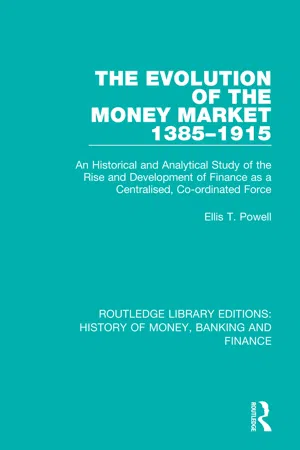
eBook - ePub
The Evolution of the Money Market 1385-1915
An Historical and Analytical Study of the Rise and Development of Finance as a Centralised, Co-ordinated Force
- 746 pages
- English
- ePUB (mobile friendly)
- Available on iOS & Android
eBook - ePub
The Evolution of the Money Market 1385-1915
An Historical and Analytical Study of the Rise and Development of Finance as a Centralised, Co-ordinated Force
Part I
Introductory Historical Sketch
The Evolution of the Money Market 1385–1915
Chapter I
The Embryology of the Money Market
AN endeavour to describe and analyse the evolution of the Money Market must begin with its embryology. But even that starting-point involves, as Maitland would have said, the making of a rent in a seamless robe. Economic phenomena are in the most profound degree mutually dependent, each the last portion of a chain that stretches back, link by link, beyond the time when our sun first hurled his satellites into their eternal orbits. There is no date in our island history since the Christian era at which we might take for granted the absence of every element of a money market, and set ourselves to discern the gradual advent of the various factors which compose it. Unless, indeed, we begin with Caesar, we are constrained to make a more or less arbitrary selection of a starting-point, and to take for granted the result of the previous evolutionary workings. Inasmuch as the idea of a money market suggests a concomitant money-economy, the best choice of a date is probably that (about the end of the fourteenth century) at which we can observe, with a fair degree of certitude, the influence of money—in the shape mainly of cash, but reinforced by a rudimentary credit—upon society. If it be objected that this date is unduly remote, the answer is that the aggregation of money, and the extended use of credit instruments are characteristic phenomena of the fifteenth century, just as the transformation of the goldsmith-banker from a mere bailee or depositary into the debtor of his client is a sixteenth-century symptom of rapidly progressing economic change. To initiate a survey of the evolution of the money market at a date subsequent to the appearance of these phenomena would be almost as futile as the writing of a history of the ascent of man by beginning with Shakespeare at the summit instead of with the anthropoid apes and the cave-dwellers at the base. The rigidity of a feudal regime had been relaxed, and the flexibility of a money-economy had begun to manifest itself when Richard II. succeeded to the throne in 1377. The money-solvent had then been at work upon the crystalloid fabric of feudalism for nearly two centuries, if we reckon from the first traceable commutation of the feudal dues into money. The process had been slow in operation upon a society mainly voiceless, economically ignorant, without national self-consciousness, or the power of united initiative. But its results are plain as we study the growing social instability which characterises the uneasy periods of Richard II. and Henry IV., as we watch the gradually gathering storm that culminated in the Wars of the Roses, and as we ultimately witness the close of the long mediaeval drama when the night fell over Bosworth Field.
The Money-Solvent at Work—Commutation
The operation of the money-solvent upon feudal society was aided by a long series of calamitous epidemics. The greatest and most disastrous was the Black Death of 1348-1349. A second pestilence came in 1361, a third in 1368, a fourth in 1381, and a fifth in 1396. But the Black Death was immeasurably the most disastrous visitation. If Stow is to be believed (but probably his figures are exaggerated), he had seen an ancient monument which recorded the mortality in London during the Black Death at 50,000—about half the total population. We have the names of the six wardens of the Hatters’ Company on December 13, 1347. All were dead before July of 1350. Four of the wardens of the Goldsmiths’ Company died in 1349. Whole villages were depopulated, entire monastic establishments left without a single inhabitant. Meanwhile, under an elementary money-regime, personal relations, once not easily alterable at will, had become liquefied. The square man was no longer forced to continue in the round hole. Labour had begun to follow capital. But a large proportion of the labour dues and obligations were commuted before there was a gold coinage, and at a time when money was extremely scarce, and prices consequently very low. By the year 1381, personal property (as distinguished from real) had been augmented to an enormous extent, and the gradual increase in the supply of currency, however irregular and unsystematic it may have been, had raised prices and changed the whole character of the conditions under which commutation had taken place, or was soon to be arranged. The tenants at Great Tew, in Essex, for instance, commuted on the basis of paying a halfpenny for each day’s winter labour owed by them, and a penny for each day’s autumn labour. But by the end of the fourteenth century the labourer who did the tenant’s commuted work was getting threepence a day for it; so that the change in money values had placed the landlord in the position of buying for threepence what he had sold for a halfpenny or a penny. He was like a landowner who lets a farm for a long term at a fixed rent in an era of rising prices. He even had to hire, instead of being able to command, the labour for cultivating his own demesne (i.e. the land which he personally occupied for his own use). Not unnaturally, he tried to undo the bargains into which his ancestors had entered with their tenants. He demanded the labour itself instead of the money commutation.
It is easy to understand how odious was the demand for a reversion to the feudal services made upon men born and bred under the new conditions. Such a requirement, addressed to freeholders, copyholders, and cottars, who had so long paid the money instead of yielding the labour—who had, in fact, neither experience nor recollection of any other state of affairs—was bound to produce dissatisfaction and resentment. Those results need not of necessity have followed under the earlier regime, where the relationship between the landlord and his legal inferiors was of the domestic and paternal type. But the conditions were vitally and fundamentally changed when the paternal was exchanged for the pecuniary nexus. These bonds breed totally different sentiments, not likely to co-exist side by side. The dissolution of the ancient tie of sentiment between owner and tenant was in one aspect the displacement of personal in favour of impersonal obligation—an innovation destined to produce, in a wider and different arena, immeasurable changes in the economic history of the world. From one point of view it may have been a loss, but in the strictly economic sense it was a gain. A man who deems himself free of the obligation to labour for the benefit of another, and who has risen to the dignity of his free position, is not likely to submit tamely to an intimation that for the future he must yield to the landlord the ancient toll of days of severe manual toil. When he can earn more as a settler in a town, or at all events swell his resources by occasionally disposing of his labour there, he will not listen patiently to the intimation that he and his are adscripti glebæ. His resistance to such demands is likely to be all the more desperate where the defendant must plead in the manor court itself before an officer whose every interest is that of the plaintiff. The unexpected reappearance of an ancient obligation to labour, and the endeavour to enforce it upon men whose ancestry, for four or five generations, had yielded no such service, are among the social incidents which (to use one of Huxley’s metaphors) beat gunpowder hollow as an explosive. They produced the tremendous concussion of 1381.1 Its results have been palpable down to our own day. If it had not happened, there would have been no money market.
The Black Death had laid the train for the explosion. Multitudes attempted to fly from the stricken land with such money as they could collect, and had to be stopped by royal proclamation (December 1, 1349). Jurors summoned to value mills and farms declared them worthless, since no miller or labourer could be found to tend them. Such labour as could be (and must be) obtained for harvest work was paid at amazing rates. The reaper, according to Knighton, got 8d. a day and the mower 12d. (in each case with food), and this at a time when a cow could be had for 12d. (the mower’s daily wage) and a fat sheep for 4d. The inevitable result (there being no such national food reserves as modern capital resources, operating in the field of international trade, would ensure) was that prices rose, in the words of Professor Thorold Rogers, “to the extent of 50, 100 and even 200 per cent.,” while some of the commonest articles of food became so dear as to be entirely out of the reach of ordinary consumers. Another inevitable consequence, then as in our day, was to inflict great hardship on all persons with fixed incomes. Commodities had doubled and trebled in price, whereas the means of paying for them remained a fixed quantity. The demands of the parish priests for increased fees were granted by statute in 1362. In our day, in the case of the railways permitted to increase statutory rates as compensation for the payment of higher wages, we have an instance of the same trouble, with the application of the same remedy. With the price of food greatly enhanced, and with the population reduced to one-half its previous numbers, wages rose in spite of legislation forbidding the labourer to demand or the employer to pay anything beyond the old rate. An attempt was made to reaffix the labourer to the soil, not by the cancellation of commutation agreements, but by forbidding him to quit the parish where he lived, in search of better employment. “Every man or woman,” said the Statute of Labourers (1351), “of whatsoever condition, free or bond, able in body, and within the age of threescore years . . . and not having of his own whereof he may live, nor land of his own about the tillage of which he may occupy himself, and not serving any other, shall be bound to serve the employer who shall require him to do so, and shall take only the wages which were accustomed in 1346, or the six or seven years previous to be taken in the neighbourhood where he is bound to serve.” The Legislature makes no attempt to revive the personal services which had been commuted or were in course of commutation. It simply endeavours to re-enact the old rate of wages. But labour seems to have defied the legislator, because it had the relentless pressure of economic law upon its side. The statute was impotent to suppress the working of human nature and the economic principle behind it. Statutory impotence and economic power will come into still more brilliant and instructive contrast as we proceed. As for the employer, he had either to accede to the demands of his workmen or see his crops rotting on the ground. The peasant’s chance was a sudden and unexampled opportunity of betterment, and the fact that he took it has altered the whole course of England’s economic history. Where efforts were made to enforce the legislation by imprisonment, such labourers as could escape fled ad silvas et boscos—to the woods and thickets. Many got away to distant manors (where their presence was welcome enough for the manner of their coming to be winked at) and were transformed from native to free labourers. Others went to the towns—progenitors of the nineteenth-century industrial workers, ready material for the use of the fifteenth and sixteenth century capitalist. Inside the town the worker was a craftsman ; outside he might be little better than a serf. Outside, he was the fixed portion of a rigid fabric; inside he could enter into a multitude of new relationships, every one of them a stimulus to individual pride and self-respect.
Land Sold by Retail
To all intents and purposes, villeinage by tenure and villeinage by blood had disappeared before the end of the fifteenth century. Services were defined—standardised so to speak—and their character inscribed on the roll of the manor as the beginning of copyhold tenure. Mr. Page’s researches have shown that of 81 specified manors before the Plague, all labour services had been commuted on 6. Partial commutation had taken place on 31, and there had been no commutation on 34. But on 182 manors in 1440, there had been complete commutation on 101, and partial commutation on 71, and no commutation only on 8, and even on these the team work was commuted. Society on a basis of status, as Sir Henry Maine would have said, was evolving rapidly into society on a basis of contract. The revolution in agricultural method resulting from the introduction of capitalistic policy, and the ever-increasing demand for labour in the capitalistic industries of the towns, represented a combined influence too strong for the manorial lords to resist.
Naturally, the tenants, finding themselves under the necessity of paying double the old rate of wages to their labourers (and realising that if the villeins were defeated their own turn would be the next to come), insisted upon concessions by the landlords. These latter were flatly told that unless they did reduce the rents the tenants would abandon their holdings. They had, in fact, no option in the matter. At a subsequent inquest upon certain of the Christ Church manors near Oxford, it was ascertained that “in the time of the mortality or pestilence which was in the year 1349, there remained hardly two tenants in the said manor (Ensham), and these had wished to leave, had not brother Nicholas de Upton, then abbot of the said manor, compounded anew with them, as well as with the other tenants who came in.” The fall in the incomes of religious foundations (partly due to the reduction of rents and partly to the falling off in the yields of tolls at the fairs) rendered the great monastic communities less able to relieve indigence, and set in motion the sentiments and forces which ultimately led to the Elizabethan Poor Law. Some of the individual landlords, despairing of the situation, began to sell small holdings ; so that by the end of the fourteenth century there was a fairly free market in them. While the realty went as an aggregate to the eldest son (in accordance with the practice of primogenitary devolution, which is the rule in mediaeval England, at all events after the time of the so-called Leges Henrici Primi), the personalty was distributable. As long as there was but little persona...
Table of contents
- Cover Page
- The Evolution of the Money Market 1385–1915
- Copyright Page
- Contents
- Part I Introductory Historical Sketch
- Part II The Nucleus of Organisation
- Part III The Rise of the Modern Money Market
- Part IV The Struggle Towards Consolidation
- Part V Confederacy, the Great Avowal and the Supreme Test
- Index
Trusted by 375,005 students
Access to over 1.5 million titles for a fair monthly price.
Study more efficiently using our study tools.
Frequently asked questions
Yes, you can cancel anytime from the Subscription tab in your account settings on the Perlego website. Your subscription will stay active until the end of your current billing period. Learn how to cancel your subscription
No, books cannot be downloaded as external files, such as PDFs, for use outside of Perlego. However, you can download books within the Perlego app for offline reading on mobile or tablet. Learn how to download books offline
Perlego offers two plans: Essential and Complete
- Essential is ideal for learners and professionals who enjoy exploring a wide range of subjects. Access the Essential Library with 800,000+ trusted titles and best-sellers across business, personal growth, and the humanities. Includes unlimited reading time and Standard Read Aloud voice.
- Complete: Perfect for advanced learners and researchers needing full, unrestricted access. Unlock 1.5M+ books across hundreds of subjects, including academic and specialized titles. The Complete Plan also includes advanced features like Premium Read Aloud and Research Assistant.
We are an online textbook subscription service, where you can get access to an entire online library for less than the price of a single book per month. With over 1.5 million books across 990+ topics, we’ve got you covered! Learn about our mission
Look out for the read-aloud symbol on your next book to see if you can listen to it. The read-aloud tool reads text aloud for you, highlighting the text as it is being read. You can pause it, speed it up and slow it down. Learn more about Read Aloud
Yes! You can use the Perlego app on both iOS and Android devices to read anytime, anywhere — even offline. Perfect for commutes or when you’re on the go.
Please note we cannot support devices running on iOS 13 and Android 7 or earlier. Learn more about using the app
Please note we cannot support devices running on iOS 13 and Android 7 or earlier. Learn more about using the app
Yes, you can access The Evolution of the Money Market 1385-1915 by Ellis T. Powell in PDF and/or ePUB format, as well as other popular books in Business & Business generale. We have over 1.5 million books available in our catalogue for you to explore.