A particular culture is associated with a particular community, and thus has a social dimension. But how does culture operate and how is it to be defined? Is it to be taken as the behavioral repertoire of members of that community, as the products of their behavior, or as the shared mental content that produces the behavior? Is it to be viewed as a coherent whole or only a collection of disparate parts? Culture is shared, but how totally? How is culture learned and maintained over time, and how does it change?
In Meaning and Significance in Human Engagement, Kronenfeld adopts a cognitive approach to culture to offer answers to these questions. Combining insights from cognitive psychology and linguistic anthropology with research on collective knowledge systems, he offers an understanding of culture as a phenomenon produced and shaped by a combination of conditions, constraints and logic.
Engagingly written, it is essential reading for scholars and graduate students of cognitive anthropology, linguistic anthropology, sociology of culture, philosophy, and computational cognitive science.
eBook - ePub
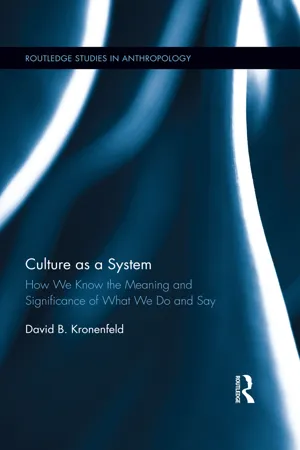
Culture as a System
How We Know the Meaning and Significance of What We Do and Say
- 134 pages
- English
- ePUB (mobile friendly)
- Available on iOS & Android
eBook - ePub
Culture as a System
How We Know the Meaning and Significance of What We Do and Say
About this book
Information
1
Introduction
A cognitive approach to culture
Certainly since the time of Boas in the US and of Tyler and Frazer in the UK, the central part of anthropology has been cultural – or, with a different emphasis, social – anthropology. Central to cultural anthropology has been the idea of culture: its content, its relationship to the community of people, and its relationship to the material objects produced by members of a cultural community. My book is not about the history of anthropological understandings of culture, but it does offer a coherent view of culture that speaks directly to complexities of the culture concept.
A particular culture is associated with a particular community, and thus has a social dimension. There has been a continuing debate concerning whether culture is to be taken as the behavioral repertoire of members of that community, as the products of their behavior, or as the shared mental content that produces the behavior. Questions have been raised concerning the coherence of any specific culture – the relationship of parts to one another; is that culture a single coherent whole or only a collection of disparate parts? Culture is shared, but how totally? How is culture learned? How is it maintained over time, and how does it change? My book’s approach to culture offers an integrated approach that responds to these questions.
I offer a cognitive and social understanding of culture that comes most directly out of cognitive anthropology, but that includes important insights from linguistics, sociology, and cognitive science – and draws significantly on my kinship research. Cognition refers to knowledge – but not just verbal or conscious knowledge. Cultural cognition is the shared pragmatic knowledge that includes our behavioral as well as conceptual knowledge – our knowledge of how to engage each other (whether via cooperation or competition) or avoid engagement, of how to make sense of what those around us say and do, of how to make things – either alone or via organized cooperation – of how to think about novel problems, and so forth.
Cognitive anthropology, as I see it, joins insights from cognitive psychology regarding individual cognition with insights about collective knowledge systems (including how to study them) that come out of linguistics (including recent work in cognitive linguistics) and linguistic anthropology. Work in artificial intelligence – especially attempts to simulate chunks of human behavior – has influenced my conception of systems, including my understanding of action systems and their relationship to knowledge systems. More generally, my approach to collective knowledge systems descends from the parallel work of Saussure and Durkheim.
The book is organized as an unfolding argument from basic principles and aims to give the reader not simply the resulting understanding of culture, but also to elucidate the combination of conditions, constraints, and logic that produce and shape culture. My aim is to couch the argument in everyday (vs. arcane or esoteric) language and to illustrate its parts with simple everyday examples.1
Culture
Basically, I am making an argument about culture – what it is and what it does. The subject is an old one in anthropology, and is one which has mostly been dealt with via one or another simple abstraction that claimed everything while saying not much. For much of my professional life I had assumed that “culture” had no technical meaning, but merely was used to speak of whatever one or another anthropologist happened to study. The abstractions – for example, the 164 definitions compiled by Kroeber and Kluckhohn (1952) from the statements of a range of anthropologists – were often neither silly nor wrong, but were so unworked-out as to seem meaningless. The complexity of my approach follows from an attempt to seriously work through the conceptions that have been offered for culture and the claims that have been made about it. I have come to realize that, whatever we choose to call it, something complex and systematic has to do the organizing and coordinating that are and have been credited to culture. And then I have begun to try to work through the specifics of what culture might be doing, and how. The progression of topics that I offer all seem to me essential if we are to understand how what we speak of as culture could have the scope and effects that we ascribe to it.
This book, then, is an exploration of the idea that culture (as anthropologists use the term) is best understood as a heterogeneously distributed collective system of pragmatic knowledge. Culture is a reference system rather than having any executive or immediately causal function. It is a system – one that sometimes provides a library of alternative categorizations or actions (and action structures with associated motives and implications) – not any deeply internalized part of anyone’s psyche. In this conception culture is seen as systematic rather than happenstantial, as collective as opposed to individual, and as conceptual instead of being directly a matter of entities or actions. Intra-cultural variability is taken to be system-based in the sense of being based on variability within or across conceptual systems rather than as a property of communities or groups of people. Cultural systems are seen to include at least three kinds of variability: a) individual knowledge is variable – different individuals know different parts of the cultural system, while none of them know the whole system, b) different subcultures may have different ways of coding or understanding the same phenomena; these differences are “system-based” because specific individuals can, at the same time, belong to alternative groups holding contrasting views of the given phenomena, and c) any given system can include internal variability (e.g., alternative meanings for the same word or action).
In this view, culture is made up of analytically distinguishable subsystems, many of which come seamlessly together in any particular cultural event. Since culture, here, is cognitive, it consists of a variety of kinds of cultural knowledge systems. We will explore some of them – including “cultural modes of thought”, “cultural conceptual systems”, and “cultural models of action” – in more detail and will consider some others including semantic systems, proxemic systems (of interpersonal space and interactive behavior), rhetorical styles, and so forth.
Culture can be, and has been, seen by anthropologists and others in a variety of ways. It represents a kind of emergent system, and many have concentrated on the properties of one or another specific emergent system, or on properties general to all such systems. Others have concentrated on the knowledge – social, environmental, or whatever – embodied in such systems. And some fewer have concentrated on some of the ways in which the system emerges from what individuals experience and do.
My own concern here is close to the latter, but includes no particular claims about the actual or specific psychological (or logical systemic) processes by which the system emerges. Instead, I want to suggest some constraints and pressures on what emerges in the context of human social life, and some apparent consequences of these constraints and pressures.
Either included within culture, or standing as a major parallel learned system, is language. Our understanding of language has changed and developed since the inception of anthropology, and various of these understandings have periodically served as the basis for attempts to understand culture. Throughout these changing understandings language has consistently been understood as forming a more tightly organized system than culture, and thus as being more amenable to rigorous analysis. Culture has mostly been seen as a looser congeries of domain- and task-specific subsystems.
Immediate background
The understanding of culture offered in this book has come out of a process. The process began in that pre-eminently anthropological domain, kinship, and subsequently extended into other domains. I started out considering words and tried to figure out what they meant – and then how they meant and how they were used (sometimes even in ways that seemed inconsistent with their basic meaning) – and finally how languages came to have the words they had. My work on Fanti kinship made clear that even the most rigorously defined2 terms were always used in ways that were innovative and creative. That is, definitions did exist and were important, but still only formed the foundation for a usage that was creative and flexible in its service of social goals. The usage still had to be socially and communicatively effective if it was to serve its speaker’s ends.
Eventually, two insights came from the kinship work. First, language is intrinsically a social construct and tool. Local traditions of usage create a socially defined context of understanding without which one cannot understand what a term communicates in one or another situation. And it is via this social usage that terms and their meanings change over time.
Second, as I widened my focus from the semantic definitions that studies of kinterminologies had traditionally been concerned with, and moved out to what the use of kinterms actually communicated, I realized that semantics was not enough. My attempts to understand kinterms and kinship, and how the two are related – what information is conveyed by kinterm usage, and what knowledge that conveyance depends on – led me into pragmatics. The resulting understanding of culture as a collectively held distributed pragmatic system provides the underlying basis for this book.
Chapter 2’s discussion of linguistic relativity is but one example of how the unique properties of the kinship domain can create a laboratory for the rigorous exploration of general anthropological issues. My kinship work (see Kronenfeld 2009 and subsequent articles in Kronenfeld List) has ranged from linguistic concerns with terminology and semantics to the pragmatics of kinship with regard to culture, language, and understanding. Pragmatically, I have explored kinship’s links to the nature of social organization, to models for politics and states, to the interactive relationship between biology and culture, to the nature of socialization, and to models of network relations.
The rigor and formality of kinship studies sometimes puts people off, but my claim is that it is these properties which make kinship so useful as a controlled laboratory for thinking about much of the rest of culture and no little bit of thought as well.
The present book is about culture in general and not narrowly about cultural models of one sort or another. It presents, and makes the case for, one specific view of culture and of the role of culture in human society. Culture here is a system of concepts, structures, and relations that groups of people use to organize and interpret their experienced worlds – including their behavior, their relationships, and the personalities, apparent beliefs, values, and so forth of others. It is shared knowledge within groups, and thus somewhat variable across different groups. Individual people each belong to some variety of such groups. The various groups are related to one another sometimes by contrast or opposition, sometimes by inclusion, and sometimes not at all. The highest level of inclusion that people in some society recognize – their most inclusive “we” – provides a rough approximation of their macro-culture – the traditionally understood anthropological sense of “American” or “Fanti” or “Navajo” or some other “Culture”, even if cross-cutting features and more inclusive affiliations keep this picture from being a clean one. But each level in each hierarchy has its own local culture or subculture. In this view culture, then, is not monolithic, but is instead a mélange of components that individuals actively and dynamically put together as their social needs require. Equally, no individual person is intrinsically part of any one culture; we all each participate in a variety of cultural entities.
This book is about how the components, pieces, and issues of culture all go together; it does not offer any empirical contribution concerning the specific content of specific issues and subjects. It winds up thus being a kind of thought experiment regarding how culture must be made up if it is to have the properties and play the role that anthropologists ascribe to it.
Aims
I want to lay out a picture of how collective knowledge systems work and how they differ from individual knowledge. By “knowledge” I mean not just the usual kind of intellectual knowledge that the term often betokens. I mean, as well, the knowledge we have of how to act in some situation, given one or another goal. I mean our knowledge of what are reasonable or possible goals, our knowledge of how to interpret the actions of those around us, our understanding of the goals and values that are likely to be guiding the actions of others, and our understanding of the implications of someone’s choice of one or another course of action. Included also are the values that one’s society recognizes, the ways those are generally interpreted, and how or under what conditions they are likely to be flouted. That is, I am talking about knowledge that may be consciously or unconsciously held, that makes up a cultural system and that guides a social system.
Involved here is a theoretical conception of “culture” and of what it does for us that makes it worth having. That worth has to do with enabling collective action that is based on varyingly complex divisions of labor. It is the participation in shared cultural knowledge systems (including behavior, values, goals, etc.) that defines social entities. Culture thus is constitutive of society. At the same time, as we shall see, it is the interaction patterns within social entities that produce shared cultural knowledge. Society, thus, is equally constitutive of culture.
Since cultural and linguistic systems can entail a variety of subcultural or dialectical subsystems – in some number of which we each participate – questions arise, which this book will address. How do we learn the productive systems with their productive variants? How do we keep the variants and their essential interrelatedness straight in our minds? How does synchronic flexibility of application lead to diachronic change?
The book addresses some basic aspects of the functioning of both language and culture. It concerns concepts, not simply vocabulary but also action concepts and conceptual structures, such as the kinds of regularities and understandings captured by Schank and Abelson’s (1977) restaurant scenarios. The approach the book lays out applies to collective cognitive structures in general – including the pragmatic knowledge systems of various sorts that make up culture. These latter systems are differentially distributed, such that different individual members of the relevant community have varying mixes of overlapping and contrasting knowledge, and no single person knows it all.
I am not directly addressing the relationship between language and culture here (though I have addressed it elsewhere – see Kronenfeld 1996), but I do want to offer an observation that may prove useful for following the argument. As I see it, culture – in contrast to language – is not a single coherent system, but rather a congeries of varyingly autonomous and varyingly complex component systems – Lowie’s “thing of shreds and patches”.3 I want to emphasize that no specific culture is monolithic; pieces from different source cultures are to varying degrees mixed and matched in every culture. Language, then, can be seen as a much more coherent and structurally complex system that either contrasts with culture or forms a major component of it.
Not all parts of what follows are new, and some are maybe even “old hat”; what is important is how they all fit together to form a coherent whole.
Terms and assumptions
We all each approach reading a new book about culture and cultural knowledge with a lot of prior knowledge and expectations. It might be helpful for you, the reader, to take a moment to think about – and write down briefly – what you understand culture to be. What is it made up of? What effect does it have on what people want and what they do? How do people acquire it? Why does culture content vary from one person to another?
In many ways the view of culture that I am proposing here differs from what is commonly held or presumed; there is a fair chance that it differs in at least some ways from what you have written down. Since we ofte...
Table of contents
- Cover
- Title
- Copyright
- Dedication
- Contents
- 1 Introduction
- 2 Linguistic background; semantics and pragmatics
- 3 Linguistic relativity: Sapir, Whorf, and kinship
- 4 Culture as shared differentially distributed pragmatic knowledge
- 5 Cognitive structures and social units
- 6 Prototype-extension view of concepts
- 7 Kinds of collective cognitive structures I
- 8 Kinds of collective cognitive structures II – cultural models of action
- 9 Individual knowledge and individual use of cultural knowledge
- 10 Cultural models, methods and empirical data
- 11 Conclusion
- Appendix 1: Saussure’s view of language
- Appendix 2: Kronenfeld semantic theory
- Bibliography
- Index
Trusted by 375,005 students
Access to over 1.5 million titles for a fair monthly price.
Study more efficiently using our study tools.
Frequently asked questions
Yes, you can cancel anytime from the Subscription tab in your account settings on the Perlego website. Your subscription will stay active until the end of your current billing period. Learn how to cancel your subscription
No, books cannot be downloaded as external files, such as PDFs, for use outside of Perlego. However, you can download books within the Perlego app for offline reading on mobile or tablet. Learn how to download books offline
Perlego offers two plans: Essential and Complete
- Essential is ideal for learners and professionals who enjoy exploring a wide range of subjects. Access the Essential Library with 800,000+ trusted titles and best-sellers across business, personal growth, and the humanities. Includes unlimited reading time and Standard Read Aloud voice.
- Complete: Perfect for advanced learners and researchers needing full, unrestricted access. Unlock 1.5M+ books across hundreds of subjects, including academic and specialized titles. The Complete Plan also includes advanced features like Premium Read Aloud and Research Assistant.
We are an online textbook subscription service, where you can get access to an entire online library for less than the price of a single book per month. With over 1.5 million books across 990+ topics, we’ve got you covered! Learn about our mission
Look out for the read-aloud symbol on your next book to see if you can listen to it. The read-aloud tool reads text aloud for you, highlighting the text as it is being read. You can pause it, speed it up and slow it down. Learn more about Read Aloud
Yes! You can use the Perlego app on both iOS and Android devices to read anytime, anywhere — even offline. Perfect for commutes or when you’re on the go.
Please note we cannot support devices running on iOS 13 and Android 7 or earlier. Learn more about using the app
Please note we cannot support devices running on iOS 13 and Android 7 or earlier. Learn more about using the app
Yes, you can access Culture as a System by David B. Kronenfeld in PDF and/or ePUB format, as well as other popular books in Social Sciences & Anthropology. We have over 1.5 million books available in our catalogue for you to explore.