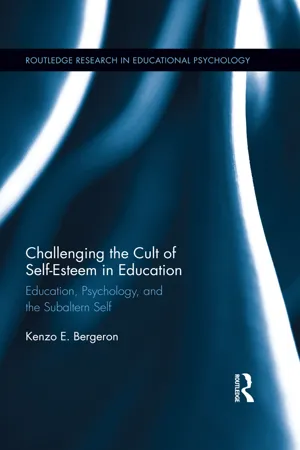
In this book, Bergeron demonstrates the negative emotional and pedagogical repercussions that result from American educators' embrace of self-esteem and the dogma surrounding its acceptance. Critically interpreting the meaning of self-esteem in education, he challenges "common sense" assumptions surrounding this notion and questions the historical, political, philosophical, and pedagogical forces that have shaped this psychological construct in education. Interrogating the pedagogical practices linked to student empowerment, self-determination, and social agency in the classroom, Bergeron discusses the ways in which the promise of self-esteem has backfired, particularly for marginalized and impoverished students.
eBook - ePub
Challenging the Cult of Self-Esteem in Education
Education, Psychology, and the Subaltern Self
- 126 pages
- English
- ePUB (mobile friendly)
- Available on iOS & Android
eBook - ePub
Challenging the Cult of Self-Esteem in Education
Education, Psychology, and the Subaltern Self
About this book
Information
1
Self-Esteem as Common Sense
Studies have repeatedly shown that having high self-esteem does not improve grades, does not improve career achievement, it does not even lower the use of alcohol, and most certainly does not reduce the incidents of violence of any sort. As it turns out, extremely aggressive, violent people think very highly of themselves.
—George Carlin, Complaints and Grievances, 2001
Midway through “Complaints and Grievances,” George Carlin’s 12th HBO stand-up special, first aired on December 11, 2001, the comedian launches into a lengthy critique of American culture. Carlin’s sermon-like analysis—punctuated by his characteristic molto allegro tempo—on “how we eat, think, feel about the world, the work we do, the games we play, mannerisms, manners, education, economy, men and women, sexuality, what shocks us and what does not” (Kona, 2010, p. 5) substantiates the words of Carlin biographer Larry Getlen (2013), who remarked: “George used comedy to smash through what he called the official ‘okie-doke’ story” (Kindle Locations 97–100). The comedian’s lengthy critique finally narrows to the over-protected, over-scheduled, over-managed lives of contemporary American youth, as he grumbles to the audience: “All of this that children have been crippled by has grown out of something called the ‘self-esteem movement’” (Carlin, 2001). As the prior epigraph illustrates, Carlin is ahead of the curve when he contends that the widespread belief about self-esteem—namely, that individuals with high self-esteem make positive life choices and those with low self-esteem make negative life choices (Kahne, 1996)—is nothing more than a popular ideological assumption.
In perfect Carlinesque spirit (Kona, 2010), the comedian goes on to implicate a complex nexus of actors and institutions within the educational system as responsible for the maintenance of self-esteem principles. Thus, Carlin (2001) is not simply challenging a philosophical supposition; rather, he is discrediting a problematic epistemological doctrine at the heart of education, two years before the Association for Psychological Science concluded that the concept of self-esteem is polluted with flawed scholarship (Bronson, 2007), and a year after the publication of Maureen Stout’s (2001) The Feel Good Curriculum: The Dumbing Down of America’s Kids in the Name of Self-Esteem.
As Carlin (2001) suggests, the axiomatic nature of the self-esteem discourse conceals a dangerous set of deeply rooted values, which positions self-esteem alongside other “okie-doke” narratives—such as, the press is free, justice is blind, all men are created equal, to protect and to serve—that we are spoon-fed throughout our lives by those in positions of authority. Thus, our longstanding cultural reliance on the self-esteem mythos should be seen as more than a simple and polite agreement with the value of feeling good, because, at its core, self-esteem is a movement, ideology, philosophy, and social doctrine that has historically held the power to define and determine a person’s level of success, worth, achievement, and so on—a dangerous generalization that reproduces colonialist discourse.
One of the more troubling features of the self-esteem mythos is that it has become mired in educational controversies that continue to this day. In fact, self-esteem may represent one of the most basic and pervasive mentalities ever to dominate the American psyche (Covington, 1989), one in which educators remain the primary moral agents and leaders in propagating its value (Gramsci, 1971). With this book, I intended to demonstrate that the term self-esteem and the self-esteem movement that Carlin (2001) described in “Complaints and Grievances” are still going strong, especially in the context of education. According to Twenge (2014), a simple Google search for “elementary school mission statement ‘self-esteem’ can yield 2.9 million Web pages of schools from across the country, including those in cities, suburbs, small towns and rural areas” (p. 74). The reality is that self-esteem, with its varied meanings and widespread cultural support, has become so commonsensical that we have not thought to question the concept (Kahne, 1996). Thus, the rhetorical power and impossible promise of self-esteem as both a quantifiable and fixed human resource are played out again for a new generation of students, parents, and educators.
The respect for these commonsense assumptions, along with the absence of any large-scale cultural or scholarly opposition to the encroachment of the self-esteem discourse within education, has led to exaggerated connections between self-esteem and desirable educational policy. The students who are the most damaged by these fallacies are those who were supposedly meant to benefit from them: racialized students who are already at the highest risk for school failure (Stout, 2001). Even more than that, promoting students’ self-esteem, particularly that of “minority and poorly performing students” (Kahne, 1996), has allowed for the strategic coproduction of privilege and disadvantage, accomplished, in part, by the voluminous literature in education that endorses the self-esteem and self-concepts of school children and adolescents.
This body of empirical work “generally places a high premium on [individual] self-discovery, self-expression, and self-fulfillment without much explicit discussion of broader educational aims, or social, cultural, moral, and political contexts of education” (Martin, 2007, p. 5, emphasis added). By ignoring the structural conditions that negatively impact performance, educators and the general public act and react in ways that privilege the values of some groups over those of others. This process results in what Ellis (1998) described as “the needless pathologization of individuals from marginalized groups” (p. 242). Indeed, the tenets of the self-esteem discourse masquerade as products of technical and empirical analysis, the culmination of some fully realized universal human trait, but, under close scrutiny, exist simply as ideas derivative of ideological, cultural, and political commitments (Kahne, 1996).
In short, the incursion of self-esteem principles within educational policy have produced ineffective results for society, as a whole, and are responsible for the creation of even greater educational inequities, especially among subaltern populations who have been simultaneously neglected by and blamed for society’s ills (e.g., working-class students of color). Based on restrictive and psychologically reductive principles, these commitments to self-esteem dogma are embodied in a variety of self-esteem strategies and act in service of limiting the control and choices afforded to subaltern student populations by positing fundamentally flawed assumptions about the nature of self, culture, and identity that serve to legitimize the dominance of Western culture within educational arrangements in the U.S. And the assumption that the self-esteem of minoritized children, in particular, requires constant focus and improvement, or that their psychosocial sphere can be manipulated by well-intentioned, yet ill-prepared white educators is not simply an unfortunate principle of American education but also reflects how psychology, as a discipline, functions to perpetuate major forms of inequality and oppression within education.
Legacy of Self-Esteem in Education
Irrespective of a plethora of prior theological, philosophical, and scholarly preoccupations with the concept of the self, by the midtwentieth century, the carefully invented subject of “self-esteem” began to consume the attention of psychologists and educators alike. Early theorists attempted to ground the validity of research findings through an emerging practice of social-scientific inquiry that mimicked the physical sciences. “By the early 1970s, social science research had amassed hundreds of studies on the antecedents of self-esteem and the effects of self-esteem on personal and social issues” (Wells, 1976, p. 5). During this era, the network of individuals working on self-esteem also began to develop relationships outside the insulated academic environment of the social sciences.
These new alliances dissolved the once-restrictive borders of empirical research and allowed the term to permeate mainstream culture. Accordingly, this fueled the widespread popular belief that “a child’s self-esteem is the primary cause of academic achievement” (Pajares & Schunk, 2002, p. 14). As a result, myriad conclusions on self-esteem became distributed across public institutions, and “a number of existing social movements and popular issues, such as educational pedagogy, social policy, business success, self-help, women’s issues, and parenting advice” (Ward, 1996, p. 7). Eventually, these institutions and organizations came to champion self-esteem as “the royal road to happiness and personal fulfillment, and an antidote to a variety of social ills” (Brown & Marshall, 2006, p. 4).
By the turn of the millennium, tensions generated by the supposed necessity of the self-esteem discourse in education had polarized the vast majority of the public and educators into one of two camps: “The pro self-esteemers, mostly educators, who scarcely believe that anyone would question the importance of trying to improve children’s perceptions of their own worth; and the critics, who dismiss such efforts as ineffective distractions from academics” (Kohn, 1994, p. 272). The majority of scholars opposed to self-esteem principles contended that the self-esteem movement and the variety of educational curricula it has inspired have not stimulated the economy or cured the variety of social ills they promised. Yet, this critical perspective has gone without much popular support. And the absence of any widespread rejection of self-esteem beliefs, especially within education, has resulted in the persistence of ideological assumptions and empirical justifications that support the promotion of mainstream self-esteem dogma. So, the core ideas and features of the self-esteem discourse endure.
Stout (2001) argued that self-esteem has “slowly infiltrated education to the point that today most educators believe developing self-esteem to be one of the primary purposes of public education” (p. 119). Kahne (1996) recalled asking a group of prospective educators, “How would you know if you were a successful teacher?” One student answered: “I want them to learn that they can accomplish anything, if they believe in themselves” (p. 7). And another: “We need to raise their self-esteem” (p. 7). When asked if they all agreed, “Many nodded; no one disagreed” (p. 7). Kahne’s anecdote raises many concerns, among them questions, such as, why does self-esteem enjoy such privilege? And, why do educators attach notions of professional success to levels of student self-esteem?
In short, educational institutions accepted the claim that raising self-esteem would improve schoolwork (Baumeister, 2013). Accordingly, teacher practices and academic strategies have been redesigned to foster students’ self-esteem (Pajares & Schunk, 2002). Teachers are instructed to provide pupils with affirmative pronouncements (i.e., “You’re incredible!”), to implement classroom activities in which students are directed to make advertisements and commercials to sell themselves (Canfield & Wells, 1976), and, finally, to incorporate “realizing your uniqueness” lessons into their curriculum (McDaniel & Bielen, 1990). In such a climate, children are taught to “make ‘me’ flags of their putative ‘me’ nations, to view history and fiction through the filter of their feelings, and to start school days with affirmations, such as ‘I always make good choices’ and ‘Everyone is happy to see me’” (Tarcher & Rufus, 2014, p. 1).
Even acclaimed educational critic Alfie Kohn (1994) has acknowledged the (seemingly) inescapable socializing capacity of self-esteem, when he writes:
There is no getting around the fact that most educators who speak earnestly about the need to boost students’ self-esteem are unfamiliar with the research that has been conducted on the question. At best, they may vaguely assert, as I confess I used to do, that “studies” suggest self-esteem is terribly important.
(p. 272)
But, unlike the prospective teachers in Kahne’s (1996) “Educational Foundations” course, who not only accept the value of student self-esteem but also promote the notion by adopting the very language used by hardened self-esteem advocates, Kohn goes on to inject an important sense of doubt into the subject.
Perhaps because high self-esteem feels good, people naturally surrender to the conclusion that it generates positive results. But the commonsense interpretation that self-esteem actually leads to various positive outcomes can be misleading. Although today’s students may hold themselves in higher regard than students in decades past, there are now studies that link high self-esteem with aggression, territorialism, elitism, racism, and other negative qualities (Tarcher & Rufus, 2014). Beneficiaries of the self-esteem boom have been brainwashed to believe they deserve the best grades, the best treatment, the best of everything. They are very easily offended, angered, disappointed, and crushed by even the faintest criticism (Tarcher & Rufus, 2014).
University of Pennsylvania psychology professor Martin Seligman (2014) has lamented: “Uncritical endorsement of the cultural value of high self-esteem may be counterproductive and even dangerous. The societal pursuit of high self-esteem for everyone may literally end up doing considerable harm” (as cited in Tarcher & Rufus, 2014, p. 1). Additionally, critics have pointed to the danger of policies and programs that blindly emphasize student self-esteem, where any talk about generosity or caring is prefaced with the assertion that you must love yourself first in order to be able to love others (Kahne, 1996). “I’m special, I’m important; here’s how I feel about things… we are taught that individual achievement and self-actualization are what matter” (Kahne, 1996, p. 12).
In sum, these egocentric practices fuel the sort of privilege that allow policy-makers—primarily through the system of education—to fundamentally recast the problems of poverty, sexism, racism, and so on. Echoing Antonio Gramsci’s (1971) notion of the ideological power of commonsense ideas, Erica Koch (2006) describes the acceptance of self-esteem into the political sphere as one based on “intuitive” assumptions:
Because high self-esteem feels good, people may naturally conclude that it results in positive consequences. A commonsense interpretation of the correlations between self-esteem and positive outcomes suggests that self-esteem actually leads to those outcomes. Thus, even those familiar with some psychological research might conclude that self-esteem causes various positive outcomes.
(pp. 262–263)
A multitude of conclusions deemed “scientific” pushed self-esteem into the public-policy arena, where it was believed that self-esteem could and should be “monitored and improved to ensure health and well being” (Kahne, 1996, p. 3). This commonsense tendency to assume self-esteem is good because it feels good proved to be a powerful force. Ideas of self-esteem, propelled by the influence of common sense, quickly captivated the public imagination, causing parents, educators, policy-makers, and others to believe it “unpardonable for schools, educators, and educational researchers to neglect the cultivation of this core resource” (Martin, 2007, p. 55). Kahne (1996) underlined the misguided aims of such policies:
If poverty, sexism, or other factors systematically constrain the self-esteem of whole groups of individuals, and if self-esteem is a goal, then policy-makers must find ways to address poverty, homelessness, sexism, and so on. If, on the other hand, improving self-esteem judgments is viewed as a means of promoting “socially desirable” behaviors, then policy-makers can focus instead on raising the self-esteem ...
Table of contents
- Cover
- Title
- Copyright
- Dedication
- Contents
- Foreword
- Preface
- Acknowledgements
- 1 Self-Esteem as Common Sense
- 2 The History and Politics of Self-Esteem
- 3 Self-Esteem and Its Colonizing Impact
- 4 Self-Esteem Curriculum as Epistemicides
- 5 An Act of Armed Love: Curriculum for Social Agency, Empowerment, and Self-Determination
- Index
Trusted by 375,005 students
Access to over 1.5 million titles for a fair monthly price.
Study more efficiently using our study tools.
Frequently asked questions
Yes, you can cancel anytime from the Subscription tab in your account settings on the Perlego website. Your subscription will stay active until the end of your current billing period. Learn how to cancel your subscription
No, books cannot be downloaded as external files, such as PDFs, for use outside of Perlego. However, you can download books within the Perlego app for offline reading on mobile or tablet. Learn how to download books offline
Perlego offers two plans: Essential and Complete
- Essential is ideal for learners and professionals who enjoy exploring a wide range of subjects. Access the Essential Library with 800,000+ trusted titles and best-sellers across business, personal growth, and the humanities. Includes unlimited reading time and Standard Read Aloud voice.
- Complete: Perfect for advanced learners and researchers needing full, unrestricted access. Unlock 1.5M+ books across hundreds of subjects, including academic and specialized titles. The Complete Plan also includes advanced features like Premium Read Aloud and Research Assistant.
We are an online textbook subscription service, where you can get access to an entire online library for less than the price of a single book per month. With over 1.5 million books across 990+ topics, we’ve got you covered! Learn about our mission
Look out for the read-aloud symbol on your next book to see if you can listen to it. The read-aloud tool reads text aloud for you, highlighting the text as it is being read. You can pause it, speed it up and slow it down. Learn more about Read Aloud
Yes! You can use the Perlego app on both iOS and Android devices to read anytime, anywhere — even offline. Perfect for commutes or when you’re on the go.
Please note we cannot support devices running on iOS 13 and Android 7 or earlier. Learn more about using the app
Please note we cannot support devices running on iOS 13 and Android 7 or earlier. Learn more about using the app
Yes, you can access Challenging the Cult of Self-Esteem in Education by Kenzo Bergeron in PDF and/or ePUB format, as well as other popular books in Education & Education General. We have over 1.5 million books available in our catalogue for you to explore.