Policy-related, academic and populist accounts of the relationship between food and class tend to reproduce a dichotomy that privileges either middle-class discerning taste or working-class necessity. Taking a markedly different approach, this collection explores the classed cultures of food practices across the spectrum of social stratification. Eschewing assumptions about the tastes (or lack thereof) of low-income consumers, the authors call attention to the diverse, complex forms of critical creativity and cultural capital employed by individuals, families and communities in their attempts to acquire and prepare food that is both healthy and desirable. The collection includes research carried out in the United States, Canada, Mexico and Denmark, and covers diverse contexts, from the intense insecurity of food deserts to the relative security of social democratic states. Through quantitative and qualitative cross-class comparisons, and ethnographic accounts of low-income experiences and practices, the authors examine the ways in which food practices and preferences are inflected by social class (alone, and in combination with gender, ethnicity and urban/rural location). The collection underlines the simultaneous need for the development of a more nuanced, dynamic account of the tastes and cultural competences of socially disadvantaged groups, and for structural critiques of the gross inequalities in the degrees of freedom with which different individuals and groups engage in food practices. This book was originally published as a special issue of Food, Culture & Society.
eBook - ePub
Food Practices and Social Inequality
Looking at Food Practices and Taste across the Class Divide
- 190 pages
- English
- ePUB (mobile friendly)
- Available on iOS & Android
eBook - ePub
Food Practices and Social Inequality
Looking at Food Practices and Taste across the Class Divide
Food Acquisition in Poughkeepsie, NY
EXPLORING THE STRATIFICATION OF “HEALTHY FOOD” CONSCIOUSNESS IN A FOOD-INSECURE CITY
Leonard Nevarez, Kathleen Tobin and Eve Waltermaurer
Abstract
This article provides and examines empirical evidence in order to evaluate scholarly, professional and activist perspectives that view food insecurity as a function of the stratification of food consciousness. This concept highlights causal models of food insecurity that emphasize micro-level and idealist factors to explain why stratified groups hold distinct attitudes and preferences regarding food provisioning and consumption. An empirical model is developed for the household activity of food acquisition, and the hypothesized preferences of food-insecure and other at-risk urban households are investigated for foods and stores that promote unhealthy eating. The data come from a community food assessment survey in the city of Poughkeepsie, New York, administered to a probabilistic sample of 355 city households. Evidence is found that disproves the stratification of food consciousness model for food acquisition, and debates and research are directed toward more significant factors and contexts of food insecurity.
In this article, we provide and examine empirical evidence to evaluate scholarly, professional and activist perspectives that explain food insecurity as a function of what we call the stratification of food consciousness. Specifically, we investigate the presumed preferences of food-insecure and other at-risk urban households for foods and stores that promote unhealthy eating. By finding initial evidence that disproves the stratification of food consciousness thesis, and which suggests that socioeconomically stratified groups are no more or less likely to report “healthy” food acquisition preferences, we seek to direct debates and research toward more significant factors and contexts of food insecurity.
As urban and regional scholars whose work includes applied community research, we come to this project via a community food assessment (CFA) undertaken in Poughkeepsie, New York, a city characterized by substantial rates of poverty and economic underdevelopment. Working with local food justice advocates and public health professionals, the first author designed a city-wide household survey to gauge food insecurity, ascertain issues in household food access, and characterize prevailing attitudes and preferences toward the food that households purchase and the stores they patronize. Gathering descriptive measurements on these variables to situate and inform public policy related to food insecurity was the primary objective in the CFA survey.
We describe the Poughkeepsie CFA in greater detail later in this article, but we imagine our experiences were familiar to many scholars conducting research on food issues in economically challenged locales. Specifically, we heard and acknowledged many Poughkeepsie stakeholders articulate views on household food insecurity that drew explicit or implied chains of causality between the food and stores households chose and the problems of food insecurity that many experienced. Such claims provide our point of departure in this article. Since our survey data offer some preliminary evidence to test the validity of such views, which are shared by many food/health professionals and scholars, in this article we go beyond the mission of the original CFA to investigate whether local food insecurity is associated with particular attitudes and values. Mindful of the problem of co-production in which “assumptions about a scientific object’s causes and character [are] built into models of examining it” (Guthman 2011, 68; Jasanoff 2004), our analysis here provides an opportunity to exercise critical reflexivity on prevailing wisdoms underlying many food security studies and initiatives conducted in other locales with similar demographics and challenges.
Modeling food insecurity
Conventionally, food insecurity is understood to be a condition experienced by households and individuals. As defined by the United States Department of Agriculture (aka the USDA, whose operationalization and measurement scales were utilized in the CFA survey), food insecurity refers to “limited or uncertain availability of nutritionally adequate and safe foods or limited or uncertain ability to acquire acceptable foods in socially acceptable ways” (USDA 2010). While the risks of food insecurity manifest as problems with physical well-being and productivity for daily life, the USDA’s survey questions (see Figure 1) specifically operationalize food insecurity as a function of socioeconomic resources—whether households have “enough money for food,” to cite a recurring phrase—and thereby presume that problems of dietary intake are set in motion by household ability to afford food and access the commercial nexus of food retail. In the conceptualization we adopt in this paper, then, food insecurity is ultimately a result of economic insecurity and household poverty.
The concept of food provisioning elaborates the chain of household activities that embed food security outcomes. Provisioning entails at least five household activities: acquisition, preparation, production, consumption, and disposal of food. Leftovers and other circular exceptions aside, these activities are undertaken in a linear sequence of household social reproduction, “where technical skills (e.g. growing, shopping, meal planning, food preparation, cooking) and resources are tacitly coordinated by a primary food provider within the social context and demands of household members, as well as the broader environment in which they live” (McIntyre and Rondeau, 2011, 117–118; quoted in Veen, Derkzen, & Wiskerke, 2012, 367). We note that the way the USDA operationally defines food insecurity highlights food acquisition, the front end of the provisioning sequence, as the site where household food insecurity is structurally constituted. By contrast, strategies and techniques for mitigating food insecurity can intervene at any number of points along the provisioning sequence.
While most food scholars, health practitioners and food justice activists agree that food insecurity is a household-level phenomenon, they differ on the question of what causes it. Two conceptual schemas are relevant to thinking about the diversity of causal theories of food insecurity. The first is macro vs. micro levels of analysis, which pertain to the scale that causal factors correspond to: external vs. household/individual life forces.
Micro-level mechanisms, macro-level mechanisms, or some combination of the two provide a formal framework through which causal theories of food insecurity propose various substantive factors. The diversity of theorized factors can be understood through a second conceptual schema, material vs. ideal factors, and the arrows of causality drawn between them. On the one hand, materialist theses posit that the material circumstances in which people find themselves have a constitutive if not strictly causal effect on consciousness, i.e., the values, outlooks, and attitudes that people hold. On the other hand, idealist theses reverse this causal arrow, proposing that consciousness mobilizes people into action that shapes if not causes their material circumstances.
The two conceptual schemas call attention to four generic models of food insecurity causality, shown in the four quadrants of Table 1. These schemas allow us to abstract the causal accounts from different explanations of and proposed remedies for low-income urban households’ food insecurity.
Returning to the example from the Poughkeepsie CFA that motivates our analysis in this article, we heard organizers and members of the public alike endorse educational proposals to mitigate food security among the city’s low-income population. For instance, educational materials and cooking demonstrations were proposed to teach food-insecure households how to prepare healthy dishes using fresh produce or how to evaluate nutritional content on food item labels. Advocates of such proposals that focus on mindsets and personal skills, which are frequently proposed by advocates and initiatives in public health and food justice elsewhere, stake out a micro-level idealist position (corresponding to quadrant 4). They presume that low-income households have incorrect information and unhealthy ideas about what foods to buy and where to grocery shop, and further that holding such ideas results in behavior (or lack thereof) that compounds if not contributes to household food insecurity, insofar as householders with such food consciousness fail to adopt strategies (e.g., for maximizing nutritional content) or practice techniques (like stretching out meals using simple healthy ingredients) that could mitigate the likelihood and risks of food insecurity. In this paper, we empirically test such idealist assumptions about the influence that “unhealthy” attitudes and preferences have on low-income urban households.
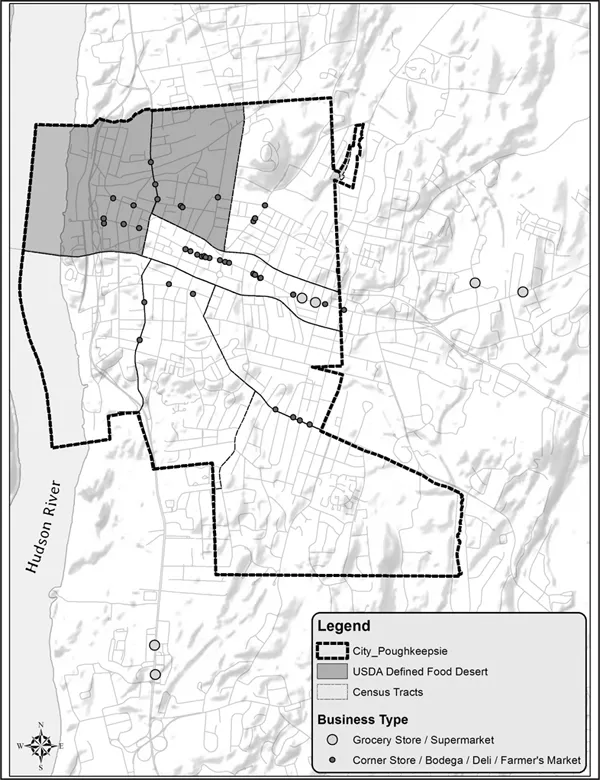
Fig 1. Map of Poughkeepsie, New York.
Table 1. Conceptual schemas of urban food insecurity.
| Material factors | Ideal factors | |
|---|---|---|
| Macro level of analysis | 1 | 2 |
| Micro level of analysis | 3 | 4 |
Stratified food consciousness and food insecurity
Such educational proposals reveal an important debate in food security work ...
Table of contents
- Cover
- Half Title
- Title Page
- Copyright Page
- Contents
- Citation Information
- Notes on Contributors
- Introduction: Looking at Food Practices and Taste across the Class Divide
- 1 Food Acquisition in Poughkeepsie, NY: Exploring the Stratification of “Healthy Food” Consciousness in a Food-Insecure City
- 2 Cultural and Symbolic Capital With and Without Economic Constraint: Food Shopping in Low-Income and High-Income Canadian Families
- 3 Making the Most of Less: Food Budget Restraint in a Scandinavian Welfare Society
- 4 Tortillas, Pizza, and Broccoli: Social Class and Dietary Aspirations in a Mexican City
- 5 The Possibilities and Limits of Personal Agency: The Walmart that Got Away and Other Narratives of Food Acquisition in Rural Texas
- 6 From “Junk Food” to “Treats”: How Poverty Shapes Family Food Practices
- 7 Understanding Food Access in a Rural Community: An Ecological Perspective
- Index
Trusted by 375,005 students
Access to over 1.5 million titles for a fair monthly price.
Study more efficiently using our study tools.
Frequently asked questions
Yes, you can cancel anytime from the Subscription tab in your account settings on the Perlego website. Your subscription will stay active until the end of your current billing period. Learn how to cancel your subscription
No, books cannot be downloaded as external files, such as PDFs, for use outside of Perlego. However, you can download books within the Perlego app for offline reading on mobile or tablet. Learn how to download books offline
Perlego offers two plans: Essential and Complete
- Essential is ideal for learners and professionals who enjoy exploring a wide range of subjects. Access the Essential Library with 800,000+ trusted titles and best-sellers across business, personal growth, and the humanities. Includes unlimited reading time and Standard Read Aloud voice.
- Complete: Perfect for advanced learners and researchers needing full, unrestricted access. Unlock 1.5M+ books across hundreds of subjects, including academic and specialized titles. The Complete Plan also includes advanced features like Premium Read Aloud and Research Assistant.
We are an online textbook subscription service, where you can get access to an entire online library for less than the price of a single book per month. With over 1.5 million books across 990+ topics, we’ve got you covered! Learn about our mission
Look out for the read-aloud symbol on your next book to see if you can listen to it. The read-aloud tool reads text aloud for you, highlighting the text as it is being read. You can pause it, speed it up and slow it down. Learn more about Read Aloud
Yes! You can use the Perlego app on both iOS and Android devices to read anytime, anywhere — even offline. Perfect for commutes or when you’re on the go.
Please note we cannot support devices running on iOS 13 and Android 7 or earlier. Learn more about using the app
Please note we cannot support devices running on iOS 13 and Android 7 or earlier. Learn more about using the app
Yes, you can access Food Practices and Social Inequality by Jennifer Smith Maguire in PDF and/or ePUB format, as well as other popular books in Business & Business General. We have over 1.5 million books available in our catalogue for you to explore.