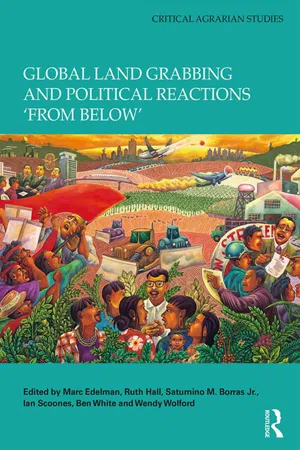
When the 2007-2008 food and financial crises triggered a global wave of land grabbing, scholars, activists and policy practitioners assumed that this would be met with massive peasant resistance. As empirical evidence accumulated, however, it became clear that political reactions 'from below' to land grabbing were quite varied and complex. Violent resistance, outright expulsions, everyday 'weapons of the weak' and demands for better terms of incorporation into land deals were among the outcomes that emerged. Readers of this collection will encounter a multinational group of scholars who use the tools of social movements theory and critical agrarian studies to examine cases from Argentina, Mexico, Guatemala, Nicaragua, Colombia, Ethiopia, Madagascar, Mozambique, Uganda, Mali, Ukraine, India, and Laos, as well as the Rio +20 Sustainable Development Conference. Initiatives 'from below' in response to land deals have involved local and transnational alliances and the use of legal and extra-legal methods, and have brought victories and defeats. This book was first published as a special issue of The Journal of Peasant Studies.
eBook - ePub
Global Land Grabbing and Political Reactions 'from Below'
- 428 pages
- English
- ePUB (mobile friendly)
- Available on iOS & Android
eBook - ePub
Global Land Grabbing and Political Reactions 'from Below'
About this book
Information
Resistance, acquiescence or incorporation? An introduction to land grabbing and political reactions ‘from below’
Ruth Hall, Marc Edelman, Saturnino M. Borras Jr., Ian Scoones, Ben White and Wendy Wolford
Political reactions ‘from below’ to global land grabbing have been vastly more varied and complex than is usually assumed. This essay introduces a collection of ground-breaking studies that discuss responses that range from various types of organized and everyday resistance to demands for incorporation or for better terms of incorporation into land deals. Initiatives ‘from below’ in response to land deals have involved local and transnational alliances and the use of legal and extra-legal methods, and have brought victories and defeats. The relevance of political reactions to land grabbing is discussed in light of theories of social movements and critical agrarian studies. Future research on reactions ‘from below’ to land grabbing must include greater attention to gender and generational differences in both impacts and political agency.
Introduction
Critical scholarly analysis of processes of agrarian change has long emphasized peasant agency and aimed to uncover forms of resistance, even in the midst of dispossession, oppression and processes of social differentiation. This collection draws on the rich base of existing scholarship to ask: in the midst of the ‘global land grab’, what are the political reactions ‘from below’? While some reactions from people directly affected may involve resistance, the essays in this collection suggest that understanding the diversity of reactions from below requires critical empirical investigations of responses in specific situations. We thus frame ‘political reactions from below’ in a wider way, to refer to responses that extend far beyond ‘resistance’ in its many manifestations, and range from mobilizations seeking to improve the compensation for people’s expulsion from their land to demands to be inserted into land deals as workers or contract farmers to counter-mobilizations against land deal resisters. Beyond the local level, highly varied responses by societies and states at national levels and in international multilateral fora and transnational movements also call for more detailed and critical assessment by social scientists.
In the midst of enclosures and commercialization of land and other natural resources across the global South, tensions and synergies mark political reactions ‘from below’ to global land grabbing. A fuller understanding of the politics from below around land grabs brings us to some classic concepts in critical agrarian studies, including the dual front of ‘struggle against dispossession’ and ‘struggle against exploitation’, as well as the question of the state. Yet even this classic political economy-based framing of people’s struggles may not fully capture the range and complexity of the politics around contemporary enclosures where the ecological dimension has become increasingly prominent. But an important starting point is to draw on concepts and analytical tools in critical agrarian studies, such as agrarian class politics and everyday forms of peasant resistance. Analytical tools from identity politics will also be relevant in understanding politics from below around global land grabbing.
When land deals gain momentum, they trigger complex political dynamics – expected and unexpected, intended and unintended – within the state and in society. Early media reports, as well as activist and academic discussions, often assumed that land deals expel people from the land and that those expelled – typically referred to as ‘local people’ or ‘local communities’ – engage in ‘resistance’. Recent research, however, indicates that what happens on the ground is more varied and complex (e.g. White et al. 2012; Wolford et al. 2013; Edelman, Oya, and Borras 2013). When land deals hit the ground, they interact with social groups within the state and in society that are differentiated along lines of class, gender, generation, ethnicity and nationality, and that have historically specific expectations, aspirations and traditions of struggle. These reshape, limit or make possible different kinds of land deals. As the contributions to this collection show, political debates and academic research have increasingly picked up differentiated impacts and variegated political reactions to land deals.
This collection addresses these questions and builds on a series of Journal of Peasant Studies (JPS) editions over the past five years that have interrogated the phenomenon of global land grabbing through the lens of critical agrarian studies. It brings together papers originally presented at the Global Land Grab II International Conference1 organized by the Land Deal Politics Initiative (LDPI2). This follows a JPS Forum on Global Land Grabbing II which dealt with methodologies and the limits to existing approaches to enumerating, explaining and assessing the impacts of land deals (Scoones et al. 2013), and a JPS collection on The New Enclosures: Critical Perspectives on Corporate Land Deals (White et al. 2012) which drew together a broad spectrum of papers outlining the contours of the phenomenon, and which drew from the Global Land Grab I International Conference,3 also organized by the LDPI. These in turn followed the first JPS Forum on Global Land Grabbing (Borras et al. 2011) which, ahead of the Global Land Grab I conference, outlined a research agenda for understanding the current land grab. This initial JPS collection of papers drew attention to the ways in which questions and approaches from within critical agrarian studies could help to systematize our knowledge and make sense both of the drivers of land grabbing and of the changes in agrarian economies and societies that land deals set in motion. The current collection aims to build on these contributions and to challenge dominant framings of rural and peasant communities across the global South as either passive victims or unified resisters of land grabs.
Explaining resistance and its absence
Three broad models for explaining resistance and its absence dominate the scholarly literature: classical collective action paradigms, Marxism and heterodox theories of social movements. First, in classical collective action paradigms, resistance is viewed as an exception, and inaction as the norm. The ‘logic’ of this position derives from premises central to neoclassical economics and rational choice theory, namely that individuals strategically weigh potential benefits and risks of particular courses of action and then proceed in their own self-interest. Because risks of collective resistance tend to be high – lost time, arrests, beatings and assassinations – the calculating individual will likely sit on the sidelines as a ‘free rider’, hoping to reap the gains of others’ risk-taking and sacrifices. As Mancur Olson, the foundational theorist of this approach, argued, ‘When the class-oriented action Marx predicted does not materialize, it does not indicate that the economic motivation is not predominant, as some of his critics imply, but rather than there are no individual economic incentives for class action’ (Olson 1965, 108, original emphasis).
Second, Marxists (unlike Olson) have generally supposed that there is a direct line from shared grievances to collective action. While they acknowledge that some forms of resistance are individual, they tend to assume that common oppression gives rise to class politics and common political projects (Barker 2014). The Marxist canon is not, of course, entirely consistent on this issue, but its numerous lamentations about ‘false consciousness’, ‘hegemony’ or failure to recognize the collective’s ‘true’ – i.e. proletarian – interests are suggestive of lingering Hegelian teleological influences in Marxism.
Third, heterodox social movement scholars have taken issue with both the figure of the rational, calculating Homo economicus in collective action theories and the Marxist presumption of oppression inexorably producing proletarian consciousness and collective struggle. Some have pointed out, for example, that the notion of ‘free riders’, and the ‘collective action problems’ that these supposedly produce, is based on a vision of the isolated individual, lacking in kin, class, ethnic, religious, national or group identities and loyalties. When scholars belatedly began to analyze the role of emotion in social movements, they naturally found that affective ties and allegiances to other movement participants were an essential ingredient in mobilization and frequently accounted for why people unite and struggle in the face of daunting risks and unfavourable odds (Goodwin, Jasper, and Polletta 2001). The Marxists’ bemoaning of ‘false consciousness’, similarly, gets turned on its head by the more perspicacious social movements theorists. Burdick (1995, 367), for example, argues that as soon as analysts’ gaze shifts from the ‘individual toward collective patterns’, it permits posing a ‘highly constructive political question: not why do people fail to come to the movement, but why is the movement failing to reach more people?’.
Critical agrarian studies and particularly research on struggles around land have made important – albeit frequently implicit – contributions to this theoretical discussion. Both Marxists (e.g. Hobsbawm 1959) and social movements theorists (e.g. Tilly 1986) posited a historical periodization of protest that distinguished ‘primitive’, ‘defensive’ and ‘pre-political’ mobilizations from those in the nineteenth century and after that aimed at seizing or at least influencing the state. Peasants’ ‘failure’ (for many Marxists) to manifest a proletarian consciousness in contention over land, or to transcend ‘defensive’ local struggles (for social movements theorists), became just one more indication of their atavistic politics and culture. When struggles for land are seen in their own terms, however, it is obvious that claiming land or defending the land one has often reflects clear class consciousness, albeit of a smallholding peasant rather than a proletarian character.
Of the papers in this collection, Natalia Mamonova’s makes the most significant and original contribution to the discussion around the absence of resistance to land grabbing. In her analysis of contemporary Ukraine, now home to some of the largest farms in the world, Mamonova critiques the premises that resistance is the only or most likely response of rural people to large-scale land acquisitions, that peasants are incapable of adapting to or coexisting alongside large-scale industrial farms, and that ‘ideological concerns about the “peasant way of life”, food and land sovereignty dominate in peasant struggles’. As an alternative to these bedrock a priori assumptions of so much agrarian scholarship, she advocates analyzing the terms of inclusion in land deals (see also Borras and Franco 2013), distinguishing between ‘illusive inclusion’ (where peasants, many of them elderly, receive land from the state and then rent it to commercial farmers), ‘subordinate inclusion’ (where peasants rent or lose land and then go to work on large holdings) and ‘competitive exclusion’ (where peasant farms are outcompeted by subsidized agroindustrial enterprises). In all three cases, collectively patterned individual choices lead in directions other than oppositional mobilization.
The outcomes Mamonova describes do not fit easily in any of the three broad explanatory frameworks outlined above. Ukrainian peasants are not eschewing collective action because they hope, à la Olson, to free ride on others’ coattails. They are hardly a Marxian class ‘for itself’ in any meaningful sense. They have not remained unorganized because existing movements have failed to reach them. Mamonova intentionally shuns explanations for the lack of mobilization against land grabbing that rely on the negative legacies of 70 years of socialism (e.g. memories of the collectivization of agriculture, which was especially brutal in Ukraine, or ongoing fears of political repression). Nonetheless, her argument relies on a historically-informed reading of the current moment. Rural people in Ukraine, she says, perceive today’s large farms as a continuation of Soviet collective and state farms – and refer to them as ‘kolkhozy’ and ‘sovkhozy’, respectively. The weight of pre-existing class relations still looms large. Employment on large farms, with their relatively high salaries and social wage, combined with income from tiny intensively-cultivated private plots, appears to be a congenial alternative, familiar from Soviet times and preferable to unequal and quixotic struggles with uncertain outcomes.
Class and identity politics, mobilizations and alliances
Borras and Franco (2013) suggest that understanding political reactions ‘from below’ to land deals requires both locating the dynamics in broader agrarian transformation processes and analyzing a main axis of political conflict. Let us look at the first question. When the land is needed but labour is not, the most likely outcome is the expulsion of people from the land (Li 2011). Those expelled may find jobs in other sectors of the economy. When they do not, land grabs are implicated in the creation of a ‘relative surplus population’. On occasions when investors need the land and the labour, peasants and villagers are not expelled, but may be subsumed into corporate enterprises as workers (perhaps even leasing their land to their employer) or as contracted small-scale farmers.
The second question involves the axis of political conflict. There are three main types: poor people versus corporate/landed elites, poor people versus the state and poor people versus poor people (Borras and Franco 2013; Borras, Franco, and Wang 2013). There are many high-profile instances where poor people confronted corporate and landed elites, such as the infamous case of Kampong Sugar in Cambodia (IDI 2014). Relatively more common is a confrontation between affected villagers and the state, which can take the form of organized national mobilizations by agrarian movements, such as occurred in the Philippines in 2006–2007 over the allocation of 1.4 million hectares of land to Chinese investors. The mobilizations in this case resulted in the cancellation of the investment agreements. Villager–state conflict may also take the form of ‘everyday forms of peasant politics’ or individual protests directed at the local state bureaucracy (Scott 1976); indeed, this is the most common form of land conflict in contemporary China (O’Brien and Li 2006). Probably the most frequent type of conflict is one that combines the first two: poor people versus corporate/landed elites and the state. This is not surprising, because the state is almost always implicated in the current land rush (Wolford et al. 2013). There is, however, the third axis: poor-on-poor conflict. From one land deal site to the next, we see social groups divided, not fully united, and with varied takes on engaging with land deals. While some may invoke the principle of free, prior and informed consent (FPIC) to justify opposition to a land deal, another group may use FPIC to justify their acceptance of and incorporation into it – a conflict usually instigated and fanned by those behind land deals (see Franco 2014). Poor-on-poor conflict is probably one of the most complex and sensitive dimensions of land de...
Table of contents
- Cover
- Half Title
- Series
- Title
- Copyright
- Contents
- Citation Information
- Notes on Contributors
- 1. Resistance, acquiescence or incorporation? An introduction to land grabbing and political reactions ‘from below’
- 2. Anything but a story foretold: multiple politics of resistance to the agrarian extractivist project in Guatemala
- 3. Listening to their silence? The political reaction of affected communities to large-scale land acquisitions: insights from Ethiopia
- 4. Land grabbing, legal contention and institutional change in Colombia
- 5. Resistance or participation? Fighting against corporate land access amid political uncertainty in Madagascar
- 6. Policy processes of a land grab: at the interface of politics ‘in the air’ and politics ‘on the ground’ in Massingir, Mozambique
- 7. Resistance or adaptation? Ukrainian peasants’ responses to large-scale land acquisitions
- 8. Politics from below? Small-, mid- and large-scale land dispossession in Teso, Uganda, and the relevance of scale
- 9. Social struggles in Uganda’s Acholiland: understanding responses and resistance to Amuru sugar works
- 10. Territorial restructuring and resistance in Argentina
- 11. Networked, rooted and territorial: green grabbing and resistance in Chiapas
- 12. Guerrilla agriculture? A biopolitical guide to illicit cultivation within an IUCN Category II protected area
- 13. Reclaiming the worker’s property: control grabbing, farmworkers and the Las Tunas Accords in Nicaragua
- 14. The ‘Goan Impasse’: land rights and resistance to SEZs in Goa, India
- 15. Oil palm expansion without enclosure: smallholders and environmental narratives
- 16. Rubber, rights and resistance: the evolution of local struggles against a Chinese rubber concession in Northern Laos
- 17. Space for pluralism? Examining the Malibya land grab
- 18. The right to resist: disciplining civil society at Rio+20
- Index
- Index-I
Trusted by 375,005 students
Access to over 1.5 million titles for a fair monthly price.
Study more efficiently using our study tools.
Frequently asked questions
Yes, you can cancel anytime from the Subscription tab in your account settings on the Perlego website. Your subscription will stay active until the end of your current billing period. Learn how to cancel your subscription
No, books cannot be downloaded as external files, such as PDFs, for use outside of Perlego. However, you can download books within the Perlego app for offline reading on mobile or tablet. Learn how to download books offline
Perlego offers two plans: Essential and Complete
- Essential is ideal for learners and professionals who enjoy exploring a wide range of subjects. Access the Essential Library with 800,000+ trusted titles and best-sellers across business, personal growth, and the humanities. Includes unlimited reading time and Standard Read Aloud voice.
- Complete: Perfect for advanced learners and researchers needing full, unrestricted access. Unlock 1.5M+ books across hundreds of subjects, including academic and specialized titles. The Complete Plan also includes advanced features like Premium Read Aloud and Research Assistant.
We are an online textbook subscription service, where you can get access to an entire online library for less than the price of a single book per month. With over 1.5 million books across 990+ topics, we’ve got you covered! Learn about our mission
Look out for the read-aloud symbol on your next book to see if you can listen to it. The read-aloud tool reads text aloud for you, highlighting the text as it is being read. You can pause it, speed it up and slow it down. Learn more about Read Aloud
Yes! You can use the Perlego app on both iOS and Android devices to read anytime, anywhere — even offline. Perfect for commutes or when you’re on the go.
Please note we cannot support devices running on iOS 13 and Android 7 or earlier. Learn more about using the app
Please note we cannot support devices running on iOS 13 and Android 7 or earlier. Learn more about using the app
Yes, you can access Global Land Grabbing and Political Reactions 'from Below' by Marc Edelman,Ruth Hall,Saturnino M. Borras Jr.,Ian Scoones,Ben White,Wendy Wolford in PDF and/or ePUB format, as well as other popular books in Politics & International Relations & Agricultural Public Policy. We have over 1.5 million books available in our catalogue for you to explore.