- 241 pages
- English
- ePUB (mobile friendly)
- Available on iOS & Android
eBook - ePub
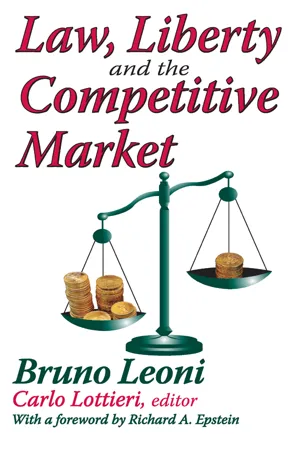
Law, Liberty, and the Competitive Market
About this book
"Law, Liberty, and the Competitive Market" brings the clash between law and legislation to the attention of economists and political scientists. It fills a void and offers a series of texts that have not previously been translated into English. This anthology connects various articles by Leoni on economics and law with the objective of emphasizing how much Leoni's own theory in the juridical environment was influenced by reflection on authors of the Austrian school - from Carl Menger to Ludwig von Mises, from Friedrich von Hayek to Murray N. Rothbard.The essays dealing with economics help us understand how many of Leoni's positions were libertarian. A careful reader of Mises, Leoni often ends up by assuming positions that are even more anti-state than those of the Austrian economist (concerning monopolies, for example). It is significant that in the 1960s his thought was influenced by Rothbard. The very critiques that he addresses to normativism and to analytical philosophy contain strong ideological elements, as they move from the awareness that legal positivism leads to statism and philosophical relativism to acquiescence in the face of power.Studying the market economy, Leoni perceives opposition between spontaneous order and planning. In this way, he understands how such a contrast is significant for the origins of norms. Leoni's idea of a law able to protect individual liberty has its roots in the market. Thus, the market is at the same time the model he uses to conceive the legal order and an institution fundamental for the service of civilization, which the law is called to protect. This is an important work by a figure only now being recognized as a pioneer in the field of economics and an innovator in political theory.
Part I
Economics
1
“Consumer Sovereignty” and the Law
Contemporary technology has accustomed us to the manufacturing of the most varied things, not only of things never previously produced or conceived of, but also those which in the not-too-distant past were produced but not manufactured—houses can now be prefabricated, for instance, and then there are the famous Liberty Ships which contributed so much to the victory of the Allies in the last war. With the help of technology, long and costly processes of production have been eliminated, costs reduced, and delivery dates accelerated. This has meant increased satisfaction for the consumer, and, naturally, for the producer as well. These technological processes have, as has already been emphasized by many, posed a series of problems in other fields, by bringing about often radical changes in the social environment and even in our ways of thinking.
A widespread commonplace concerning contemporary culture is the position affirmed by—among others—the distinguished American jurist Wolfgang G. Friedman in his recent book, Law in a Changing Society:1 namely, that technical progress has necessarily and directly entailed a profound revolution of legal institutions. In this age of space satellites and astronauts, we often hear it asked, how can we possibly limit ourselves to, say, the concepts inherited from the Romans on the subject of property or contractual obligations, and so on? In reality, however, the modifications of legal institutions through the agency of technical innovation are not so numerous nor so important as they seem; in any case, it is very doubtful, and surely at least debatable, that such innovations of themselves entail radical modifications of the institutions and relations which have ruled our societies for thousands of years. While, for example, the private ownership of property admittedly no longer reaches usque ad sidera in any country of the world, nevertheless, it still persists and fulfils its necessary role. In the same way, the word or signature given by telefax, or any other ultra-modern method, serves the same necessary function that it has had for some millennia. The modern man who communicates by television and travels in jets is of the same flesh and blood as, and is psychologically and physically similar to, his distant ancestors who communicated by voice and traveled in chariots and sailing ships.
Yet notwithstanding the relative stability of legal institutions, at least in the countries of the West, a noteworthy change has arisen during the last 150 years: the alteration of the way in which people had for centuries, and even millennia, conceived the nature, origin and functions of the law.
The decline of the idea that the law is on the whole independent of the will of the rulers, and that it cannot be identified immediately and completely with the laws and decrees emanating from time to time from the holders of political power, is a most striking development, for its implications no less than for its diffusion in almost all societies in the contemporary period.2 Strangely enough, this development—perhaps through the continuity and gradualness with which it has taken place since the beginning of the last century—has seemed so natural, especially in Europe, that very few scholars up to now have addressed themselves to the task of considering it in its whole import or have dedicated the attention to it that it deserves. Nor, I would wish to add, have they approached it with the apprehension it deserves.
If only one word had to be used to define this widespread change in the idea of the law, I would say that according to the man on the street, the law today is something that must be manufactured, or even pre- fabricated. That is, it is something produced with the minimum of time and effort judged necessary, according to plans prepared in advance, by “suitable” people in the “suitable” places (national legislatures), and presented to those who must obey the laws. These latter people (we might say “consumers,” if the word were not misleading for reasons which we shall shortly see) do not have—or are thought not to have—any role other than that of using the product ready-made for them, just as they use the automobile or the washing machine.
The production of the law today by other procedures would seem to many people slow, inadequate and imprecise. Habits, customs, judicial precedents and the opinions of experts in this matter were the classical instruments of the production of the law in classical Rome, in medieval and modern England, in the United States, and, notwithstanding some contrary appearances, in the majority of the countries of Europe until the compilation of the current legal codes, that is, generally speaking, until the beginning of the nineteenth century. But today these instruments appear, at least to the superficial glance of many, like the outmoded tools of an “artisan” society, inadequate for the needs of a “rapid” civilization on the vast scale that we are familiar with today.
The analogy between juridical “products” and the products of our technical and industrial civilization is not, however, as suitable as it appears at first glance. In fact, considered more attentively, it turns out to be wholly deceptive and false. A fundamental difference exists in the relationship between producers and consumers of the goods manufactured with the resources of industrial technique, on one hand, and between “producers” and “consumers” of legal rules manufactured, even mass-produced, by the wielders of political power with the resources of legislative techniques, on the other.
In spite of every contrary appearance, the industrial productive process in the countries of the West is still originated and sustained by the initiative of private individuals—that is to say, by individuals who do not have the police or the army at their disposal to constrain consumers to buy the products that these private individuals put on the market. “One dollar, one vote,” describes very well the nature of that continuous process with which the consumer directs and dominates the conduct of producers in the free market. While the latter study how to entice the consumer (and sometimes even how to deceive him), they know that in the final analysis they must serve the consumer, satisfy his will, and cater to his whim under penalty of going into the red, and thus having to cease their productive activity.
There is a radically different relationship between the “producers” and “consumers” of the legal rules manufactured through the use of legislative technique. The vote of the “consumers” in this case is discontinuous, a circumstance arising from the fact that it can be given only at certain times and under certain conditions, with a meaning almost always empty or equivocal, and with effects that are not predicted, often unpredictable and frequently unwanted. We may also add that not all “consumers” can vote, whereas in the market even a five-year-old boy who has ten cents to buy himself an ice cream cone casts his “ballot.” Further, there are always some voters who will find themselves in the minority in any political election and, despite any electoral invention and device, are destined purely and simply to waste their votes. In this case, controlling the production of legislation is an evidently hopeless job for “consumers,” the people for whom the rules themselves are intended.
It is said that these differences between economic processes and legislative techniques are inevitable, and that it is therefore necessary to know how to resign oneself to them. Our civilization does not allow us to take into consideration the desires of all the electorate on the political level, the argument goes, and political representation is consequently the best substitute that can be offered us for that real “representation” which would otherwise be unfeasible. This position would make sense if the people for whom the laws are intended could control the production of these laws in no other way than through the institution of “representa-tion.” But it is exactly this claim—that there is no other way to produce law than through the institution of representation—which has to be demonstrated, since this technique of production of the law (legislation) reveals its grave inefficiency. It is the problem of defining “law” that must be entirely reconsidered and, in particular, the problem of whether the law, and, especially the above-mentioned private law, can be “manufactured,” as today a washing machine or automobile is manufactured. Might it not be, instead, that the law is something that evades the rules of industrial production and consumption, something not susceptible of being manufactured by a limited number of “entrepreneurs” for the use of everyone else?
One can cite contemporary experience: the law of today which denies that of yesterday evening, and which will be superseded by that of tomorrow morning; the two thousand laws manufactured every year by 500 men in our own country, as in others, without the majority of the citizens even knowing of the existence of these laws; the obviously ephemeral character of much legislative activity, owing to the transitory triumph of no less ephemeral majorities in parliaments; the consequent impossibility of citizens making long-range plans which take the constancy of juridical rules for granted; the equally serious consequence that the law of today can be the result (as frequently happens) of the oppressive design of a slender majority, or even of an effective minority (the “pressure groups,” as they are called today), who tomorrow will see themselves oppressed in their turn by a new minority in the seats of power. All these are reasons for profound perplexity about the nature and the function of law “manufactured” by legislators who produce laws on a vast scale. This process of “production” may seem equivalent to the techniques evolved for manufacturing industrial items, but, unlike the industrial sector, in the case of law there are actually very few reasons for preferring those techniques to the ancient “artisan” methods for ascertaining and “producing” customary and statutory law.
Perhaps one day the common man will understand a truth that he appeared to be instinctively acquainted with in times not too distant from our own, although they seem to fade more and more into the past. In reality, law is not something that is pre-fabricated in some specially designated place, by some specially designated producer using some pre-established technique. In much the same way, followers of artificial languages such as Esperanto and Volapuk have not yet succeeded in finding a substitute for the language that we speak every day, a language that also is not prefabricated. In the last analysis, the law is something that everyone makes every day with his behavior, his spontaneous acceptance and observance of the rules that everyone helps to establish, and finally—even if it seems paradoxical—with the very disagreements which may arise among individuals about the observance of these rules.
The consequences of this old but always valid conception of the law will not necessarily consist in the total abandonment of the “manufac-turing” of law. But certainly our law-factories will have to very much limit their “production,” and sooner or later renounce (if the West is not destined to fall into servitude) many of their “products.” Finally, “law-consumers” will take back their true function of being producers of their own laws or at least of those laws—and they are not few—whose production they would otherwise control but today cannot.
Notes
1. Wolfgang G. Friedman, Law in a Changing Society (London: Stevens, 1959).
2. The phenomenon concerns not only the countries of continental Europe (where, as is well-known, the “will of the prince” has been repeatedly regarded as the fount of the law), but also the Anglo-Saxon countries, where it used to be maintained, at least up to the beginning of this century, and still is in part, that the “prince” (today we should say “parliament.” and through it the government, when the parliament delegates to it the necessary powers) is not so much the creator of the law as the guardian of justice, which the judges administer in the prince’s name, but in full independence of his personal will.
2
The Problem of Economic Calculation in a Planned Economy
1. The Problem and Its Solution in a Market Economy
The problem of economic calculation can be defined in general as the problem of ascertaining what the ratio is between the costs and the results of the process of satisfying economic choices. If the results exceed the costs, the action is profitable; if the costs exceed the results, the action is damaging. A parity between costs and results defines the action as useless.
The problem expressed in the general sense above obviously concerns both manufacturers and consumers: producing—as well as consuming—means choosing. Each choice has a result (the good that has been enjoyed or produced) and a cost. Goods are produced or consumed, in fact, time after time, some goods to the exclusion of others, and the exclusion of some does not necessarily occur because the excluded goods do not interest those making the choice, but mainly because the choice-maker is less interested in them than he is in those goods that he decides to produce or consume. The exclusion from consumption or production of goods that are less interesting but interesting nevertheless becomes, in a general sense, the cost of choice.
Furthermore, the problem of economic calculation concerns the producer who produces directly for himself no less than the producer who produces the chosen goods for others. Finally, the problem concerns producers and consumers in any type of society, from the most primitive to the most evolved.
There are, however, some important differences between the possible solutions to the problem, in relationship to the type of economy (primitive or evolved) where the operators find themselves working.
In evolved economies, where the exchange of goods occurs through the intermediation of monetary means, the solution to the problem is relatively simple for both consumers and producers.
The former, in fact, can calculate the costs that the obtained result implies in terms of prices of the goods they have given up. That is, they can calculate in terms of the enjoyment of the selected goods, which in turn can be expressed in terms of prices of these goods.
As to producers in economies of exchange of the monetary type, they can solve—at any time—the problem of comparison between the costs and results of their productive activity in a way which, although more complex than that of consumers, is nevertheless straightforward. They decide what they must produce by comparing first the market prices of the various goods alternatively producible through the employment of resources...
Table of contents
- Cover
- Half Title
- Title Page
- Copyright Page
- Table of Contents
- Foreword
- Introduction
- Part I—Economics
- Part II—Law
- Bibliography
- Index
Trusted by 375,005 students
Access to over 1.5 million titles for a fair monthly price.
Study more efficiently using our study tools.
Frequently asked questions
Yes, you can cancel anytime from the Subscription tab in your account settings on the Perlego website. Your subscription will stay active until the end of your current billing period. Learn how to cancel your subscription
No, books cannot be downloaded as external files, such as PDFs, for use outside of Perlego. However, you can download books within the Perlego app for offline reading on mobile or tablet. Learn how to download books offline
Perlego offers two plans: Essential and Complete
- Essential is ideal for learners and professionals who enjoy exploring a wide range of subjects. Access the Essential Library with 800,000+ trusted titles and best-sellers across business, personal growth, and the humanities. Includes unlimited reading time and Standard Read Aloud voice.
- Complete: Perfect for advanced learners and researchers needing full, unrestricted access. Unlock 1.5M+ books across hundreds of subjects, including academic and specialized titles. The Complete Plan also includes advanced features like Premium Read Aloud and Research Assistant.
We are an online textbook subscription service, where you can get access to an entire online library for less than the price of a single book per month. With over 1.5 million books across 990+ topics, we’ve got you covered! Learn about our mission
Look out for the read-aloud symbol on your next book to see if you can listen to it. The read-aloud tool reads text aloud for you, highlighting the text as it is being read. You can pause it, speed it up and slow it down. Learn more about Read Aloud
Yes! You can use the Perlego app on both iOS and Android devices to read anytime, anywhere — even offline. Perfect for commutes or when you’re on the go.
Please note we cannot support devices running on iOS 13 and Android 7 or earlier. Learn more about using the app
Please note we cannot support devices running on iOS 13 and Android 7 or earlier. Learn more about using the app
Yes, you can access Law, Liberty, and the Competitive Market by Bruno Leoni in PDF and/or ePUB format, as well as other popular books in Business & Business General. We have over 1.5 million books available in our catalogue for you to explore.