eBook - ePub
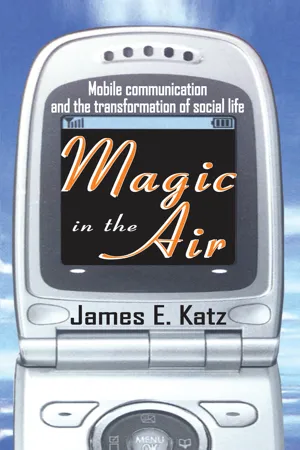
Magic in the Air
Mobile Communication and the Transformation of Social Life
- 207 pages
- English
- ePUB (mobile friendly)
- Available on iOS & Android
eBook - ePub
About this book
In this timely volume, James E. Katz, a leading authority on social consequences of communication technology, analyzes the way new mobile telecommunications affect daily life both in the United States and around the world. Magic in the Air is the most wide-ranging analysis of mobile communication to date. Katz investigates the spectrum of social aspects of the cell phone's impact on society and the way social forces affect the use, display, and re-configuration of the cell phone. Surveying the mobile phone's current and emerging role in daily life, Katz finds that it provides many benefits for the user, and that some of these benefits are subtle and even counter-intuitive. He also identifies ways the mobile phone has not been entirely positive. After reviewing these he outlines some steps to ameliorate the mobile phone's negative effects. Katz also discusses use and abuse of mobile phones in educational settings, where he finds that their use is eroding students' participation in class even as it is helping them to cheat on exams and cut class. Parents no longer object to their children having mobile phones in class in a post-Columbine and 9/11 era; instead they are pressing schools to change their rules to allow students to have their phones available during class. And mobile phone misbehavior is by no means limited to students: Katz finds that teachers are increasingly taking calls in the middle of class, even interrupting their own lectures to answer what they claim are important calls. In keeping with the book's title, Katz explores the often overlooked psychic and religious uses of the mobile phone, an area that has only recently begun to command scholarly interest. Magic in the Air will be essential reading for communications specialists, sociologists, and social psychologists.
Information
Part 1
Mobile Communication and Social Transformation
1
Introduction
An oft-voiced criticism of modern life is information overload: too much information and too many choices lead to exasperation, depression, or worse. Yet despite complaints, mobile communication technology is being avidly adopted across all demographic segments and social groupings. Mobile devices have become an important way by which people interact with others (as well as avoid doing so). In this process, they are able to gain access to a widening pool of service, information, and entertainment options.
Mobile communication is becoming a way of life, with billions of people expending vast amounts of time and resources via the technology. Statistics from the U.S. concerning mobile phone usage in cars is illustrative of the point. A June 2005 survey of more than 1,200 adults found that 43 percent of all drivers said they had in the prior six months used a cell phone while driving (Roper Center, 2005b). A January 2005 survey, also of about 1,200 respondents, found that 40 percent of drivers said they have talked on their cell phones in stop-and-go traffic to pass the time (Roper Center, 2005a). A still larger study by the U.S. Department of Transportation used direct observation. It found that in 2004 about 8 percent of all drivers during daylight hours were using a mobile device and about 5 percent were using handheld cell phones. These figures translate into 1.3 million and 800,000 motorists respectively. The estimated usage is about double that of 2002 (Glassbrenner, 2005). At the same time, a Harvard University study in 2002 estimated that use of cell phones by U.S. drivers results in 2,600 deaths a year nationwide and 330,000 injuries (Cave, 2005).
Small-scale studies are required to understand the reality of what is going on. Typical of the studies that are needed is one carried out by Rutgers University graduate students Yi-Fan Chen and Katie Lever that has provided a snapshot of mobile device usage patterns. In spring 2005, they observed people, mostly students, at various locations around the Rutgers campus to see how many were using mobile phones or music players (or, in some cases, both). Via systematic (but not random) sampling over several weeks, they eventually recorded 4,500 observations. To say that many young people in the U.S. are now heavily involved with their mobile technology in public places would seem to be an understatement. Chen and Lever found that about 13.6 percent of people were using either a mobile phone or music player, that is, about one out of seven were ambling about on campus with at least some level of involvement with a mobile device. The researchers also found gender differences: of the roughly one out of seven women using mobile devices, three-quarters of them were using mobile phones. About the same proportion of men were using mobile devices, but unlike the women their usage was evenly split between mobile music devices and mobile phones. Based on this study, and one's own casual observation, it does seem that public space is being transformed by individualized, portable information and communication technology. There is also a gender aspect to this behavior. Use of mobile devices for entertainment within one's own world (i.e., music) is more typical of males, while being in communication with others was more typical of females.
There are many places where mobile phones are banned and there are ongoing attempts to impose formal rules as behavioral expectations concerning mobile communication conflict and become redefined. Although these bans are predicated on safety reasons, many in affected areas continue to use their phones while driving. Yet even when safety is not an issue, appropriate mobile communication settings are a frequently contested domain. During a 2004 visit to New York City's Metropolitan Museum of Art, where mobile use is forbidden, I saw young people ducking behind statues to make mobile phone calls, and clerks behind cash registers chatting away. Of course, there is also a distinction between public usage and having a mobile phone on but silent. A sense of just how prevalent "carrying" behavior may be, a 2005 survey of museum goers found that 84 percent of visitors to the New Jersey-area museum were carrying active cell phones into the exhibit area (Goldman and Foutz, 2005).
With about two billion mobile phone users worldwide, and mobile services rapidly proliferating, some intriguing questions can be raised. These include topics of mobile communication in relationship to gender, empowerment, to productivity, socialization and life satisfaction. Mobile communication also problematizes anew significant sociological questions that include cross-group communication and integration, use of public space, sense of time and interpersonal communication and coordination. Not least does mobile communication broaden the range of human possibilities across various levels of human expression ranging from artistic to political. There are also more knotty questions: how do people make meaning out of their technology and how does the technology change humans as individuals and as social participants.
Many of these issues are addressed in the present volume not only in terms of mobile communication, but also, in the book's second part, in terms of telecommunication and information generally. The volume has two major sections. The first section deals specifically with mobile phones and their use, abuse, and social consequences; the second with the social role of telecommunications and information. In order, the chapters address specifically:
- perspectives on the issue, which is the present chapter;
- transcendental, religious, and spiritual uses of mobile technology;
- how "being there" in space and time seems modified due to mobile communication technology;
- the manner in which mobile communication technology affects self-presentational activities and the choreography of the body in public space;
- the symbolic inculcation, display, and contested meanings of mobile phones, with special attention to its design and fashion characteristics;
- the ironies of the way mobile phones have become used in educational settings and their prospects for transforming education; and
- the way in which crises have become changed due to emergency uses of the telephone. This is demonstrated by an analysis of what transpired during and after the 9/11 terror attack on the U.S.
- the macro-social role of the telephone as it has evolved since its invention, utilizing a broad-brush perspective;
- what major ideas have been advanced concerning information societies and their prospects;
- speculations about the future services that might become available as technology continues to advance, and what some of those social implications might be; and, finally
- an overview of some enduring issues and concluding remarks.
A thread that connects the chapters is the concern with the social side of information technology, be it mobile or location-bound. On the other hand, the scope of any book has to exclude some material. In the present case, a book devoted to a survey of mobile communication and social aspects of information technology, I have decided to restrict sharply my exploration of other communication technologies, such as television or the Internet even as these are becoming available via mobile phone and other mobile devices.
It is worthwhile making a brief methodological note since I use many different modes of argument and evidence in the book. Some of my claims are based on careful, systematic research that adheres to the stricter cannons of empirical investigation. Other claims are based on a few selected examples uncovered by observers and reporters. Some claims are my own professional judgments. And some of what I offer is pure speculation. I have tried to alert the reader to the distinctions among the various types of claims that are advanced, though in most cases these should be apparent. Certainly it is the case that the better the data are the more one can have confidence in the conclusions that might be drawn from them. I have sought to structure my arguments accordingly. Yet there is also much value in the educated guess or first approximation judgments. This is especially so in terms of setting out questions or issues that can be further explored in a more systematic fashion. Above all, I view human understanding of social phenomena as a dynamic process that invites critical evaluation and ever-improving revision.
The reason I chose the title Magic in the Air was because magic is one of the salient characteristics of the technology as it is first experienced by many people. The technology itself not only seems to have a magical feel to it in the way it works but also in the power that it seemingly conveys to the user. Users of advanced mobile devices wander around and yet invisibly connect to just about anyone while accessing information from sources near and far. From an experiential viewpoint, an enormous number of complex functions are crammed into a Vanishingly small container. Complex operations can be performed quickly, ranging from calculator functions to geo-position mapping, and from music sharing to making micro-wallet payments at parking meters. For many who have grown up without mobiles, the initial experiences with mobiles can truly seem magical.
Consider a distinction between the practice of magic and the practice of science. Both consist of thoughtways, tools, and procedures. Magic and science have rational ends: the manipulation of the environment to understand cause-and-effect and to produce results. Both are processes and operational systems. But obviously there are some important differences. Science makes universal claims and uses empirically verifiable testing. Magic sometimes makes universalistic claims, sometimes not. However, in terms of verifiable results stemming from magic, there have been none to date. Perhaps surprisingly, there is a substantial amount of money available to anyone who can demonstrate that there is any paranormal, ESP, or other psychic phenomena whatsoever. This includes procedures such as healing touch or psychic surgery, their insurance reimbursability notwithstanding. In point of fact, the James Randi Foundation has had for more than a decade offered a prize of one million dollars "to anyone who can show, under proper observing conditions, evidence of any paranormal, supernatural, or occult power or event" (James Randi Educational Foundation, 2005).
Yet good technology looks like great magic. And as Carl Sagan (1995) pointed out, most people are far more fascinated by pseudoscience, psychics, and the occult than by science. He considers the latter far richer and deeply meaningful, certainly full of surprises. While I agree with his view, I realize that many people do not. Given the proclivity of popular culture and the media that serves it, one should not be entirely surprised that many people take what is essentially a magical approach to mobile communication. So it is entirely fitting that the mobile phone, magical in its appearance, in its operational specifics, and in its power, be accepted by much of the general public as a form of magic. The mobile phone is a form of magic for which someone must pay, generally by subscriberships or prepaid cards. But that is nothing new: anyone who wishes a Tarot Card reading, a papal indulgence, or a curse lifted will find that little in life is free, magical or not.
The title also refers to the too often overlooked spiritual, psychic and religious uses of the mobile phone, an area that has only recently begun to command scholarly interest. This is the topic of the book's keystone chapter. And finally, the title refers to the marketing success of the mobile phone. Contrary to the opinions of many media scholars, this success is a great testimonial not to the magical abilities of copy-writers. Rather it is to the powerful attraction of being able to communicate to others at any time from nearly any place. If nothing else, the success of the mobile phone has been magical, in that in the span of a little more than three decades—from its first experimental use in public in 1973 to the year 2005 – worldwide subscribership has grown to about two billion people. That is, one out of three humans in the entire world has become a mobile phone subscriber. Magic indeed.
Doing magic implies projecting power across geographical space and often in a way that purports to affect the minds of others. Ithiel de Sola Pool (1983) gave wide circulation to the phrase, "technologies of freedom." Certainly the TV and Internet, and even the fax and radio have been given great (and well-deserved) credit for their role in giving the possibility of freedom to people worldwide. Yet it may be that no technology has done more to give individuals freedom than the mobile phone. I say this using the word freedom not only in the political sense, but also in the sense of freedom and control it gives to people over their own personhood. The freedom goes beyond the control of immediate circumstances, such as schedules, contacts with friends, or gaining information access. The importance of mobile communication for advancing freedom for interpersonal relationships of all descriptions has been argued in other contexts (Fortunati, 2003). Of course it cannot be forgotten that power is often reciprocal, and that by definition it means exercising influence over others, and sometimes that targetted "other" is oneself. So while mobile communication can increase one's power and freedom vis-à-vis circumstances and others, it also allows others a degree of control over one.
In 2002, I coined the word "Apparatgeist," to convey a perspective that Mark Aakhus and I were trying to convey in our theoretical approach to the use of mobile communication technology. It combined the sense of "apparatus," or mechanism, with Geist, or spirit. We were not suggesting that inanimate objects have inherent spiritual qualities. Nor did we believe that they could somehow inherit them. Rather, we wanted to emphasize the context-sensitive nature of knowledge and behavior concerning communicative practices, as well as its enduring and transcendental aspects. The emphasis was on the device and the interpretation of the device by its users. The term also was meant to connect the individual and group to show the making of social meaning. We also used the term Perpetual Contact to suggest the aim of pure communication that people often strive for, the melding, as it were, of minds. This, of course, is an unattainable ideal, as Peters (1999) has also suggested. (Unbeknownst to us at the time Peters was working in a parallel, albeit more historical, vein.)
For us, though, "Appara...
Table of contents
- Cover
- Half Title
- Title
- Copyright
- Dedication
- Contents
- Preface and Acknowledgements
- Part 1: Mobile Communication and Social Transformation
- Part 2: Telecommunication and Information in Society: Past, Present, and Future
- Index
Trusted by 375,005 students
Access to over 1.5 million titles for a fair monthly price.
Study more efficiently using our study tools.
Frequently asked questions
Yes, you can cancel anytime from the Subscription tab in your account settings on the Perlego website. Your subscription will stay active until the end of your current billing period. Learn how to cancel your subscription
No, books cannot be downloaded as external files, such as PDFs, for use outside of Perlego. However, you can download books within the Perlego app for offline reading on mobile or tablet. Learn how to download books offline
Perlego offers two plans: Essential and Complete
- Essential is ideal for learners and professionals who enjoy exploring a wide range of subjects. Access the Essential Library with 800,000+ trusted titles and best-sellers across business, personal growth, and the humanities. Includes unlimited reading time and Standard Read Aloud voice.
- Complete: Perfect for advanced learners and researchers needing full, unrestricted access. Unlock 1.5M+ books across hundreds of subjects, including academic and specialized titles. The Complete Plan also includes advanced features like Premium Read Aloud and Research Assistant.
We are an online textbook subscription service, where you can get access to an entire online library for less than the price of a single book per month. With over 1.5 million books across 990+ topics, we’ve got you covered! Learn about our mission
Look out for the read-aloud symbol on your next book to see if you can listen to it. The read-aloud tool reads text aloud for you, highlighting the text as it is being read. You can pause it, speed it up and slow it down. Learn more about Read Aloud
Yes! You can use the Perlego app on both iOS and Android devices to read anytime, anywhere — even offline. Perfect for commutes or when you’re on the go.
Please note we cannot support devices running on iOS 13 and Android 7 or earlier. Learn more about using the app
Please note we cannot support devices running on iOS 13 and Android 7 or earlier. Learn more about using the app
Yes, you can access Magic in the Air by James E. Katz in PDF and/or ePUB format, as well as other popular books in Social Sciences & Media Studies. We have over 1.5 million books available in our catalogue for you to explore.