- 291 pages
- English
- ePUB (mobile friendly)
- Available on iOS & Android
eBook - ePub
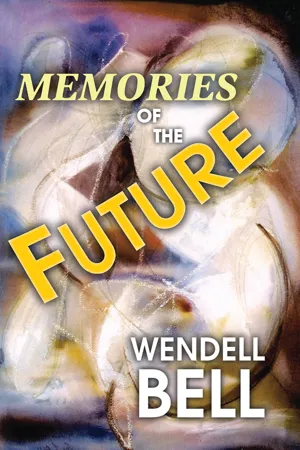
Memories of the Future
About this book
Life courses, both professional and personal, are often directed by unplanned experiences. At crossroads, which path is followed and which hard choices are made can change the direction of one's future. Wendell Bell's life illustrates how totally unforeseen events can shape individual lives. As he notes, despite our hopes and our plans for the future, there is also serendipity, feedback, twists and turns, chance and circumstance, all of which shape our futures with sometimes surprising results. In Bell's case, such twists and turns of chance and circumstance led to his role in developing the new field of futures studies. In Memories of the Future, Bell recognizes the importance of images of the future and the effect of these images on events to come. Such images-dreams, visions, or whatever we call them-help to determine our actions, which, in turn, help shape the future, although not always in ways that we intend. Bell illustrates, partly with the story of his own life, how people remember such past images of the future and how the memories of them linger and are often used to judge the real outcomes of their lives. This is a fascinating view of the work of an important social scientist and the people and events that helped define his life. It is also about American higher education, especially from the end of World War II through the 1960s and 1970s, a period of educational transformation that included the spread of the merit system; the increase in ethnic, racial, gender, and social diversity among students and faculty; and a massive increase in research and knowledge.
Information
1
Moving West: From Chicago to Fresno
Growing up in the city of Fresno in California’s San Joaquin Valley, I knew “Chicago” mostly as the past, a place “back there” in both time and space, a thing of hearsay and memories. Yet even today, sketchy images of Chicago can come flooding back to me, triggered by a variety of small things, such as a train whistle, a word, or a song. Among other things, I think of shimmy and shake, people dancing the Charleston, and my young, pretty, flapper mother dressed up and eager to party in that wonderful toddlin’ town.
Although “Chickagou” may have been the “place of evil smell” to the Pottawatomie Indians who, some believe, named it for the stench that in times past lingered there, for me Chicago meant big city chic, swagger, and swank.
And it meant more. For Chicago was part of my family lore. It was where we came from, where my mother and grandmother left their past lives, where in 1924 I was born, and where people lived who still mattered to us and who gave meaning to our lives. It also meant jazz, friendly people, big-time gangsters, corruption, machine politics, wild parties, drunkenness and despair, and both good and hard times.
Both my maternal grandmother and grandfather had graduated from the eighth grade, which, according to my mother, they were very proud of having done. Later, my grandmother did study piano for a time at the Chicago Conservatory of Music. My father never went to high school and probably did not finish the eighth grade. My mother had a year and a half or so of high school, which included a semester of business arithmetic, typing, and Munson shorthand. Then, she dropped out, which was not unusual among her friends many of whom were leaving school and going to work.
My mother told me that it was so generally accepted at the time no one said a word to her about quitting school, not even her father, which is surprising since she had frequent battles with him about nearly everything and anything. At their worst, they were two very stubborn people, especially when dealing with each other. My mother grumbled about her father being a “German squarehead,” a “goddamned Leiferman,” but when they were shouting at each other, my mother butted heads with equal squareheadedness. When she was eighteen, she married and moved out of her father’s house. Simmering anger toward her father was to fuel an off-and-on-again war with him until he died in Fresno at age sixty in 1941.
The boy she married was Wendell Cedric Bell. He had a sister and three brothers. On my birth certificate, it says that my twenty-year old father was a “contractor.” More accurately, he was a bricklayer who, along with his brothers, worked for his father, William H. Bell, who, indeed, was a building contractor. The Bells trace their ancestry back to a William Bell who was born circa 1685, his son Samuel who was born circa 1724, and Samuel’s son John who was born in Staunton, Virginia, circa 1772. The Bells were slave-owners. John Bell, for example, lists at least three slaves in his will, Maria, Gilbert, and Jefferson, but there may have been others listed as personal property.1
My grandfather, William Henry Bell, was born in 1859 in Christiansburg, Virginia, became a brick mason, but moved to Kansas City, where he was in 1900, and then moved with his family to Chicago before 1910, where he became a building contractor.
When my mother married, it was 1923 and, for her and my father, the times were easy and carefree. They lived, my mother told me later somewhat wistfully, “luxuriously” in an apartment. Economically, if not educationally, they had a middle-class life, supported by my paternal grandfather’s successful construction business.
Perhaps times were too easy for them. My young father, nicknamed “Babe” because he was the youngest child, and his brothers were heavy drinkers who often were out of control when drinking, something that later in life I would have to struggle with myself. The drinking wasn’t all the time, every night, but rather party-type, weekend binge-drinking, starting out with pleasant anticipation, moving to fun and exhilaration, and, as drinking continued, becoming loud and wild, often ending in angry fights, recriminations, and sometimes in minor violence and major regurgitations.
Most of these recollections come from listening to my mother and grandmother describe the past. My memories include a kaleidoscope of vivid bits of different scenes: the sound of loud talking and laughter in another room, my being awakened in my crib to be shown off and fawned over by my parents’ friends and then left in the dark again as the party moved on, sounds of music and laughter, and later shouting and a screech along with a thud or two, and the next morning a favorite toy found broken, an inadvertent victim of what? Recklessness? Innocence? Stupidity? Or just plain drunkenness?
I remember one such toy, a plastic ram about four inches long—not really much of a toy for a two- or three-year-old kid. My father had brought it home for me some weeks earlier, partly to make up and soothe my mother’s anger because he was late and drunk. I played with it a lot and became attached to it. One morning after a party, I found it with its leg broken. I was devastated. Why do we still remember the hurt of such childhood things that now seem of no importance?
It was the rip-roaring twenties, a time of big money, liberation, and good-time Charlies, a time of change and experimentation, a time, too, when people did not know where they were headed. My mother, Blanche, was on the leading edge. Although she had never heard of F. Scott Fitzgerald’s story, “Bernice Bobs Her Hair,” she had been the first of her friends to have her hair cut short or “bobbed” and was, thereafter, known among her friends as “Bobby.” She loved to party, to dance, and to feel free—free from her father, from teachers, and from limits. She loved to get gussied up, to go out on the town, and to drink, dance, and have fun herself. My father was not alone in his excesses.
But the relationship became stormy. My mother began to think that she had escaped one lousy man only to get hooked up to another. She told me that she felt threatened and trapped by my father’s drunken, unreliable, and sometimes violent behavior.
Although she was in some ways shallow and self-centered, my mother had an unselfish and loyal love for her mother, Grace. Blanche wanted to protect her mother, to make her happy, and to heal the humiliations that my grandfather heaped upon her. This loving concern on my mother’s part, for which I came belatedly to admire her, lasted until Grace’s death—and even beyond since my mother continued to grieve for her until my mother’s own death many years later.
My grandmother did need help, because my grandfather sometimes hurt her deeply. Charles—or “Charlie,” as his friends called him—was the son of German immigrants, who had become a successful traveling salesman for Marshall Fields department store. He was an articulate and intelligent man, personable and well-dressed, though opinionated and sometimes overbearing. When sober, he could be charming. He was also talented. He played the drums, and he could draw, paint, and make beautiful lettering in a variety of styles. Clearly, he had had some artistic training, and both my mother and grandmother took pride in his talents. I liked him some of the time and was afraid and wary of him the rest of the time. When I started to talk, I called him “Lappa,” which for my mother, my grandmother, and me became his name for life.
Indeed, he was a “good-time Charlie.” He was a womanizer and a drunkard, seemingly determined to become a living stereotypical example of the “traveling salesman” of the day. Moreover, when drunk, he could have tidal mood swings and in a moment could change from congenial to angry and violent. Now that my mother had left his house, my grandmother had to deal with his hurtful behaviors on her own. His behavior infuriated my mother.
Thus began the great deception. The two women, each in their separate households, began on the sly to siphon off a bit of money here and there. My mother saved hers in a shoe in her closet and my grandmother squirreled hers away in a bowl with a lid on the top shelf in her kitchen. For months they put away small amounts of money, saving up for the day they would make their move.
The first move came in 1927 when my mother divorced my father for “excessive drinking” and was awarded $20 a week for the support of her two-and-a-half-year-old son. But the relationship between them continued in an off-again, on-again fashion with periodic outbursts of anger and recrimination, followed by pleas for forgiveness. My mother still felt trapped.
In 1929, when I was four years old, the second and final move came and the great deception became the great escape.
On a day when my grandfather was out on the road selling, “in some hotel room with a floozy,” my mother said, and my father had been unseen for some days, “probably drunk,” said mother, they packed up. My mother, with the help of a girlfriend, got her suitcases and me into a taxi, picked up my grandmother, and headed for the train station.
Finally, as the train jerked, began a slow unsteady movement forward, and then, heaving and puffing, left the station with a proud whistle, my mother and grandmother began to relax. They had made their escape.
Their feelings of relief, however, were soon replaced by anxiety as they began to think about the unknown future toward which they were headed.
I remember the swaying of the train at full speed as I ran wobbly legged up and down the aisle, the white tablecloths in the dining car, a bag of candy orange slices my mother bought me, the rhythmic “hinnymanooch, hinnymanooch” humming of the wheels on the tracks, the soulful moan of the train whistle at night and a distant answering call, the berths made up for sleeping with green curtains giving a false promise of privacy to the sleepers, and the awe I felt as we crossed part of the Great Salt Lake. Like so many other Americans, we were heading west looking for a new and better life.
Of course, I can only imagine what the women felt, because they tried to show mostly calm determination, although my mother could not suppress an occasional unconscious hand-wringing and worried look. At least, that is all the self-centered little boy of four noticed—that and how many orange candy slices were still left in the bag.
Knowing my mother as I came to do much later, I realize that she must have been scared to death. My grandmother must have been scared too. Heading off on their own! Going into the unknown! Not having much money! Not having a job! “Oh, my god,” they must have thought, “what have we done?” Worry must have piled upon worry. But they could cling to one life-preserving family link to Fresno, California: Grace’s father, my great-grandfather, who had gone there to live some years earlier.
When he was a young man, Aidwin D. Robinson, had seen an advertisement that offered a round trip from Chicago to Fresno to attend a wine festival for a special price of $7. He bought a ticket, took the trip, and loved Fresno. He decided that Fresno, an agricultural center in the heart of California’s San Joaquin Valley, would be a good place to live, something that he never forgot as he traveled widely some time later peddling hand- and foot-powered sewing machines. Never finding a place that he liked better than Fresno, when the sewing machine business cooled down—probably when his brand lost out to Singer’s, he went to Fresno to make his home.
Like so many other Europeans who migrated to America, some members of our Robinson family, step-by-step and generation-by-generation, traveled west across the continent. Their trip probably started in Yorkshire, England, arriving, via the Netherlands, by ship on the northeastern shore of the North American continent.
Aidwin D. Robinson’s family tree can be traced back to James Robinson, who was born about 1734 and is said to have furnished supplies for the Revolutionary army. James’s son Nathan was born in 1769 in Durham, Connecticut, which became home base for some decades. For example, Nathan’s son Chauncey Robinson was also born in Durham, in 1792. But in 1794, Chauncey’s family moved west to Sauquoit, Oneida County, New York.2
In the summer of 1813, Chauncey, with his wife and two children, left Sauquoit and moved somewhat farther west to Clarendon, New York, where he cleared the land, built a home and other buildings, and ended with “a farm of one hundred acres cleared up and paid for, with tolerable buildings and fixtures, and a good orchard and garden.”3
Some of Chauncey’s children continued the move west. For example, one of his sons moved to Marshall City, Michigan, and sired Aidwin D. Robinson, who was born in 1850. Later, Aidwin moved on to Illinois, then to Nebraska, and, finally, to California.
Now, in 1929, Aidwin’s daughter Grace, granddaughter Blanche, and great-grandson Wendell were chugging across the continent on their own westward trek. By then, Aidwin was a widower living in a small house on M Street in Fresno, usually with his son, Frank, who was a troubled survivor of his army service in World War I, an alcoholic. Aidwin put the three of us up until we could get settled into a place of our own.
At the time, and for some years afterward, “Grampa,” which is what my mother and I called Aidwin, worked for the city of Fresno. When he started working for the city, his main job was market master of the Farmers’ Free Market that was held every Thursday and Saturday alongside the Court House Park near the center of town. Farmers from around the town and from some miles away would set up stands and sell their produce there. Grampa’s house was only a block away. Later, Grampa became city license clerk, a job in which he was to grow old—quite old as it turned out, working fulltime until he was ninety and becoming known by his coworkers as “Old Robbie.”
When he was about ninety-four and my grandmother, who by then had been living with him and keeping house for him, couldn’t cope with him any longer, my mother placed him in a nursing home. “Old Robbie,” though, did not go gentle into that good night. Instead, he raged. Somehow, he managed to escape from the nursing home, not once but several times—one time in dressing gown and bare feet—and made his way back to his house on M Street. Although I didn’t tell my mother, I admired him for his determination to live his life the way he wanted to live it. Finally, he died at age ninety-six.
But I’m getting ahead of my story. When we arrived in Fresno in 1929, Grampa was a healthy seventy-nine-year-old, working fulltime, and having a sometime relationship with a younger woman, which for some reason my mother thought to be scandalous.
The women had acted. It was too late for regrets. Here we were, strangers in Fresno, California, with little more than the clothes we wore and could carry along with some family mementos in a few suitcases. My mother, putting aside her devil-may-care, party attitude, became focused and stern as she went out job- and house-hunting.
Within a few days, she found a job as an office worker at Sun-Maid Raisin Company. And within a few weeks, the women had found a furnished house to rent, and we moved into our new lives in California.
Notes
1. Personal communication from my cousin, Frank Hines.
2. Robinson, Chauncey. 1866. A Few Leaves from Father Robinson’s Scrap-Book. New York: Printed for family distribution.
3. Ibid., p. 13.
2
Family Life
During our first year or so in Fresno, then a town of about fifty thousand people, we moved several times, trying to find the right fit for us. We went from one small house or dup...
Table of contents
- Cover
- Half Title
- Title Page
- Copyright Page
- Dedication
- Table of Contents
- Foreword
- Preface
- Acknowledgments
- 1. Moving West: From Chicago to Fresno
- 2. Family Life
- 3. Men of Raenford
- 4. Return to Public School and Working
- 5. Winning Wings of Gold
- 6. Operational Flying in the Navy
- 7. College, Marriage, and the End of Flying
- 8. Becoming a Sociologist
- 9. People of the City
- 10. Moving to the Suburbs
- 11. Getting Started in Jamaica
- 12. Decisions of Nationhood
- 13. Embracing the Caribbean
- 14. A Time of Change at Yale
- 15. We’ll Always have Paris—and Horses
- 16. Becoming a Futurist
- 17. The Land of Oz
- 18. A Period of Grace
- 19. Looking Back
- Epilogue Moving West Again?
- Index
Trusted by 375,005 students
Access to over 1.5 million titles for a fair monthly price.
Study more efficiently using our study tools.
Frequently asked questions
Yes, you can cancel anytime from the Subscription tab in your account settings on the Perlego website. Your subscription will stay active until the end of your current billing period. Learn how to cancel your subscription
No, books cannot be downloaded as external files, such as PDFs, for use outside of Perlego. However, you can download books within the Perlego app for offline reading on mobile or tablet. Learn how to download books offline
Perlego offers two plans: Essential and Complete
- Essential is ideal for learners and professionals who enjoy exploring a wide range of subjects. Access the Essential Library with 800,000+ trusted titles and best-sellers across business, personal growth, and the humanities. Includes unlimited reading time and Standard Read Aloud voice.
- Complete: Perfect for advanced learners and researchers needing full, unrestricted access. Unlock 1.5M+ books across hundreds of subjects, including academic and specialized titles. The Complete Plan also includes advanced features like Premium Read Aloud and Research Assistant.
We are an online textbook subscription service, where you can get access to an entire online library for less than the price of a single book per month. With over 1.5 million books across 990+ topics, we’ve got you covered! Learn about our mission
Look out for the read-aloud symbol on your next book to see if you can listen to it. The read-aloud tool reads text aloud for you, highlighting the text as it is being read. You can pause it, speed it up and slow it down. Learn more about Read Aloud
Yes! You can use the Perlego app on both iOS and Android devices to read anytime, anywhere — even offline. Perfect for commutes or when you’re on the go.
Please note we cannot support devices running on iOS 13 and Android 7 or earlier. Learn more about using the app
Please note we cannot support devices running on iOS 13 and Android 7 or earlier. Learn more about using the app
Yes, you can access Memories of the Future by Wendell Bell in PDF and/or ePUB format, as well as other popular books in Social Sciences & Sociology. We have over 1.5 million books available in our catalogue for you to explore.