- 338 pages
- English
- ePUB (mobile friendly)
- Available on iOS & Android
eBook - ePub
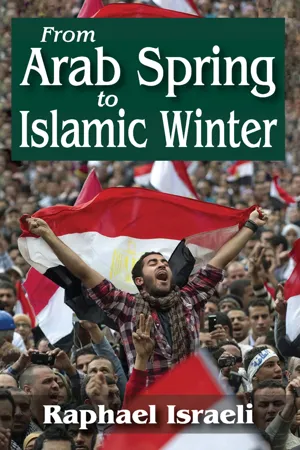
From Arab Spring to Islamic Winter
About this book
The world is watching with uncertainity as the "Arab Spring" unfolds. Optimistically named by international media sources, the term "Arab Spring" associates the unrest with ideas of renewal, revival, and democratic thought and deed. Many hoped the overthrow of authoritarian leaders signaled a promising new beginning for the Arab world. Raphael Israeli argues that instead of paving a path toward liberal democracy, the Arab Spring in fact launched a power struggle. Judging from the experiences of countries where the dust is settling-including Tunisia, Egypt, Yemen, and perhaps also Syria and Libya-it appears that Islamic governments will fill the vacuum in leadership. The hopes that swept the Islamic world with the Arab Spring have given way to a winter of lost hopes and aspirations, as it becomes increasingly clear that democratic outcomes are not on the horizon. What is worse is that the West seems to have abandoned its hopes for democracy and freedom in the region, instead making peace with the idea that Islamic governments must be accepted as the lesser of evil options. Presenting a clear-eyed picture of the situation, Israeli examines thematic problems that cut across all the Muslim states experiencing unrest. He groups the countries into various blocs according to their shared characteristics, then discusses these groups one by one. For each country, he considers whether the liberal-democratic option is viable and examines what kind of regime could be considered legitimate and stable. This volume offers valuable insights for political scientists, Middle Eastern specialists, and the general informed public eager to comprehend the import of these momentous events.
1
The Structure of Arab Society: Tribes and Artificial States
Modern nationalism, which sorts out peoples and nations according to their national belonging and which often cuts through ethnic, religious, linguistic and interest groups, for two centuries has been an invention of the West, which exported it to its previous colonial possessions across the world for emulation as the ideal model for political and administrative organization of people who wished to live autonomously of others under their own sovereignty. These processes have had their impact on the emerging modern Muslim countries as well, when they rid themselves of foreign occupation as colonial possessions of other powers. Today they number some fifty-seven Muslim-majority countries, which are all members of the Conference of Islamic nations across Africa and Asia. But it is far from a forgone conclusion that the new nation-states have been able to cultivate well-rooted, homogeneous, and harmonious Islamic societies. Rather, as evidence in some of these countries suggests, their ancient tribal makeup, their subordination willy-nilly to different Muslim or multicultural empires (the Umayyads, the Abbasids, the Fatimids, the Mameluks, the Mongols, the Ottomans, and the Persians in the Middle East; the Almoravids and the Almohads in North Africa; or the Moghuls in India) left an indelible mark on their history and identity.
Judging by the incredibly easy and rapid collapse of long-standing countries like Libya and Yemen, with Syria to follow, one suspects that this artificial entity of nation-state either did not go deep enough yet into the fiber and consciousness of Arab citizens, or that the ancient tribal identity simply refuses to die out. The idea of nation-state that was born in the West presupposed a collective of individuals who share the same history, territory, culture, and language and are willing to surrender voluntarily some of their individual freedoms and pay taxes to the state, which in return keeps peace and order and governs the country according to the will of the people, who periodically choose the government of their taste. Governments come and go, but the structures and institutions of the state still provide continuity, and every individual regards himself as directly linked to the state and its machinery. But when the will of the people does not count, as under autocracies, and the rulers impose their will without being legitimately delegated by the people to do so—and especially when the artificial state is composed of a medley of various ethnic groups that share little else except territory—then the entire survival of the state is ensured only as long as the tyrant ruler holds the reins. As soon as he dies or is reversed, the pecking order will change, the estrangement between ruler and ruled will grow, and people will naturally revert to their basic tribal fealty, having never felt any belonging and close identity with the state. This seems to have been the case with the countries most typically comprised in the category of the tribal model (Syria, Libya, Yemen), though almost no Arab/Islamic country is totally immune to various degrees of tribalism (Iraq, Morocco, Algeria, Pakistan, Afghanistan, Somalia, and more).
Then add to that the tremendous mosaic of religions—beginning with the major divisions between Sunnites and Shi’ites, and then the sects and subsects that derived from the Shi’a but then went so far afield that they were excluded from Islam (like the Druze, the Alawis, the Bahai), or the members of the many Christian denominations (Copts, Armenians, Greek Orthodox, Maronites, Assyrians, and others)—that are out of place in the Islamic world that had conquered them and evicted them from their lands or assimilated them into the dominant culture. And also add the many ethnic/national groups that inhabit the vast Islamic world (Kurds, Alevis, Turkemans, Assyrians, who despite their Islamization have kept their separate cultures, languages, and customs, and continue to aspire to autonomy). All together, you have a foolproof and fatal recipe that contradicts the requirements of a modern nation-state and makes for perennial political, social, and religious conflicts, jealousies, competitions, and tensions in the lands of Islam, as we have been watching during this Spring.
Thus, to detect the sources of the divisions, differences, and inability in the lands of Islam to bridge these gaps and create harmonious societies where all groups consent to one social contract common to the entire population and share one state of law, under one steady constitution not given to the whims of any dictator, and the judiciary is independent and inspires awe—we have to clarify the fundaments of government common to all Muslim countries that have been surfacing with various degrees of intensity and making any permanent settlement difficult or impossible. Autocracy, the only method that worked so far to keep those countries together, no longer works, and a Western-style democratic and voluntary system seems unattainable in the short run. These fundamentals are historical, traditional, political, psychological, and religious. They were molded for centuries and came to be sanctified; therefore they cannot be changed overnight and have to be recognized and gradually adapted into the modern world. These fundamentals are: the tribal organization of old; the utopia that looks backward; the Islamic political ideology; the all-encompassing nature of civilizational Islam, which has set standards and established yardsticks to gauge everything from political regime to artistic taste and from social activity to individual conduct both at home and outdoors; and, finally, the authoritarian rule that did not permit the development of participatory democracy in the Western style. Some of these aspects will be tackled here.
Tribal Organization in the Prophet’s Era
Life in the desert was nearly unbearable in the pre-Islamic era (jahiliya); therefore no individual could survive unless he leaned on his family, clan, and tribe, and sometimes on the even wider base of an alliance of tribes. Tribal federations were necessary in order to strengthen one’s party in the constant wars for meager pastures in the vast and hostile deserts, or as a measure of defense against threats from the outside. Dependence on the tribal structure was so absolute that a tribal culture was developed with its own laws, traditions, and value systems, which were personified by the head of the tribe (the sayyed, the very word for sir or master in modern Arabic) or the sheikh (old man, old age being coterminous with wisdom), who was always expected to be wise in leadership, courageous in battle, judicious in mediating quarrels, and generous as a host at home, all qualities of machismo (muruwwa) worthy of emulation. All these qualities were manifested by the chieftain, making him a nearly perfect gentleman, (or a Junzi in the classical Confucian tradition). These lofty qualities made the reputation of the leader within his tribe and of his tribe outside of it. The greater and wider the renown of the tribe, the more outsiders would flock to the tribe to seek its protection (jiwar), something that would further increase its fame. This ideal, which preceded the time of the Prophet, was incorporated into the Islamic tradition and came to be typically expressed in the persona of the Prophet, the most perfect of men ever living on earth, and this won him his election by Allah as his messenger and as the Seal of Prophets.
In modern times, this ideal model was picked up by many Arab and Islamic leaders, from Sadat of Egypt to Arafat of the Palestinians, for if they were recognized as enjoying one speck of those qualities, they would also be acknowledged as sharing Muhammed’s unequalled wisdom and divinely guided leadership. Latter times’ federations of Arabs (like the Arab League) and of Muslims (like the Organization of Muslim Cooperation)—and the Arab and Muslim forums in the UN, the African Unity Organization, and the Group of 77—are but an echo of the tribal federations from the times of Prophet, which Arabs and Muslims regard as part of their heritage, with a view of aggrandizing their collective impact in the world and their bargaining power in any world forum. But as in old times, these forums are flimsy and fragile and can be dissolved or rendered impotent (like the Islamic Congress and the Islamic League in the 1930s and 1940s) due to personal or tribal battles and jealousies, with others replacing them, to fit in with the pace of the shifting sands of the desert.
In that illiterate society, where the holy scripture of the Qur’an was transmitted from God to an illiterate messenger, the Prophet’s lack of literacy and education did not hurt his reputation but on the contrary enhanced it, for it showed that his genius was so overwhelming that it overcame his technical deficiency in writing and reading. This turns the transmission of Allah’s word to him, via the angel Gabriel, into a miraculous event unparalleled in history and never destined to recur. The Prophet’s illiteracy could not have encouraged learning, intellectual curiosity, and scholarship among his followers, who grew to believe that everything there was to know was told by the Prophet and about him in the holy book and in the vast literature about him and his life. Hence, whenever there is talk of reform, change, advancement of knowledge and science, intellectual and spiritual development, reference is invariably made to the revival and application of that corpus of traditional knowledge that Muhammed brought to its peak and that constitutes the core of the Islamic shari’a. World Islamic movements, from the Muslim Brotherhood to the international Hizb-ul-Tahrir, from Hamas to the Pakistani Lashkar-e-Taiba, profess the same slogans/mantras, which advocate that “Islam is the solution,” or proclaim, “Muhammed is our leader, the Qur’an our constitution, jihad in the Path of Allah our way, and death as shahids (martyrs) our most sublime goal.”
In general, Islamic societies, which have remained at the bottom of the international scale of human development according to UN surveys, owe that status in no small measure to their fixed ideology, having turned the Prophet and his life in distant Arabia a millennium and half ago into the ideal that cannot be improved upon, thus erecting obstacles on the way to modern and progressive state and society building. In consequence, the emerging alternatives to the crumbling tyrants of the Spring do not seem to hold much promise of extricating those societies from their accumulated multigenerational backwardness. This is only one aspect of the perennial contradiction between the principles of democracy and progress and the revival of political Islam, should free elections produce Islamic parties that would further dig in the past and strive to emulate it. Certainly, Islamic societies also include bourgeois sections that have lived in or visited other countries and have grown modern and Westernized enough to recoil from the prospect of seeing their countries thoroughly Islamized and thrown backward (e.g., Egypt, Turkey, Tunisia, and Iran). It is precisely in those countries that a mammoth struggle has been unleashed between these forces of change and the new Islamic forces that threaten takeover, over the back of the masses, via democratic means of participatory elections—which if successful can also be the last.
The chieftain of the tribe was not alone in the leadership spot. At his side there was a poet (sha’ir), who acted as a kind of public relations man and spokesman for the tribe. His role was to preserve the oral records of his tribe, which essentially played and replayed its days of glory. Paradoxically, the jahiliya (Era of Ignorance) collections of poetry, known as Ayyam al-Arab (The Chronicles of the Arabs) have been recognized as one of the pinnacles of poetry and literary creation. For want of better, they have also become one of the important sources for the history of that period before the emergence of the Prophet. Again paradoxically, despite its sublime beauty and the richness of its expression, this literature was also stigmatized for smacking of the Jahili atmosphere and culture in which it evolved, when humanity was sunken in sin, loss, and disorientation until the messenger of Allah came to bring it salvation. In our context, critiques of contemporary Muslim societies, precisely some of those who kindled the Spring and led it, have accused their countries of having relinquished Muslim values to the point of reverting—Allah Forbid!—to a jahiliyya-like condition. Therefore, the remedy today, as of old, has been to readopt the thinking of the Prophet and to migrate, as he did from Mecca to Medina in AD 622, traveling spiritually if not physically to a purer Islamic society where the revival of Islam might become possible. This is the sense that Islamic Spring leaders wish to give to their popular movements, implying that like the Prophet, after they have revitalized the Shari’a state, the entire world would open up to a world Islamic revolution. Many of those Muslim fundamentalists had tried for years to precipitate this process through violence, but as they were crushed by their tyrannical rulers who were supported by the West, they metamorphosed into peace- and legitimacy-seeking parties, as during the Spring in some countries, and gained as a result the support of world public opinion.
The poet was also the living oral archives of his tribe, for lack of written record. He stored in his mind his tribe’s literature, stories, legends, and tales of heroism, in order to raise the morale of his kin, together with tales of other tribes’ history that denigrated them as cowards who yielded to his own people’s courage. He also was the author of the never-drying fountainhead of new epic tales and poems unfolding as the history of the tribe evolved, whether or not those events occurred or were inventions. In our days, Arab poetry readings still attract masses, and national poets enjoy a great reputation (Darwish and Ziyad, for example, were worshipped by Palestinian nationalists). And often the leaders of Islamic countries use poetry to mobilize the masses. Some of them, like Nasser and Sadat of Egypt, delivered speeches for hours in public squares, acting not only as the chieftains of their countries but also as poets of their tribes, who accuse their enemies of cowardice and heap praise on their own noble people and heroic armed forces. Only in more recent times, due to the increasing requirements of security and the threat of terrorism, did tyrants retreat to their palaces (or tents in the case of Qaddafi) and content themselves with spreading their messages through the state media.
The difference is that in old days the chieftains and poets grew organically out of the tribal milieu, due to their natural gifts, because in that situation it was nearly impossible for anyone to impose himself upon his kin. From many respects, this was a kind of meritocratic order, but instead of the public servants being tested and approved by the authorities (as in ancient China and modern England), the order evolved and was accepted by the elders’ consensual silent agreement. Over time, however, as the Umayyads (AD 661–750) and the Abbasids (AD 750-1253) took over and imposed a dynastic order, Islam absorbed the idea of blood inheritance, which received a further boost from the emerging Shi’ites, who based their religion on the concept of the Twelve Imams. In dynastic succession beginning with Ali, these imams had imputed to themselves the sole right of inheritance of the rule of Islam. The idea of inheriting power rather than competing for it peacefully has taken such deep roots in Islam that even in republican regimes today, the tyrants who saw their masses rising against them during this Spring had destined their sons to inherit their rule after many years of autocratic power: Mubarak of Egypt, Saleh of Yemen, Qaddafi of Libya, Saddam of Iraq. Even in Syria, where the transition of power between Hafez Assad and his son was complete ten years prior to the Spring, it was that continuity that enraged the rebels, among their other grievances.
The chieftain of the tribe and its poet were bound to the concept of honor (sharaf). The violation of honor could not be ignored, for otherwise an undefended honor could appear as unworthy of defense and fatally harm the reputation of its owners. Honor was also related to the possession of assets and women, and a violation of either could trigger a chain of hostile acts between the contending parties, because leaving a violated honor unpunished would leave the matter hanging, yearning for a settlement, tied to compensation, or taking the life of a killer (lex talionis). This is quite different from the modern idea of retaliation for wrongdoing, or inflicting punishment for it, that derives from the Roman legal tradition. For in ancient Arabia, and in the Islamic world today, the very act of vengeance—for example in case of the violation of a woman’s honor or of the killing of someone of another clan—is supposed, eo ipso, to calm down the boiling blood of the victim or of the owner of the defiled honor. (Honor killings among Muslim communities are well known not only in the Islamic world, but also in the West.) The idea of retaliation in the modern world, by contrast (e.g., bomb Berlin and Dresden as retaliation for London and Coventry, or Tokyo and Hiroshima as punishment for Nanjing and Manila), is to chastise for what is known as a war crime and to deter recurrence. This retaliation is not motivated primarily by a primal desire to take revenge, but by a calculated consideration to make the enemy pay such a high price for his deed that he is deterred from repeating it. On the personal level, or in cases of inter-family, inter-clan, or inter-tribal rifts, honor killings for a woman’s immoral conduct can be accepted and understood in Islamic societies, and these killings occur all too often. But European societies and Israel, where large Muslim populations live, cannot take these murders indifferently, for they are bound in their Roman and Jewish traditions by their civil codes of law to punish any murder. However, when they punish murders as criminal acts of manslaughter, clashes unavoidably occur between the authorities and Muslim minorities, who, based on their own history and tradition, consider themselves entitled to follow their customs. These minorities consider the insistence of the law enforcement agencies on imposing the criminal code to be Islamophobia.
The idea of justice (‘adala) in Arab and Islamic societies is also derived from the ancient Bedouin culture of Arabia. Then, it meant the balance between the two sides of the saddlebag on the camel’s back. Just as the camel—so essential for the survival of the Bedouin in the desert—should have its saddlebags balanced on its back lest it limp and be unable to stride through the sand, so no Arab can function in daily life if the wrong done to him in his eyes is not redressed. In such societies, justice has never had, and does not have today, objective yardsticks to gauge the damage caused by the enemy or the compensation required to achieve redress. It used, and still uses, only a subjective criterion for measure, and that is the self-satisfaction of the wronged party. Only if he feels that the proper compensation was paid, or a ritual of conciliation (sulha) is held, and his honor is upheld and not humiliated, would he agree to accept the redress. The result is the concept of a “just peace” that is largely unparalleled in other cultures, as if justice had absolute parameters, when in reality what is just for one can seem unjust to another. For example, today, Arabs and Muslims demand a just solution for the Palestinians, which means, in their terms, the elimination of Israel and its replacement by them. And since no country would agree to commit suicide, and a compromise on that cannot be achieved, no peace can be expected.
When President Sadat spoke at the Israeli Knesset in November 1977, he insisted on a “just peace,” which should return “every grain of sand of Sinai” to Egyptian possession. It was not because sands are important in themselves, but because what he considered to be his should be returned without argument or bargaining, regardless of who started the war where that territory was lost, regardless of who lost the war, and regardless of who should make redress for the damages of the war. Indeed, Sadat would not even have come to Jerusalem had the return of the Sinai Peninsula not been pledged to him a priori. On another occasion, Sadat said that in the Egyptian countryside where he came from, clans used to fight for generations over a useless patch of rocky land, solely because without the justice of returning that land to its owner, peace could not return to the village. On the international level, any Arab leader Israel who engages in early negotiations demands as a first step the return of the entire claimed land (for Syria the Golan, for the Palestinians the West Bank and Jerusalem), short of which no process can even begin. Arabs often demand that justice should be done for their prisoners in Israel by releasing them, regardless of their criminal convictions. They also demand that any incarcerated Palestinian should be set free on Ramadan, because those are days of haram (forbidden warfare), regardless of the fact that they launched the October 1973 war on Ramadan, and not to speak of Temple Mount in Jerusalem (haram al-Sharif), where they allow no Jew to set his foot, because it is now a...
Table of contents
- Cover
- Half Title
- Title Page
- Copyright Page
- Dedication
- Table of Contents
- Acknowledgements
- Introduction: The Transition from an Arab Spring to an Islamic Winter
- 1 The Structure of Arab Society: Tribes and Artificial States
- 2 The Ottoman Heritage
- 3 Authoritarian Rule in the Islamic World
- 4 The Caliphate and the Ideal of the Islamic State
- 5 The Globalization of Information and the World Media
- 6 Turkey, Egypt, Tunisia, Pakistan, and the Republican Model
- 7 Saudi Arabia, the Gulf States, Morocco, Jordan, and the Monarchical Model
- 8 Syria, Libya, Yemen, Afghanistan, Bosnia, Kosovo, and the Tribal Model
- 9 Iran, Iraq, Lebanon, and the Shi’ite Model
- 10 Algeria, Mali, Sudan, Somalia, the Palestinians, and the Revolutionary Model
- Summary: The Islamic Spring and Israel, and What Lies Ahead
- Bibliography
- Index
Trusted by 375,005 students
Access to over 1.5 million titles for a fair monthly price.
Study more efficiently using our study tools.
Frequently asked questions
Yes, you can cancel anytime from the Subscription tab in your account settings on the Perlego website. Your subscription will stay active until the end of your current billing period. Learn how to cancel your subscription
No, books cannot be downloaded as external files, such as PDFs, for use outside of Perlego. However, you can download books within the Perlego app for offline reading on mobile or tablet. Learn how to download books offline
Perlego offers two plans: Essential and Complete
- Essential is ideal for learners and professionals who enjoy exploring a wide range of subjects. Access the Essential Library with 800,000+ trusted titles and best-sellers across business, personal growth, and the humanities. Includes unlimited reading time and Standard Read Aloud voice.
- Complete: Perfect for advanced learners and researchers needing full, unrestricted access. Unlock 1.5M+ books across hundreds of subjects, including academic and specialized titles. The Complete Plan also includes advanced features like Premium Read Aloud and Research Assistant.
We are an online textbook subscription service, where you can get access to an entire online library for less than the price of a single book per month. With over 1.5 million books across 990+ topics, we’ve got you covered! Learn about our mission
Look out for the read-aloud symbol on your next book to see if you can listen to it. The read-aloud tool reads text aloud for you, highlighting the text as it is being read. You can pause it, speed it up and slow it down. Learn more about Read Aloud
Yes! You can use the Perlego app on both iOS and Android devices to read anytime, anywhere — even offline. Perfect for commutes or when you’re on the go.
Please note we cannot support devices running on iOS 13 and Android 7 or earlier. Learn more about using the app
Please note we cannot support devices running on iOS 13 and Android 7 or earlier. Learn more about using the app
Yes, you can access From Arab Spring to Islamic Winter by Raphael Israeli in PDF and/or ePUB format, as well as other popular books in History & World History. We have over 1.5 million books available in our catalogue for you to explore.