- 189 pages
- English
- ePUB (mobile friendly)
- Available on iOS & Android
eBook - ePub
About this book
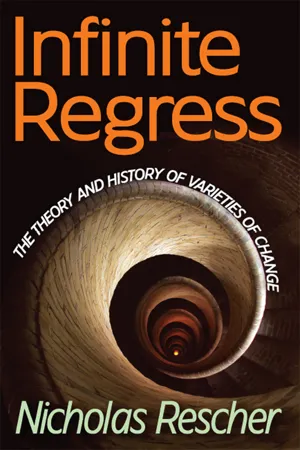
Regression addresses what has come before; it is a matter of looking backward of retrospections? The motionless things of nature are generally forward-looking their problem is that of the question: Where do we go from here? It is primarily with intelligent beings that we ask: How did we get to where we now find ourselves? Regression and infinite regression in particular is thus a concept that has gained a greater prominence in the human sciences than in the sciences of nature. Argumentation to infinite regress has long been a favored instrument of philosophical dialectic. Philosophers have used it to disprove the positions they model to criticize. Infinite regresses, so they reason, are unrealizable: they cannot be completed so as to achieve some definitive result. And thereby anything that would engender an infinite regress is automatically made ineffective. Infinite Regress examines the theory of regression and includes information on the topics of vicious regress, innocuous regress, circularity regress, and propositional regress. Also discussed is the history of regression stemming from ancient times, to medieval times, to early modern history. Some of the other chapters in this book focus on world class philosophers including Immanuel Kant, Georg Wilhelm Friedrich Hegel, and Bertrand Russell. The book will play a significant role in theoretical philosophy as well as in social philosophy and the philosophy of mind.
Information
Table of contents
- Cover
- Half Title
- Title Page
- Copyright Page
- Dedication
- Table of Contents
- Preface
- Introduction: The Conception of Infinite Regress
- Part 1: Systematic Considerations
- Part 2: Historical Considerations
- Bibliography
- Index
Trusted by 375,005 students
Access to over 1.5 million titles for a fair monthly price.
Study more efficiently using our study tools.
Frequently asked questions
Yes, you can cancel anytime from the Subscription tab in your account settings on the Perlego website. Your subscription will stay active until the end of your current billing period. Learn how to cancel your subscription
No, books cannot be downloaded as external files, such as PDFs, for use outside of Perlego. However, you can download books within the Perlego app for offline reading on mobile or tablet. Learn how to download books offline
We are an online textbook subscription service, where you can get access to an entire online library for less than the price of a single book per month. With over 1.5 million books across 990+ topics, we’ve got you covered! Learn about our mission
Look out for the read-aloud symbol on your next book to see if you can listen to it. The read-aloud tool reads text aloud for you, highlighting the text as it is being read. You can pause it, speed it up and slow it down. Learn more about Read Aloud
Yes! You can use the Perlego app on both iOS and Android devices to read anytime, anywhere — even offline. Perfect for commutes or when you’re on the go.
Please note we cannot support devices running on iOS 13 and Android 7 or earlier. Learn more about using the app
Please note we cannot support devices running on iOS 13 and Android 7 or earlier. Learn more about using the app
Yes, you can access Infinite Regress by Nicholas Rescher in PDF and/or ePUB format, as well as other popular books in Philosophy & Philosophy History & Theory. We have over 1.5 million books available in our catalogue for you to explore.