- 345 pages
- English
- ePUB (mobile friendly)
- Available on iOS & Android
eBook - ePub
About this book
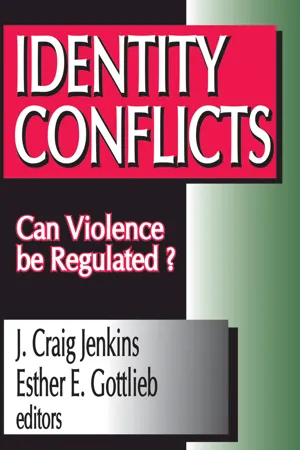
Social conflicts are ubiquitous and inherent in organized social life. This volume examines the origins and regulation of violent identity conflicts. It focuses on the regulation of conflict: the constraining, directing, and repression of violence through institutional rules and understandings. The core question the authors address is how violence is regulated and the social and political consequences of such regulation. The contributors provide a multidisciplinary multi-regional analysis of identity conflicts and their regulation. The chapters focus on the forging and suppression of religious and ethnic identities, problematic national identities, the recreation of identity in post-conflict peace-building efforts, and the forging of collective identities in the process of democratic state building. The instances of violent conflict treated here range across the globe from Central and South America, to Asia, to the Balkans, and to the Islamic world. One of the key findings is that conflicts involving religious, ethnic, or national identity are inherently more violence prone and require distinctive methods of regulation. Identity is a question both of power and of integrity. This means that both material and symbolic needs must be addressed in order to constrain or regulate these conflicts. Accordingly, some chapters draw on a political-economy approach that places primary emphasis on resources, organization, and interests, while others develop a cultural approach focusing on how identities are constructed, grievances defined, blame attributed, and redress articulated. This volume offers new ideas about the regulation of identity conflicts, at both the global and local level, that engage both tradition and modernization. It will be of interest to policymakers, political scientists, human rights activists, historians, and anthropologists.
Information
1
Identity Conflicts and Their Regulation: An Introduction
J. Craig Jenkins and Esther E. Gottlieb
…every decrease in power is an open invitation to violence--if only because those who hold power and feel it slipping from their hands, be they the government or be they the governed, have always found it difficult to resist the temptation to substi- tute violence for it.—Hannah Arendt
(1969: 87)
Every day the news is filled with reports of suicide bombings, ethnic cleansing, collective rapes, calls for ethnic reconciliation and atonement, and violent power struggles. The location changes but the basic story does not. Ethnic and religious groups use violence to intimidate and destroy other groups, seeking control over resources, a sense of security, and to restore lost honor. What drives these conflicts and can they be regulated? Most identity conflicts occur within a single state, but reflecting the globalization of the economy and increasing international migration and interdependence these conflicts increasingly operate across international borders. Is globalization contributing to this growing pandemonium?
This volume focuses on two questions. First, what are the sources of identity conflicts? By identity conflict, we mean any rivalry between two or more groups that define themselves in mutually exclusive terms that use a collective “we/they” definition. This leads us to address theories of ethnic identity and mobilization asking when and why these groups resort to violence. Are these conflicts due to ancient hatreds, the opportunistic actions of political entrepreneurs, ideologies that justify dehumanization of the other, or situations that facilitate ethnic mobilization? Below, we will argue for a synthesis of the last three explanations along with the idea that identity conflicts tend to be zero-sum, creating greater intensity and likelihood of violence, and the idea of violence cycles, that is, that violence creates strong identities that lead to retributive violence.
Second, we address the regulation of identity conflicts. By regulation, we mean the constraining, directing, and channeling of conflict through institutional rules, cultural understandings and collective definitions. Regulation is often treated as simply a question of rules, such as new constitutions or rule-enforcing institutions, such as courts and police. While rules and enforcement institutions are critical, it is also important to include the ideational side of conflict regulation. Collective symbols, integrative humanizing ideologies, and diffuse social networks may also regulate conflict by creating alternative sources of integration and overarching common belief. In the following chapters, we show that post-conflict reconstruction and peace-building require new collective symbols as well as new constitutions and governance institutions.
At the outset, we should state our argument that identity conflict is not inevitably negative. Identity conflict can be a source of positive social and political innovation. Promoting a broader inclusive definition of citizenship, minority rights advocates and democracy reformers can create pressures for social reform to create a more just and equitable society. Resulting conflicts can pave the way for a more open, inclusive society. But identity conflicts can also be destructive, destroying the bases of social trust that help promote markets and economic transactions and provide a sense of security. A striking example comes from the research on civil wars, which have been found to reduce economic wealth in countries by a quarter or more of the prewar standard, undermine social trust, and impose major social costs on the population in terms of higher mortality, widespread psychological trauma, and greater exposure to disease (Collier et al. 2003: 11-32). None of the groups, victors or losers, is exempted from war loss. More limited identity violence, such as suicide bombings and assassinations, likewise stoke ethnic hatreds, provoke retaliatory attacks, and create security fears that undermine the normal working of society.
The chapters in this book illustrate many such situations in which two or more groups perceive themselves as having incompatible objectives that involve questions of honor, cultural integrity, territorial control and/or core values. Sometimes called “cultural clashes” or “identity wars,” these conflicts typically center on the recognition and cultural integrity of ethnic groups. In this introduction, we provide a framework for understanding the origins of identity conflicts and their possible regulation. In addressing the first, we argue that a theory of identity conflict needs to integrate insights from multiple academic disciplines, work at different levels of analysis, and address the complex processes that contribute to identity conflict. With regard to conflict regulation, we draw heavily on discussions of post-conflict reconstruction and conflict transformation, especially the literature on political reconstruction and peace-building (Barton 1990; Galtung, Jacobsen and Brand-Jacobson 2002; Galtung 2004). We underscore the social and cultural side of these processes, arguing that, in addition to institution-building and the creation of rules to adjudicate between conflicting identities, such peace-building efforts need to create a sustained social dialogue that creates new collective symbols, ideologies, and interpersonal social networks. Democratization, targeted nationality policies, and self-governance schemes that protect ethnic minorities also need to be complemented by new collective symbols, inclusive humanizing ideologies, and inter-group trust. Durable political reconstruction and peace-building require social and cultural reconstruction. We begin first with the nature of identity conflict and its origins.
Identity Conflict and Polarization
Social conflict can be both socially beneficial and harmful. Lewis Coser (1956) argued that conflict can be a source of social and political innovation, giving individuals and groups an opportunity to articulate new ideas, experiment with new practices, and challenge prevailing social myths and institutions. This is most evident in social movements that attempt to open up opportunities for disadvantaged groups by overturning discriminatory laws and practices and, in the process, make society more flexible and adaptive. Drawing on Georg Simmel’s (1955) ideas about conflict, Coser (1956) had in mind moderate reform movements in modern diversified societies in which contests over identity could be channeled into “realistic conflicts” over divisible material benefits, such as better streets and minority access to jobs. Such “realistic conflicts” mean that contenders are more likely to find compromises and positive-sum or “win-win” solutions. Coser (1956) contrasted these to “non-realistic conflicts” in which the key contention was over indivisible symbolic goods, such as social honor, territorial control, and sacred values. Such zero-sum identity conflicts are more intense and likely to create violence. Only one country can claim territorial control over Jerusalem’s Temple Mount. Coser traced such identity conflicts to traditional societies with a more simple division of labor, reliance on retributive justice, and fewer cross-group social ties.
This structural explanation of identity conflict needs to be supplemented by a discussion of conflict process. Identity conflict is not simply a product of social structure but also of conflict dynamics. A fundamental rule of social interaction is reciprocity, that is, that one should respond with similar or like action. Peaceful and positive actions should be reciprocated with similar actions. Likewise, threats and violence should receive a similar negative response. Violence also creates in-group solidarity as people come to see group identity as more central and group survival at risk. This is especially the case where claims to legitimize violence rely on dehumanizing definitions. Victims are defined a subhuman, as animals or vermin that deserve their fate. Such violence deserves retaliation, which of course sets off further retaliation, creating a cycle of violence that is broken only when one party is no longer capable of resistance. Conflict leads to identity polarization, that is, the reduction of social interactions and group identities so that eventually there are only two groups both of which are characterized by strong positive in-group interaction but negative between-group interaction. Violence means that everyone has to pick sides, supporting one or the other party. So the question becomes: What can be done to prevent or regulate violence cycles and identity polarization?
One answer is provided by the conflict resolution movement (Kriesberg 1997, 1998; Galtung, Jacobsen and Brand-Jacobsen 2002; Galtung 2004; Rothman 1997; Ross and Rothman 2000). The basic “conflict resolution” idea is that broad participatory negotiations and third-party mediation can mutually educate contenders, make them aware of the interests and identity claims of opponents, create a better understanding of the benefits of future positive interactions with opponents, and generate a greater willingness to redefine identities so that the situation becomes a positive sum or “win-win” one. According to this approach, the basic tactics of mediation and negotiation are applicable to individual, group, societal and international conflicts and, with skillful third-party mediation and the creation of a sustained dialogue, identity conflicts, can be transformed, that is, redefined in positive “win-win” terms. Conflict transformation means that all parties come to recognize the limits of their claims and the benefits they receive from maintaining positive relations with other contenders, and to realize the merits of new social practices that protect the basic needs of all parties (Barton 1990; Kriesberg, Northrup and Thorson 1989; Rupesinghe 1995; Lederach 1995). To use Coser’s (1956) language, a conflict can be transformed from a “non-realistic” into a positive-sum “realistic” conflict. A core feature of such conflict transformation is redefining social identities so that identities are no longer seen in mutually exclusive terms but as inclusionary. “They” in effect become part and parcel of the “we.” This, of course, requires identity change and the creation or at least partially overlap with new integrative symbols and understandings that sustain these new identities.
This conflict transformation idea requires going beyond the standard rule-based formulas for conflict regulation. Over the past few decades, a standard package of post-conflict reconstruction or “conflict resolution” methods have been developed that focus on creating new rules for regulating inter-group relations (Gurr 1993, 2000; Lederach 1995; Collier et al. 2003). A key is democratization with new constitutions and law enforcement institutions that provide legal and institutional protections for minority and other group civil liberties and political rights. To accommodate ethnic diversity, peace-builders often recommend the creation of self-governance institutions, such as specialized regional or group-based courts to deal with family law and separate educational institutions to protect cultural heritages (Horowitz 1991; Van Cott, chap. 16 below). Compulsory multilingualism in the courts, legislatures, and schools also contributes to protecting diverse cultural heritages. If there are a small number of large ethnic groups, it may be preferable to use proportional representation to insure that all groups have access to centers of power. In contrast, where there are a large number of small groups, majoritarian “winner-take-all” elections may work better by forcing groups to band together to form broad coalitional majorities. Where there is a history of ethnic exclusion and persecution, peace-builders frequently recommend protective quotas to insure that disadvantaged groups are included. These need not protect numerical minorities. In Malaysia, for example, quotas are used to protect the majority Malay population, which historically was excluded from higher education and government positions. In India, quotas are used to protect minority listed castes, insuring them positions in higher education and government posts.
The idea of conflict transformation also highlights the importance of intergroup trust. Studies of civil war settlements show that the primary obstacle to peace is the lack of trust between contenders (Walter 1997, 2002). Unless there is a neutral third party or other enforcement mechanism that can insure that the terms of the peace settlement are honored, why should rebels or governments lay down their arms? Further, the greater the number of claimants and the closer the military balance of power between the major contenders, the less likely a peace settlement (Zartman 1995). The most favorable setting is a civil war in which territorial control is not at issue and either the government or the rebels has a clear military advantage. A third-party intermediary, such as the Catholic Church or a foreign government that is certain to remain engaged, can provide guarantees for a durable settlement.
Conflict transformation also entails creating new symbols so as to re-fashion self and social identities to bring contenders together (Gottlieb 2001). This can be seen from failures to transform conflict in Lebanon. Sawalha shows in her chapter below that a major barrier to a durable peace is the lack of new cultural models for national identity. Despite formal democratization and many of the above-mentioned peace procedures, the government planners who oversee the urban reconstruction of post-civil war Beirut define the urban slums inhabited by thousands of Shiite refugees as lacking in “civilized qualities.” Their solution was to remove the settlers, attempting to recreate a pre-war Beirut. Would the recent 2006 war with Israel be followed by a more inclusionary social/national Lebanese identity that includes all the major groups? Democratization and minority guarantees can help by facilitating sustained dialogue. But often there is no guarantee that this dialogue will go beyond elites, to fashion new self and social/national identities. In the Oslo accord negotiations between Israel and the PLO during the early 1990s, the dialogue remained limited to a small number of elites who did little to engage the broader population in an on-going discussion about what would be needed to create a lasting settlement and social/national embracement of peace. On both sides, unrealistic perceptions about exclusionary demands persisted. Hamas and other Palestinian factions continued to claim that their primary objective is to abolish Israel and recreate a unified Palestine. Israeli groups continued to talk about the need for more security settlements, creating a “greater” Israel. So long as such exclusionary identities persist, there is little likelihood of a durable solution. Had there been a broader participatory dialogue that engaged the majority of the population, the odds are greater that the major contenders would have redefined their identities in inclusionary terms (Galtung et al. 2002). Similarly, the Dayton accords over the breakup of Yugoslavia failed to include the broader population, leaving elites able to re-ignite the war when it became advantageous. So long as the dialogue remained limited to elites, elites could go back on their promises and restart the war, hoping to gain new territories and “cleanse” those from undesirable groups.
Various measures of reconciliation and atonement have been tried in post-conflict settings. Which is better, court-like legal proceedings that bring war criminals to justice or open-ended “truth forums” where victims can articulate their grievances and guilty parties acknowledge their guilt without threats of punishment? James Gibson’s (2004) work on the Truth Commission in South Africa suggests that open-ended forums are far more effective, promoting broader public education and identity exchange, breaking down stereotypes and making clear that all parties were victims. The problem with legal tribunals and similar justice efforts is that they are primarily concerned with retribution and hence tend to reinforce polarized identities. While the circumstances that surround the Truth Commission in South Africa are unique and highly unlikely to be replicated (all groups shared a strong commitment to the rule of law; all groups shared some guilt in terms of human right abuses...
Table of contents
- Cover
- Half Title
- Title
- Copyright
- Dedication
- Contents
- Acknowledgement
- Preface
- 1. Identity Conflicts and Their Regulation: An Introduction
- 2. Uncertain Connections: Globalization, Localization Identities, and Violence
- Part IV. Reconstructing Identities/Peace-Building
- Contributors
- Index
Trusted by 375,005 students
Access to over 1.5 million titles for a fair monthly price.
Study more efficiently using our study tools.
Frequently asked questions
Yes, you can cancel anytime from the Subscription tab in your account settings on the Perlego website. Your subscription will stay active until the end of your current billing period. Learn how to cancel your subscription
No, books cannot be downloaded as external files, such as PDFs, for use outside of Perlego. However, you can download books within the Perlego app for offline reading on mobile or tablet. Learn how to download books offline
Perlego offers two plans: Essential and Complete
- Essential is ideal for learners and professionals who enjoy exploring a wide range of subjects. Access the Essential Library with 800,000+ trusted titles and best-sellers across business, personal growth, and the humanities. Includes unlimited reading time and Standard Read Aloud voice.
- Complete: Perfect for advanced learners and researchers needing full, unrestricted access. Unlock 1.5M+ books across hundreds of subjects, including academic and specialized titles. The Complete Plan also includes advanced features like Premium Read Aloud and Research Assistant.
We are an online textbook subscription service, where you can get access to an entire online library for less than the price of a single book per month. With over 1.5 million books across 990+ topics, we’ve got you covered! Learn about our mission
Look out for the read-aloud symbol on your next book to see if you can listen to it. The read-aloud tool reads text aloud for you, highlighting the text as it is being read. You can pause it, speed it up and slow it down. Learn more about Read Aloud
Yes! You can use the Perlego app on both iOS and Android devices to read anytime, anywhere — even offline. Perfect for commutes or when you’re on the go.
Please note we cannot support devices running on iOS 13 and Android 7 or earlier. Learn more about using the app
Please note we cannot support devices running on iOS 13 and Android 7 or earlier. Learn more about using the app
Yes, you can access Identity Conflicts by Esther Gottlieb in PDF and/or ePUB format, as well as other popular books in Politics & International Relations & Political History & Theory. We have over 1.5 million books available in our catalogue for you to explore.