- 326 pages
- English
- ePUB (mobile friendly)
- Available on iOS & Android
eBook - ePub
About this book
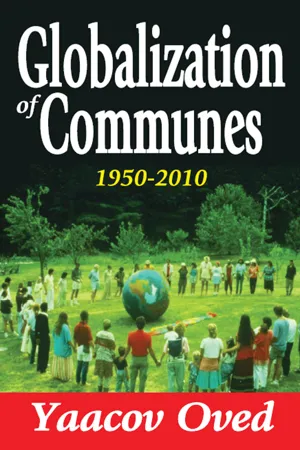
After World War II, communes and cooperative communities became internationally oriented in their membership and networking began to develop. Unlike earlier such enterprises, these groups shared an openness to international relationships. This was evident both in the groups' social composition, and in the extension of networks beyond their own country. Such globalization opened up the possibility of comparative analysis, which has become a trend in research since the 1950s. The dynamism and speed with which voluntary communities have spread throughout the world is impressive. In the 1950s there were only a few hundred such societies, but by the end of the last century there were thousands. These have taken a variety of forms. There are religious and secular communes, intentional communities, ecological communities, co-housing projects, various types of Christian communities, communities of Eastern religions, and spiritual communities inspired by New Age thought. Yaacov Oved shows that such societies maintain a community based on cooperation and expand their influence through newspapers, television, and the Internet. Their chief characteristic is their openness to the outside world, and their search for a way to move beyond a world of individualism and competitiveness. To accomplish this, they embrace all the tools of the modern world. Oved observes that those who predicted the failure of communes and intentional communities failed to appreciate the extent to which people in today's society aspire to communal life. This book answers the doubters and does so with a sense of deep historical understanding.
1
The Fifties—The First Buds
Pacifist Cooperative Communities in the United States
During World War II no new communes were established. It was an interim between two periods in the history of the twentieth century. During these years the veteran communes—the Hutterites, the Bruderhof,1 and the kibbutzim in Israel—continued to exist, but the wars in Europe and Asia precluded any attempt to seek a path to an alternative society. However, in the English-speaking democracies—the United States, Britain, Canada, and New Zealand—the first seeds were sown, among groups of pacifist conscientious objectors who were interned in the allied countries. Among these groups could be found a desire to spread a positive message during and after the war, and this expressed itself in an aspiration to lay the foundation of communities based on peace and human harmony and solidarity.
In the United States, the postwar decade became known as “the complacent decade” It was characterized by material abundance and complacency, and the dominance of a conformist ethos which did not encourage a search for social alternatives. At this time, however, a new period in the history of cooperative communities began, a period which foretold the beginning of a trend toward globalization.
This trend was expressed in the growing interest of scholars in the phenomenon of cooperative communities in the world. The Group Farming Research Institute, founded in 1948 in Poughkeepsie, New York State, was dedicated to research of cooperative communities and aid to their development. The director of the institute, the sociologist Henrik Infield, made an important contribution to the promotion of the cooperative idea during the fifties. In 1949, this institute founded the journal Cooperative Living, which made an important contribution to the dissemination of knowledge about cooperative communities throughout the world. In 1950, the GFRI published an international symposium entitled Cooperative Group Living, edited by H. Infield,2 which described cooperative communities in various parts of the world: the United States, Canada, Israel, Mexico, the USSR, England, Germany, and China. This was the first publication of a research institute that related to communes and cooperative agricultural communities as a worldwide phenomenon.
The outstanding manifestations of the creation of pacifist cooperative communities as witness to an alternative way of life took place in the United States, where conscientious objectors of various persuasions—members of religious sects, pacifists, and anarchist—were detained in internment camps. The leaders of the pacifist churches, who were active in the management of the camps, believed that they could develop a cooperative way of life among their followers, which would be a paradigm of a “good society” and would constitute a living example of a pacifist way of life. The conscientious objectors’ varied experience in cooperative activities in internment camps during the war bred the aspiration to coordinate these activities in order to create a public movement after the war. Their isolation, and the nature of the relationships created in the course of their work, prompted them to seek a constructive alternative: a cooperative community based on harmonious personal relationships. Those few who had struggled against the tide and opposed military service continued to feel the antagonistic atmosphere after the war. They were isolated, and in order to break out of this isolation they sought ways of joining up with the organizations for mutual aid, which they hoped to find in the communal and cooperative communities that began to spring up in the United States after the war. At the end of the 1940s, conscientious objectors found in the establishment of communes one of the few ways in which they could continue to put the ideals of fraternity and nonviolence into practice.3
In the early fifties, the pacifist communities created the first links with other small communities in the United States in meetings of intentional communities at Yellow Springs, Ohio. Their purpose was to create a framework for economic cooperation. As a result of these discussions the Homer Morris Fund, which gave loans and extended credit to small communities, was established, and in 1952 the Fellowship of Intentional Communities was founded. This organization held two annual gatherings, one in summer and one in winter, usually in Yellow Springs, Ohio. In these meetings, links with various members of cooperative communities in North America and other countries were created. A kibbutz member from Israel (Zvi Offer, then a member of Kibbutz Afikim) represented the kibbutz movement in one of these meetings. After Offer’s participation, one of their journals4 commented: “This meeting strengthens our self-confidence, and the feeling that in certain respects we are getting closer to the principles prevailing in the kibbutzim in Israel.”
In 1953, the conditions for the admittance of communities to the fellowship were formulated. Intentional communities were defined as groups united on the basis of a common goal in order to practice an economic, social, and spiritual way of life appropriate to the goal for which they were established. Among other things, the regulations say that the communities must include at least three families or five adults, and that they must constitute a social unit, owning in common land and adjoining buildings, which enable them to maintain community life. Emphasis was placed on the need for economic and spiritual cooperation, and on essential fundamental principles such as democracy, nonviolence, a certain degree of partnership in material and spiritual goods, absence of dogmatism, tolerance in matters of religion and belief, freedom of choice of ways of life, and an aspiration to create links with the surrounding society in order to spread the message of the community.5
In 1953, the Fellowship of Intentional Communities numbered about a dozen communities of various types. Two of them, Macedonia and Koinonia, which were founded by pacifists, had an important standing in the Fellowship, and their histories are of special interest, since, despite their common pacifist background and their communal way of life, each developed in its own way.
The Macedonia Community
The nucleus of this group was formed in an internment camp for conscientious objectors. Here, the pacifist Morris Mitchell ran a “School of Cooperative Living” in which the idea of establishing a cooperative community after the war was fostered. Under Mitchell’s influence a group was formed, which intended to settle in the district of Macedonia, Georgia, on land that he owned. This group of idealists conceived the notion of establishing a model settlement that would combine cooperative community life with space for the development of the individual. Their life in the camps strengthened their bonds as a community, and their experience as pacifists swimming against the current reinforced each one’s individualism.
This group aroused the interest of scholars of cooperatives attached to the Group Farming Research Institute, directed by Henrik Infield, the sociologist and scholar of cooperatives.6 Infield himself, who had published several books on agricultural cooperation in the world during the forties, accompanied this group from its beginnings, and saw in it a unique model of cooperative settlement in the postwar period.7 In the spring of 1946 the group settled at Macedonia. In 1946, equipment for a workshop was acquired, and the group began to manufacture wooden toys and furniture for educational institutions. In 1948, they began to sell their products to schools in the United States, but their financial situation was still precarious. During those years there was not enough money to pay the members’ wages, so they reduced them to the minimum, and then abolished them altogether. Thus, Macedonia became a commune as a result of financial pressure, but also of their basic principles. In 1949, the community adopted the principle that families’ incomes should be based on their needs. Shortly after this, Mitchell, who did not believe in the idea of the commune and was disappointed that they did not adopt the structure of a cooperative, sold the land to the settlers and broke off his connection with them.8
The crystallization of the group as a commune began with the formulation of the “Mutual Membership Agreement,” which was a sort of founding covenant. It included members’ regulations which contained both general ideological principles and far-reaching individual obligations. The members were obliged to give all their property to the commune, to contribute all their labor power, and to participate in the deliberations and activities of the commune. In return, the commune was obliged to supply every family’s needs—food, clothing, housing, education, and medical care—in so far as it was able, and also assist the members’ relatives even if they did not live in the commune. If a member were to leave, the commune was not obliged to compensate him for his past contribution, apart from taking into account whatever he needed in order to establish himself outside the commune.9
A “coordinator” was appointed to manage the social and economic affairs of the community, and in 1948 an eight-hour day, which afforded leisure for hobbies and family time, was decided on. At first women worked like men, but in the course of time, when family homes were built, the traditional division of labor between men and women was adopted, and the women looked after the home. In addition, women worked for the commune three days every week. Women were responsible for care of the children, and for the family’s role in education. Until 1950, most of the children attended kindergarten during working hours, but the parents were able to visit them during the morning break. Within a few years the question of schooling arose. The school in the neighboring community was considered unsuitable because of its low standard, and it was decided to send the children to a more distant school whose standards were higher. Most meals were eaten en famille, but there was a common meal for all the members once every week. Every family took all it needed from the food store as it desired, and it was debited to the family account. The members received money for purchases outside the commune. From the earliest days the custom that each family bought commodities according to its needs with no control was established; it was left to each person’s conscience and knowledge of the commune’s financial situation.10
In the early postwar years the commune was distinguished by its lack of a common religious belief. There was openness to and toleration of different beliefs, including atheism. The original members considered their community to be a model of cooperation and toleration which would influence its surroundings, and they made efforts to pass on their message outside their community—first of all, to their neighbors. They encouraged mutual visits, and took part in community festivals and meetings of the local church, but without significant results; the differences of education and mentality were too great. The population of the region was poor, culturally undeveloped, and suspicious of the communards’ pacifism. In 1952, their economic situation became stabilized as a result of the growth and increasing profitability of the toy factory, which from then on was known as “Community Playthings.”11
In the autumn of 1952, the commune was struck by a number of setbacks. In October the central building which served for accommodation and as community center was destroyed by fire, leaving them with no dining room, kitchen, kindergarten, library, or music room. The building was not insured, and the settlement suffered severe financial loss. At the same time an epidemic of jaundice, which left most of the members incapacitated for a long time, broke out. In December they were struck by another disaster: a member of the commune drove a truck in reverse and ran over an infant. This was also a difficult year from the economic point of view. These difficulties weakened morale and prompted several of the leading members to leave.12 Some of those who remained hoped to find consolation for their troubles by searching for a new common faith which would afford meaning to their lives.13 Toward the end of 1953, a sort of religious revival took place, which prompted them to seek connections with religious communes. These strengthened their links with near-by pacifist communes, one of which was Koinonia.
The Koinonia Community
This settlement was founded by Clarence Jordan. He was born in Georgia in 1912 and graduated from the agricultural faculty of the University of Athens, Georgia. While still a student he adopted two principles which determined his future: opposition both to discrimination against colored people and to violence of any sort. Some years later, in 1933, he became a pacifist as a result of his interpretation of the New Testament. The Book of Acts introduced him to the sacred tradition of the fraternity of believers in the Christian community after the death of Jesus. In this chapter he discovered the Greek word Koinonia, a word that could be interpreted as “church,” “fraternity,” “partnership,” or “community” He believed that the deepest meaning of the concept was “partnership,” and concluded that it was the moral duty of a Christian to live in a community of complete material and spiritual partnership.14 In the summer of 1941, he was active in the pacifist Fellowship of Conciliation, where he met Martin England, a missionary on leave; during the thirties he had worked in Burma, but was forced to leave because of the war. Jordan discovered that he shared his views on the commune and on racial equality. They engaged in long conversations about their beliefs, and decided to found a cooperative community which they intended to turn into a model society in which colored and white people would live together in complete equality. To this end they bought a farm in the south-west of Georgia, in the Sumter County region.15
While they were seeking a place for their ideal cooperative farm, the Japanese bombed Pearl Harbor and drove the Americans into war. In this atmosphere, they had to decide on their conduct as pacifist conscientious objectors. As individuals, they decided not to join the army. Martin England was too old to be called up; Jordan asked for exemption as a conscientious objector, but was automatically exempted as a minister of religion. They founded the Koinonia community, which was based from the beginning on four principles: (1) Economic and spiritual equality between all the believers (“We renounce private property, and own our property in common”). (2) Distribution according to need (“Everything that we own has been transferred to a common fund, and distribution will be according to need”). (3) The community is open to all, without distinction of race, colo...
Table of contents
- Cover
- Half Title
- Title Page
- Copyright Page
- Dedication
- Table of Contents
- Preface
- Introduction: The Globalization of Communes and Cooperative Communities
- 1. The Fifties—The First Buds
- 2. US Communes in the Sixties: The High Tide
- 3. The Seventies’ Communes—Stability and Diversity
- 4. The Eighties: From Decline to Recovery
- 5. Expansion and Diversity in the 1990s
- 6. Communes and Cooperative Communities at the Turn of the Century
- 7. A Collective Profile of the Communes and Intentional Communities
- 8. The Kibbutz Movement and the Communes
- 9. A Personal Afterword
- Bibliography
- Index
Trusted by 375,005 students
Access to over 1.5 million titles for a fair monthly price.
Study more efficiently using our study tools.
Frequently asked questions
Yes, you can cancel anytime from the Subscription tab in your account settings on the Perlego website. Your subscription will stay active until the end of your current billing period. Learn how to cancel your subscription
No, books cannot be downloaded as external files, such as PDFs, for use outside of Perlego. However, you can download books within the Perlego app for offline reading on mobile or tablet. Learn how to download books offline
Perlego offers two plans: Essential and Complete
- Essential is ideal for learners and professionals who enjoy exploring a wide range of subjects. Access the Essential Library with 800,000+ trusted titles and best-sellers across business, personal growth, and the humanities. Includes unlimited reading time and Standard Read Aloud voice.
- Complete: Perfect for advanced learners and researchers needing full, unrestricted access. Unlock 1.5M+ books across hundreds of subjects, including academic and specialized titles. The Complete Plan also includes advanced features like Premium Read Aloud and Research Assistant.
We are an online textbook subscription service, where you can get access to an entire online library for less than the price of a single book per month. With over 1.5 million books across 990+ topics, we’ve got you covered! Learn about our mission
Look out for the read-aloud symbol on your next book to see if you can listen to it. The read-aloud tool reads text aloud for you, highlighting the text as it is being read. You can pause it, speed it up and slow it down. Learn more about Read Aloud
Yes! You can use the Perlego app on both iOS and Android devices to read anytime, anywhere — even offline. Perfect for commutes or when you’re on the go.
Please note we cannot support devices running on iOS 13 and Android 7 or earlier. Learn more about using the app
Please note we cannot support devices running on iOS 13 and Android 7 or earlier. Learn more about using the app
Yes, you can access Globalization of Communes by Yaacov Oved in PDF and/or ePUB format, as well as other popular books in History & North American History. We have over 1.5 million books available in our catalogue for you to explore.