- 257 pages
- English
- ePUB (mobile friendly)
- Available on iOS & Android
eBook - ePub
About this book
The nonprofit sector in China (including nongovernmental organizations, foundations, and charities) is fairly new, especially to foreigners, since the rapid development of this "third sector" has not been widely studied in Western scholarship. The contributors to this volume have been engaged in research of China's nonprofit sector for many years, and are intimately familiar with the operation of Chinese nonprofit organizations. China's Nonprofit Sector describes the development of China's nonprofit sector since 1995, including discussions on the rise of corporate responsibility and charitable foundations, grassroots organizations, and the microphilanthropy that arose after the Sichuan earthquake in 2008. It enumerates the shifting legal framework, the complex relationship between government-affiliated and private sector organizations, the media's role, the emergence of microphilanthropy, and the lack of knowledge of the general public regarding philanthropic enterprises. This volume, in Transaction's Asian Studies series, directly addresses the topic of China's nonprofit sector and gives a coherent and comprehensive account of its development and challenges. This work will be of value for all policy specialists, Asian Studies scholars, and all individuals interested in China.
Part I
The Development of the Nonprofit Sector in China
1
The Development of China’s Nonprofit Sector since 1995
Guosheng Deng*
Nongovernmental organizations (NGOs) in China have gone through four phases of development since 1949. During the first phase—the emerging phase (1949–1966)—many academic, arts, and other large public organizations were founded, such as the Federation of Industry and Commerce and the China Association for Science and Technology. In the second phase—the lag phase (1966–1978)—the Cultural Revolution slowed the activities of most organizations to a near halt and prevented new organizations from forming. Next, in the redeveloping phase (1978–1995), a large number of NGOs, particularly industrial associations and foundations, sprang up and developed rapidly in response to the demands of China’s Reform Era. Unlike these earlier phases, NGOs in China have changed substantially in the last phase (1995–present). During this time, NGOs have begun to play new roles in the country’s economy and political development.
This article focuses on NGOs founded after 1995. The discussion covers changes in NGOs in China and transitions in the relationship between the government and society. I also attempt to explain the motivations and barriers of NGO reform, and finally attempt to predict future trends in NGO development.
The Increasing Autonomy of NGOs
Many scholars—especially Western scholars—believe that there are no true NGOs in China because they do not function independently from the government. This might have been true before 1995, but since then NGOs have progressively become more autonomous.
The Rise of Grassroots NGOs since 1995
In 1995, many civic groups, scholars, and government officials in China attended the NGO Forum at the World Conference on Women, during which they began to contact and build relationships with NGOs outside China (hereafter, foreign NGOs), especially grant-giving NGOs. The conference and related media reports not only raised awareness about NGOs, but also inspired people to find new NGOs or modify existing NGOs to follow the international model. Since then, grassroots NGOs have increased in number and have become more active in China. Overall, the development of Chinese grassroots NGOs has consisted of three phases since 1995.
The Emergence of Grassroots NGOs, 1995–2000
The first generation of Chinese grassroots NGOs emerged from 1995 to 2000. During this time, grassroots NGOs were primarily located in Beijing and Yunnan Province. These organizations worked on issues such as environmental protection, women’s rights, and poverty alleviation. Most of these organizations were founded and led by important members of society, who tended to be older in age, such as Congjie Liang from Friends of Nature, Xingjuan Wang from the Maple Women’s Hotline, Lihua Xie from Rural Women, and Xiaoyi Liao from Global Village, among others. Funding for these grassroots NGOs mostly came from grants from other countries. For Friends of Nature and the Maple Women’s Hotline, for instance, 70 to 90 percent of funding was from foreign donations. Of course, some organizations, especially the lesser known ones, were supported by individual organization leaders. These NGOs were generally small in size, their expenses were mostly related to transportation and communication, and they relied on volunteer efforts. For example, the Green Friends Association had no formal funding and relied exclusively on donations from its founder and volunteers in its early stages of development.
Before 2000, the majority of grassroots NGOs did not have a board of directors, and the organizations ’ founders had a high level of authority and the power to make decisions. Generally speaking, the government did not influence the administrative decisions in these organizations, especially in NGOs that were registered as industrial or commercial organizations or were not registered at all. At the same time, foreign funders did not intervene in the organizations’ decisions. Therefore, for the most part, these NGOs were able to make decisions independently.
Most organizations did not need to ask for government approval before conducting their activities, mainly because they were not registered with the Ministry of Civil Affairs. Another reason was that organizations purposely chose nonpolitical activities to avoid conflict with government institutions. Therefore, local governments managed these organizations with the Three-No policy (no recognition, no intervention, and no publicity). However, although government impact on these organizations was very less, a few of them experienced high levels of intervention from their international funders, particularly organizations that relied too heavily on one or two funders. Because a precondition for receiving program grants was that the program would coincide with the supporting agency’s interests and strategies, many NGOs had to adjust the planning, design, and implementation of their programs and activities. Overall though, these NGOs had some level of autonomy in terms of their staffing, finances. decision making, and activities.
The Steady Development of Grassroots NGOs, 2000–2008
The success of the first-generation grassroots NGOs motivated others to find new NGOs and obtain foreign financial support. After 2000, grassroots NGOs spread to thirty-one cities nationwide, and their activities expanded to serving migrant populations, serving people with AIDS, providing legal aid, and working as civil think tanks. After 2000, a significant characteristic of the development of Chinese grassroots NGOs was the rise of capacity building, which led to the founding of several capacity-building centers. For example, the China Association for NGO Cooperation founded a training center with grants from the Evangelischer Entwicklungsdienst Church Development Service. From 2003 to 2006, the center trained 843 people 1,081 times for 521 grassroots organizations. The Institute for Environment and Development and the NGO Information Center continually provide NGO training and consulting services with the grants they receive from foreign NGOs.
Influenced by the capacity-building trend, some grassroots NGOs began to develop organizational strategies, and some even developed a board of directors. Although most of the strategies and boards were not run effectively, these efforts still signified the beginning of a process of institutionalization and normalization for Chinese grassroots NGOs.
Around 2003, Chinese grassroots NGOs experienced a wave of organizational secession. Some founders or key members left Global Village, Rural Women, the Maple Women’s Hotline, and other first-generation grassroots NGOs, to start new organizations. Some organizations were broken into four or five new organizations. In general, the organizational departures were good for the development of Chinese NGOs because they resulted in new organizations, but for some NGOs, the situation impeded their growth.
Meanwhile, another development trend was taking place: organizations were beginning to network with each other. Foreign NGOs, such as the Asia Foundation and the Misereor Foundation, encouraged NGOs that provided similar services to form informal action networks and oversight committees. One such network included the China Youth Development Foundation, the China Foundation for Poverty Alleviation, the Aider Foundation, and the Enjiu Information Center. Another NGO, the Beijing Stars and Rain Organization, started a network of child-autism NGOs. An anti-domestic violence network was run by the China Law Society. The Civil-Society Network on Chinese Trade, Environment, and Development was formed by various environmental-protection NGOs and colleges. Another network was the Participatory Rural Appraisal Network, which spanned over Yunnan and Guizhou. These networks greatly improved the ability of grassroots NGOs to work together, advocate for policy, and impact society. For example, the network of environmental-protection NGOs played a significant role in impacting local government policy and temporarily preventing the construction of a dam in Nujiang.
Instead of relying on the charismatic leaders from the first-generation grassroots NGOs, a new generation of leaders emerged. The shift in leadership was away from elites and toward young people from modest socioeconomic backgrounds. In particular, college graduates began to take leadership roles, which greatly improved the professionalization and specialization of grassroots NGOs. For example, Chinese environmental-protection NGOs moved from more traditional activities such as observing birds, planting trees, and cleaning up trash to activities such as environmental evaluation, advocacy, and public participation.
Additionally, the funding sources of grassroots NGOs diversified after 2000. While the portion of foreign grants continually decreased, the portion of national grants continually increased. For instance, the portion of international grants for Friends of Nature and Global Village fell from 70 to 90 percent to under 50 percent. One of the primary causes of the decrease in international funding was that corporate social responsibility became a hot topic in society, and consequently, Chinese corporations began to be an important funding source for grassroots NGOs. Additionally, new regulations for foundations were enacted in 2004 that favored private foundations, making them another major funding source for grassroots NGOs.
Since 2008, Accelerated Development of Chinese Grassroots NGOs
The 2008 Wenchuan earthquake was another milestone in the development of Chinese grassroots NGOs. Since then, Chinese grassroots NGOs have developed rapidly.
First, the legal environment for the development of grassroots NGOs has improved significantly. Government and public understanding of volunteers and grassroots NGOs increased greatly because of their outstanding disaster-relief efforts; therefore, 2008 is also often referred to as “the first year of civil society” in China. Since then, provincial and local governments began to have a new attitude toward NGOs; for instance, Guangdong Province enacted a policy to strengthen the management of nonprofit organizations and loosened restrictions on the registration of grassroots NGOs. In particular, community organizations that focus on economic, technological, public service, urban, and rural issues can register at their local civil affairs office directly, without needing permission from the applicable governmental oversight department. Normally. Chinese law dictates that NGOs may register with their local civil affairs office only after obtaining approval from their local oversight department. Due to difficulties in being approved by this department, grassroots NGOs cannot usually become legally registered organizations. Therefore, the Chinese government’s treatment of NGOs is also referred to as a “dualoversight system.” In an attempt to provide a more comfortable environment for NGO development, the central government is also amending laws on registering associations, managing foundations, and registering and managing private nonprofit enterprises.
Second, the trend toward local funding sources for grassroots NGOs has become increasingly prevalent. The 2008 Wenchuan earthquake inspired people to donate to public causes, and that year Chinese public donations exceeded ¥100 billion for the first time. In the same year, China held the Olympics, and international funding declined substantially. Within this context, China’s Red Cross Foundation, the China Foundation for Poverty Alleviation, the China Women’s Development Foundation, and other large domestic private foundations began to fund programs run by grassroots NGOs. At the same time, private domestic foundations, such as the Narada Foundation and the SEE Foundation, have been making a greater effort to support grassroots NGOs. As a result, grassroots NGOs are gradually diversifying their funding sources by adding local resources to their budgets, which have traditionally relied heavily on international resources.
As noted above, since 2008, local governments have begun to increase their support for NGOs. Many local governments have created programs dedicated to fostering and supporting the development of grassroots NGOs; examples include the Charity Organization Incubator in Shanghai, the Social Organization Service Base in Guangzhou, and the Social Organization Incubator in Chengdu. Meanwhile, the government has also allocated more money to purchasing NGO services, which has in turn diversified NGO funding sources.
Finally, after 2008, a new development trend has taken place among Chinese grassroots NGOs. Some NGOs that used to completely rely on external funding began turning into “social enterprises,” such as the Beijing One-Plus-One Cultural Development Center for People with Disabilities and the Workers’ Home. These organizations have attempted to solve the problem of financial instability and enhance NGOs’ autonomy and sustainability.
The discussion up to this point shows that, since 1995, Chinese grassroots NGOs have increased in number and have evolved substantially. How can the rise of grassroots NGOs be explained?
First, in terms of demand, since 1992, China has continued its conversion to a market economy. Due to the high costs of providing public services, the government—especially at the local level—has relied on societal resources to provide many services. After implementing the market economy system, vulnerable groups had to protect their own benefits by organizing their resources.
Second, in terms of supply, the public has growing resources and freedom to initiate nonprofit activities. Meanwhile, in addition to greater funding from foreign NGOs and the United Nations, China’s grassroots NGOs have begun to attract attention and financial support from international development-aid agencies and international corporate donors because of their growing focus on aid efforts. Additionally, the sudden growth of the middle class and a difficult job market for college graduates have created a human resource pool for China’s grassroots NGOs. (Figure 1.1)
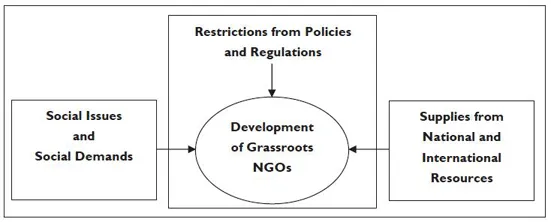
A Supply-and-Demand Theory of the Development of Grassroots NGOs
The Increasing Autonomy of Government-Affiliated NGOs
Since 1995, China’s NGOs have experienced a revolution, and this has been especially true for NGOs that were officially founded in order to apply for international funding and collaborate with international organizations. At first, these organizations were mainly headed by government officials or individuals appointed by the government. Although they were registered as NGOs, they were actually government departments. Indeed. their identity as an arm of the government superseded their identity as NGOs. In China today, some NGOs are still run (to varying degrees) by government departments; these NGOs are customarily referred to as official or government-affiliated NGOs. Through collaborations with international agencies, leaders in government-affiliated NGOs have obtained many opportunities to communicate, train, and engage with international funding agencies. After witnessing successful cases of grassroots NGOs, these leaders began to form their own organizations around their own interests. Most of these NGOs were registered in local civil affairs offices; were authorized as independent, legal entities; and were funded by international agencies rather than the government. Therefore, they could hire and fire staff, manage finances, and make other decisions independent of the government. Meanwhile, local governments relied on these NGO leaders, who were known by national and international agencies, to obtain more funding for public services.
Among government-affiliated NGOs, foundations had the most independent footing and demand. Unlike foundations in developed countries, China’s foundations are normally official fund-raising agencies founded by the government. They have diverse funding sources, including indirect policy support from the government and direct financial support from the public, corporations, and international agencies. Funding is used to operate programs. Thanks to the advantages in funding sources, foundations do not have to rely on the government; therefore, they enjoy a high degree of autonomy in designing and managing their programs and activities and in making executive decisions. However, for the same reason, the local government oversight department has stricter control over foundations; for instance, the boards of directors and secretary-generals of government-affiliated NGOs are appointed by the government. Foundations also need authorization from their local oversight department to conduct large-scale programs and activities. Under ...
Table of contents
- Cover
- Half Title
- Title Page
- Copyright Page
- Table of Contents
- Preface
- Acknowledgements
- Introduction
- Part I: The Development of the Nonprofit Sector in China
- Part II: Environment and Challenges of China’s Nonprofit Sector
- Glossary of Terms
- References
- About the Contributors
- Index
Trusted by 375,005 students
Access to over 1.5 million titles for a fair monthly price.
Study more efficiently using our study tools.
Frequently asked questions
Yes, you can cancel anytime from the Subscription tab in your account settings on the Perlego website. Your subscription will stay active until the end of your current billing period. Learn how to cancel your subscription
No, books cannot be downloaded as external files, such as PDFs, for use outside of Perlego. However, you can download books within the Perlego app for offline reading on mobile or tablet. Learn how to download books offline
Perlego offers two plans: Essential and Complete
- Essential is ideal for learners and professionals who enjoy exploring a wide range of subjects. Access the Essential Library with 800,000+ trusted titles and best-sellers across business, personal growth, and the humanities. Includes unlimited reading time and Standard Read Aloud voice.
- Complete: Perfect for advanced learners and researchers needing full, unrestricted access. Unlock 1.5M+ books across hundreds of subjects, including academic and specialized titles. The Complete Plan also includes advanced features like Premium Read Aloud and Research Assistant.
We are an online textbook subscription service, where you can get access to an entire online library for less than the price of a single book per month. With over 1.5 million books across 990+ topics, we’ve got you covered! Learn about our mission
Look out for the read-aloud symbol on your next book to see if you can listen to it. The read-aloud tool reads text aloud for you, highlighting the text as it is being read. You can pause it, speed it up and slow it down. Learn more about Read Aloud
Yes! You can use the Perlego app on both iOS and Android devices to read anytime, anywhere — even offline. Perfect for commutes or when you’re on the go.
Please note we cannot support devices running on iOS 13 and Android 7 or earlier. Learn more about using the app
Please note we cannot support devices running on iOS 13 and Android 7 or earlier. Learn more about using the app
Yes, you can access China's Nonprofit Sector by Chien-Chung Huang in PDF and/or ePUB format, as well as other popular books in Business & Business General. We have over 1.5 million books available in our catalogue for you to explore.