eBook - ePub
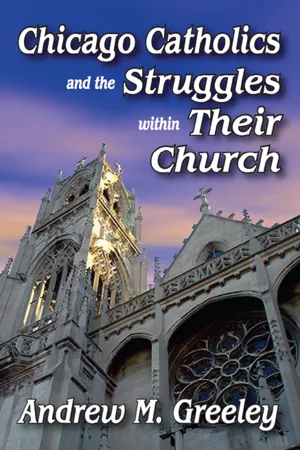
Chicago Catholics and the Struggles within Their Church
- 218 pages
- English
- ePUB (mobile friendly)
- Available on iOS & Android
eBook - ePub
Chicago Catholics and the Struggles within Their Church
About this book
What might one expect to learn from a probability sample study of the Archdiocese of Chicago? Can one form a national portrait of Catholics in the United States from data about Chicago? Certainly, Chicago is unique in its judgments about its clergy. As the eminent Catholic sociologist Andrew M. Greeley argues, it is this very difference that makes rigorous comparisons between Chicago Catholics and other Catholic subpopulations possible. He suggests that history and geography provide a basis for understanding the development of the Catholic Church not just in this specific area, but also in the entire United States. The Catholic Archdiocese of Chicago it composed of two counties, Lake and Cook. At the same time the Catholic population has been pushed up against the boundary of DuPage County by racial change in the city, so that much of the west and south side Catholic population of the city has moved into the southern and western suburbs. In this research area, half of the Catholics have attended college and half of those have attended graduate school. Thus, the conventional image of Chicago as a mix of ethnic immigrant neighborhoods has to be modified-although there are still many new immigrants attending special immigrant parishes. Greeley argues that the official church in Chicago, and by inference elsewhere, has not recognized the community structures that permeate the neighborhoods, that it does not grasp the religious stories that shape its peoples' identity, and it does not understand the intense, if selective, loyalty of the archdiocese to its leadership. As part of this argument, Greeley includes transcriptions of in-depth interviews with former Catholics. This study provides a fascinating window into the world of Catholicism in twenty-first century urban America.
Information
1
Destabilization of Structures in the Local Church
In The Catholic Revolution (Greeley, 2004a) I proposed a theory, based on the “event sociology” propounded by William Sewell (1996) that Vatican Council II was a revolutionary event that destabilized the structures of the Catholic Church—habits of routine behavior and supporting motivations, e.g. Sunday Church attendance supported by the fear of mortal sin and hellfire for failure to attend. In this book, I propose to investigate the revolutionary event as it has affected one archdiocese in the United States.
The Vatican curialists rejected such an explanation.1 The council was not a rupture with the past but a continuation. The documents of the council could be authoritatively interpreted only by the “magisterium,” theoretically the pope and the bishops but practically the pope and the curia. A proper understanding of the Church’s teachings could be found not in the documents of the council but in the Catechism of the Catholic Church. Nothing had changed.
“Rupture” was a deceptive word. No one claimed that the Catholic tradition had been ruptured. However, it had been dramatically changed. John Courtney Murray S.J., who drafted the council’s document on religious liberty, Dignitatis Humanae had been forbidden to write or speak on the subject only a few years before the council convened. He had been “disinvited” to the first session and attended the second only because of the patronage of Cardinal Francis Spellman. Yet, as one of its most important theologians, he had concelebrated the concluding Eucharist with Pope Paul VI. Seldom had the Church changed a traditional teaching so quickly and so dramatically.2 The opponents of the council, like the Society of Pius X which broke with the Church, refuses to be drawn back in by the possibility of the Mass in Latin again. Dignitatis Humanae must be repealed and repudiated.
If one grants the theory of the curialists that nothing has changed, one must still contend that tremendous destabilization has occurred around the Catholic world. If one introduces the yeast of change into an institution, the resultant changes, perhaps not explicitly intended by the Council fathers, will be dramatic and perhaps traumatic. Secure in their dicasteries and supported by their own handpicked bishops around the world, the curialists can hardly deny the changes, as much as they rail against them. Church attendance has declined even in traditionally Catholic countries. Vocations to the priesthood and religious life have diminished. The laity in every country on which data are available (including Second- and Third-World countries, including Poland) generally ignore the Church’s sexual ethic and pay little attention to Roman documents.3
I argued in The Catholic Revolution that the destabilization has become worse, precisely because Church leadership apparently cannot admit to itself that such changes are occurring. One must blame the erosions of the past forty years not on the council or the council fathers, but on the curialists for their denial of the ferment and their failure to support sensitive and nuanced implementations of the council. One can understand their desire to reassure the timid laity and themselves, but the price of such reassurance is burying their heads in the sands of denial. Repetition of jeremiads against “secularism” and “relativism” have little impact.
In this book I intend to examine the destabilization of religious structures in the Archdiocese of Chicago to determine whether and to what extent the Sewell model must be applied to a vigorous Catholic diocese in the United States and how the Catholic laity of Chicago has reacted to the stresses and strains of the changes.4
In 1970 there were 1141 diocesan priests, 8331 religious women, and 1607 seminarians5 in the Archdiocese. In 2006 there were 839 priests, 2397 religious women, and 348 seminarians. If ever there was evidence of destabilization of structures, it is to be found in those numbers. Should the Council Fathers be blamed? Should the secularist, relativist laity be blamed? Or should the curialists who stonewalled the full implementation of the Council? If you’re in Rome, of course, you blame the Catholic laity.
Churches that were packed on Sundays are now half-empty. Rectories, which once housed four priests, now have only one. More than half the priests are from outside of the Archdiocese, most of them from outside the country (Asia, Africa, and Poland). Young priests, the traditional ministers to the young, have virtually disappeared. The more mature vocations are often, as Hoge (2001) has reported, more likely to think of themselves as qualitatively different from the laity and that the laity must be taught to obey them. Ordination is less a challenge to ministry than the conferring of an identity. The Southwest Side and its adjoining suburbs, once a seedbed of priestly vocations, have not produced a new priest for many years.
To make matters worse the American Church, including Chicago, has been plagued by the sexual abuse crisis, a phenomenon which as we will see in this book has profoundly angered many Catholics.” In Chicago—after the stonewalling ended “credible accusations” were brought against priests of whom most have subsequently been removed from the priesthood. The practice of reassigning accused priests to new parishes ended in the late nineteen nineties. However, the charges against priests continues as does the payment of money to victims. In fact, the 4 percent of priests who have been charged is no higher than in other denominations or among teachers or athletic coaches. The anger of the laity is against the bishops who tried to cover up and reassign suspect priests.
Simultaneously, some bishops have ruled that it is seriously sinful to vote for a political candidate who support policies to which the church is opposed—abortion, gay marriage, artificial insemination. Others have ruled that Catholic politicians who do not vote against such policies should not receive the Eucharist. Such bishops are accused of hypocrisy for tolerating abusive priests and condemning politicians who are making crucial and painful political decisions. In Chicago, this has meant only that priests are told not to give communion to gay couples who present themselves in the rainbow sashes (and many priests ignore such instructions). Some priests also refuse the sacraments to politicians but most others do not do so.
Moreover, the laity are troubled by the constant fussing with the Sunday liturgy, which they think to be an obsession with the trivial, while Rome burns.
Yet if one goes back a half century, one remembers a very different Church. The parish and the precinct were the centers of life in the ethnic neighborhoods. The churches were filled on Sundays, the school halls on weekday nights with various meetings or athletic events. There were separate organizations for men and women (Holy Name Society to fight blasphemy and Altar and Rosary Society to keep the church neat and clean) and perhaps an organization for young men and women to come in contact with one another for possible marriage. In some parishes there would be a high club or teen club, though such ventures were not durable because teens made noise and mess, to both of which janitors and sisters superior strongly objected. There was always a building fund for new or renewed construction.
A Catholic identity included fish on Friday, mass on Sunday, and no birth control. Typically on Saturday afternoon and evenings, confessions continued for two hours in the afternoon and an hour and a half in the evenings and the whole school was processed through the confessionals on the Thursday before first Friday, a practice which violated the young people’s rights and verged on blasphemy.
Perhaps a little more than half of the parish went to church every week, and half of that received Communion. At Christmas and Easter, most of the parish turned out for Mass and received Communion. The non-communicants labeled themselves as people who were having “problems with birth control.” Divorced and remarried Catholics were denied the sacraments and were described as “living in sin,” an embarrassment to themselves and especially to their children.
Every couple of years, “missionaries” were brought into the parish to rekindle the faith and morality of their people, though to those of us who had to hear confessions, all they did was stir up scruples about past “bad” confessions. We used to reflect that it took several months after the missionaries had departed to settle the parish down and to persuade the people that God was not trying to trick his people into hell.
Grammar school graduation was the high point of the school year, when, not without some relief, the parish sent the eighth graders off to high school, having fulfilled its major educational obligation.
Stations of the cross were said during lent, benediction of the blessed sacrament (and the Sorrowful Mother Novena) took place every Friday evening. Dispensations from Lenten fast and abstinence were given, often times ungraciously, to those who were going away for a week of sun. Ashes were distributed on Ash Wednesday and throats were blessed on the Feast of St. Blaise. If you were Irish, your pastor was likely to violate all rules and wear green vestments at Mass—a custom that has not disappeared altogether. Masses were also said on the “Holy Days of Obligation” (originally Holy Days of Celebration) and many people showed up at Church or down in the Loop, though the obligation was not take so seriously as the Sunday obligation. Some devout Catholics of my generation are furious at the bishops and priests for “fooling around” with the obligations—as well they might be. The biggest offense, however, was the elimination of the Friday abstinence obligation—a harmless symbol that was destroyed simply because it was there. Everything seemed to unravel after that.
Birth control declined as a problem for people in 1965. Most younger Catholics today can’t believe that it was an issue that created so much anguish for their parents and grandparents. Yet, when the church eliminated fish on Friday and priests generally eliminated birth control (and masturbation too) everything did unravel. Mortal sin and hellfire no longer frightened younger Catholics. People went to confession less often because it seemed there were fewer things to confess.
Those of us who achieved what passed for maturity before the council and then lived through its heady years would not have believed that the Chicago parish I have described would ever change. Some of us were furious at its passing, others delighted, still others confused. We have gradually been replaced by the demographic processes according to which the young arrive and the older depart. I confess I miss the crowded churches and the young priests and the chaste young people, but I don’t—and won’t ever—miss the fear and the absence of the God who is love. If it all had to go down the drain to recover the insight that Deus Caritas Est, then it had to go. The point is that loss of the overarching power of Mortal Sin as the universal motive for being a Catholic and keeping the Catholic rules is not a bad thing. Though many of the older laity are not yet prepared to let it go.
The overwhelming majority of American Catholics liked the changes that the council created. Seven out of eight approved of the English mass. Most, even the elderly, approved of the “change” in birth control—even though it was a change of which the Vatican did not pronounce, but which the laity embraced nonetheless. In the early seventies, 29 percent of American Catholics thought that premarital sex was never wrong, in the early 21st century that has risen to 43 percent, validation perhaps of the “hook-up” sexual culture. In the same era, the proportion thinking that homosexual sex is always wrong has declined from 69 percent to just under 50 percent.6
It is not fair to say the laity in Chicago or anywhere else are polarized. In the rapid change of the last several decades, there has been a polarization of ideologies on the Vatican Council. There is a segment of the Catholic population that would like to return to the status quo ante, either because they miss it or because they miss it without having experienced it and yearn for artificial nostalgia. The Latin Mass is so elegant and graceful. Marian devotions are so lovely.7 However, it is unlikely that the restorationists constitute more than the 10 percent of the population still convinced that birth control is wrong. Much of the reaction to the “New Church” is not ideological. Most Catholic laity are not inclined to sign on either with the Voice of the Faithful or the Faithful Voice, either with the Call to Action or Opus Dei, either with pro-life or pro-choice groups or to subscribe either to the National Catholic Reporter or the Wanderer, either to First Things or The Commonweal. This pragmatic and extremely large Catholic middle may be the lukewarm that Jesus would vomit out of his mouth or they may be the wise ones who have better things to do with their time than become involved in internal Catholic “politics” as they see it, like earn a living and raise their children, and keep the marital boat from rocking too much.
Yet the dissidents on the right are always around—in Chicago there are two Opus Dei high schools (and one Jesuit High school that uses an Opus text book for a sophomore religion text book) and one High School run by the Legionnaires of Christ (whose founder was in effect suspended from public ministry after serious pedophile charges). There is Mother Angelica’s Eternal Word TV channel and her flock of strange looking clergy. There is the occasional retreat or day of recollection master who wants to talk about birth control or masturbation or the “missionary” who denounces youthful yearning for sex. There are the Catholics United for the Faith who harass college and university faculties and the Newman Society, which goes after individual scholars.
These kinds of folks—who certainly have the right to their convictions and beliefs and the right to push them—are part of the Chicago Catholic environment. Once upon a time, there was little evidence of such polarization or the zeal of, let us say, folk such as the Voice of the Faithful (VOTF) which wants to blackball bishops from holding office in the national hierarchy. Part of the struggle of Chicago Catholics is to fend off such, as they see it, zealots.
Nationally the more important struggles for the mass middle of the Catholic laity are against bishops who harass them with political instructions, interminable pastoral letters (written to win approval from their masters in Rome) and seem unwilling to apologize or resign because of the mess they have made in their dioceses—either financial or administrative or in matters of sex abuse. The laity also stand against priests who have turned the reception of the sacraments—especially marriage and baptism—into obstacle courses, extra-canonical hoops through which the laity are made to jump, often several times, before they can receive the sacraments; against priests who do not know how to smile; against priests who are rude and insulting; against priests who are unable to put together a single sentence of decent prose for a sermon; and finally against priests who still believe that possessing a roman collar makes them a lord of creation.
Having said that, one must also add that large majorities of Chicago Catholics give high marks to their parish priest, to the Cardinal, and to the pope. Most are not about to leave the Church, no matter how sick they might be of the incompetence of its leaders.
The middle mass of Chicago Catholics about whom I will report in this book like being Catholic and even like, more or less, their clergy. The de-stabilization continues and will probably continue for a long time. There are very serious problems and problems with which Chicago Catholics must wrestle. Chastity (not the same thing as celibacy) and regular church attendance are serious problems. Respect for women is of utmost importance and not just to ideological feminists and the Church in Chicago has not made much progress in demonstrating to women that it knows that its women problem is very serious. In retrospect, the good old days seem simple and, to tell the truth, dull.8
Notes
1. My own claim that the council was “eventful” has been ignored. I am too much a minor league player to be taken seriously.
2. One commentator calls this kind of doctrinal change an exercise in “selective amnesia.” It must be very powerful amnesia to forget the thunder against religious freedom in the Syllabus of Errors.
3. At the time of the drafting of this book, a retired Australian bishop has issued a book which criticizes the sexual ethic and the exercise of power in the Church, a group of Dutch Dominicans have urged the Netherlanders to organize their own parishes, select their own priests, and demand that bishops ordain them, only 18,000 Austrian Catholics came out to welcome the pope’s visit to Vienna, and the German hierarchy has rejected a “definitive” document from the Congregation for the Defense of the Faith on other religions.
4. The present book is based on data from five hundred Catholic respondents in Cook and Lake Counties contacted by the Social Science Survey Lab at the University of Chicago in the summer and autumn of 2007. (See Appendix A for a sample design by Professor Colm O’Muircheartaigh.) In the spring of the same year I had commissioned a pretest of a hundred respondents to be conducted by a firm in Arizona to determine whether the project was feasible. As luck (i.e. probability statistics) would have it, the pretest numbers came very clo...
Table of contents
- Cover
- Half Title
- Title Page
- Copyright Page
- Dedication
- Table of Contents
- Foreword
- Introduction: The Archdiocese by the Lake
- 1. Destabilization of Structures in the Local Church
- 2. The Lost Sheep
- 3. Catholic Identities
- 4. Cafeteria Catholicism
- 5. Time to Leave?
- 6. Mass on Sundays
- 7. Priests at Work
- 8. Secularized Young People
- 9. Why Do They Stay?
- 10. Competing Identities
- 11. Ethnic Groups and Regions of the City
- Appendixes
- References
- Index
Trusted by 375,005 students
Access to over 1.5 million titles for a fair monthly price.
Study more efficiently using our study tools.
Frequently asked questions
Yes, you can cancel anytime from the Subscription tab in your account settings on the Perlego website. Your subscription will stay active until the end of your current billing period. Learn how to cancel your subscription
No, books cannot be downloaded as external files, such as PDFs, for use outside of Perlego. However, you can download books within the Perlego app for offline reading on mobile or tablet. Learn how to download books offline
Perlego offers two plans: Essential and Complete
- Essential is ideal for learners and professionals who enjoy exploring a wide range of subjects. Access the Essential Library with 800,000+ trusted titles and best-sellers across business, personal growth, and the humanities. Includes unlimited reading time and Standard Read Aloud voice.
- Complete: Perfect for advanced learners and researchers needing full, unrestricted access. Unlock 1.5M+ books across hundreds of subjects, including academic and specialized titles. The Complete Plan also includes advanced features like Premium Read Aloud and Research Assistant.
We are an online textbook subscription service, where you can get access to an entire online library for less than the price of a single book per month. With over 1.5 million books across 990+ topics, we’ve got you covered! Learn about our mission
Look out for the read-aloud symbol on your next book to see if you can listen to it. The read-aloud tool reads text aloud for you, highlighting the text as it is being read. You can pause it, speed it up and slow it down. Learn more about Read Aloud
Yes! You can use the Perlego app on both iOS and Android devices to read anytime, anywhere — even offline. Perfect for commutes or when you’re on the go.
Please note we cannot support devices running on iOS 13 and Android 7 or earlier. Learn more about using the app
Please note we cannot support devices running on iOS 13 and Android 7 or earlier. Learn more about using the app
Yes, you can access Chicago Catholics and the Struggles within Their Church by Andrew M. Greeley,Robert J. Haggerty in PDF and/or ePUB format, as well as other popular books in Philosophy & Philosophy History & Theory. We have over 1.5 million books available in our catalogue for you to explore.