- 391 pages
- English
- ePUB (mobile friendly)
- Available on iOS & Android
eBook - ePub
About this book
China is more than a socialist market economy led by ever more reform-minded leaders. It is a country whose people seek liberty on a daily basis. Their success has been phenomenal, despite the fact that China continues to be governed by a single party. Clear distinctions between the people and the government are emerging, underlining the fact that true liberalization cannot be imposed from above. Although a large percentage of the Chinese people have been part of China's long march to freedom, farmers, entrepreneurs, migrants, Chinese gays, sex pleasure seekers, and black-marketers played a particularly important role in the beginning. Lawyers, scholars, journalists, and rights activists have jumped in more recently to ensure that liberalization continues. Social dissatisfaction with the government is now published in the media, addressed in public forums, and deliberated in courtrooms. Intellectuals devoted to improvement in human rights and continued liberalization are part of the process. This grassroots social revolution has also resulted from the explosion of information available to ordinary people (especially via the Internet) and far-reaching international influences. All have fundamentally altered key elements of the moral and material content of China's party-state regime and society at large. This social revolution is moving China towards a more liberal society despite its government. The Chinese government reacts, rather than leads, in this trans formative process. This book is a landmark - a decade in the making.
1
The Right to Be Let Alone: The Grassroots Decollectivization Movement and Baochan Daohu
The natural progress of things is for liberty to yield and government to gain ground.—Thomas JeffersonI had nothing against the state. I just wanted to be left alone to farm for my family.—Lao Chu, a farmer in Tongxin Village, Hubei
China’s grassroots civil disobedience movements are the result of thirty years of Chinese communist total control over society. This control reached so thoroughly into individual life that in some instances children went to sleep fearing that they might unknowingly cry out forbidden thoughts, such as a dislike for Mao-style clothes. One young girl used to ask her sister to awaken her if she started violating such taboos in her sleep. The state dictated how much to eat, where to eat, what to wear, whom to marry, where to live and work, and what children to have. But the most oppressive control mechanism under Mao was the commune system.
Social Transformation: Becoming Communist “Peasants”
The Chinese Communist leaders won military victories largely because of rural support. But those same rural people became the victims, rather than victors, of Mao’s revolution. Through the party’s overreaching organization, collectivization, and the hukou’s (household registration through grain rationing) systematic control over mobility, the Chinese state transformed traditional Chinese farmers from legally mobile independent proprietors into commune peasants who were “bound legally and substantively to the land.”1 They no longer owned land, could not move from the land, and had no escape from the social class in which they were born. They were subject to direct and comprehensive control by the Communist state.
Collectivization was the most important means of transformation of Chinese farmers. The Communist leaders implemented collectivization in China by the use of two effective methods that consolidated their control in the countryside: class labeling and land reform.
The state used class labeling to divide the rural population which had formerly organized itself along clan, family, and village lines. The Communists assigned each family to a class, based on the family’s economic circumstances at the time of land reform (1947–52). Mao defined six classes: landlords, rich peasants, upper-middle peasants, middle peasants, lower-middle peasants, and poor peasants. Landlord and rich peasant classes were considered wicked, while the lower-middle and poor peasants were considered virtuous classes. Through the struggle against former local elites, the state recruited new local leaders who were loyal to the party.
In the beginning, the state used the image of a helpless and impoverished peasantry to mobilize the majority against rural elites. During land reform (1950–53), class struggle offered many poor farmers tangible rewards in the form of land. By promising “land to the tiller,” the state mobilized the poor against the rich, destroying the power base of the traditional elites.
However, land reform did not give land entitlement to the poor. It confiscated land from all classes. The state allocated land for the farmers’ use, but denied them both ownership and control. Although before communism, many farmers had lived a life of landless rentier subsistence, at least 60 percent of the rural population consisted of small, relatively independent landowners. Many peasants both owned and cultivated rented land; some rented and others rented out, including middle peasants and even some who were rather poor. This varied regionally, with a high tenancy rate in the South and central areas and a low tenancy rate (but a higher rate of hired labor) in the North. Under Mao, land reform transferred the land from independent proprietors, most of whom were poor, to the collective (i.e., a local state organization).2
Even before land reform started, the communist leadership had already committed to a collective future modeled on the Soviet collective experience. From a political perspective, Mao used land reform as a stepping-stone to collectivization. Immediately after the land reform, the government launched a campaign to attack the anti-revolutionaries (mostly landlords, other wealthy people, and people who had connections with the former nationalist government). Between 1950 and 1951, 712,000 were executed, 1,290,000 were imprisoned and 1,200,000 were sent to labor camps.3 The repression of the campaign set a precedent, establishing the state as a source of coercing and silencing any political oponents.
Very often, both Chinese and international scholars and the Beijing elites have regarded the Great Leap Forward and the People’s Commune policy as the work of Mao only and maintained that Mao’s associates such as Deng Xiaoping, Chen Yun and Liu Shaoqi opposed these policies. However, this is not true. Influenced by the communist view of socialism, most Chinese leaders of the 1950s, like their Soviet counterparts, pushed massive collectivization. Socialism was to incorporate collective ownership, as Bo Yibo recalled in “Our Advanced Cooperatives Copied the Soviet Collective Farms” (1991).4 Such ideological attachment to an accelerated industrialization process was the root cause of conflicts between nearly the whole of the party elite and the majority of rural people who hungered for land. In common with many underdeveloped countries in Asia and Africa where elites attempted to rush industrialization at the expense of rural populations, China adopted an industrialization policy designed to squeeze resources from rural areas to feed workers in a newly industrializing planned economy. This ideological attachment pushed all top CCP leaders to support the Great Leap Forward, the People’s Commune policy, and the Socialist General Principles. Justifying their actions with alleged social justice, they ruthlessly used all available means to push their idea of a utopian society.
Abolition of Private Property and the Procurement System
In 1953, four years after the new Communist government took power, it began a strict policy of curtailing the rights of farmers that reached fruition in 1958 and remained in force until 1978. It began by abolishing private property and proceeded to restrict the rights of the new peasant class to buy, sell, or rent land. Key rural properties such as housing, land, grain, labor, animal husbandry, farm tools, farm animals, and even kitchen utensils (during the Great Leap Forward period) became collective goods.
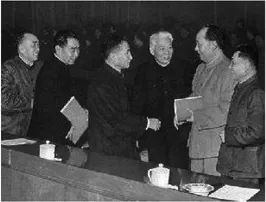
Note: (from left to right) Zhu De, Zhou Enlai, Chen Yun, Liu Shaoqi, Mao Zedong, Deng Xiaoping
Source: http://en.wikipedia.org/wiki/History_of_the_People’s_Republic_of_China_(1949–1976)
Figure 1.1
China’s First Generation of Communist Leaders Shared Mao’s Socialist Vision in 1950s
China’s First Generation of Communist Leaders Shared Mao’s Socialist Vision in 1950s
The introduction of tonggou tongxiao (the procurement system) in 1953 was the first mechanism to control rural people. On November 23, 1953, the state issued a directive to ban all private grain sales.5 During its entire previous history the Chinese state had never been able to control the national grain market. Before 1949, the government (both local and national) collected taxes, sometimes years in advance, but never laid claim to the entire harvest. However, the procurement system overcame the farmers’ resistance to taxation by nationalizing the grain market so that the state became the only buyer of grain. Further, the government set the selling price, which was low. Rural people were forced to sell fixed quotas of grain to the government at official prices. Only after farmers reached the state’s procurement quotas, were they allowed to sell at state-supervised grain markets. In 1954 the state also took control over the trading of vegetable oil and raw cotton, bringing a several thousand-year-old commercial system of private grain merchants and grain mills to an end. According to a document from the Shaoxin government, state procurement workers banned market activities for grain, cotton, oil, and raw materials in 1952 in order to ensure that the state procurement target was met, as American anthropologist Helen Siu found in her examination of old government commerce documents.6
From time to time, the compulsory grain purchases generated fear and confusion. As described in retrospect by a Chinese study, the government was ill prepared to set up a realistic system for the unified procurement of grain based on estimates of individual production. It set guideline quotas subject to negotiation, but peasants were unsure how much grain the government actually intended to procure. Many feared that the more they produced, the more they would be duty-bound to sell. In 1954, when natural disasters caused crop failures, the government took 7 billion catties beyond what would have been realistic adjustments, thus, drastically shrinking peasant reserves. The study acknowledges that anxiety over grain procurement stirred unrest in the rural areas.7 However, with the establishment of the procurement system, the state was able to force rural people to foot its industrial bills.
The state-planned grain procurement system was economically devastating for those rural peasants who traditionally were not grain farmers. Helen Siu’s research in the Pearl River delta confirmed our research in Hunan, Hubei, Hebei, Shandong, and Fujian provinces that the grain command quota hurt farmers who had historically relied on grain imports because of highly valued local production of cash crops. Farmers called them yidaoqie zhengci (policies of one knife cutting all). Fruit farmers in Shandong, Guangdong, and Fujian provinces had to cut down fruit trees that yielded higher returns in order to meet the state grain quota. Despite rural resistance at many local levels, both the central and the provincial governments continued the rigid and inflexible policies. For example, Tao Zhu, the party secretary in charge of Guangdong province, continued to demand that Guangzhou not only be self-sufficient in grain but that it must also reserve a portion of its grain for national allocation, as described by Helen Siu:
In the meeting of the People’s Political Consultative Committee held in November 1956, a speaker pointed out that collectives had overstressed grain production at the expense of other activities. Meijiang’s citrus crop was estimated to have dropped 10 ...
Table of contents
- Cover
- Half Title
- Title Page
- Copyright Page
- Dedication
- Table of Contents
- Foreword
- Acknowledgements
- Introduction
- 1. The Right to Be Let Alone: The Grassroots Decollectivization Movement and Baochan Daohu
- 2. Struggling to Move Freely
- 3. The Chinese Entrepreneur: Challenging the Status Quo
- 4. Capitalism with Chinese Characteristics and the Basis of Civil Society
- 5. Information Wants to Be Free
- 6. Sexual Revolution in China
- 7. Global Trade, Foreign Influence, and the Effects of Globalization
- Conclusion
- Bibliography
- Index
Trusted by 375,005 students
Access to over 1.5 million titles for a fair monthly price.
Study more efficiently using our study tools.
Frequently asked questions
Yes, you can cancel anytime from the Subscription tab in your account settings on the Perlego website. Your subscription will stay active until the end of your current billing period. Learn how to cancel your subscription
No, books cannot be downloaded as external files, such as PDFs, for use outside of Perlego. However, you can download books within the Perlego app for offline reading on mobile or tablet. Learn how to download books offline
Perlego offers two plans: Essential and Complete
- Essential is ideal for learners and professionals who enjoy exploring a wide range of subjects. Access the Essential Library with 800,000+ trusted titles and best-sellers across business, personal growth, and the humanities. Includes unlimited reading time and Standard Read Aloud voice.
- Complete: Perfect for advanced learners and researchers needing full, unrestricted access. Unlock 1.5M+ books across hundreds of subjects, including academic and specialized titles. The Complete Plan also includes advanced features like Premium Read Aloud and Research Assistant.
We are an online textbook subscription service, where you can get access to an entire online library for less than the price of a single book per month. With over 1.5 million books across 990+ topics, we’ve got you covered! Learn about our mission
Look out for the read-aloud symbol on your next book to see if you can listen to it. The read-aloud tool reads text aloud for you, highlighting the text as it is being read. You can pause it, speed it up and slow it down. Learn more about Read Aloud
Yes! You can use the Perlego app on both iOS and Android devices to read anytime, anywhere — even offline. Perfect for commutes or when you’re on the go.
Please note we cannot support devices running on iOS 13 and Android 7 or earlier. Learn more about using the app
Please note we cannot support devices running on iOS 13 and Android 7 or earlier. Learn more about using the app
Yes, you can access China's Long March to Freedom by Kate Zhou in PDF and/or ePUB format, as well as other popular books in History & Asian History. We have over 1.5 million books available in our catalogue for you to explore.