- 409 pages
- English
- ePUB (mobile friendly)
- Available on iOS & Android
eBook - ePub
About this book
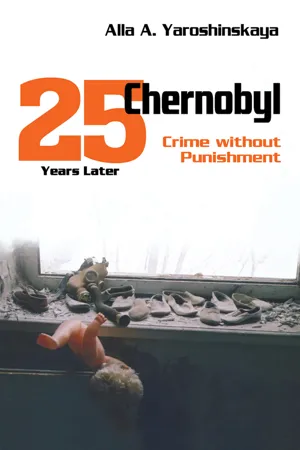
Long before the tragedy of the 2011 nuclear disasters in Japan, the nuclear reactor at Chernobyl experienced an explosion, meltdown, fire, and massive release of radioactivity. Twenty-five years later, we still know very little about the event and its aftermath. Few of the professional papers describing the aftereffects of the disaster have been translated from Russian into English or distributed in the West. This is now remedied, with the publication of this definitive volume, based on original sources, and originally published in Russian. Alla A. Yaroshinskaya describes the human side of the disaster, with firsthand accounts by those who lived through the world's worst public health crisis. Chernobyl: Crime without Punishment is a unique account of events by a reporter who defied the Soviet bureaucracy. The author presents an accurate historical record, with quotations from all the major players in the Chernobyl drama. It also provides unique insight into the final stages of Soviet communism. Yaroshinskaya describes actions after the disaster: how authorities built a new city for Chernobyl residents but placed it in a highly polluted area. She also details the actions of the nuclear lobby inside and outside the former Soviet Union. Bringing the book into the twenty-first century, the author reviews the latest medical data on Chernobyl people's health from the affected countries and from independent investigations; and states why there has been no trial of top officials who covered up Chernobyl and its disastrous consequences.
1
Rudnya-Ososhnya: A Deception Zone
The year was 1986, April 27, a day after the Chernobyl accident, and I was a reporter working for the regional party daily Radyanska Zhitomirshchina, in the town of Zhitomir. We received information that four villages in the Narodichi District of our region had been evacuated because of lethal radiation levels registered there. The Central Party press, radio, and television assured us that people had been resettled in safe areas. Everything humanly possible had been done for them. Our daily paper always followed the party line. I had no evidence at all that anything untoward was happening in the affected areas. But intuitively I felt that things were not well there (a journalistic trait?). Apparently, what had put me on guard was the fact that the new houses for these people were being built in the immediate vicinity of Chernobyl, right next to the fenced-off villages that recently had been evacuated. Would these poor peasants suffer in silence?
Our paper reported that the builders from all over the region were doing a splendid job, quickly constructing accommodations for the people being rehoused and to the best standards. Yet not a word was said about what these new houses were doing next to the crippled reactor. Was that place really safe, being so close? I decided to find out.
When I went to chief editor Dmitry Panchuk to share my misgivings, he, a party functionary of many years’ standing, heard me out and rather brusquely and stonily replied, “We did not make the decision. It’s nothing to do with us.” I asked to be sent to the old Narodichi District, now evacuated, to observe firsthand the new settlement only a few miles away. (But my request was flatly turned down. I then decided to dissemble; I came to my superiors with a plan for a trip to Malin, to a local experimental pilot plant, to write about science and technology progress. That request was OK with my boss, so I went. Sorting out the matter of science and technology progress took me a day and a half, and I also contrived to make a detour to the out-of-bounds Narodichi District (it borders the Malin District, and that had been my journalistic ruse). It turned out that a construction team from the Malin plant was building a kindergarten in the village of rudnya-Ososhnya.
The plant manager let me use a decrepit bus with a driver. For a couple of hours we rattled on to the facility in question. The hot summer was drawing to a close. The bus was going through luxuriant forests ringing with bird song. Mushrooms grew almost under the bus’s wheels. The sun could barely filter through the dense tree crowns. The elderly driver—I forget his name—was telling me, with anguish in his voice, how terribly Chernobyl had defiled the land and what a wonderful mushroom and berry country this had been. It still was, in fact, except that now one could not enter a forest, plump down on the lush grass, or pick a wide variety of delicacies, including strawberries, bilberries, and mushrooms. Everything was contaminated. However, the locals were unable to comprehend a danger they could not see, feel, or taste. They ignored all talk of danger and made forays into the woods to fill their baskets with berries or mushrooms for their own tables or to take to the Kiev and Zhitomir markets.
Rudnya-Ososhnya is a typical Polesye village. In spring, when orchards give off heavenly fragrance, it resembles a big flowerbed wedged between fir forests. We drove up to a group of workers who, it turned out, were building a public bathhouse right next to the woods. The conversation was sticky. The five men were morose and taciturn. Besides, it started to drizzle unpleasantly. But I still did not abandon attempts to understand what was going on, why they were building precisely at this spot, and what the radiation levels were. At long last they warmed to the subject and became more forthcoming. It transpired that the bathhouse was being built on that site because of high radiation levels. How high they did not know. No one told them anything about these things. “The army chaps come, take the readings, and say nothing to us.” The work was taking longer than originally planned. At first they hoped to have the bathhouse built in two months. But as was usually the case under the Soviets, something went wrong. There was no crane. No one could explain why a bathhouse that could service ten people at a time should be built beyond the village green—when each homestead had one anyway. Besides, the project cost fifty thousand rubles.
But back to the kindergarten construction. I found the team of eight workers somewhat more cooperative. The foreman, Yuri Grishchenko, told me that the kindergarten would cost the state 120,000 rubles. They had been working there for over a month, and the locals were already laughing at them. Who would use it? There were practically no toddlers or preschool kids in Rudnya-Ososhnya, and the kindergarten was for twenty-five children. It was then that I heard for the first time the terrifying phrase “coffin money.” That was how people referred to the measly monthly sum of thirty rubles for the villagers and construction workers building the bathhouse and the kindergarten—to pay for a “high-caloric diet,” if you please. It worked out at just one ruble over their daily wages. The victuals at their disposal included peas, vermicelli, and beef. Chicken meat was not for them because, I was told, it would come to more than the mandatory three rubles a day for food.
The workers complained that they felt sick and weary and suffered from persistent headaches. They blamed it on increased radiation levels. And today, years after the Chernobyl explosion, I can say this. They were dead right. Just four years after the nuclear disaster, the village with the unusual name of Rudnya-Ososhnya was evacuated, after all. Staying in it had proved to be life-threatening. But it was not till four years later that the villagers were told about it by the authorities. That time, however, I had to keep my trip to Rudnya-Ososhnya secret from my own bosses and colleagues.
Having talked to the builders, we set out across the village to look for the foreman’s house. The village, it appeared, lacked a village Soviet or a kolkhoz management. Rudnya-Ososhnya, its inhabitants informed us, was a village “without a future,” as the phrase went. It did not even have a secondary school. There were countless such villages “without a future” in the country, forsaken by God and Soviet power. Some of them did not boast even a shop or a post office, let alone telephones or other amenities of civilization. And yet, there were human beings living in them, needing all sorts of things—bread, clothing, matches, electricity, books, radio. The people were left without any of those “luxuries.” Today the government condemns the policy of “futureless villages.” But it is much too late. The harm has been done. The countryside is dying out. The once sound houses stand boarded up and paths and cemeteries are overgrown with weeds. People are leaving the countryside for cities, to be closer to civilization.
Here is what I heard (told bitterly and half-mockingly) then from the head of a kolkhoz team, Valentina Ushchapovskaya, who was also a member of the regional Soviet of People’s Deputies:
Our village has ninety homesteads. It is a limited-access village (contaminated by radiation). There are twenty-seven children between the ages of 7 and 14, and two senior graders of 15–16 plus six preschool kids. The elementary school has been closed because rooms inside the building registered 1.5 mR. There were thirteen children attending school. The premises consisted of just two rooms. Now water here registers 0.2 mR, and soil, 0.4 mR. The level is higher at the other end of the village and a bit lower over here. I personally measured the levels with a dosimeter. I have a DOS-5 device, so I use that to measure radiation, though it’s a liar of a device. It shows about one third of the actual level. Last year a special lab came over and measured 1.1 mR here. The place was “habitable,” they said. They issued me with the dosimeter at the district Soviet executive committee. Army chaps also come now and then to take measurements, but they do not tell us anything.
Did you see the kindergarten they are building? What for? Oh, all right, let it stand. We have a lot of young guys but too few lasses. It will make a good old people’s home for them eventually. Also, there are no proper roads here. You can’t get from Rudnya-Ososhnya to Lesser Minky. I spoke at the district Soviet session in Narodichi about that—about the roads and about the children. For ten years our children have been walking to a school ten kilometers away. After the radiation, the dirt road got completely impassable from heavy trucks. We have to travel seventeen kilometers to reach the flax field, and if there was a road here, it could be just three. For six years they have been promising us to fix the road. True, they’ve laid asphalt in the village.
We wrote to the Ukrainian council of ministers, to Masol (council of ministers chairman). After that we had visitors from the regional Soviet executive committee. We were promised a road in the fourth quarter. We were instructed as to how we should behave and what to eat when we had already eaten our fill of all the right and wrong stuff in the periodic table.
The team head went on, wiping her earth-stained hands on her dress.
When we had come up, she was digging up potatoes on her vegetable plot. Not far from her, other women were picking potatoes out of the soft earth. Next to them children were playing in the sand. Some distance away someone was burning the leafy tops of potato plants. And radioactive ash showered down on the vegetable plots and orchards, and on children’s heads. … They had intended to remove the top soil around the village right after the accident, but they must have thought better of it and simply plowed the land. The village itself had been “washed.” As for limestone decontamination, that had to wait until the fall of 1987. Dozens of the villagers, having survived the first radiation shock and having been exposed to radiation inside and outside their bodies, drank radioactive milk from their cows for almost three months following the disaster and ended up in the district hospital. Some had done several stints there.
The women who worked on the plots also came over. Hearing what we were talking about, they joined in with their own disheartening life stories. It transpired that sixty-three cows had been taken away from the village, and the owners had been paid 1.92 rubles per kilo of live weight. The cows were taken to a kolkhoz nearby, in the village of Bazar in the same district. (It was not until four years later that Bazar was chalked up for total evacuation). Why there? They said Bazar was “clean” and the cows could be fattened there and sold for meat later. The cows were removed on July 17, 1986. The heifers were left behind. But later they, too, were taken away. The only animals allowed on homesteads were pigs and chickens. “In the first days after the blast,” the women told us, “we all went hoarse. This year we have been forbidden to eat currants and strawberries. Apples were allowed, but they said we had to wash them in running water. The same for tomatoes and cucumbers.” I also learned that the village had a dairy farm of 86 cows, and a cattle-fattening farm of 113 head. The Krasnoye Pole-sye (“Red Polesye”) collective farm had fulfilled its annual production plan in the first half-year by 113 percent. While previously the cereal yield here had been ten to thirteen hundredweight per hectare, now the figure was 18.
The more the women told me, the more I was convinced that crimes were being committed, crimes against the people. Wasn’t that the reason why my request to be sent here had been denied? It turned out that the newly built kindergarten in Rudnya-Ososhnya was a stone’s throw from the evacuated and barbed wire–fenced villages of Bober and Vladimirovka in the Kiev region. As for the fields, they positively hugged the barbed wire. Not far off was the village of Golubievichi. There, the women told me new houses had been built, but people from evacuated villages refused to settle there. For a while the houses stood empty, but eventually some of the locals moved in. It was just sixty kilometers from there to the Chernobyl reactor, and just thirty kilometers to the thirty-kilometer exclusion zone. At present, the village of Rudnya-Ososhnya does not exist. Four years after the blast the government decided to have it urgently evacuated. Urgently—after years of deception! Criminal deception.
I vowed then that I would go on with my journalistic investigation at whatever cost to myself and would write about everything I had seen and heard. Publicity alone could save those people. Despite the fact that glasnost had been declared in this country in 1985, when Mikhail Gorbachev came to power, there was no sign of it in those parts. My trip to radioactive Rudnya-Ososhnya was kept secret from the newspaper staff. My husband and I drove to various villages in the Narodichi District in our Lada. Those were heartrending encounters with bewildered, crushed, and deceived people. Twenty years on, I still remember every one of those meetings because they are impossible to forget. I keep in my Chernobyl archives the writing pads from those trips. The memory of very old people who expect nothing but death from life, living out their remaining days in quiet desperation, remains with me forever.
2
“Halt! Life Hazard!”
Here it lies, autumnal land strewn with crimson and golden leaves, too beautiful for words. On the left are the fields, and beyond those, pastures with herds grazing in them. Against the haze of the forest melting away behind them, this looks like a painting. Could this be Provence? Hardly. Provence would fall well short of this scenery. Pole-sye! Wide open spaces and woods give one a poignant sense of eternal affinity with them. Over there lies Khristinovka like a precious brooch in the unvaryingly rich green setting. Was it named after Christians? After Christ? Or could it be related to the Ukrainian khrest, that is, cross? So what was that special cross which Providence gave this village to bear? On its right, in the distance, Polesye wooden cottages and newly built good houses of white firebricks are barely discernible for the cherry and apple orchards. That is Old Sharneh. And right in front … a warning sign on the swing-beam barrier, screaming, “Halt! No Passage! Life Hazard!” There is another sign on the barbed wire of the gate with a heavy padlock.
Impossible. It simply can’t be. It’s inconceivable. It doesn’t make sense. There’s a cottage, isn’t there, not a hundred yards away, this side of the barbed wire? An apple drops in the orchard off a tree by the fence and rolls away in the grass. A tiny tot of five or so comes out of the house and waddles happily among the riot of fall flowers. He stretches out his small hand to reach for the apple, and then the hand goes back to his mouth, apple juice running down his chin, dripping on his little boots and on the grass. The boy is laughing about something, oblivious to the gathering ash.
The houses beside the meadow on the other side of the barbed wire are the village of New Sharneh, sprawling along the river Uzh. After the Chernobyl disaster, it ceased to exist. It is dead. The same sad lot befell three more local villages—Dolgy Les, Motyli, and Omelniki. I knew from the press that in the summer of 1986, two hundred and fifty-one families were evacuated from them, a total of five-hundred-odd people. Where did they go? How were they faring now? This is what interested me above all else. How do people adjust psychologically to a new and terrifying situation? That Saturday, when I came to Narodichi for the first time since the Chernobyl explosion, I failed to comprehend the scale of the calamity and deception, even as far as our region was concerned. This being a day off, the district executive committee building was deserted. I simply talked to people in the streets or in shops and knocked on people’s doors. I was advised to go, first of all, to the outskirts of Narodichi, to the township of Mirny. It was there that fifty new houses had been built for resettled families. People did not want to live in them. What was their complaint? I would soon find the answer, and much more, as I talked with New Sharneh villagers rehoused in Mirny. And here is what the evacuees told me.
Adam Pastushenko, a World War II invalid, found a job at the Narodichi District finance department on resettlement:
They should never have built those houses here, for two reasons. First, this place is not much better than the one we were evacuated from. Second, years ago there was a pesticide store here for agriculture aircraft. The air is simply not fit for breathing.
As word got around of the arrival of a journalist, evacuees started flocking to the shop where I was talking to the victims of the “peace-ful atom,” to share their grievances and ask for help. And every one of them, literally everyone, asked me the same question: Who had given the orders? Who had decided to build new houses for resettling here, next door to dangerous contaminated areas—houses for people who had already had more than their fair share of suffering by the Chernobyl walls? I did not have an answer then, but I was determined to explore Chernobyl’s impact in the entire region. The villagers suggested taking me on a tour along the two streets of the new settlement. Many of the houses stood empty. In four new buildings workers were ripping up the floorboards and throwing pesticide-laden earth clods out of the window. One of my interlocutors joked, “We don’t even have flies around here. They’re all dead.” The nauseating stench of ammonia permeated the air. It wouldn’t be a bad trade-off if it could wash away the radioactive ash.
In some houses it was quite cold. The steam boilers had blown up. “The bosses say,” people complained, “that old grannies don’t know how to handle steam heating, so the boilers have exploded.” In Zhukov Street, the locals told me, all the earth in eight houses had to be removed after the floorboards had been pried off. One of the new settlers, Fyodor Zaichuk, invited me in and showed me his three rooms. The ceilings were black from damp and cold. He kept asking me wearily and dejectedly, “How can one live here?” After examining the houses, we returned to the shop. I wanted to know how the evacuees were supplied with “clean” food. The shop manager, Lyud-mila Pastushenko, complained that they were sent terrible loaves of bread, burnt and altogether inedible. There was no mineral water. Quite often they were short of meat. Those at work could not buy it in the daytime, and after working hours, meat was usually sold out. No smoked fish or chicken meat. Sometimes they got duck. Fruit juices were usually in stock, but generally, the food rations prescribed by the authorities were only a meager kilo of buckwheat a month per settler, a kilo of millet, plus a couple of cans of stewed meat and condensed milk.
The greatest concern, though, was for their health. War veteran Adam Pastushenko discovered he had absorbed 17 µCi of cesium. For twenty-four days he received treatment in a hospital in Zhitomir. On discharge, they told him his cesium level had dropped to 9 µCi.
Nina Mokhoid:
I have two girls—Olya, twelve, and Lyuda, nine. Olya spent some time in the district children’s clinic a while ago. Lyuda, too, is...
Table of contents
- Cover
- Half Title
- Title Page
- Copyright Page
- Table of Contents
- Introduction
- Prologue: Life Weighed on Chernobyl Scales
- 1. Rudnya-Ososhnya: A Deception Zone
- 2. “Halt! Life Hazard!”
- 3. Brainwashing in Zhitomir
- 4. Voices Crying in the Parliamentary Wilderness
- 5. “Top Secret: Ban Chernobyl Theme!”
- 6. Crime without Punishment
- 7. The Cover-Up
- 8. Byzantium in the Kremlin
- 9. Dissident Experts
- 10. “The Monster is Huge, Massive, and Barking!”
- 11. Reactor ’Round Our Neck
- 12. Did Chernobyl Babies Smoke?
- 13. Korosten, Luginy, and All the Rest
- 14. “I Only Dipped My Finger in the Milk!”
- 15. Warning Signs from The Urals
- 16. Secret Records of the Kremlin
- 17. The Enemy Uses Poison-Tipped Needles
- 18. Mikhail Gorbachev: “You are Wrong!”
- 19. Guilt Established—But No Trials
- 20. Cesium, Curies, and Cover-up
- 21. “Curtains of Fog and Iron”
- 22. Scientific Shell Game
- 23. Who Stole Chernobyl’S Green Meadows?
- Epilogue
Trusted by 375,005 students
Access to over 1.5 million titles for a fair monthly price.
Study more efficiently using our study tools.
Frequently asked questions
Yes, you can cancel anytime from the Subscription tab in your account settings on the Perlego website. Your subscription will stay active until the end of your current billing period. Learn how to cancel your subscription
No, books cannot be downloaded as external files, such as PDFs, for use outside of Perlego. However, you can download books within the Perlego app for offline reading on mobile or tablet. Learn how to download books offline
Perlego offers two plans: Essential and Complete
- Essential is ideal for learners and professionals who enjoy exploring a wide range of subjects. Access the Essential Library with 800,000+ trusted titles and best-sellers across business, personal growth, and the humanities. Includes unlimited reading time and Standard Read Aloud voice.
- Complete: Perfect for advanced learners and researchers needing full, unrestricted access. Unlock 1.5M+ books across hundreds of subjects, including academic and specialized titles. The Complete Plan also includes advanced features like Premium Read Aloud and Research Assistant.
We are an online textbook subscription service, where you can get access to an entire online library for less than the price of a single book per month. With over 1.5 million books across 990+ topics, we’ve got you covered! Learn about our mission
Look out for the read-aloud symbol on your next book to see if you can listen to it. The read-aloud tool reads text aloud for you, highlighting the text as it is being read. You can pause it, speed it up and slow it down. Learn more about Read Aloud
Yes! You can use the Perlego app on both iOS and Android devices to read anytime, anywhere — even offline. Perfect for commutes or when you’re on the go.
Please note we cannot support devices running on iOS 13 and Android 7 or earlier. Learn more about using the app
Please note we cannot support devices running on iOS 13 and Android 7 or earlier. Learn more about using the app
Yes, you can access Chernobyl by Alla Yaroshinskaya in PDF and/or ePUB format, as well as other popular books in History & World History. We have over 1.5 million books available in our catalogue for you to explore.