- 191 pages
- English
- ePUB (mobile friendly)
- Available on iOS & Android
eBook - ePub
About this book
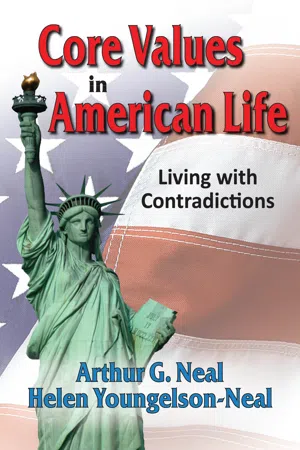
What values do Americans hold dear? What happens when real-world situations cause those values to conflict? To better understand the intellectual map of how American society works, Arthur G. Neal and Helen Youngelson-Neal analyze values prominent in American word and deed. These values appear in our nation's formal documents-rights and privileges prominently emphasized in the US Constitution and inscribed on the Statue of Liberty. They have shaped the historical destiny and, indeed, include those values most extensively propagated by the general population. Using these criteria, the authors identify individualism, the pursuit of happiness, freedom, consumerism, materialism, equality of opportunity, technology, mastery of the environment, quality of marriage, and national unity as the core American values. Core values provide the raw materials for the construction of contemporary society as a moral community, wherever that community is located. Such values are clusters of ideas that are central to self-identities; they generate a sense of collective belonging and membership. As such, core values define the existing social order and advance a set of ideas for depicting a desirable future. The analysis presented here helps us understand contemporary conflicts inherent in the American value system and the problems confronted by Americans as they try to live within the limitations and contradictions of value systems.
Information
1
Introduction and Orientation
Values shape what men and women see as important in life, how priorities are to be established, and how they create their own places within a given historical context. It is the intensity of commitment to a set of values that provides sources of meaning in what otherwise would be a drab and mundane world. This intensity ranges along a continuum from the vigor and fervor of true believers to only qualified confidence in their own beliefs and commitments. To some, values are at the center of self-identities.
There are several criteria we have drawn upon in our selection of the core values for our analysis. One of these is their prominence in the formal documents that Americans have drawn upon in the shaping of their historical destiny (Dershowitz, 2004). For example, the values of individualism, the pursuit of happiness, freedom, and equality were noteworthy in the Declaration of Independence and the US Constitution. The rights and privileges prominently emphasized in the Constitution were designed to place limits on what our government could or could not do. The equality of opportunity is formally inscribed on the Statue of Liberty and also a prominent part of the value system of Americans.
The core values of American life are deeply embedded in historical experiences and traditions (Shils, 1981). All modern nations are required to create and maintain their society as a moral community. It is through deployment of the many aspects of their core values that they are able to achieve this purpose. The values that are drawn upon in this process do not endure for very long without modifications. Each generation finds it necessary to take the data from the past and rework it to fit the needs of their time and place.
Other core values were selected as a result of the extensiveness with which they are held in the general population and for the direction in which society is moving. For example, the importance of intimate relationships is primarily emphasized in individual hopes and aspirations for having “a good marriage.” Other prominent values include consumerism, materialism, and technology. These beliefs and values are clearly evident in lifestyles that continue to be accentuated with the passing of time. No claims are made for the exclusiveness of the values selected. Other investigators may very well select and focus on other values.
In the first half of the nineteenth century, sociologists were observing the impact of the radio and the automobile on American life. In this context, William F. Ogburn (1922) developed “the cultural lag hypothesis.” This hypothesis held that technology was advancing very rapidly, while social institutions were changing slowly. In the long run, he maintained, social institutions would be required to make changes appropriate for the technology that was being elaborated. Ogburn referred to the time required for this adaptation as a cultural lag.
In recent years there have been spectacular accomplishments in technology. We have split the atom, landed a man on the moon, travelled faster than the speed of sound, eliminated small pox on a worldwide basis, and developed satellite communication. The development of computers and other forms of communication technology have revolutionized information processing and interpersonal communication. These stunning developments have a high degree of visibility and perhaps contribute more than anything else to the accelerating changes in the modern world.
The materialism of Americans is reflected in their emphasis on making a lot of money. Forbes (March 2013) reported that of the 1,426 billionaires in the world. There were 442 billionaires in the United States, an increase of seventeen over the prior year of 2012. This is symptomatic of the increasing concentrations of wealth in the United States. Surveys in recent years have clearly indicated that the major reasons for attending college are career development and having a high lifetime income. Americans are building and buying large houses and assuming that their happiness will increase with increasing incomes. Among married couples in the United States, an emphasis is placed on having dual careers.
Values related to materialistic lifestyles consist of the enduring attitudes of Americans to the environment. Mastery and control over the physical environment is closely linked with American concerns with practicality, efficiency, and profitability. For example, the concern with “better methods” in coal mining led to developing techniques for mountain top removal. The removal of immense amounts of natural gas can be achieved through the use of “fracking.” This is a procedure for drilling deep holes into the ground and filling them with vast amounts of explosive chemicals.
The contradictions inherent in the emphasis on mastery of the environment has been made evident by environmental activists, who are concerned with irreparable damage to the environment, with preserving scarce resources for the benefit of future generations, and with maintaining an environment that is sustainable. The business emphasis on growth, development, and profitability stands in contrast to the notion of collectively developing a custodial approach to the environment.
The growth of consumerism in the United States in the post–World War II years was a result of the pent-up demand from wartime rationing. After the war production was shifted to the manufacture of consumer goods. Advertising played an important part in generating a demand for the products of modern industry. Easy credit and the availability of credit cards made it simple to buy now and pay later. Data from the Bureau of Economic Analysis, Department of Commerce (December 20, 2013) indicated that 69 percent of the GDP (gross domestic product) consisted of consumer spending. Consumer confidence and consumer purchases make a definitive contribution to the viability and growth of the American economy.
We are including national unity as a core value, although this requires qualifications. In everyday life, the nation is divided in many ways. This is evident in the rancorous conflicts in Congress, in the deep divisions over environmental issues, and in the controversies over racial profiling. The list could go on and on, but underlying the deep divisions, there is also a great deal of national pride and national unity.
The national unity of Americans becomes evident during times of crisis. For example, the national trauma engendered by the Japanese attack on Pearl Harbor precipitated a strong sense of national unity among all segments of the population. Group differences fell by the wayside as the entire nation pooled their resources for winning World War II. Following the assassination of President Kennedy in 1963, the daily activities of Americans suddenly ground to a halt, as the entire nation became deeply involved in watching television. Over the three days prior to the funeral, the entire nation, indeed much of the world, shared a sense of sadness and uncertainty. A similar response of collective sadness and anger followed the terrorist attack on the World Trade Center in New York City on September 11, 2001. All Americans became involved as they reflected on the cause and consequences of the traumatic event (Neal, 2005).
Core values provide the raw materials for the construction of contemporary society as a moral community. Core values consist of those clusters of ideas that are central to self-identities and that generate a sense of collective belonging and membership. As such, they define the existing social order and advance a set of ideas for depicting a desirable future. Shared values provide individuals and groups with an intellectual map of how their society works, as well as a generalized view of a desirable world.
Through our values we are able to impose order on an otherwise chaotic world and create a sense of purpose and coherence. In doing so, we exaggerate the degree to which our personal values are shared by others. We assume that our own knowledge is adequate, although it is seriously incomplete and full of contradictions (Schutz, 1971). Drawing upon the prevailing values of our society helps to sustain the assumption that social life as we know it up to this point will continue into the future.
Core values engender a combination of thought and action. In combining theory and practice, value clusters are sometimes internally contradictory and lacking in consistency. For example, the institution of slavery stood in contradiction with the values of our founding fathers in creating a civil society. The right to life movement may be opposed to abortion but in favor of capital punishment and modern warfare. Political leaders speaking eloquently about family values may in their personal lives be engaged in illicit sexual affairs or infidelity. Such contradictions stem in part from human tendencies to compartmentalize the separate spheres of life.
Structural Conflicts
The militancy of the civil rights movement (during the 1950s and 1960s) forced Americans to recognize that the United States was a fragmented society. The forms of oppression, exploitation, and abuse had produced routine conditions of fear and anger among African Americans. The unwillingness of blacks to further endure the humiliations that had been imposed upon them produced an acute crisis for those committed to perpetuating the status quo. The nation became traumatized by having to confront its own internal contradictions.
Segregated schools, buses, lunch counters, swimming pools, rest rooms, and drinking fountains were among the many aspects of public life that restricted the freedom of movement for black Americans (Alexander, 2012). Discrimination in voter registration, housing, college admissions, and employment were among the many aspects of public life by which blacks were relegated to an inferior status. All of these practices reflected deep-seated racism in American life (Guinier, 1994). Such practices also contradicted the ideology held by those in positions of power and influence that all Americans lived in a land of freedom and equal opportunity for all.
The civil rights movement emerged under the leadership of Martin Luther King, Jr., to promote remedial action. In mobilizing a constituency, King drew heavily upon two major documents in the heritage of the nation: the US Constitution and the Declaration of Independence. These were central ingredients in shaping the national identities of Americans. King described these documents as “promissory notes” that guaranteed “the inalienable right to life, liberty, and the pursuit of happiness” for all. In one of his speeches, King declared that America had defaulted on her promissory note to her citizens of color. The words of Jefferson that “we hold these truths to be self-evident, that all men were created equal” were taken seriously and regarded as justifying a call to action (Branch, 1988).
The declaration that “all men are created equal” had the effect of excluding over half of the population. The paternalism that prevailed at the time of the American Revolution held that women were inferior to men and that a woman’s primary duty in life was to bear and rear children. Instead of having a career of her own, she was expected to devote her energies to advancing her husband’s career.
The freedom of movement for women has been severely restricted, historically, in the religious sphere, in the political sphere, and within the family. Women were not permitted to vote in national elections throughout most of American history. A major symbolic event in the limitations on the rights of women occurred in 1912 with the arrest, conviction, and imprisonment of Margaret Sanger for giving a public lecture on birth control (Kennedy, 1970). Lecturing on birth control was defined as an act of obscenity under the Comstock Laws. Although it was first proposed in 1923, an amendment affirming that women and men have equal rights under the law is still not a part of the US Constitution.
Traditionalism continues to be expressed in the acceptance of customary beliefs and practices as valid ones. In this view, definitions of reality are grounded in the social heritage and are thought to represent the accumulated wisdom of the ages. The traditionalist view emphasizes the appropriateness of the subordinate position of women relative to that of men. These include the notion that “the woman’s place is in the home,” “that a woman’s most important task in life should be taking care of her husband and children,” and that “it goes against nature to put women in positions of authority over men.” Such traditional attitudes tended to segregate the roles of men and women within society, as well as within the family (Bedard, 1992). The quest for social justice as women became increasingly involved in the provider role, revealed the inappropriateness of the older cultural blueprints.
The modern view holds that with the increased proportion of women preparing for careers and entering the labor force, emphasis should be placed on equal employment opportunities for women and on fairness in pay for men and women who do comparable work (Glazer and Waehrer, 1977). In the family, greater emphasis should be placed on sharing chores that must be done and on increasing involvement of fathers in childcare and childrearing (Kimmel, 1992). The modern values are far from being uniformly held, and as a consequence, a great deal of conflict surfaces in relationships between wives and husbands, as well as between parents and their children.
Many of the conflicts surrounding male/female relations are expressed in cultural debates over what constitutes a public issue and what constitutes personal choice in the lives of individual men and women. These debates include, for example, the persistence of rancorous conflicts over the legitimacy of abortion, pornography, and multiple sexual realities. In these cases, there are collisions over what promotes the collective good, and what is seen as personal decisions to be made by individuals. A growing number of people are insisting on their right to decide on such issues and to follow what they see as proper forms of morality for themselves (Derber, 2010)
The conflicts between traditional and modern constructions of reality are expressed in several ways. For example, they occur in the clash between traditional social norms and the emergence of a new morality; they may be found in the refusal of some to offer the deference expected by others; they show up in the gap between traditional family forms and the modern experimentation with group living and cohabitation. But among the conflicts expressed in recent years, few have matched the intensity and soul searching that have accompanied the attempts to redefine the proper roles for men and women in their relationships with each other.
The new ways of writing gender scripts have resulted in a proliferation of nontraditional family forms. These include, for example, cohabitating couples, dual-career couples, married non-cohabitating couples, voluntarily childless couples, lesbian and gay couples, single parent families (with or without previous marriage), and blended families. Some of these arrangements are by design and are intentional, while others are not. For example, in making life plans, few people deliberately intend to end up in a blended family or as a divorced mother with dependent children to raise. These are outcomes that could not have been foreseen from the idealistic and romanticized notions of early adulthood. But through a process of drift in the lives of individual men and women, they end up in a set of circumstances they were unable to see or to adequately prepare for.
Living with Contradictions
In the chapters that follow, we will describe the core values and their intrinsic meaning to Americans. The analyses, however, will be on the conflicts inherent in the American value system and on the problems confronted by Americans in living with the limitations and contradictions in value systems.
We may desire an internal consistency in our basic beliefs, values, and lifestyles, but such is not a realistic possibility. We live in a time period in which increased contradictions are inherent in the demands placed upon us. A part of the inconsistencies and contradictions in our lives stems from having to interact with those who hold values that differ significantly from our own.
A specific contradiction in American life was the focus of a classical article by Robert Merton (1957) on “Social Structure and Anomie.” He presented the theory that the violation of social norms stems from a contradiction inherent in the organization of modern society. He argued that within American society, the emphasis on success goals and status attainment (money, fame, power, and so forth) is pervasive, while opportunities for gaining access to such goals are blocked for those at the lower socioeconomic levels. In his view, the underprivileged have internalized monetary values and status attainment as personal goals but do not have the necessary resources (such as education and family sponsorship) for achieving them through the use of socially approved means.
As a result of blocked opportunities, individuals may turn to the use of illegitimate means for the attainment of goals that are widely held and acceptable within society. The explanation...
Table of contents
- Cover Page
- Halftitle
- Title Page
- Copyright
- 1 Introduction and Orientation
- 2 Individualism
- 3 The Pursuit of Happiness
- 4 Freedom
- 5 Having a Good Marriage
- 6 Consumerism
- 7 Materialism
- 8 Equality of Opportunity
- 9 Technology
- 10 Mastery of the Environment
- 11 National Unity
- Author Index
- Subject Index
Trusted by 375,005 students
Access to over 1.5 million titles for a fair monthly price.
Study more efficiently using our study tools.
Frequently asked questions
Yes, you can cancel anytime from the Subscription tab in your account settings on the Perlego website. Your subscription will stay active until the end of your current billing period. Learn how to cancel your subscription
No, books cannot be downloaded as external files, such as PDFs, for use outside of Perlego. However, you can download books within the Perlego app for offline reading on mobile or tablet. Learn how to download books offline
Perlego offers two plans: Essential and Complete
- Essential is ideal for learners and professionals who enjoy exploring a wide range of subjects. Access the Essential Library with 800,000+ trusted titles and best-sellers across business, personal growth, and the humanities. Includes unlimited reading time and Standard Read Aloud voice.
- Complete: Perfect for advanced learners and researchers needing full, unrestricted access. Unlock 1.5M+ books across hundreds of subjects, including academic and specialized titles. The Complete Plan also includes advanced features like Premium Read Aloud and Research Assistant.
We are an online textbook subscription service, where you can get access to an entire online library for less than the price of a single book per month. With over 1.5 million books across 990+ topics, we’ve got you covered! Learn about our mission
Look out for the read-aloud symbol on your next book to see if you can listen to it. The read-aloud tool reads text aloud for you, highlighting the text as it is being read. You can pause it, speed it up and slow it down. Learn more about Read Aloud
Yes! You can use the Perlego app on both iOS and Android devices to read anytime, anywhere — even offline. Perfect for commutes or when you’re on the go.
Please note we cannot support devices running on iOS 13 and Android 7 or earlier. Learn more about using the app
Please note we cannot support devices running on iOS 13 and Android 7 or earlier. Learn more about using the app
Yes, you can access Core Values in American Life by Arthur Neal,Arthur G. Neal in PDF and/or ePUB format, as well as other popular books in Social Sciences & Cultural & Social Anthropology. We have over 1.5 million books available in our catalogue for you to explore.